• Home
  • About
  • Living Faith
  • Home and Family
  • Home Education
  • Books
  • Recommended Resources
  • Media

Kept and Keeping

~ Rest in Grace, Labor in Love

Kept and Keeping

Tag Archives: devotional

Wise Women Build Up, Part Two: Good Works

30 Friday May 2025

Posted by Lauren Scott in Home and Family, Living Faith

≈ Leave a comment

Tags

bible, biblical womanhood, Christian hospitality, Christian life, Christian Women, christianity, devotional, faith, god, Good works, Home and Family, Homemaking, Jesus, motherhood, Wisdom

The following article and the other two in this series are talks that I gave at a women’s retreat in my area. The theme was “Pioneer Women”, and the scriptures were chosen for me. It was a fruitful exercise for me and a delight to get to share some insights from God’s word with the lovely ladies who gathered to hear it. I hope you’ll find it to be an encouragement to you, as well. Building on the foundation of Godly Wisdom, this second article discusses a Christian woman’s Good Works, and the third article focuses on the Gracious Words that ought to flow from hearts that have been redeemed by the love of God through the gospel of Jesus Christ.

In Part One we covered how Godly Wisdom can help us build up our homes and people. Now we’re going to look more specifically at how that Godly Wisdom produces a life of Good Works.

First we’ll discover from our passage that modesty and Good Works flow from the same heart.

Then we’ll look at examples of Good Works and consider how they might look different in different seasons in our life.

And then I have a poem to share with you.

wise women build up good works christian

Getting Dressed in … Good Works

Our world puts a lot of emphasis on outward beauty, and we all have likely felt the pressure to keep up. There’s an endless supply of makeup and beauty products from companies that are eager to play on your insecurities as a business strategy. Fast fashion provides an endless supply of clothing and accessories, cheaply made, and changing from season to season so that you’ll always fall behind.

These influences can promote insecurity about who we are, competition with others, and the temptation to exalt ourselves to keep up. While it’s good to care for your body and your physical appearance, it’s not good to sell your soul to do so, or to crowd out things that are far more important.

To that point, let’s take a look at 1 Timothy 2:9-10:

Likewise, I want women to adorn themselves with proper clothing, modestly and discreetly, not with braided hair and gold or pearls or costly garments, but rather by means of good works, as is proper for women making a claim to godliness.

The apostle Paul calls us to wear proper clothing, but even more so he calls us to adorn ourselves with good works!

Modesty is part of the context of our passage, so I want to give you something you can take home on the subject—and you might be surprised that it actually relates to our topic of good works. The Greek word translated “modestly” or “with modesty” in many of our English translations means “shame.” But it’s not the wallowing, debilitating kind. In fact, in the only other place it’s used in the New Testament, it’s translated “awe” toward God. So this is a shame that doesn’t get stuck feeling bad about oneself but rather sees the importance of something outside itself. It’s a kind of shame that goes hand in hand with honor.

God is worthy of honor, so I would be ashamed to do something or wear something that would dishonor Him. The people around me are worthy of honor, so I would be ashamed to do or wear something that would in some way harm or dishonor them. My body, which God has made, is worthy of honor, so I would be ashamed to wear something or behave in a way that treats it as though it’s cheap.

When we know what is truly valuable, we order our lives to reflect it. When we see God for who He is, the most other, the most holy, the most powerful, loving, just, merciful, and good—worthy of all praise and adoration; when we see that this amazing God sent His own Son to die so that we could live; when we see that our sin and shame was nailed to the cross and Jesus’ righteousness has been credited to our account—then our tendency to want to exalt ourselves by what we wear or do melts away. That’s where a truly modest heart comes from. And that’s what drives both our manner of dress and what we choose to do with the time and energy we are given.

Our primary focus is not on showing off our wealth or our bodies or even our self-righteousness. Our primary focus is on honoring God and others by what we wear and even more so by what we do.

What Good Works?

So if we have clothed ourselves first with godly wisdom, which in this case means a heart that values God supremely and that sees the value of others and wants to honor them, how then do we clothe ourselves in good works? What can that look like?

1 Tim. 5:9-10 gives a list of good works that were to make up an older widow’s reputation if she was to be assisted by the church. What kind of works were listed there?

Bringing up children — Don’t forget that your care for your children is not just a good work, it is one of the greatest works of your life. Devote yourself to doing it well. Those of you that work with children, whether you have any of your own—nurturing and caring for them, teaching them and pointing them to Jesus—that is a good work. If you give to support the work of ministries who care for children, who care for women facing a surprise pregnancy, who help the foster or adoptive parent community. These are all good works.

Showing hospitality to strangers — In the ancient world, this often meant welcoming a traveler into your home, providing every comfort and sustenance for their stay and helping them on their way when it was time to leave. When we open our homes to others, it has the potential to nourish them spiritually, physically, emotionally—in just about every way.
hospitality good works christian women

So look for and invest in those opportunities the Lord brings to show hospitality: whether it’s having people into your home to share your food and your life with them, or cooking food for a potluck at church enabling a longer and more intimate time of fellowship on a Sunday afternoon, having someone live with you while they’re between jobs or housing options, or throwing a graduation party, bridal shower, baby shower, charitable bake sale, you name it.

By this work of provision and hosting, we women have the ability to deeply impact our families, our churches, and our broader communities, bidding them each to taste and see that the Lord is good and that fellowship among His people is sweet. That the grace that saves us is also a grace that changes us. It is amazing how God uses the love of Christians for one another to draw people to trust in Jesus.

Washing the feet of the saints — This is about serving in lowly ways. Feet get dirty. And they especially got dirty back in Bible times. Do you think certain acts of service are beneath you? Or are you willing to stoop down and do the work that must be done, whatever it is? Cleaning toilets. Changing diapers. Staying up with a toddler until they’re done throwing up the last bite of supper. Staying up through the night praying with a friend until she’s willing to flush that last joint. Pet sitting for a neighbor when you’re not a pet person, but her husband is in the hospital, so of course you say yes. These moments are not glamorous. They’re not fun. They may not line up with your gifts. And they won’t make it on your resume. But God sees. And He delights in and works through such sacrifices when they are offered to Him in faith.

Assisting those in distress — James tells us that part of true religion is visiting orphans and widows in their distress. The focus here is not just on the material need; it’s about those who are suffering alone: widows, orphans. Loneliness is a very real problem today, even in our supposedly connected modern world. Sometimes the best thing you can do for someone is simply show up. On an average Tuesday afternoon. Or in the hospital. At the funeral. With a card or flowers a year later at the anniversary of a loss. At their home with a warm meal or cup of coffee and an offer to listen.

This is where today’s hustle culture can really lead us astray. Chasing our dreams with no concern for the needs of those around us means we likely don’t even see them. And if we do, we excuse ourselves. We don’t have time. We’re too busy getting ahead.

But true religion sees and seeks to meet needs.

Good Works Go Both Ways

Now, I want to tell you a story that demonstrates how good works don’t always have to go in one direction.

Almost two years ago there was a godly older man in our church whose wife was dying of cancer. A storm had downed a lot of limbs in his yard, but he didn’t have the time or energy to handle it in that season—especially not by himself. My husband Nathaniel organized a group of men from church to show up on a Saturday to cut and haul and burn until his yard was cleared.

Several months later, after his wife went home to be with the Lord, Nathaniel broke his hand. There was a lot of work to do on our property, and he was discouraged about it. So, I planned a surprise work day party for his 40th birthday, inviting friends from church to come help us clear brush and get our garden ready for the season. And you know who was the first person to show up that day, chainsaw in hand, ready to serve? The very same man my husband had helped several months before.

Sisters, that’s what it looks like when the church behaves like a family. Or like an old-time community on the frontier, where neighbors help each other. It’s just what they do. There’s not one class of people doing good works all the time with another class of people always on the receiving end. We each serve when we’re able and how we’re able. And we receive with gratitude when we’re the ones in need.

Part of making this kind of thing happen, though, is being vulnerable enough to share our needs with others so that we give them the opportunity to joyfully meet them in the name of Jesus.

There’s a particular need that my husband and I have noticed in recent years. There are a lot of young people, and even some approaching middle age, whose parents never taught them how to do basic life skills. They need someone to step in and provide for them the kind of life training that they didn’t receive growing up. If your parents taught you a handful of life skills and you’ve been on your own or caring for a family for a decade or more, you probably take your skills for granted. You don’t have to be a homesteader and make sourdough to have something to offer. The skills you’ve gained over the years are incredibly valuable, and there are people who need to learn from what you know.

Aside from the obvious home skills, what other skills do you have that could bless the people around you? In your church? In your place of work? The point here is not to zero in on any one set of skills, but to see what you have to offer that meets the needs of the people around you.

Good Works, Different Seasons

It’s cliché but true: We can’t all do everything, but we all can do something.

Sometimes we’re in a season of expansion—where we find we are capable of taking on more responsibility, more good work out there. Other times, we find ourselves in a season of pulling back, focusing on the essentials—or even being more on the receiving end of other people’s good works and service on our behalf. There is no shame in any of these seasons. If you can’t give much right now, if you are doing a lot more receiving than giving—then do so graciously. Give thanks. Don’t let feelings of guilt crowd out your ability to rejoice in the good work God is doing through others while you receive it or watch from the sidelines. And don’t forget that your prayers are a very important part of the work of the kingdom.

If this message finds you in a season of overwhelm, where you’re thinking, this all sounds nice, but I’m swamped, maxed-out, worn out… let me encourage you that the Christian life isn’t about doing more. Some may need a nudge to get moving, maybe you don’t.

At the next opportunity, I encourage you to step outside. To take a moment to pause. Take some deep breaths, and look around you at this incredible world that God has made. A world that He keeps spinning. A whole big world that doesn’t depend upon you. You don’t have to carry the weight of the world. God’s got that covered.

Soak up what God has made—the birds of the air, offering up their songs to the Lord and to our ears for our enjoyment; the trees and flowers in bloom, filling our view with dazzling colors. And consider. God cares for each of these. And He cares for you, too.

In all your busyness, in all your responsibilities, in all your overwhelm, don’t forget your Heavenly Father’s tender care for you—and cast your cares on Him. Seek first His kingdom and His righteousness, and all these things will be added unto you. God cares and provides for His people. And the work that has you so bogged down right now may produce fruit in due season—if you do not lose heart. Do not grow weary in doing good.


For your reflection:

What are the good works that God is calling you to do right now? Are there things to add?

Is there anything on your plate right now that doesn’t belong there? That is either too much or all about exalting yourself? Or is it simply a distraction from the good work that you know God has called you to?

Are there good things that you are already doing, but you’re grumbling as you do them? Can you see with the eyes of faith that the work set before you is GOOD and therefore, it’s worth doing it cheerfully?

I’d like to leave you with a poem that Elisabeth Elliot often shared in her writing and teaching. “Do the next thing” may sound like just another modern, over-simplified, get-er-done mantra. But in the context of the poem and a life lived to the glory of God, it is much more: a call to live out our faith in Christ through surrendering to God in each task He sets before us, casting our cares on Him each step of the way.

DO THE NEXT THING

From an old English parsonage down by the sea
There came in the twilight a message to me;
Its quaint Saxon legend, deeply engraven,
Hath, it seems to me, teaching from Heaven.
And on through the doors the quiet words ring
Like a low inspiration: “DO THE NEXT THING.”

Many a questioning, many a fear,
Many a doubt, hath its quieting here.
Moment by moment, let down from Heaven,
Time, opportunity, and guidance are given.
Fear not tomorrows, child of the King,
Trust them with Jesus, do the next thing

Do it immediately, do it with prayer;
Do it reliantly, casting all care;
Do it with reverence, tracing His hand
Who placed it before thee with earnest command.
Stayed on Omnipotence, safe ‘neath His wing,
Leave all results, do the next thing.

Looking for Jesus, ever serener,
Working or suffering, be thy demeanor;
In His dear presence, the rest of His calm,
The light of His countenance be thy psalm,
Strong in His faithfulness, praise and sing.
Then, as He beckons thee, do the next thing.

But Rather By Means of Good Works

Being a wise and godly woman involves more than just donning the right outfit. Putting on a cotton prairie dress and some makeup can change your appearance, and that’s fine, but it doesn’t change your heart or get the work done for you.

prairie dress good work done christian

Please don’t let the algorithm or someone else’s business model determine who you are, how you dress, and what you do. Stay rooted in God’s word, dressing in a way that fits your profession of faith (and your daily activity!), and devoted to walking in the good works that God has prepared for you (1 Tim. 5:10 & Eph. 2:10).

women roll up sleeves good works

Dear Father,

Help us to be women who are willing to roll up our sleeves, to step into the messes of life to lend a helping hand to our brothers and sisters in need. Help us to not be afraid to get dirty, having the heart of a true servant, like our Lord Jesus who stooped down to wash the feet of His disciples and to heal those who were sick or unclean.

May we see all of our work—in our homes, in our jobs or studies, in Your church, in our local communities, and even reaching to other nations—may we see all of it as an opportunity to serve others and adorn the gospel, the message of good news that while we were sinners, utterly lost in our rebellion, hopeless to gain salvation by our own works—that You, Jesus, lived that perfect life that pleases God, that You died on the cross as a payment for our sins, so that simply by placing our faith and hope in You, Jesus, we could be forgiven and gain full acceptance into Your family.

Help us to trust in You, Jesus, to see our sin and need for salvation, that no amount of our own good works can save us. But may we also see Your incredible love for us and Your offer of forgiveness and the hope of eternal life. May we do good works because You have done the ultimate work, and it is finished. May we rest in grace and labor in love. It’s in Your sweet name, Jesus, that we pray. Amen.

Here are the other posts in this series:
Wise Women Build Up, Part 1: Godly Wisdom
Wise Women Build Up, Part 2: Good Works (that’s this post!)
Wise Women Build Up, Part 3: Gracious Words


Contentment Doesn’t Grow in a Vacuum

14 Saturday Sep 2024

Posted by Lauren Scott in Living Faith

≈ 3 Comments

Tags

Christian contentment, Christian growth, Christian life, Christian Suffering, Contentment, devotional, faith, trials

This post contains an affiliate link. If you make a purchase through this link, I may make a commission at no additional cost to you. Thank you for supporting my blog!

“I can do all things through Him who strengthens me.”

Philippians 4:13 is an oft-quoted bible verse. Here’s what people often mean by it:

“I can win at sports because Jesus gives me strength!”

“I can stand up to the bully through Christ who strengthens me!”

It’s like a meme that pre-dated the internet.

But the context of this beloved verse, as some of you well know, doesn’t lend itself to the kind of blank check that ‘90s Christian T-shirt manufacturers would like you to believe.

The apostle Paul isn’t facing giants, he’s practicing contentment. Here’s the verse in context:

10 But I rejoiced in the Lord greatly, that now at last you have revived your concern for me; indeed, you were concerned before, but you lacked opportunity. 11 Not that I speak from want, for I have learned to be content in whatever circumstances I am. 12 I know how to get along with humble means, and I also know how to live in prosperity; in any and every circumstance I have learned the secret of being filled and going hungry, both of having abundance and suffering need. 13 I can do all things through Him who strengthens me. 14 Nevertheless, you have done well to share with me in my affliction.

Paul wrote this section of his letter to the Philippians to thank them for sending a gift to help meet his needs, to support him in his ministry. But he wants them to know that he’s more thankful for their hearts than for the gift itself. He’s learned to be content, whether “being filled or going hungry, …having abundance and suffering need.”

Here in the wealthy West, we might need to stop and really consider what that meant for the apostle Paul. For reference, he shares some of his resume in 2 Corinthians 4:7-18.

Paul didn’t learn contentment by sitting in a comfy chair, sipping a latte, and meditating on the idea of it. He learned contentment through trials and practice. The apostle James shares the same principle in his epistle:

Consider it joy, my brethren, when you encounter various trials, knowing that the testing of your faith produces endurance. And let endurance have its perfect work…

So how do we, in a world full of modern conveniences and comforts, grow in contentment?

woman window christian contentment trials
Getaways are great, but real contentment will follow us back into the fray.

Learning Contentment through Giving Thanks in All Circumstances

To be content means to be satisfied, happy, or pleased with what you have. So at the most basic level, we can learn contentment by stopping to recognize what we have—and that it has been graciously given to us by a good God.

When times are good, look around and give thanks for the Lord’s provision. When times are bad, do the same. It might be harder, but there is always something for which we can give thanks. Even if you have to start with the fact that you’re alive.

Sometimes it’s easier to practice this when things are either extraordinarily good or extraordinarily bad. It can be harder to recognize the goodness of God in our everyday mundane lives as we simply go with the flow and try to keep up with the pace of life. This is why, in any season, it is worthwhile to sit down and look around you. Take it in. And give thanks. Audibly, in a journal, expressed towards God and towards others: Give thanks.

Learning Contentment through Trials

Sometimes the Lord provides ample opportunity to grow in contentment through the trials we experience. Going through some really hard trials at the turn of the year has made some of our more recent challenges both harder and yet also easier to face. While we’re somewhat blindsided by each one that comes up, we’re also at least somewhat practiced at suffering and looking to the Lord in our need. When the last hard season has hardly even ended and you’re faced with another, it’s a lot. But the endurance muscles are still warm from use. They might be tired, but they at least know the drill.

We don’t automatically get contentment from our trials, however. The Apostle Paul had to “learn” contentment. And James reminded his readers to “consider it joy” when they faced trials. Mere meditation on the sidelines of life isn’t going to produce contentment in us without that contentment being tested in some way. But biblical meditation is essential if those trials are to produce real contentment in the Lord.

This is not and either-or proposition. It’s both-and.

So go ahead and enjoy your coffee as you dig into God’s word, hide it in your heart, and pray for God’s Spirit to empower you to grow in contentment. Just don’t imagine that sitting comfortably with your Bible is the end-game or even all of the means. Welcome God’s invitation to grow in faith, trust, endurance, and contentment with each new trial you face. And bring the Scriptures into your everyday moments, reminding yourself of Truth right in the middle of the challenges you’re facing.

Learning Contentment through Fasting

Even in easier seasons, however, there are practical ways we can grow in contentment. We can “discipline [ourselves] for the sake of godliness.” We don’t have to wait for the trials to come. We don’t have to seek them out, but it can be a good thing to practice dealing with less comfort than we’re used to.

In fact, Jesus expected His followers to do just that. In the Sermon on the Mount, He didn’t say, “If you fast…” He said “When you fast…” (Matt. 6:16-18)

Fasting is one of those spiritual disciplines that we maybe prefer to forget exists. If you’re starting to get uncomfortable, rest assured I’m stepping on my own toes, too.

Christians are not called to deny themselves for the sake of being super religious or having something to boast about (Jesus condemns those motives!). The point is to turn down those things that compete with the Lord and to turn our hunger and our desires toward Him, knowing that He is the One who can really satisfy our souls and meet our deepest needs.

Another purpose in fasting is to express grief or desperation in prayer. If I look around and think that the world is a big hot mess right now, but I keep stuffing my face at all hours like nothing is wrong, am I really concerned about what’s going on or am I just shrugging my shoulders and moving on to my next meal?

It’s hard to eat when you’re grieving. When you’ve lost someone or long for something so deeply that it hurts. Am I willing to make myself uncomfortable [at least some of the time] so that my prayers come with an earnestness that reflects a heart that grieves over a fallen world?

One very practical result of saying “no” to a meal or two is the realization that we can, in fact, survive on less than we usually consume. We can learn to be satisfied with less by the practice of fasting.

Learning Contentment through Putting Others First; “Put off” and “Put on”

Now, short of fasting (or perhaps in addition to fasting), we can look for opportunities to put the needs and desires of others ahead of our own. Do you take the biggest slice of cake or offer it to someone else? Do you rush in for the best seats or look for others you can honor above yourself?

Whether we eat or drink or whatever we do, we ought to do it for the glory of God. (1 Corinthians 10:31) If there’s an area where you can’t bring yourself to say no for a short while, or where you can’t bear the thought of someone getting the better deal, that’s probably an area where you need to learn contentment. Confess it, pray about it, yes. But then “bear fruit in keeping with repentance” (Matthew 3:8).

Roll up your sleeves and give or share in that area rather than simply trying to muster enough willpower to forgo the thing to no real purpose. Look for opportunities to celebrate the good things others have rather than defaulting to envy. And give thanks for what the Lord has given you rather than muttering about what you don’t have. As the Apostle Paul exhorts us in Ephesians chapter 4: “put off” the old and “put on” the new.

Learning Contentment through “Roughing It” a Bit

Aside from direct commands around thanksgiving, fasting, and putting others first, it’s possible and profitable to stretch yourself in other tangible ways. We’re getting into extra-biblical territory here, so take this as an invitation to think creatively about your own situation rather than feeling like you have to copy-and-paste. 😉

My family is into backpacking. We enjoy being out in God’s creation, hiking, and sleeping under the stars. But it isn’t always a walk in the park. And that’s also part of why we do it.

Our lives in the West can be so comfortable and controlled and disconnected from how people have had to live and survive for most of human history. It can be argued that we are weaker for it—physically, mentally, and perhaps even spiritually.

How ready am I for discomfort if I spend everyday of the year in a temperature-controlled box? If all of my furniture is selected to be aesthetically pleasing and super comfy? These are wonderful modern conveniences (for which we should give thanks!), but we do learn from what we live.

How ready am I to kneel down and serve others if I have carefully manicured hair, nails, and everything? If I am not used to getting dirty—ever?

When we go backpacking as a family, we often sit on rocks or the ground. We sleep in hammocks or on mats …on the ground. We hike in the heat. We sleep in the cold. We take care of our business in the woods. We don’t have access to indoor running water for days.

We have to gather and filter our drinking water. Sometimes it tastes great, other times, not so much. We have to bring our own food, so it’s a different kind of fare than we eat at home. We’ve learned first-hand the Proverb that “A sated man loathes honey, But to a famished man any bitter thing is sweet.” (Proverbs 27:7) Because just about any backpacking food tastes amazing after walking ten to fifteen miles in a day.

We don’t know what the future holds for us or for our sons. But we’d like to think that we are preparing our boys to serve the Lord in whatever capacity He calls them to. If they need to hike into the mountains to reach isolated villagers in some foreign country, well, they’ll have at least a little bit of training under their belts.

You may not need to get into backpacking. That’s not the point. But maybe you can find ways to stretch yourself, to step out of your comfort zone.

Go outside on a day when the weather isn’t ideal. Sit on the floor rather than a chair sometimes, if you are able. Walk outside barefoot just to try it out and see if your feet get less sensitive over time. Go for a long walk or do some other kind of exercise that gets your heart rate up.

To kind of flip the script, I would argue that these things are actually good for us beyond just the development of contentment and character. These things are healthy. Our attachment to comfort can rob us of more than just contentment if we don’t take some initiative to step out of our modern boxes and pursue a different path than the usual way-of-least-resistance to which we’re all so accustomed.

Learning Contentment through Christian Biography

If you need some inspiration and perspective, try reading or listening to stories of Christians who have served and suffered for the Lord throughout church history.

When I listened to Faithful Women and their Extraordinary God by Noel Piper earlier this year, I was struck by how believers who knew that persecution was coming, knew that they would be thrown into prison and barely be given enough to survive…these believers began to fast ahead of their suffering. We might think we’d need to “tank up” in order to last longer. But these precious saints wanted to “tank up” in a different way. They wanted to know the nearness of God in their trial before the worst of it came to them. They wanted to be practiced at depending upon the Lord for strength so that they would not give in to their torturers.

Our family backpacking is still just a field trip compared to that.

But this is the kind of perspective we gain when we read the stories of those who have gone before us: a “cloud of witnesses” like in Hebrews 11 who encourage us to run the race with endurance a la Hebrews 12:1-3.

Contentment Isn’t Learned in a Vacuum

Contentment isn’t a static virtue–it moves with us or it isn’t there at all. It doesn’t grow in a vacuum, sequestered away from real life. It’s a deep joy and satisfaction in the Lord that leads us to give thanks to Him in all things (1 Thess. 5:16-18), to put the needs of others ahead of our own, and to endure all kinds of circumstances, whether “being filled and going hungry, both of having abundance and suffering need” with joy–for the sake of Christ and His kingdom.

I hope you can gather from this article that aside from the straightforward biblical call on our lives, I’m not prescribing any particular practice of self-denial, as though backpacking (or whatever form of roughing it appeals most to you) is some kind of biblical ideal. But I am trying to say that merely creating a Bible-centered Zen garden away from all the noise of ordinary life isn’t the biblical ideal either. We might imagine that we will grow more content in a frictionless, vacuum-like environment, but that’s a peace that’s based on having the just-right environment, not a peace that grows in the heart, as a fruit of the Spirit, in the midst of all of life’s joys and sorrows.

How have you seen the Lord work contentment in your heart through trials? Or through voluntary fasting or other forms of self-denial?

Fair vs. Right: A Story

30 Tuesday Apr 2024

Posted by Lauren Scott in Home and Family, Living Faith

≈ Leave a comment

Tags

bible, biblical righteousness, Christian life, Christian mom, devotional, fair vs. right, Jesus, motherhood, parenting, righteousness, self-righteousness

Some time ago both my boys were sick. And then one of them had mostly recovered.

One thing you ought to know about my boys is that they do an awful lot around the house, so when they’re sick, I have to pick up the slack, and some things just don’t get done.

Photo by Vika Glitter on Pexels.com (This is not my son, in case anyone was wondering. 😉 )

It’s His Turn!

This time it was the compost bin that hadn’t been taken care of. I told my recently-recovered son that it was time for that thing to be cleaned. It was nasty, let me tell you. It stank. There were gnats and gnat larva. Ew.

My recently-recovered son, at that moment, decided to protest.

“[My brother] was supposed to do it last Monday, before we were sick, and he didn’t. I shouldn’t have to do it. It’s his turn.”

I raised an eyebrow: “[Your brother] is sick. And today is his birthday. The compost bucket needs to be cleaned out, and you can do it.”

He balked and wanted to “explain” the situation further, so I employed the mom look.

He quickly said, “Ok, I’ll do it.”

Mom look: 1

Middle school boy: 0

He did do it. And he did a great job.

Fair vs. Right

Later, as I was relating this story to my husband, I began to put my finger on what my son’s response meant. He was responding in a very natural and understandable way. But it wasn’t right. Why?

In the moment when he objected to my request, he was focused on fairness instead of righteousness. As it turns out, while those two ideals can overlap at times, they are actually quite different.

A quick look at Merriam Webster’s can help us see the difference.

Fair : 1 a : marked by impartiality and honesty : free from self-interest, prejudice, or favoritism…
B(1) : conforming with the established rules : ALLOWED
(2) : consonant with merit or importance : DUE
a fair share

When it comes to the case my son was making, he was in line with that last part of the definition. He didn’t think that taking out the compost on that particular day was his fair share. He knows we try to divvy up the chores in our home reasonably and equitably, not dumping all of the responsibility on any one person, not letting one brother off the hook and forcing the other to play Cinderella.

And while it can be reasonable to appeal to such precedent at times, there is something higher than fairness. Consider the dictionary entry for righteous:

Righteous : acting in accord with divine or moral law : free from guilt or sin
2 a: morally right or justifiable

That definition matches our common English use of the term. In the Bible, however, “righteous” or “righteousness” seems to carry a more active and positive connotation—it’s more than merely not breaking divine or moral laws. When Jesus, in the Sermon on the Mount, tells his listeners that their righteousness is to surpass the scribes and Pharisees, He elaborates on that point in the verses that follow. He not only gives instruction to keep oneself pure or from transgressing the law (Matt. 5:21-37), but He also calls His followers to go far beyond mere technical obedience to law in order to show radical love to others—even to our enemies (Matt. 5:38-47).

[For a bit more study on how righteousness looks like more than an avoidance ethic, see Psalm 37:21, and Proverbs 10:16-21, 12:10-12, 21:26, & 29:7.]

Self-righteousness is often focused only on the “without guilt” or “racking up points” idea of righteousness—it focuses on keeping score for oneself. And it often doesn’t mind making a fuss when it doesn’t get what it thinks it deserves.

True, biblical righteousness (the practical kind believers are to grow in, not the only-in-Christ theological kind that we receive by faith) thinks of God and others and not one’s own winning streak. It does what is just and good concerning duty to God and others. It implies judging rightly (according to God’s law and/or the needs of a situation) and acting in accordance with that judgment.

Fairness is Good. Righteousness is Better.

If my other son hadn’t still been sick, I might have agreed with my recently-recovered son that it was right for his brother to pick up the slack that he himself had left behind. Even if it was his birthday. That would have been both right and fair.

But when one of our number is out for the count, the right thing to do is serve them, or serve in their place. To go the extra mile. To give the cloak off of our back.

Love covers a multitude of sins. And spills. And forgotten or just-didn’t-get-to-it chores.

This is, of course, not just about middle school boys and their excuses. We can respond to the obvious needs around us with the same attitude, can’t we?

We may complain that it isn’t fair for us to have to do whatever it is that needs to be done right now. Maybe it is unfortunate, even unfair. But that doesn’t change the fact that the thing needs done and that God has given us eyes to see it.

Will we whine like a teenager over fairness when it conveniently serves our interests … or will we simply do what’s right to the glory of God and the good of those around us?

If we’re paying attention, we’ll probably begin to see that this question pops up on the daily.

Do you ever see your own attitudes reflected back at you by your children? Those moments can be comical and convicting! Share your story in the comments below.

Family Bible Time Grows with the Kids!

23 Wednesday Aug 2023

Posted by Lauren Scott in Guest Posts, Home and Family, Home Education, Living Faith

≈ Leave a comment

Tags

Bible Reading, Bible Reading Plan, Bible Study, Christian Classical Education, Christian Classical Homeschool, Christian Parenting, devotional, family bible time, Family Worship, Home Education, Homeschool Bible, Homeschooling Middle School, Spiritual Disciplines

Amazon links are affiliate links. If you make a purchase through one of these links, I may receive a commission at no additional cost to you.

I’ve written in the past about how our family covers “Bible” in our homeschool, which is to say, I’ve written about how we don’t consider it a subject in school so much as a part of life. You can read that article here, especially if you have little ones or are just getting started reading the Bible together as a family.

The following article is actually a guest post from my husband, as he reflects on what we have done differently in our family Bible time this year–instead of reading a chapter aloud at the kitchen table, we’re reading independently and discussing it together over a meal.

I hope my husband’s words are an encouragement to you to see how family bible time can grow and mature as you and your children grow and mature together. If you don’t have kids, I hope these meditations on reading the Scriptures and the resources listed might encourage you in your own pursuit of God through His Word.

For reference, our boys are turning 14 and 12 this calendar year. So the following practice reflects what is possible with fairly strong readers, ages 11 and up.

Here’s Nathaniel:

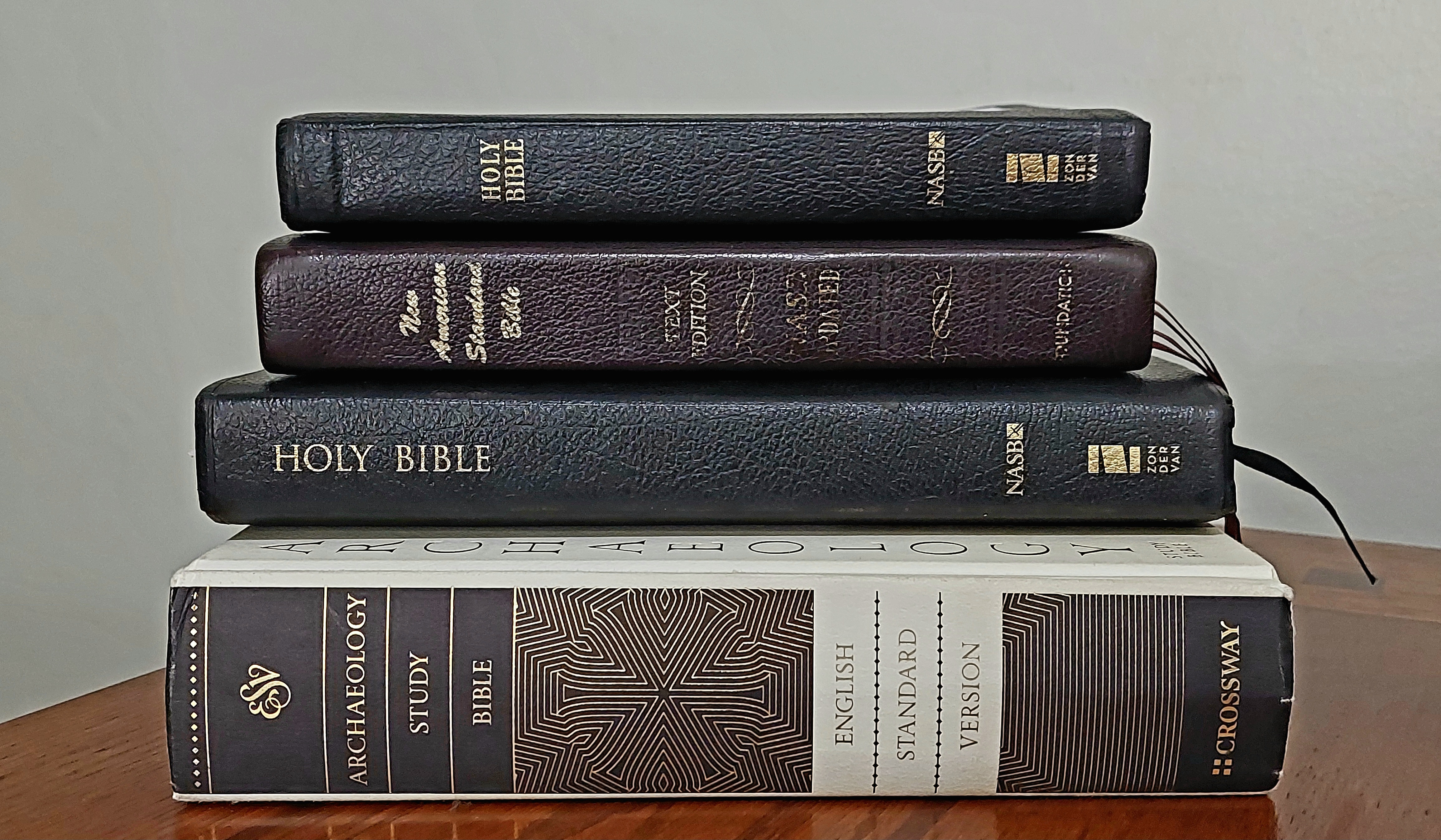
bibles stack bible reading ESV NASB

This year we changed up how we do family Bible time. We decided to read through the Bible in a year by having each person read on their own. Then we discuss over a meal every day. It has been incredibly rewarding for the whole family. Today we finished our last reading in the Old Testament, and I want to share some things that have made it rewarding so far:

1) A primary intention was to read the Bible as literature. Not as “mere literature”, but as literature nonetheless. We wanted to see the overall story arcs and major themes, to enjoy each genre, and to see how it all worked together.

2) We followed a reading plan that is based on the book order of the Hebrew Bible, which would have been the order in Jesus’ day. It has some nice advantages, particularly in that the prophets follow immediately after the books of Kings. For example, I have long enjoyed the poetry and imagery of Isaiah, but had a hard time understanding to whom he’s talking, particularly when he’s cursing neighboring nations. I thought I needed to find a good commentary to provide all the historical background. Turns out, the book of 2 Kings is a good commentary to provide the historical background! When these books are read quickly and close together, I can remember who these neighboring nations are and why they are being cursed.

3) The reading plan we’re using also has us read a Psalm every day. I have been amazed at how often the Psalms connect with the historical reading. It’s much easier now to see the role of the Psalms as the hymnbook of ancient Israel and to see the value of the imprecatory prayers in the context of national turmoil and destruction.

4) I read the ESV Archaeology Study Bible. It was phenomenally helpful to fill in the gaps of historical details and to better understand the world and worldview of the Ancient Near East. It has lots of maps (!!!) and some helpful historical explanation.

ESV Archeology Study Bible Map Genesis
Here’s an example spread from Genesis.

Today, I read in 2 Chronicles 35 of King Josiah going to an ill-advised battle with Pharaoh Neco, who’s just passing through on his way to fight someone else. The scripture doesn’t explain who that someone else is, because it’s concerned with Josiah, not with world history. But the study Bible commentary (a portion is pictured below) explained that Neco was allied with the Assyrians and on his way to battle the newly-resurrected Babylonian empire. Neco and Assyria are defeated, and 2 Chronicles 36 picks up a few years later as Babylon sweeps in and attacks Jerusalem.

ESV Archeology Study Bible

5) I appreciated that the commentary in this study bible is primarily observation-level commentary. It’s not about digging out deep theological interpretations, it’s more about understanding the historical and literary context of the Scripture. Which really helped in seeing the literary flow of the Bible.

6) We also have watched the Bible Project summary videos of each book. I know that in some theological camps there is some controversy around the Bible Project, and I certainly don’t agree with all of their systematic theology, but I think they do a great job aiding a literary reading of scripture with their compelling outlines and summaries of each book of the Bible in their Read Scripture series.

7) The pattern in our family time this year is for our youngest son to narrate the day’s reading and for our oldest to read his written one-sentence summaries of each chapter. Then I will share my observations, Lauren will chime in, and we generally have an enthusiastic discussion.

The boys have enjoyed it, too. They have established a great habit of daily bible reading as soon as they get up. Without being reminded, they are committed to it and haven’t missed a day all year. Prior to this, our youngest was about halfway through reading the entire bible on his own. But he says this group discussion approach has helped him understand it much better. It is my prayer that this year will provide a great foundation for a lifetime of rewarding Bible reading for my sons.

When we started this plan, I mentioned it offhand to a father at church who is some years my elder. He mentioned that a read-the-Bible-in-a-year plan really makes you appreciate the New Testament when you finally get to it. I don’t think I have ever enjoyed reading the Old Testament as much as this year — even Leviticus and Zechariah — but I believe he’s right: The Old Testament has clearly demonstrated humanity’s sinfulness and persistent rebellion against all that is holy and good and right. Against God Himself. Over and over again, God creates good things, and men reject His leading and ruin everything, resulting in tragic consequences. Even as the Jews return from exile in Babylon, they still can’t get it right. And those of us outside the Jewish nation are even worse off, without the scriptures! We need light to break through our darkness. We need new hearts, with God’s law written on them. We need an anointed King of a transformed people to spread His kingdom of love, peace, and righteousness all over the earth.

I’m ready for Jesus!

Back to Lauren:

Amen! I’m eager to see Jesus enter into our needy world, “in the fullness of time”, as we begin our readings in the New Testament–tomorrow!

To wrap up, here’s a quick summary of our family Bible time practice for this year:

  • Follow the Bible reading plan from the Bible Project, each of us doing our daily reading independently.
  • Discuss as a family, usually at breakfast:
    Youngest son gives an oral narration (or retelling) of our reading;
    Oldest son shares his short, written summary (usually 1-2 sentences per chapter);
    Nathaniel guides discussion and shares from his findings in the ESV Archaeology Study Bible;
    Lauren shares her insights (sometimes drawing from Words of Delight by Leland Ryken) and asks a guiding question on occasion.
  • At the start of a new book, watch the corresponding Bible Project video(s).
  • We have also added some side studies on the Code of Hammurabi and the Canaanite god Ba’al (among others) to broaden our understanding of biblical and ancient history and to be aware of the way that some critics and liberal theologians will use such sources and subjects to undermine divine inspiration and biblical historicity. It’s been a fascinating study that has made for great discussions. Keep in mind: this level of study is best undertaken when the kids already have a good grasp of history and the parents are solid in the faith and have at least some knowledge of how to interact with historical source material, able to ask good questions of a text or artifact and able to separate what’s actually there from a scholar’s speculative commentary.

Where are you in your own Bible reading journey? (Hint: It’s ok for it to look different in your home!)

Do you have a habit of reading and/or discussing the Bible with your family? What does that look like in your current stage of life?

If you’re just getting started, don’t be intimidated. Just take the next right step. And be sure to check out this post for what we’ve done in younger years.

May you and yours be built up in the Lord as you feast upon (or are just acquainting yourselves with) His word.

A Good Friday Devotional

07 Friday Apr 2023

Posted by Lauren Scott in Living Faith

≈ Leave a comment

Tags

Bible Lessons, Bible Study, Christian life, devotional, faith, Good Friday, Good Friday Devotional, Hymns, Jesus

I won’t spend many words of my own on this post. I’d like to point to a few passages of Scripture and a hymn to aid your thoughts of the Lord Jesus and His death on the cross in the place of sinners. My goal is simply to introduce these passages for your reading, meditation, prayer, and praise. Let the Scriptures speak to you of the death of our Lord.

Scriptures: Psalm 22, Isaiah 53, and Matthew 27

Hymn: Stricken, Smitten, and Afflicted

Psalm 22 Good Friday devotional death of Christ

Psalm 22

Psalm 22 is a Psalm of David, where he expresses in vivid terms his own anguish and hope in the Lord. The details of suffering match the crucifixion of Christ more than anything that we know of David’s own experience. Jesus cried out from the cross, “My God, My God, why have you forsaken Me?”–the opening line of the Psalm. David, inspired by the Holy Spirit, hinted at the sufferings of Christ, the promised Son of David, about 1,000 years before He arrived on the scene.

Here is Psalm 22 in its entirety (read the text with footnotes Here):

1 My God, my God, why have you forsaken me?
    Why are you so far from saving me, from the words of my groaning?
2 O my God, I cry by day, but you do not answer,
    and by night, but I find no rest.

3 Yet you are holy,
    enthroned on the praises of Israel.
4 In you our fathers trusted;
    they trusted, and you delivered them.
5 To you they cried and were rescued;
    in you they trusted and were not put to shame.

6 But I am a worm and not a man,
    scorned by mankind and despised by the people.
7 All who see me mock me;
    they make mouths at me; they wag their heads;
8 “He trusts in the Lord; let him deliver him;
    let him rescue him, for he delights in him!”

9 Yet you are he who took me from the womb;
    you made me trust you at my mother’s breasts.
10 On you was I cast from my birth,
    and from my mother’s womb you have been my God.
11 Be not far from me,
    for trouble is near,
    and there is none to help.

12 Many bulls encompass me;
    strong bulls of Bashan surround me;
13 they open wide their mouths at me,
    like a ravening and roaring lion.

14 I am poured out like water,
    and all my bones are out of joint;
my heart is like wax;
    it is melted within my breast;
15 my strength is dried up like a potsherd,
    and my tongue sticks to my jaws;
    you lay me in the dust of death.

16 For dogs encompass me;
    a company of evildoers encircles me;
they have pierced my hands and feet—
17 I can count all my bones—
they stare and gloat over me;
18 they divide my garments among them,
    and for my clothing they cast lots.

19 But you, O Lord, do not be far off!
    O you my help, come quickly to my aid!
20 Deliver my soul from the sword,
    my precious life from the power of the dog!
21     Save me from the mouth of the lion!
You have rescued me from the horns of the wild oxen!

22 I will tell of your name to my brothers;
    in the midst of the congregation I will praise you:
23 You who fear the Lord, praise him!
    All you offspring of Jacob, glorify him,
    and stand in awe of him, all you offspring of Israel!
24 For he has not despised or abhorred
    the affliction of the afflicted,
and he has not hidden his face from him,
    but has heard, when he cried to him.

25 From you comes my praise in the great congregation;
    my vows I will perform before those who fear him.
26 The afflicted shall eat and be satisfied;
    those who seek him shall praise the Lord!
    May your hearts live forever!

27 All the ends of the earth shall remember
    and turn to the Lord,
and all the families of the nations
    shall worship before you.
28 For kingship belongs to the Lord,
    and he rules over the nations.

29 All the prosperous of the earth eat and worship;
    before him shall bow all who go down to the dust,
    even the one who could not keep himself alive.
30 Posterity shall serve him;
    it shall be told of the Lord to the coming generation;
31 they shall come and proclaim his righteousness to a people yet unborn,
    that he has done it.

Isaiah 53

Isaiah 53 is another prophetic Old Testament passage that gives incredible detail about the Suffering Servant–the Messiah Who would come not only to rule as a King after David, but to suffer for His people, being “crushed for our iniquities” and “justify[ing] the many.” This is the passage the Ethiopian eunuch was reading when Phillip came to him, explained the gospel, and he believed (see Acts 8).

Here is Isaiah 53 in its entirety, one of the most obvious descriptions of Jesus Christ in the Old Testament, written some 700 years Before Christ. (Find the passage with footnotes Here.)

1 Who has believed what he has heard from us?
    And to whom has the arm of the Lord been revealed?
2 For he grew up before him like a young plant,
    and like a root out of dry ground;
he had no form or majesty that we should look at him,
    and no beauty that we should desire him.
3 He was despised and rejected by men,
    a man of sorrows and acquainted with grief;
and as one from whom men hide their faces
    he was despised, and we esteemed him not.

4 Surely he has borne our griefs
    and carried our sorrows;
yet we esteemed him stricken,
    smitten by God, and afflicted.
5 But he was pierced for our transgressions;
    he was crushed for our iniquities;
upon him was the chastisement that brought us peace,
    and with his wounds we are healed.
6 All we like sheep have gone astray;
    we have turned—every one—to his own way;
and the Lord has laid on him
    the iniquity of us all.

7 He was oppressed, and he was afflicted,
    yet he opened not his mouth;
like a lamb that is led to the slaughter,
    and like a sheep that before its shearers is silent,
    so he opened not his mouth.
8 By oppression and judgment he was taken away;
    and as for his generation, who considered
that he was cut off out of the land of the living,
    stricken for the transgression of my people?
9 And they made his grave with the wicked
    and with a rich man in his death,
although he had done no violence,
    and there was no deceit in his mouth.

10 Yet it was the will of the Lord to crush him;
    he has put him to grief;
when his soul makes an offering for guilt,
    he shall see his offspring; he shall prolong his days;
the will of the Lord shall prosper in his hand.
11 Out of the anguish of his soul he shall see and be satisfied;
by his knowledge shall the righteous one, my servant,
    make many to be accounted righteous,
    and he shall bear their iniquities.
12 Therefore I will divide him a portion with the many,
    and he shall divide the spoil with the strong,
because he poured out his soul to death
    and was numbered with the transgressors;
yet he bore the sin of many,
    and makes intercession for the transgressors.

Matthew 27:11-66

Here is Matthew’s account of the crucifixion. Notice especially the detailed connections to Psalm 22, and consider both the details and the theological implications of Isaiah 53 as you read. (Find Matthew 27:11-66 with footnotes Here.)

Jesus Before Pilate

11 Now Jesus stood before the governor, and the governor asked him, “Are you the King of the Jews?” Jesus said, “You have said so.” 12 But when he was accused by the chief priests and elders, he gave no answer. 13 Then Pilate said to him, “Do you not hear how many things they testify against you?” 14 But he gave him no answer, not even to a single charge, so that the governor was greatly amazed.

The Crowd Chooses Barabbas

15 Now at the feast the governor was accustomed to release for the crowd any one prisoner whom they wanted. 16 And they had then a notorious prisoner called Barabbas. 17 So when they had gathered, Pilate said to them, “Whom do you want me to release for you: Barabbas, or Jesus who is called Christ?” 18 For he knew that it was out of envy that they had delivered him up. 19 Besides, while he was sitting on the judgment seat, his wife sent word to him, “Have nothing to do with that righteous man, for I have suffered much because of him today in a dream.” 20 Now the chief priests and the elders persuaded the crowd to ask for Barabbas and destroy Jesus. 21 The governor again said to them, “Which of the two do you want me to release for you?” And they said, “Barabbas.” 22 Pilate said to them, “Then what shall I do with Jesus who is called Christ?” They all said, “Let him be crucified!” 23 And he said, “Why? What evil has he done?” But they shouted all the more, “Let him be crucified!”

Pilate Delivers Jesus to Be Crucified

24 So when Pilate saw that he was gaining nothing, but rather that a riot was beginning, he took water and washed his hands before the crowd, saying, “I am innocent of this man’s blood; see to it yourselves.” 25 And all the people answered, “His blood be on us and on our children!” 26 Then he released for them Barabbas, and having scourged Jesus, delivered him to be crucified.

Jesus Is Mocked

27 Then the soldiers of the governor took Jesus into the governor’s headquarters, and they gathered the whole battalion before him. 28 And they stripped him and put a scarlet robe on him, 29 and twisting together a crown of thorns, they put it on his head and put a reed in his right hand. And kneeling before him, they mocked him, saying, “Hail, King of the Jews!” 30 And they spit on him and took the reed and struck him on the head. 31 And when they had mocked him, they stripped him of the robe and put his own clothes on him and led him away to crucify him.

The Crucifixion

32 As they went out, they found a man of Cyrene, Simon by name. They compelled this man to carry his cross. 33 And when they came to a place called Golgotha (which means Place of a Skull), 34 they offered him wine to drink, mixed with gall, but when he tasted it, he would not drink it. 35 And when they had crucified him, they divided his garments among them by casting lots. 36 Then they sat down and kept watch over him there. 37 And over his head they put the charge against him, which read, “This is Jesus, the King of the Jews.” 38 Then two robbers were crucified with him, one on the right and one on the left. 39 And those who passed by derided him, wagging their heads 40 and saying, “You who would destroy the temple and rebuild it in three days, save yourself! If you are the Son of God, come down from the cross.” 41 So also the chief priests, with the scribes and elders, mocked him, saying, 42 “He saved others; he cannot save himself. He is the King of Israel; let him come down now from the cross, and we will believe in him. 43 He trusts in God; let God deliver him now, if he desires him. For he said, ‘I am the Son of God.’” 44 And the robbers who were crucified with him also reviled him in the same way.

The Death of Jesus

45 Now from the sixth hour there was darkness over all the land until the ninth hour. 46 And about the ninth hour Jesus cried out with a loud voice, saying, “Eli, Eli, lema sabachthani?” that is, “My God, my God, why have you forsaken me?” 47 And some of the bystanders, hearing it, said, “This man is calling Elijah.” 48 And one of them at once ran and took a sponge, filled it with sour wine, and put it on a reed and gave it to him to drink. 49 But the others said, “Wait, let us see whether Elijah will come to save him.” 50 And Jesus cried out again with a loud voice and yielded up his spirit.

51 And behold, the curtain of the temple was torn in two, from top to bottom. And the earth shook, and the rocks were split. 52 The tombs also were opened. And many bodies of the saints who had fallen asleep were raised, 53 and coming out of the tombs after his resurrection they went into the holy city and appeared to many. 54 When the centurion and those who were with him, keeping watch over Jesus, saw the earthquake and what took place, they were filled with awe and said, “Truly this was the Son of God!”

55 There were also many women there, looking on from a distance, who had followed Jesus from Galilee, ministering to him, 56 among whom were Mary Magdalene and Mary the mother of James and Joseph and the mother of the sons of Zebedee.

Jesus Is Buried

57 When it was evening, there came a rich man from Arimathea, named Joseph, who also was a disciple of Jesus. 58 He went to Pilate and asked for the body of Jesus. Then Pilate ordered it to be given to him. 59 And Joseph took the body and wrapped it in a clean linen shroud 60 and laid it in his own new tomb, which he had cut in the rock. And he rolled a great stone to the entrance of the tomb and went away. 61 Mary Magdalene and the other Mary were there, sitting opposite the tomb.

The Guard at the Tomb

62 The next day, that is, after the day of Preparation, the chief priests and the Pharisees gathered before Pilate 63 and said, “Sir, we remember how that impostor said, while he was still alive, ‘After three days I will rise.’ 64 Therefore order the tomb to be made secure until the third day, lest his disciples go and steal him away and tell the people, ‘He has risen from the dead,’ and the last fraud will be worse than the first.” 65 Pilate said to them, “You have a guard of soldiers. Go, make it as secure as you can.” 66 So they went and made the tomb secure by sealing the stone and setting a guard.

Stricken, Smitten, and Afflicted

This is one of my long-time favorite hymns. It ties a lot of themes together from the passages we’ve read above. Consider these words and sing along, meditating on the Lord and His work, with praise and thanksgiving. (These are the lyrics from the Trinity Hymnal, find more details Here.)

1 Stricken, smitten, and afflicted,
see him dying on the tree!
‘Tis the Christ by man rejected;
yes, my soul, ’tis he, ’tis he!
‘Tis the long-expected Prophet,
David’s Son, yet David’s Lord;
by his Son God now has spoken:
’tis the true and faithful Word.

2 Tell me, ye who hear him groaning,
was there ever grief like his?
Friends thro’ fear his cause disowning,
foes insulting his distress;
many hands were raised to wound him,
none would interpose to save;
but the deepest stroke that pierced him
was the stroke that Justice gave.

3 Ye who think of sin but lightly
nor suppose the evil great
here may view its nature rightly,
here its guilt may estimate.
Mark the sacrifice appointed,
see who bears the awful load;
’tis the Word, the Lord’s Anointed,
Son of Man and Son of God.

4 Here we have a firm foundation,
here the refuge of the lost;
Christ’s the Rock of our salvation,
his the name of which we boast.
Lamb of God, for sinners wounded,
sacrifice to cancel guilt!
None shall ever be confounded
who on him their hope have built.

Here are two good lyric videos so that you can sing along:

May you be blessed and encouraged as you consider the Lord Jesus today and celebrate His resurrection this Sunday!

Books Read in 2022: Christian Thinking and Life Management (and one Just for Fun)

25 Saturday Mar 2023

Posted by Lauren Scott in Books, Living Faith

≈ Leave a comment

Tags

Book Review, Books, Christian life, devotional, faith, micro book reviews

This post contains affiliate links. If you make a purchase through one of these links, I may make a commission at no additional cost to you. Thank you for supporting my blog.

Here’s another installment of my micro book reviews for 2022. In my last post, I shared the books I read for our homeschool. This time around, I’ve collected my 2022 reads on Christian Thought as well as Life Management (and a bonus category Just For Fun).

Christian books theology life management book reviews

Christian Books on Theology, Practice, Philosophy, or Education

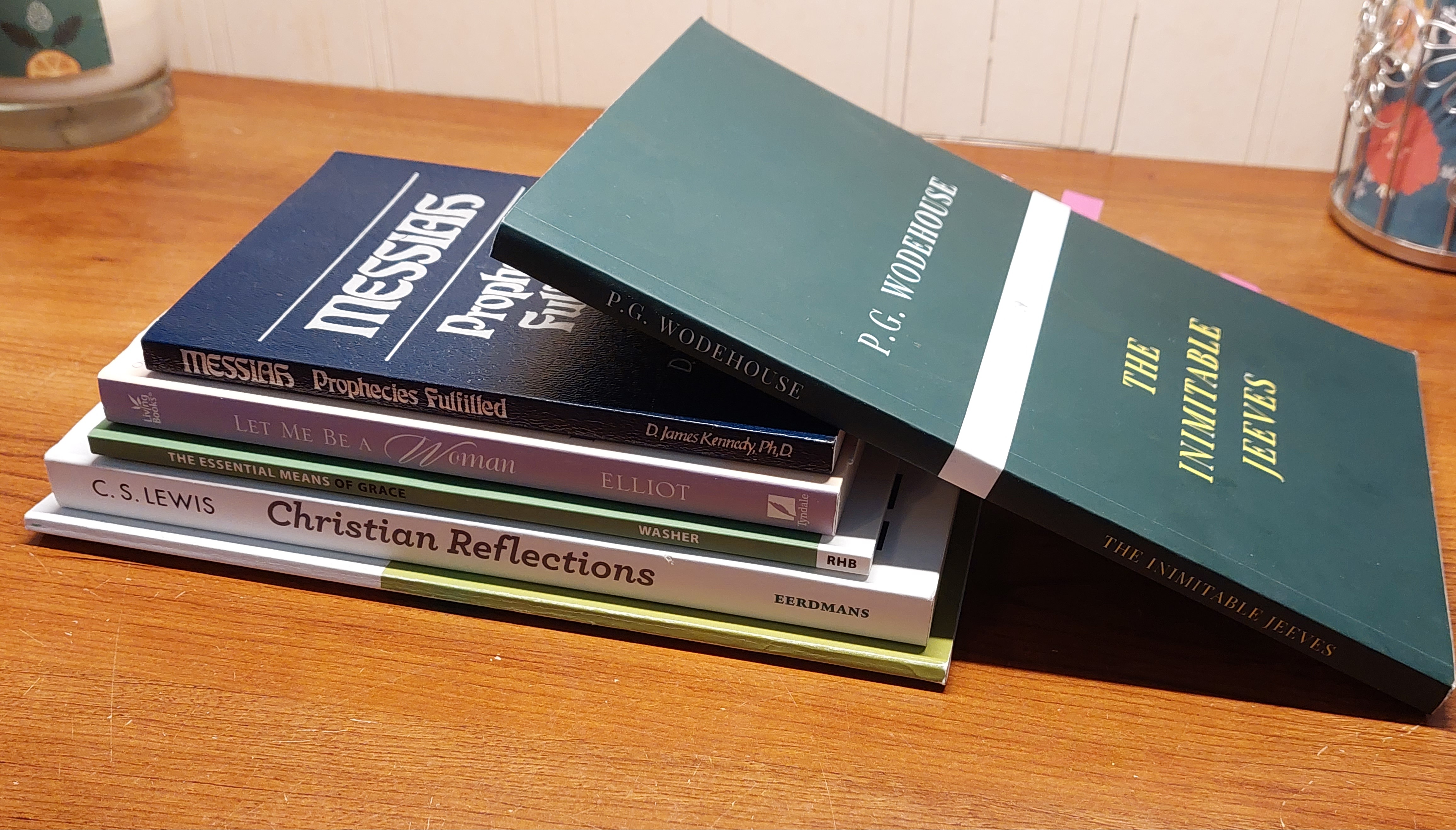
On Christian Teaching by Augustine This was probably the oldest work I read last year, aside from Plutarch and the Bible. Writing in the fourth century, Augustine lays out some important guidelines and considerations for teaching–with applications for education in general and for the study and teaching of the Scriptures. Augustine’s ordering of loves (ordo amoris) is incredibly edifying, explaining how all earthly loves can and ought to be turned into the stream of love that we have for God most of all. He also addresses some classical education practices and suggests how Christians ought to approach them. I found reading Augustine to be more approachable and edifying than I had anticipated. I can see why his writing has stood the test of time.

Let Me be a Woman by Elisabeth Elliot This was a re-read of a beloved book. Elisabeth Elliot is one of my all-time favorite authors. Given the crazy confusion of our time, it was good to be immersed in a book that celebrates being a woman—and being a godly woman at that. Let Me be a Woman is a collection of short chapters written to Elliot’s daughter, making her prose both warm and candid. Here’s a particularly poignant quote about worldly attitudes toward women:

Women’s work, particularly the task assigned by Creation exclusively to women, that of bearing and nurturing children, is regarded not only as of lesser value but even degrading and “animal-like.” This is a hideous distortion of the truth, and an attempt to judge women by the criteria of men, to force them into an alien mold, to rob them of the very gifts that make them what they were meant to be. To subject femininity to the criteria of masculinity is as foolish as it would be to judge meat by the standards of potatoes. Meat would fail every test. For women to assume an esatz [or artificial] masculinity means that they will always lose.

Let Me Be a Woman, P. 151

Turns out women also lose when men assume an “esatz” femininity. But I digress…

Christian Reflections (essays) by C. S. Lewis I have to say, Lewis is right up there with Elisabeth Elliot as one of my favorite authors. I bought this book initially for Lewis’ essay on “Historicism,” which I very much enjoyed. I’ve read many of his books: The Chronicles of Narnia (series), The Screwtape Letters, Mere Christianity, A Grief Observed, The Great Divorce, The Four Loves, The Abolition of Man, and That Hideous Strength. But this is my first read through a collection of his essays. Lewis has an incredible ability to evaluate the past and see where things are headed in days to come. I don’t always agree with his take on everything (his essay on “Church Music” being a good example), but he sure does make me think. Here are some of my favorite essays from this collection: “The Poison of Subjectivism,” “Historicism,” “The Psalms,” “The Language of Religion,” and “Modern Theology and Biblical Criticism.” So many of the problems we see today are the fall-out of ideas that Lewis confronted in his day. I think this makes his writing essential reading. Start with Narnia (at least The Lion, the Witch, and the Wardrobe) and Mere Christianity, especially if you need to strengthen your reading muscles. But do work your way “further up and further in.” You will be rewarded for doing so.

First Principles: Becoming a Disciple by Geoff Reed My husband and I hosted an outreach Bible study last year using this first book in the First Principles series. We covered the gospel, baptism, and the call to renew our minds in God’s truth, which stands in stark contrast to the ideas and values of the world. It was a great study, digging into one Bible passage for each lesson, as well as offering discussion questions and commentary. One thing that sets this book apart from other Bible studies is the heavy emphasis on both discussion and follow-through. The questions make you think and examine the Scriptures without feeling like an exercise out of an academic textbook. There is ample room for taking your own notes and recording your own questions to bring to discussion. And the sixth and final lesson in the book asks you to look back over the first five lessons to restate what you’ve learned, ground it in the Scriptures, pick a verse or passage to memorize, and set some goal or intention for your life going forward. A lot of studies have little assignments with each lesson and then just plow ahead. This one makes you sit with what you’ve covered a bit more–and challenges you to really apply it before moving on. Because simply gaining academic knowledge of God’s word isn’t what we’re after–we want to respond to it properly, applying it to our lives with the help of the Holy Spirit and in fellowship with other believers who can hold us accountable.

The Essential Means of Grace by Paul Washer I have appreciated the teaching of Paul Washer since my college days, but this is the first book I’ve read by him. It was a short but meaty and refreshing read, covering our relationship to God through the Scriptures, prayer, repentance and confession, and the local church. Highly recommended. Only 71 pages.

Messiah: Prophecies Fulfilled by D. James Kennedy My husband read this to us in December as our Advent devotional. It was a good overview of Old Testament prophecies about Jesus Christ, the Son of God. My boys are in 7th and 5th grade, and it was a good fit for our family, though there was a reference to infant baptism, which we do not practice, so we simply and briefly discussed that with our kids. (Links are to a newer version of the book than we own.)

Life Skills/Management

Do More Better by Tim Challies I started 2022 off listening to this audiobook. Challies has some good principles for productivity that were helpful to me, and for a season I tried his process for managing tasks in ToDoist. I fell off of that specific application, but together with the books listed below, I think this has been a help to my focus and life management this past year.

Essentialism by Gregg McKeown This was recommended by a friend last spring and I snagged it on Audible. I wish I had a hard copy, because I think there are some diagrams that would be helpful, especially to review. At any rate, I loved this book. It urges you to really ask the important questions—what matters most? What is most essential? And then it challenges you to live by that. It’s not a Christian book, but it is Christian-friendly.

Effortless by Gregg McKeown This is the follow-up book to Essentialism. I’m not sure “effortless” is really what you get out of it, but the author does help you think through applying the principles of essentialism more thoroughly to your life. It was a good listen (again, audiobook). I will probably revisit both of these books sometime soon—maybe even this year. I think they’ve helped me a lot.

Cozy Minimalist Home by Myquillyn Smith I found this delightful book at an “extras” bookstore on our long drive home from a trip to Florida. Why have I never read a book on decorating before? I’ve been a homemaker for fifteen years, for crying out loud! Anyway, I’m glad I read this and glad to have some principles and guidelines for making décor decisions for my home. Cozy + minimalist is really a great combination, putting people above stuff, but also not putting bare minimalism over people. The author is apparently a Christian, so the decorating advice is well-ordered and not at all about putting on a show or keeping up with the Joneses.

Don’t Overthink It by Anne Bogel This was a fairly helpful book. As I listened to the audiobook, I kept finding myself wishing that the author would have dealt with the spiritual side of worry/overthinking. Instead all she did was give positive tips and tricks. All of which are helpful, but it’s just not the complete picture, and I had hoped for better from an author who is a professing Christian. Tips and tricks don’t fix my trust-in-God issues. All that to say, this was a profitable listen, but not nearly so much as it could have been. This is a your-best-life-now kind of book, and needs to be balanced by biblical truth.

Ploductivity by Doug Wilson Speaking of biblical truth, there’s a lot of it in this little book (again, for me, audiobook). I was surprised to find a lot of discussion on technology—even a theology of technology. This book was far less about tips and tricks and processes and far more about our assumptions and beliefs about technology, work, etc. A very good read, especially after having finished Don’t Overthink It and finding it wanting in the theological department. That said, I don’t share Doug Wilson’s Presbyterian eschatology, which does come out in the book; but that is a small part of the whole, and it was interesting and edifying to listen to nonetheless.

Just for Fun

The Inimitable Jeeves by P. G. Wodehouse This was my second-ever Wodehouse read. I liked The Code of the Woosters better, but this book was fun, too. I read it at the beginning of 2022 and can hardly remember what happened in the story…Bertie gets himself in trouble and Jeeves has to help him out of it, but some of that trouble is caused this time by his even-more-pathetic friend, Bingo. This one is more serial while all of Code of the Woosters unfolds from Bertie’s accidental pinching of a cow creamer. It’s hard to beat a cow creamer for ridiculous and memorable comedy. So if you want to enjoy some good laughs and British humor, you know which one I’d recommend.

That’s a wrap for today! What are your favorite Christian theology or Christian living books?
What books have helped you to manage life well?
I don’t seem to make much space for fun, comedic reading, but I find it refreshing when I do–what about you?

For more Books Read in 2022:
For Homeschooling
On Marxism and Black Christian Perspective (coming soon!)

Resting on God

31 Tuesday May 2022

Posted by Lauren Scott in Living Faith

≈ Leave a comment

Tags

Christian life, devotional, Homemaking, motherhood, rest

I’m in the midst of a rather busy season. We still have three weeks left in our homeschool year, but summer, with its mowing, gardening, and adventuring, is already in full swing.

As the work picks up outside, mess and clutter build up inside, too. New projects create new piles, and sometimes it’s hard to walk through the house without tripping over something.

I might like to have my plans accomplished and tied up with a bow, but that doesn’t happen very often. I might like to have my whole house cleaned and organized at one time–even just the first floor all at one time!–but that feels like a distant dream and not a soon-to-be-had reality.

So when I sat at my desk to pray this morning after sleepily popping a couple pans of baked oatmeal into the oven, I gave thanks for all I could. And then I pulled out the Valley of Vision and read a prayer, one that happened to speak to me ever so sweetly even as it prompted me to speak to God. I would reproduce it here for you, but I want to respect copyrights, so I’ll link to it instead. The prayer is titled Resting on God. I hope you’ll find it an encouragement like I did.

As I roll up my sleeves and get busy with the day’s work, I’m going to try to keep these truths at the forefront of my mind. Join me?

The mind of man plans his way,
But the Lord directs his steps.

Proverbs 16:9

The counsel of the LORD stands forever, The plans of His heart from generation to generation.

Psalm 33:11

My soul, wait in silence for God only,
For my hope is from Him.
He only is my rock and my salvation,
My stronghold; I shall not be shaken.
On God my salvation and my glory rest;
The rock of my strength, my refuge is in God.
Trust in Him at all times, O people;
Pour out your heart before Him;
God is a refuge for us. 

Psalm 62:5-8

Come to Me, all who are weary and heavy-laden, and I will give you rest. Take My yoke upon you and learn from Me, for I am gentle and humble in heart, and you will find rest for your souls.”

Jesus in Matthew 11:28-29

Books Read 2015-2016

15 Thursday Sep 2016

Posted by Lauren Scott in Books

≈ 2 Comments

Tags

Books, Bradley Method, childbirth, CS Lewis, devotional, Elisabeth Elliot, homeschooling, Laura Ingalls Wilder, Little House, micro book reviews, My Utmost for His Highest, Oswald Chambers, Own Your Life, Story of the World, Susan Wise Bauer, Suzanne Collins, The Hunger Games, Unbroken, Valley of Vision

This post contains affiliate links. If you make a purchase through one of these links, I may receive a commission at no additional cost to you. 

I’m a little late in posting this, but here are the books I’ve enjoyed over the past year (June to July).  I hope you’ll enjoy some of them, too.

Embracing Obscurity by Anonymous  No, this isn’t a book written by the infamous group Anonymous, it’s a book written by a Christian author who decided to practice what they preach.  I found this to be a great read, challenging the pride and selfish ambition that I wrestle with from time to time.  A great read for any disciple of Jesus, but perhaps especially for those in or pursuing some form of leadership.  I heartily recommend it.

Own Your Life by Sally Clarkson  Do not come to this book expecting a Bible Study.  It is most definitely a self-help book.  If you come expecting something along the lines of John MacArthur, you will be disappointed.  If you come expecting the fluff and gospel-neglect of Joel Osteen, you will be very, very pleasantly surprised by the God-glorifying, scripture-filled content that Sally brings.  I don’t mean this as criticism, but since many of my friends are in Christian circles that prefer books that read like bible studies and may have an aversion to self-help books, I’m trying to give you a perspective from which to approach this book and really appreciate it for what it is.  Sally makes many assertions that are more philosophical than they are directly backed up by scripture.  She herself writes much more like a philosopher than like a Bible teacher.  She borrows a lot of language from the current self-care trend.  This may be a bother to some, even a concern, but the central message of the book and its emphasis on taking responsibility while simultaneously trusting everything to the Lord is indeed a rock-solid exhortation.  So, if you need the encouragement and inspiration, this is a great book.  Just don’t treat it like scripture (not that you should treat any work by fallen man as such).  I feel blessed to have happened to enjoy this book while simultaneously reading Embracing Obscurity, reviewed above, which I believe balances the message of this book quite well.  In fact, I would recommend that you read them together so that you can hold in tension Sally’s idea of “dreaming dreams for the glory of God” with Embracing Obscurity’s challenge to make sure we are building God’s kingdom and not our own.  Really, reading these two books together is a win-win situation, in my opinion.

Unbroken: A World War II Story of Survival, Resilience, and Redemption by Laura Hillenbrand  When I attended my ten year high school reunion a few years ago, one of my former classmates recommended this book to me.  I wasn’t disappointed.  This riveting true story follows Louis Zamperini from his troublesome youth, to the 1936 Olympic Games in Germany, to a fateful flight over the Pacific in WWII.  As a Japanese POW Louie is completely broken—or is he?  Read this book.  If you think you know the story because you watched the movie, you really have missed so much.  Read this book.  It will move you to the core.

The Silver Chair, The Magician’s Nephew, and The Last Battle by CS Lewis  I finally finished the Chronicles of Narnia this year!  Not much else to say except that these were a lot of fun to read and quite encouraging and thought provoking.

Paddle to the Sea by Holling C. Holling  This was on several homeschool booklists, so it caught my attention.  Paddle is a picture book following the adventures of a boy’s wood-carved model canoe as it journeys through the Great Lakes and out to sea.  My boys loved it and picked up quite a bit of geography.

Assistant Coach’s Manual  by Susan Bek  I’ve had the privilege of attending two births as a doula in the past eighteen months, and Lord willing I will get to attend another within the week.  I benefited greatly from taking classes in the Bradley Method of Natural Childbirth to prepare for the birth of my two sons.  I found the training and support invaluable.  One day I may pursue certification as a class instructor and doula, but for now I’m staying up on the subject through reading and supporting some of my friends as they welcome their children into the world.  Thus, this book.  It is a great resource for those coming alongside a woman and her husband who are using the Bradley Method.  It is an “assistant coach’s” manual because the husband is to be his wife’s primary coach.

Farmer Boy by Laura Ingalls Wilder  In my listening to podcasts from the Circe Institute, I jotted down a mental note when David Kern recommended introducing little boys to the Little House series with Farmer Boy because it follows the boyhood story of Almanzo Wilder and is replete with descriptions of rich, enticing farm food.  Hat tip to Mr. Kern for the excellent recommendation.  My boys were sucked into the whole series after we listened to Farmer Boy on audio from our library.

Keep a Quiet Heart by Elisabeth Elliot  I have come back to this book again and again for refreshment and encouragement–and let’s face it, tough love.  Elisabeth Elliot brings timeless wisdom to the struggles women face.  Timeless, of course, because her thoughts are so saturated by the word of God.

CS Lewis on Joy  This wasn’t a book written by CS Lewis as much as it was a collection of excerpts from several of his works, all relating to the subject of joy, and all packaged neatly into a coffee-table-ready little book complete with classical artwork.  Can’t say I’d recommend it, because all it really did was make me want to read more of Lewis’s works in their entirety, but I did enjoy it.  Not bad for a quarter at a garage sale anyway.

For the Children’s Sake by Susan Shcaeffer Macaulay  It’s no secret on this blog that our family homeschools, and it’s no secret in the world of Charlotte Mason homeschooling that For the Children’s Sake is a classic.  I think my mother-in-law read it when my husband was little.  My mom gave it to me for Christmas this year since it was on my wish list, so I gave it a read for the first time this winter.  So much of it clicked with me.  I even started up a Schole Sisters group with a few local homeschool moms this spring, and Macaulay’s book is the first one we’re reading together (which means I’m reading it for a second time now).  A friend of mine has already written an excellent review here.

The Hunger Games, Catching Fire, and Mockingjay by Suzanne Collins  This was my second pass through this trilogy, and I did it in a week.  I didn’t have quite the same sense of PTSD at the end of Mockingjay that I did the first time I read it (that entire novel in one night).  This story and its characters and themes stick with me.  And for good reason—these are themes and characters that have compelled human interest for millennia.  This is not just another young adult series.  I think these books will stand the test of time.  If you’ve read them before but missed the rich historical and literary allusions, why not pick them up again and see them with new eyes?

Little House in the Big Woods by Laura Ingalls Wilder  I think I read this back in third grade, but this year I read it aloud to my boys.  A fun read and a great way for kids to imagine life in the latter half of the 19th century.  My seven-year-old just picked it up to read it for himself this fall.

My Utmost for His Highest by Oswald Chambers and The Valley of Vision: A Collection of Puritan Prayers and Devotions edited by Arthur Bennett  These two books were my daily companions over the past year.  Chamber’s classic devotional was often times very edifying and sometimes simply something I read.  Many of his exhortations were challenging—to pray, to surrender completely to Christ, to love Him supremely.  Overall a great read, though some entries were simply a little too disconnected with the face value meaning of scripture for me to really “get” them.  On those days, I simply read and moved on.  One thing is for sure, by the time I finished a year of reading Chambers everyday, I was eager to simply read the Scriptures for myself.  I don’t mean this as a fault to Chambers—in fact it should be more to his credit for whetting my appetite for more of God’s word.  After all, man shall not live on devotionals alone, but on the very word of God.  In addition to Utmost, The Valley of Vision was a very encouraging guide in personal prayer and worship.  Many times I find I don’t have the words.  These puritan prayers helped me in the discipline of praising and depending upon the Lord, even when my flesh was weak and my mind would rather wander.  I will probably revisit this book in the future.

The Story of the World, Volume One:  Ancient Times by Susan Wise Bauer  This is another gem from our homeschool reading.  Our whole family has enjoyed this overview of ancient history written for elementary aged students.  We are reading through the four-volume series together, and then the plan is for our boys to read it a second time for themselves.  There are activity books available to flesh this out into a very full history curriculum, but for now we are simply enjoying them together and looking up the places we read about on our inflatable globe (the best kind of globe as far as little boys are concerned).

What have you been reading lately?  Have any recommendations for me?

Purity Isn’t for Me

12 Friday Feb 2016

Posted by Lauren Scott in Living Faith

≈ Leave a comment

Tags

devotional, glory of God, love, marriage, meditations, Purity, sanctification, set apart life, singleness, the

Purity isn’t for me. No, really—it isn’t.

There seems to exist some disillusionment for those who have reached what we could call “the other side of purity”. I’ve seen an article or two from people in my own generation bemoaning the fact that saving one’s virginity for the wedding night just wasn’t all that it’s cracked up to be. The reality that came after saying “I do” just hasn’t seemed to measure up to the ideal they were promised by their parents and youth pastors. Somehow these people who once made a commitment to purity now regret following through with it.

But why?

Maybe they were given all of the practical considerations and potential blessings of purity as though they were promises: avoiding STDs and unwanted pregnancy, having the potential for a very special physical relationship in marriage free from comparison with and the baggage of past “experience”, having a sense of self-respect, keeping your parents and church leaders happy (because the Bible says so!), making sure you don’t waste your gift on someone who doesn’t really love you, and, let’s not forget “married sex is the best sex”. In the minds of all too many teens and young adults, this boils down to: you will be healthier and happier if you wait. None of those are necessarily bad considerations or potential outcomes, mind you, but perhaps, neither are they proper motivation for a lifetime of purity.

I would offer that those who are disillusioned with the results of waiting didn’t understand what purity is for in the first place. Their complaints seem to be along the lines of “It didn’t work out for me like I thought. It didn’t make me as happy as I thought it would.” But, as the title of this article suggests, purity—in the Christian sense—isn’t for me.

My husband and I were recently asked to speak to a local youth group about how the Lord worked to bring us together (especially since our story is quite different from the way many people go about finding a spouse), so the issue of purity has been fresh on my mind for the past several weeks.

One of the discussion questions my husband tossed out that night for the teens to consider is, I believe, a very fitting one for any godly discussion of purity: What is the most important thing in the world to you?

I’d be interested to hear answers to that question from those who regret their past purity.

Hopefully those who know the Lord Jesus Christ as their Savior would at least know that the answer ought to be God Himself, or some variation including loving, serving, or glorifying Him. After all, the Bible says “Whether you eat or drink or whatever you do, do all to the glory of God.” The Westminster Shorter Catechism suggests that the “chief end of man is to glorify God and enjoy Him forever.” Once you know that is the correct answer, it’s pretty easy to come up with—but a whole lot harder to say honestly, isn’t it?

Riding that train of thought a little further, the greatest commandment, according to Jesus, is this:

Love the Lord your God with all your heart, soul, mind, and strength.

Here’s something to consider: If this is the greatest commandment, perhaps we should understand God’s call to sexual purity in light of it. Could it be that the goal of those “lesser” commands is in fact to obey that first one? Let’s review a few passages and see:


Now flee youthful lusts and pursue righteousness, faith, love and peace, with those who call on the Lord from a pure heart. 2 Timothy 2:22


“Youthful lusts” stand in opposition to the pursuit of “righteousness, faith, love and peace”, and this is to be done with others who “call on the Lord”—the Lord and His goals for us seem to be the focus.


Finally, then, brethren, we request and exhort you in the Lord Jesus, that as you received from us instruction as to how you ought to walk and please God…that you excel still more…For this is the will of God, your sanctification; that is, that you abstain from sexual immorality…For God has not called us for the purpose of impurity, but in sanctification. So, he who rejects this is not rejecting man but the God who gives His Holy Spirit to you. 1 Thessalonians 4:1-8


We are exhorted to walk in a way that pleases God, here and also in Colossians 1:10. The strong message of this passage to the Thessalonians is that our sanctification, or being “set apart” unto God, is not only pleasing to God but is also somewhat synonymous with sexual purity. In other words, good luck being set apart for God’s purposes while clinging to sexual sin. Sexual purity is so important because sexual sin is so at odds with our greatest goal: loving and glorifying God.

And perhaps the strongest statement yet:


…the one who joins himself to the Lord is one spirit with Him. Flee immorality. Every other sin that a man commits is outside the body, but the immoral man sins against his own body. Or do you not know that your body is a temple of the Holy Spirit who is in you, whom you have from God, and that you are not your own? For you have been bought with a price: therefore glorify God in your body. 1 Corinthians 6:17-20


This passage sets up a two-fold view of our bodies:

1 – There is a sense in which our bodies have dignity and we can disgrace them by acts of sexual sin (“the immoral man sins against his own body”), so arguments for purity that involve a sense of self-respect and dignity are actually, in my opinion, rather appropriate according to this verse. But…

2 – The strongest point to be made in this passage, however, is not that we sin against ourselves, but, if we are Christians, that we sin against the very purpose for which we have been rescued by Christ—to be a set-apart vessel, a temple for the Holy Spirit. Sexual sin is clearly at odds with glorifying God in our bodies, because our bodies are not ultimately ours, but the Lord’s, for Him to fill and abide. What could be more dignifying than that?!?

In my study of these passages, among others, I don’t see God holding out any carrots in order to twist our arms into sexual purity. There isn’t any bait-and-switch, as if God were to say, “Do this and you will be happy, healthy, whatever you want—but eventually I’ll tell you that I really I just want you to glorify Me.” God’s word is actually quite straightforward. If these passages tell us anything, they tell us that purity isn’t about us, it’s about God.

So to those who are young and wondering if sticking it out for the long haul is worth it: yes, it is. Not because it will ensure “your best life”—now or later—but because it is God’s good will for you and it pleases and honors Him. The commitment to set apart your body for God’s service will be a testimony to a world that His ways are better than theirs and that you are willing to wait for God’s good gifts in His good time.

To those who are not so young anymore and wondering if marriage and family will ever happen for them or if they will have lived a life of purity “for nothing”: take heart, it is not for nothing. It is for God and for your eternal delight in Him far above anything else. This will speak volumes of the value of your God above anything this world can offer. It may be a hard and lonely road, and it may be that you don’t see a reward for it in this lifetime, but “God is not unjust so as to forget your work and the love which you have shown to His name” (Hebrews 6:10).

To those who have not lived a life of purity and wonder if they can somehow make up for their sins: no, you can’t. But Jesus already did. He died for sin—for all kinds of sin, including the most perverse and unfaithful. Look to the cross, cast your cares on Jesus, believing He died for your sin and rose from the dead. He lives now to intercede for all who trust Him. So trust Him. And dig into what God’s word says about how to live with a goal of pleasing Him—and walk now in purity because the death of Jesus has made you clean and His Holy Spirit gives you new life.

To those who are married and think that the pursuit of purity is behind them: it’s not. Purity is just as important in marriage as it is when single. The goal is still the same—to glorify God with our bodies—only, in marriage, this includes both nurturing our relationship with our spouse and guarding our minds and bodies from temptation to sin. The fight isn’t over; it just looks a little different.

And finally, to those who think that their commitment to purity before marriage has let them down: it was never meant to be the key to temporal happiness anyway, though it certainly can contribute to it. If you’re a Christian, purity wasn’t ultimately about you at all, but about God. Try not to be resentful towards those who may have misled you into believing the whole point was to be healthy and happy—they probably meant the best for you. Instead of looking back in resentment, open up God’s word to see more of what He has to say about it. If your attitude has been sinful, selfish, or self-righteous, repent. Jesus died for those things, too. And don’t let go of purity—just recognize it isn’t an end in itself or a means to merely temporal ends. It is a part of living life to the glory and enjoyment of God.

I have, of course, only barely scratched the surface when it comes to what the Bible says about sexual purity, nor have I even really shared my own experience in the matter, but I hope that I have at least demonstrated the central purpose for the Christian’s call to purity, which is the very purpose for life itself: to love and glorify our Creator God. If I have as my greatest aim something other than that, my lifelong commitment to purity will quite likely be fraught with disappointment. Because, after all, purity isn’t for me.


Whatever you do in word or deed, do all in the name of the Lord Jesus, giving thanks through Him to God the Father. Colossians 3:17


Amen.

Lauren’s Bible Reading Plan for Busy Moms

30 Wednesday Dec 2015

Posted by Lauren Scott in Living Faith

≈ Leave a comment

Tags

Bible Reading Plan, children, devotional, motherhood, New Years 2016, Seriously Satirical

I have done several kinds of Bible reading plans since I became a believer in my early teens. The first few times around it was difficult to find the discipline to read the Bible every day all year long, so I usually left off somewhere between February and September.

As I grew up, I became a bit more disciplined. In recent years, I have followed the reading plan I found in my day planner and Justin Taylor’s Plan for Shirkers and Slackers. Both are wonderful plans.

In the past year, however, that discipline has largely fallen apart in favor of working through some much-needed topical bible studies—when I could find the time. But when I finished the last study, it left a vacuum of sorts, both in my schedule and in my plan. As a result I turned to My Utmost for His Highest in the mornings.

Bless you, Oswald Chambers, for your brevity.

This devotional only takes about five minutes, and it has been a wonderful tool to spark prayer, meditation on scripture, and worship. Occasionally I also pull out The Valley of Vision as a further aid to prayer and worship. I plan on continuing with this, but at the same time it’s not the Bible, and I find myself hungering for more of God’s word in my daily fare.

But who has time for a devotional and several chapters of Bible reading before the kids get up and it’s time to make breakfast? I know some of you do—good for you! Keep it up! But others of us can’t afford to chip away at our sleep (whether in the morning or at night) due to our current season of life or health issues. Can I get an Amen?

One of the most difficult aspects of sticking to a Bible reading plan for us busy (and sleep-dependent) moms is the question of when we will do it and do it consistently. When it comes to developing habits we can stick with, it helps to attach our new habit to a habit that we already practice each day, like praying as a family before sending the kids to bed, drinking a glass of water as soon as we wake up, or taking medicine before a certain meal. With this principle in mind, I’ve created this Eight-Step process for establishing a Consistent Bible Reading Time. Here we go:

Lauren’s Bible Reading Plan for Busy Moms

Step One: Locate a Bible (a compacted size may be preferable) and a Bookmark

Yes, you can find it.
DSC_0149
DSC_0128

Step Two: Place Bookmark in Bible

DSC_0131

It’s handy if the bookmark comes already attached!

Step Three: Locate the Toilet

DSC_0121

Step Four: Locate a Drawer or Basket near the Toilet and put the Bible in it

DSC_0124

You know, a place where you already keep necessary items.

Warning! Shelves or Baskets above the Toilet are not a Good Idea if you do not own a Water Proof Microban Bible. No, I don’t know this from Experience, but I do have a rather Vivid Imagination.

Wet book and razor blade | Flickr - Photo Sharing!

Step Five: When nature calls, or when the kids have driven you crazy and you need to Relieve Yourself of Burdens and Refuel Your Soul, go do your thing in the bathroom (locking the door behind you). But be sure to leave your Phone in your pocket and read your Bible instead.

Use these free images for your websites, art projects, reports, and ...

Step Six: When you are Done, be sure to mark your place with the Bookmark and put the Bible back in its special Drawer or Basket BEFORE you do anything to soil your hands. Just because we’re in a Common Place doesn’t mean we have to treat the Bible as Common—Keep. It. Holy.

DSC_0126

Step Seven: Flush and wash hands. (Of course.)

how to wash hands hand washing 150x150 Hand Washing Worksheets ...

Step Eight: Step back into the Domestic Mayhem with a Smile.

How To: Clean Your Granite Countertops | Granite Grannies

That’s it. Just read the Bible from front to back and use a book mark to keep your place. Or if you get bogged down in the Old Testament, read one book in the Old and then the next in the New Testament, using two book marks, and just go back and forth after each book until you’ve read the Old Testament once and the New Testament…more than once. You could even just start with a goal reading through the New Testament, or just the Gospels on repeat. Whatever your preference, my plan is all about finding the time to actually do it by anchoring it to something you find time for every day anyway.

My personal goal is to actually make it through the Bible in a year by reading it while I’m on the can, so I aim to read three chapters every time I sit down and I’m not-in-a-hurry. You can read different amounts each time or set a goal like I did. Either way, you’re redeeming that alone time and saturating your mind with truth. I’m pretty well convinced that it will work since I’ve read through several books simply by keeping them in the bathroom. In fact, when you’re done with this pass through the Bible, check out Loving the Little Years by Rachel Jankovic—my all-time favorite mommy bathroom book (short chapters, anyone?).

Now, I know this may not work for everyone…for those of you who are very regular you may never spend more than two minutes on the toilet. Take that minuscule period of time to count your blessings, favored ones. For the rest of us, we know we’ll be spending some considerable time in the bathroom—and especially on days when we just need a few more minutes of solitude while the kids are silently destroying something in another room (at least it won’t involve toilet paper this time, right?).

And just think! When you finally get up from reading the scriptures, and hopefully praying for God to give you grace to love your children as you should, you will be so much better prepared to not rip their precious little heads off when you find them painting the windows with peanut butter. Or flooding the kitchen and living room by emptying the water filter reservoir. (True story.) Imagine if you’d spent that time on your phone heathenishly playing meaningless games, scrolling endlessly through your news feed, or watching late night TV excerpts and the latest movie trailers on YouTube. You’d surely feel guilty and make the kids pay for it. But instead you were reading the bible. No guilt. No guilt at all.

…And hopefully no reactions you’ll later regret.

And who knows, perhaps sanctifying potty time will motivate you to consecrate the space more often (read: keep that porcelain throne spotless and shining—and maybe even light a candle. What could be more inviting?).

At any rate, I’m highly optimistic that this new Bible reading plan will go quite smoothly for me this year.

← Older posts
  • View KeptandKeeping’s profile on Facebook
  • View lauren.keptandkeeping’s profile on Instagram
  • View keptandkeeping’s profile on Pinterest
  • View @laurenscott.keptandkeeping’s profile on YouTube
Lauren Scott

Lauren Scott

Christian. Wife. Mother. Homemaker. Home Educator. Blogger. Book Addict. Outdoorist.

View Full Profile →

Enter your email address to follow Life Meets Jesus and receive notifications of new posts by email.

Affiliate Disclosure

We are a participant in the Amazon Services LLC Associates Program, an affiliate advertising program designed to provide a means for us to earn fees by linking to Amazon.com and affiliated sites.

Hands-on Math Curriculum

RightStart™ Mathematics

Check Out Prodigies Music Curriculum!

music curriculum sale

Quality Video Curriculum

Top Posts & Pages

  • Five Refreshing Scriptures for Finishing Strong when You Feel Weak and Weary
    Five Refreshing Scriptures for Finishing Strong when You Feel Weak and Weary
  • Wisdom in the Book of James
    Wisdom in the Book of James
  • 30 Day Dress Challenge Recap
    30 Day Dress Challenge Recap

Advent April Fool's Day April Fools Book Review Books Books Charlotte Mason Charlotte Mason Homeschool children Christian Classical Education Christian Classical Homeschool Christian Homeschool Christian life Christian mom Christian Parenting Christian Women Christmas Classical Education Classical Homeschool devotional education faith Guest Post Home and Family Home Education Homemaking homeschool encouragement homeschooling Jesus Living Books love marriage meditations micro book reviews motherhood Nature Nature Studies parenting poems poetry Practical Atheism Reading List Reflections Relationships trials

A WordPress.com Website.

  • Subscribe Subscribed
    • Kept and Keeping
    • Join 171 other subscribers
    • Already have a WordPress.com account? Log in now.
    • Kept and Keeping
    • Subscribe Subscribed
    • Sign up
    • Log in
    • Report this content
    • View site in Reader
    • Manage subscriptions
    • Collapse this bar
 

Loading Comments...