
• Home
  • About
  • Living Faith
  • Home and Family
  • Home Education
  • Books
  • Recommended Resources
  • Media

Kept and Keeping

~ Rest in Grace, Labor in Love

Kept and Keeping

Tag Archives: Christian Suffering

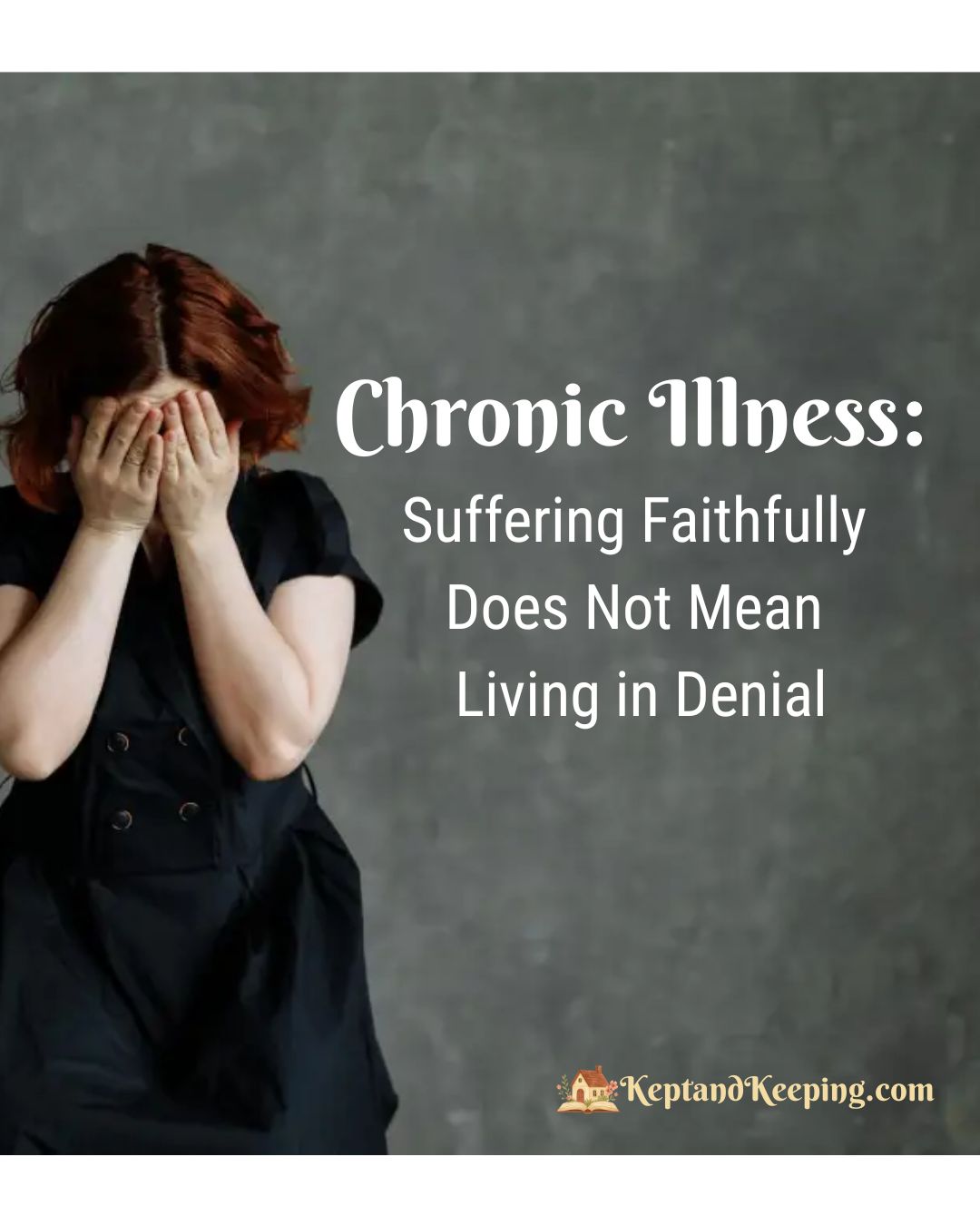
Chronic Illness: Suffering Faithfully Does Not Mean Living in Denial

27 Wednesday May 2026

Posted by Lauren Scott in Living Faith

≈ 1 Comment

Tags

bible, biblical counseling, Christian Suffering, christianity, chronic illness, denial, devotional, faith, god, grief, hope, perseverance

Autoimmunity, My Old Friend

I was first diagnosed with an autoimmune disease when I was 24. It was triggered by pregnancy and didn’t go away until months after delivery, so in a very practical way, my disease “ruined” my introduction to motherhood.

Shortly after my first son was born and we were still trying to dial in my treatment, I remember my mom commenting about “this horrible disease,” but I couldn’t bring myself to see it that way. Sure, it was annoying. It was painful. But it was just a bunch of itchy skin blisters, bumps, and plaques…that covered nearly my entire body, turned not just itchy but painful, and hindered my ability to hold my newborn baby without either pain or gobs of steroid cream. I didn’t change a single diaper that first week since my fingers were covered in painful blisters. And I cried at my inability.

Somehow, despite my denial that the disease was in fact horrible, my mind was able to recognize the eerie similarity of my condition with that of Job. Sure, I wasn’t to the point of scraping boils with potsherd, but I was staying up at night cleaning popped blisters and ineffectively treating the itch with solarcaine and cold foot baths, so on some level, it was nice to have a bible character I could relate to.

Even so, it was “just” a skin issue. For me to call it a “horrible disease” seemed like somehow giving in to a bad attitude. But my complacence was perhaps a naive protective mechanism more than it was a godly response. My mom knew what it was to enjoy being done with the pains of labor and to enjoy your baby during a normal postpartum experience. I would never know what I’d missed.

Minimizing Brick Walls Doesn’t Work

I apparently have a habit of minimizing my own problems and attempting to plow through them. But let’s be real: minimizing can’t really help us plow through a brick wall. We and our delusions will not get through to the other side, and we’ll likely get hurt in the process.

Ever gone from “I’m fine. It’s ok,” ad nauseum to “I am very not ok, and I don’t know what in the world is wrong with me!!!”??? That might be the brick wall reminding you it’s there.

Eventually the emotional weight of our suffering will break through. When we can’t ignore it any longer, the dam of our denial breaks and the pain and grief come rushing upon us to overwhelm us. We do well to turn to the Lord in these moments. But perhaps some of the overwhelm could be lessened if we would learn to see our suffering for what it is on the front end—and deal with it properly from the start.

Sometimes the right way forward is to get really honest about the brick wall in front of you. To be honest with yourself and with the Lord about the weight you carry so that you can cast your burden on Him.

…To get honest about the hugeness of your need so that you can cry out for help.

…To get honest about the depth of your loss and pain so that you can grieve in the presence of the Divine Comforter.

A bruised reed He will not break; and a dimly burning wick He will not extinguish.
Isaiah 42:3

He Himself knows our frame. He is mindful that we are but dust.
Psalm 103:14

We do well to be mindful of it, too.
Denial and Chronic Illness

I have dealt with chronic illness most if not all of my adult life. But I’m only just now starting to say that out loud. What I’ve done instead is to say, “It’s not that bad. Could be a lot worse. I’ve technically been in remission for years.”

While those statements are true, they are not the whole truth. They ignore the toll my disease has taken on me physically and emotionally, the impact it’s had on the course of my life and my family, the daily reality of fatigue and occasional flare ups that force me to reassess what I’m able to take on in a given season.

And, most recently, I’ve got another diagnosis on the table and a third on the horizon if I’m not careful, adding more complexity to the picture than a mere “could be worse–look on the bright side” sentiment.

I’m beginning to learn that I cannot Pollyana my way through every trial of life. Not even Pollyanna could do so.

Biblical rejoicing through trials is not the same as merely grinning and bearing it. It’s not playing a simple “glad game,” useful as that may be at times. It’s not stoicism. It’s not joy by way of denial. It’s joy by way of real tears and pain—offered up in faith to the Man of Sorrows who is acquainted with grief (Isaiah 53:3).

When the diagnoses begin to pile up, we can’t pretend everything’s ok. We live in a sin-cursed world. Our own bodies bear testimony to this truth.

When our to-do list becomes more than we can physically bear, we can’t go on imagining that we’re somehow infinitely capable.

We’re finite creatures. Those of us with chronic illness are finite even more so (if that’s even possible).

We do well to accept this rather than live in denial.

Just as we must see our sin to fully appreciate our salvation through Jesus Christ, we must see our limitations and human weakness to fully appreciate the strength and and comfort of our God in the midst of trials.

More than a Biblical Bandaid

The Lord can and does give supernatural strength to his people to sustain their joy in truly incredible ways through the darkest trials. But that grace is often for a short season of intense suffering and directed toward a specific opportunity to give testimony to the Lord. When the trial is long and lingering, or the effects of suffering surprise and weigh you down ten or even twenty years later… then the Lord’s grace to you might take a different form. You’re maybe no longer in a season of enduring by ignoring, by simply “setting your minds on things above” (Colossians 3:2).

Hear me: We absolutely must set our minds on things above. Don’t get me wrong. Memorize Scripture. Run to it in moments of pain and fear and doubt. Pray. Gather with God’s people in regular worship and fellowship. The ordinary means of grace–basic spiritual disciplines–are foundational and continually needful. Just know that at some point, your own mental fortitude (even if biblically informed) can only take you so far, and you may find that your body, mind, and spirit need more than a mere change of focus, using spiritual truth to distract you from the pain. There may come a time when every part of you needs to grieve.

And that’s ok.

Some would even list lamentation among the spiritual disciplines. So it’s good to learn to be comfortable with it having a place in your life.

Sometimes I think we can try to apply the scriptures in immature ways, as though a couple spiritual disciplines will prevent our need for lamentation. Like a bandaid to make us feel better or a mantra to help us refocus our minds. A biblical quick-fix may be appropriate in some seasons of life, when our circumstances demand a quick turn-around, when our bodies are younger and more resilient, when we’re early in our walk with Christ. But I think our application ought to grow up as we do and as life and the Lord’s work of sanctification demands a deeper reckoning with our weaknesses (middle age, anyone?).

More than Making the Grade

Here’s an example of what I’m talking about:

I think that I have sometimes attempted to speed through to the other side of suffering by looking for the lesson I can learn from it. Like a school girl who wants to know the answers so that she can ace the test and maybe make the anxiety and pressure go away faster.

If I rush quickly to the moral, can I skip the painful part of the story?

While we should look for ways to grow in wisdom, we must remember that God’s testing isn’t the kind that produces a grade. It produces endurance and hope (see James 1 and Romans 5). That endurance and hope comes not just from how we perform or what we learn, though obedience in the midst of trials is certainly commendable and honors God. The endurance and hope God intends to produce in us are directly tied to our faith: deep abiding trust, not the speed with which we can put on a smile or give a pat answer.

Our trials are not just a test for us to pass, a grade for us to earn, or an unpleasant event to rush through. They’re an opportunity and even an invitation to know our own pain and weakness more deeply and to find God’s grace and love and strength to be more than sufficient for us in those depths. It’s an invitation not to plow through with a forced smile on our face but to grieve deeply, cry out, and find that our loving heavenly Father does indeed hear, does indeed see, does indeed sympathize with our weaknesses. He weeps with us, provides comfort and love, and may even heal some of our deepest wounds when we admit that they’re there. But we don’t feel or see all of that incredible provision if we’re trying to convince ourselves that our problems are “no big deal,” as though we’re strong enough that nothing ever phases us.

We need to choose our medicine: lying to ourselves about our circumstances or telling the truth in our hearts and finding that “God is greater than our heart and knows all things” (1 John 3:20) and that He is a “very present help in time of need” (Psalm 46:1).

No Comparison—No, Really, Don’t

But let’s make sure we’re not going from one form of lying to ourselves about our circumstances straight into the same kind of ditch on the other side of the road.

We don’t want to go from comparing ourselves to others in order to minimize our suffering (which is admittedly a lot of what I tend to do) to comparing ourselves to others in order to maximize our grumbling (can’t say I’ve never been there, either). Acknowledging what’s true and lifting our eyes to Jesus our Savior ought to make those comparisons fall from view. And it shouldn’t lead to grumbling but rather to a release of stuffed emotion and a feeling of being known and cared for by God.

Because you are.

The goal is to speak truth in our hearts (Psalm 15:2) so that we can cry out to the Lord from an honest place of pain, so that we are laying our burdens out before Him instead of hiding them or pretending they don’t exist. And so that we can enjoy fellowship with Him as one who “abides in His tent” and “dwells on His holy hill” (see Psalm 15).

He knows the weight we carry better than we do. Always. So we can bring every bit of it before Him.

Cast all your anxiety upon Him, because He cares for you.
1 Peter 5:7

An Invitation to Honest Prayer and Real Joy

Dear sister, what hard providence are you facing? What burdens has the Lord called you to carry? Can you honestly acknowledge them? Can you honestly confess your inability to shoulder them alone? And then cast them all upon the Lord who cares for you?

“I can’t bear this, Lord. I’m not strong enough! O, Lord, be my strength!”

He does not intend for you to find comfort through denial. Nor does He ask you to bear your burdens all alone. He invites your to pour out your heart to Him. To know His tender care for you. To know His nearness. To find comfort and joy in His love.

I will rejoice and be glad in Your steadfast love, Because You have seen my affliction; You have known the distress of my soul.
Psalm 31:7

Further Reading

No Story Is the Same, No Pain Ever Wasted

On Miscarriage: By Now I Might Have Held My Baby

Contentment Doesn’t Grow in a Vacuum

14 Saturday Sep 2024

Posted by Lauren Scott in Living Faith

≈ 3 Comments

Tags

Christian contentment, Christian growth, Christian life, Christian Suffering, Contentment, devotional, faith, trials

This post contains an affiliate link. If you make a purchase through this link, I may make a commission at no additional cost to you. Thank you for supporting my blog!

“I can do all things through Him who strengthens me.”

Philippians 4:13 is an oft-quoted bible verse. Here’s what people often mean by it:

“I can win at sports because Jesus gives me strength!”

“I can stand up to the bully through Christ who strengthens me!”

It’s like a meme that pre-dated the internet.

But the context of this beloved verse, as some of you well know, doesn’t lend itself to the kind of blank check that ‘90s Christian T-shirt manufacturers would like you to believe.

The apostle Paul isn’t facing giants, he’s practicing contentment. Here’s the verse in context:

10 But I rejoiced in the Lord greatly, that now at last you have revived your concern for me; indeed, you were concerned before, but you lacked opportunity. 11 Not that I speak from want, for I have learned to be content in whatever circumstances I am. 12 I know how to get along with humble means, and I also know how to live in prosperity; in any and every circumstance I have learned the secret of being filled and going hungry, both of having abundance and suffering need. 13 I can do all things through Him who strengthens me. 14 Nevertheless, you have done well to share with me in my affliction.

Paul wrote this section of his letter to the Philippians to thank them for sending a gift to help meet his needs, to support him in his ministry. But he wants them to know that he’s more thankful for their hearts than for the gift itself. He’s learned to be content, whether “being filled or going hungry, …having abundance and suffering need.”

Here in the wealthy West, we might need to stop and really consider what that meant for the apostle Paul. For reference, he shares some of his resume in 2 Corinthians 4:7-18.

Paul didn’t learn contentment by sitting in a comfy chair, sipping a latte, and meditating on the idea of it. He learned contentment through trials and practice. The apostle James shares the same principle in his epistle:

Consider it joy, my brethren, when you encounter various trials, knowing that the testing of your faith produces endurance. And let endurance have its perfect work…

So how do we, in a world full of modern conveniences and comforts, grow in contentment?

woman window christian contentment trials
Getaways are great, but real contentment will follow us back into the fray.

Learning Contentment through Giving Thanks in All Circumstances

To be content means to be satisfied, happy, or pleased with what you have. So at the most basic level, we can learn contentment by stopping to recognize what we have—and that it has been graciously given to us by a good God.

When times are good, look around and give thanks for the Lord’s provision. When times are bad, do the same. It might be harder, but there is always something for which we can give thanks. Even if you have to start with the fact that you’re alive.

Sometimes it’s easier to practice this when things are either extraordinarily good or extraordinarily bad. It can be harder to recognize the goodness of God in our everyday mundane lives as we simply go with the flow and try to keep up with the pace of life. This is why, in any season, it is worthwhile to sit down and look around you. Take it in. And give thanks. Audibly, in a journal, expressed towards God and towards others: Give thanks.

Learning Contentment through Trials

Sometimes the Lord provides ample opportunity to grow in contentment through the trials we experience. Going through some really hard trials at the turn of the year has made some of our more recent challenges both harder and yet also easier to face. While we’re somewhat blindsided by each one that comes up, we’re also at least somewhat practiced at suffering and looking to the Lord in our need. When the last hard season has hardly even ended and you’re faced with another, it’s a lot. But the endurance muscles are still warm from use. They might be tired, but they at least know the drill.

We don’t automatically get contentment from our trials, however. The Apostle Paul had to “learn” contentment. And James reminded his readers to “consider it joy” when they faced trials. Mere meditation on the sidelines of life isn’t going to produce contentment in us without that contentment being tested in some way. But biblical meditation is essential if those trials are to produce real contentment in the Lord.

This is not and either-or proposition. It’s both-and.

So go ahead and enjoy your coffee as you dig into God’s word, hide it in your heart, and pray for God’s Spirit to empower you to grow in contentment. Just don’t imagine that sitting comfortably with your Bible is the end-game or even all of the means. Welcome God’s invitation to grow in faith, trust, endurance, and contentment with each new trial you face. And bring the Scriptures into your everyday moments, reminding yourself of Truth right in the middle of the challenges you’re facing.

Learning Contentment through Fasting

Even in easier seasons, however, there are practical ways we can grow in contentment. We can “discipline [ourselves] for the sake of godliness.” We don’t have to wait for the trials to come. We don’t have to seek them out, but it can be a good thing to practice dealing with less comfort than we’re used to.

In fact, Jesus expected His followers to do just that. In the Sermon on the Mount, He didn’t say, “If you fast…” He said “When you fast…” (Matt. 6:16-18)

Fasting is one of those spiritual disciplines that we maybe prefer to forget exists. If you’re starting to get uncomfortable, rest assured I’m stepping on my own toes, too.

Christians are not called to deny themselves for the sake of being super religious or having something to boast about (Jesus condemns those motives!). The point is to turn down those things that compete with the Lord and to turn our hunger and our desires toward Him, knowing that He is the One who can really satisfy our souls and meet our deepest needs.

Another purpose in fasting is to express grief or desperation in prayer. If I look around and think that the world is a big hot mess right now, but I keep stuffing my face at all hours like nothing is wrong, am I really concerned about what’s going on or am I just shrugging my shoulders and moving on to my next meal?

It’s hard to eat when you’re grieving. When you’ve lost someone or long for something so deeply that it hurts. Am I willing to make myself uncomfortable [at least some of the time] so that my prayers come with an earnestness that reflects a heart that grieves over a fallen world?

One very practical result of saying “no” to a meal or two is the realization that we can, in fact, survive on less than we usually consume. We can learn to be satisfied with less by the practice of fasting.

Learning Contentment through Putting Others First; “Put off” and “Put on”

Now, short of fasting (or perhaps in addition to fasting), we can look for opportunities to put the needs and desires of others ahead of our own. Do you take the biggest slice of cake or offer it to someone else? Do you rush in for the best seats or look for others you can honor above yourself?

Whether we eat or drink or whatever we do, we ought to do it for the glory of God. (1 Corinthians 10:31) If there’s an area where you can’t bring yourself to say no for a short while, or where you can’t bear the thought of someone getting the better deal, that’s probably an area where you need to learn contentment. Confess it, pray about it, yes. But then “bear fruit in keeping with repentance” (Matthew 3:8).

Roll up your sleeves and give or share in that area rather than simply trying to muster enough willpower to forgo the thing to no real purpose. Look for opportunities to celebrate the good things others have rather than defaulting to envy. And give thanks for what the Lord has given you rather than muttering about what you don’t have. As the Apostle Paul exhorts us in Ephesians chapter 4: “put off” the old and “put on” the new.

Learning Contentment through “Roughing It” a Bit

Aside from direct commands around thanksgiving, fasting, and putting others first, it’s possible and profitable to stretch yourself in other tangible ways. We’re getting into extra-biblical territory here, so take this as an invitation to think creatively about your own situation rather than feeling like you have to copy-and-paste. 😉

My family is into backpacking. We enjoy being out in God’s creation, hiking, and sleeping under the stars. But it isn’t always a walk in the park. And that’s also part of why we do it.

Our lives in the West can be so comfortable and controlled and disconnected from how people have had to live and survive for most of human history. It can be argued that we are weaker for it—physically, mentally, and perhaps even spiritually.

How ready am I for discomfort if I spend everyday of the year in a temperature-controlled box? If all of my furniture is selected to be aesthetically pleasing and super comfy? These are wonderful modern conveniences (for which we should give thanks!), but we do learn from what we live.

How ready am I to kneel down and serve others if I have carefully manicured hair, nails, and everything? If I am not used to getting dirty—ever?

When we go backpacking as a family, we often sit on rocks or the ground. We sleep in hammocks or on mats …on the ground. We hike in the heat. We sleep in the cold. We take care of our business in the woods. We don’t have access to indoor running water for days.

We have to gather and filter our drinking water. Sometimes it tastes great, other times, not so much. We have to bring our own food, so it’s a different kind of fare than we eat at home. We’ve learned first-hand the Proverb that “A sated man loathes honey, But to a famished man any bitter thing is sweet.” (Proverbs 27:7) Because just about any backpacking food tastes amazing after walking ten to fifteen miles in a day.

We don’t know what the future holds for us or for our sons. But we’d like to think that we are preparing our boys to serve the Lord in whatever capacity He calls them to. If they need to hike into the mountains to reach isolated villagers in some foreign country, well, they’ll have at least a little bit of training under their belts.

You may not need to get into backpacking. That’s not the point. But maybe you can find ways to stretch yourself, to step out of your comfort zone.

Go outside on a day when the weather isn’t ideal. Sit on the floor rather than a chair sometimes, if you are able. Walk outside barefoot just to try it out and see if your feet get less sensitive over time. Go for a long walk or do some other kind of exercise that gets your heart rate up.

To kind of flip the script, I would argue that these things are actually good for us beyond just the development of contentment and character. These things are healthy. Our attachment to comfort can rob us of more than just contentment if we don’t take some initiative to step out of our modern boxes and pursue a different path than the usual way-of-least-resistance to which we’re all so accustomed.

Learning Contentment through Christian Biography

If you need some inspiration and perspective, try reading or listening to stories of Christians who have served and suffered for the Lord throughout church history.

When I listened to Faithful Women and their Extraordinary God by Noel Piper earlier this year, I was struck by how believers who knew that persecution was coming, knew that they would be thrown into prison and barely be given enough to survive…these believers began to fast ahead of their suffering. We might think we’d need to “tank up” in order to last longer. But these precious saints wanted to “tank up” in a different way. They wanted to know the nearness of God in their trial before the worst of it came to them. They wanted to be practiced at depending upon the Lord for strength so that they would not give in to their torturers.

Our family backpacking is still just a field trip compared to that.

But this is the kind of perspective we gain when we read the stories of those who have gone before us: a “cloud of witnesses” like in Hebrews 11 who encourage us to run the race with endurance a la Hebrews 12:1-3.

Contentment Isn’t Learned in a Vacuum

Contentment isn’t a static virtue–it moves with us or it isn’t there at all. It doesn’t grow in a vacuum, sequestered away from real life. It’s a deep joy and satisfaction in the Lord that leads us to give thanks to Him in all things (1 Thess. 5:16-18), to put the needs of others ahead of our own, and to endure all kinds of circumstances, whether “being filled and going hungry, both of having abundance and suffering need” with joy–for the sake of Christ and His kingdom.

I hope you can gather from this article that aside from the straightforward biblical call on our lives, I’m not prescribing any particular practice of self-denial, as though backpacking (or whatever form of roughing it appeals most to you) is some kind of biblical ideal. But I am trying to say that merely creating a Bible-centered Zen garden away from all the noise of ordinary life isn’t the biblical ideal either. We might imagine that we will grow more content in a frictionless, vacuum-like environment, but that’s a peace that’s based on having the just-right environment, not a peace that grows in the heart, as a fruit of the Spirit, in the midst of all of life’s joys and sorrows.

How have you seen the Lord work contentment in your heart through trials? Or through voluntary fasting or other forms of self-denial?

By Now I Might Have Held My Baby

29 Thursday Aug 2024

Posted by Lauren Scott in Home and Family, Living Faith

≈ 2 Comments

Tags

Christian mom, Christian Suffering, early pregnancy loss, faith, miscarriage, motherhood, pregnancy, pregnancy loss

Dear sisters, this article is about miscarriage. Some things I share may be a little too much if you are in the early weeks of pregnancy waiting for that first appointment, or if a loss is still fresh in your memory. It’s ok to skip reading this for now if that is what is best for you. For the rest, I hope what I share will be an encouragement and a help—if you have suffered pregnancy loss, may it remind you that you are not alone and that your have a heavenly Father who cares for you; and if you have not, may this help you to understand what many, many women experience during their childbearing years so that you can love them well in your own community. >hugs<

pregnancy loss miscarriage story
Maternity photo when my oldest was on the way.

Today might have been my due date.

The pregnancy was a surprise. We had discussed perhaps trying for another child before my fertility ran out (for reference, I’ll be 40 this fall), but we hadn’t made any decision yet to do so. We were both shocked when the test was positive.

My youngest son was 12. There would have been a 13 year gap. I was excited at the thought of a new baby, but I mourned the gap.

We had sold our minivan over the summer and replaced it with a pick-up truck. Vehicle prices had gone way up, and it looked like we would need to find another van.

We were in the middle of a very busy Christmas season, and with my pregnancy-induced autoimmune disease looming on the horizon, I had to find a doctor—and the right one–FAST.

To say that this news rocked our world would not be an understatement.

To add injury to shock, a few hours after the positive pregnancy test, my oldest fell on his other arm, and we were off to the emergency room that very same day.

Thankfully the fracture was mild this time, but while he was still in a brace, his brother got the flu, and we missed Christmas with my family. We tried to go down for New Year’s, but Nathaniel and my oldest got sick as well. We prayed, were careful, invested in some TamiFlu, and I thankfully managed to stay well.

Even so, my first OB appointment got delayed a week since we still had some lingering flu symptoms in the house.

Before moving on, I want to take a moment here to share how I related to God through this time of expectant waiting…

I knew I was a much older mom at this point, and that the likelihood of pregnancy loss was much higher. But I thanked God for the gift of new life, no matter what would come of it. To be expecting again was a gift. To be carrying a child, to love a child I could not yet see, was a gift. No matter what happened.

In terms of symptoms, I marveled that my initial hint-of-queasiness that started at 6 weeks hadn’t ramped up any by almost 8 weeks. Maybe this pregnancy would be different!

And indeed it was.

At what should have been 7 weeks and about 5 days, the ultrasound, though it showed a sac and everything in the right place, measured only 5 weeks and 5 days. No visual on the baby. No heartbeat.

“Everything looks good. It could just be that we’re working on a different time line than we originally thought.”

But I’d been charting my cycles for 16 years. I had the dates right. I knew something wasn’t right.

We were very pleased with the doctor and her staff, however. They were absolutely wonderful. And we were relieved to have a doctor who would readily prescribe the medication I needed to manage my autoimmune disease with nothing more than a phone call as soon as it started to flare up.

To get a better picture of how I was progressing, they drew blood to check HCG levels. And scheduled me to come back two days later to check it again.

But later that evening I started spotting. I thought perhaps it was related to a potential UTI, for which they’d given me antibiotics. By the next morning, it had gotten worse, and I was in pain.

By the day of my follow-up HCG draw, the pain grew intense. I had labored without pain medication for both of my boys, and would gladly do it again, but seeing the writing on the wall, I took a Tylenol to take the edge off for the ride to doctor’s office, which was awful. I’d never labored in a vehicle before. My autoimmune disease had required us to induce twice, so this was a new experience. That car ride was the worst.

Given my symptoms, we did another ultrasound to check on things. This time there was no sac to be seen. I could hear the heartbeat from another baby in another room, but again none in mine. I went home to wait.

The next day I stayed in bed and by evening had lost the pregnancy—and whatever there was of a tiny, yet unseen by me, baby—in the toilet.

I stayed home from church the next morning. Physically needing rest and knowing that I just couldn’t handle it emotionally yet anyway.

Friends took good care of us, bringing us meals. I can’t say enough how wonderful it was to be so well cared for. Our family and church family are such a blessing.

And we got to return the favor rather quickly, as a friend at a similar place in pregnancy had the same experience one week later. We grieved together and prayed for one another.

With my firstborn son, fifteen years ago. Add a few lines around the eyes, gray hairs, and extra pounds to imagine what might have been.

Once I had rested adequately, taking it slow for about four weeks, I threw myself into whatever work was at hand. Speaking at a local homeschool mini conference, planning a surprise party for my husband’s 40th birthday, reaching out to ladies at church, among other things. If having a baby would provide one set of opportunities, not having a baby would open up another. We weren’t sure if we would try again, so in the mean time, I put my hand to the plow and tried not to look back. If this was the door the Lord had open for me, I would walk through it with as much fervor as I had thrown into supporting my pregnancy.

Sometimes it’s hard to know whether we have fresh diligence in our work or if we’re just looking for a distraction from pain. I think it was a mixture of the two for me. I tried to be present with my grief when it came over me, talking it through with my husband, and pouring it out before the Lord. But I also didn’t want to sit in it. Still, it would come on in waves, the triggers taking me by surprise.

Like shopping for clothes for my boys at the big consignment sale event. I didn’t think anything of it most of the time we were there…until we stepped into the room with all the baby gear…the kinds of things I would have been shopping for that day if there was still a baby growing in my womb.

Another trigger hit with a wave of both grief and gratitude.

When I was going through some important papers a couple months after the miscarriage, I came across my youngest son’s birth certificate. I read the words: “Certificate of live birth,” and immediately burst into tears and gave thanks to God. How precious those words were. Because my son is precious, and I can remember how tumultuous his birth was—how I had been monitored for almost ten weeks by a high risk OB with ultrasounds and non-stress tests, how my amniotic fluid levels got to be too low and risk of stillbirth increased, how his heart rate wasn’t great when we went in to induce, how things got better with an IV but eventually got worse and even risky as labor went on, how close we were to an unmedicated emergency C-section, how the doctor coached me to push non-stop-no-breaks until he was out and breathing. “Oh, baby, baby, baby!” That’s how I greeted him when he took his first breath, filled his lungs, and let out his first, sweet cry.

But I had processed all of that before. This time the words hit me with all of that weight and the added weight of a live birth that now could never be. There’s a sinking feeling as I type those words, but my overwhelming takeaway from that moment with my son’s birth certificate in my hands is this: life is precious. It’s a gift. It’s not guaranteed. The fact that I have two amazing sons who are now in their teen years is all of grace, all a gift of God. And I’m thankful.

Fast forward to today. In the midst of a busy end-of-summer, start-of-school, birthday-celebration season for our family, it’s strange to think of how different our current pace would be if I’d been battling an autoimmune disease and late-pregnancy fatigue and had had a baby a week ago (I didn’t expect to reach my due date).

The grief doesn’t rush over me like a wave anymore. It’s more like a sad but distant peak into an alternate life that might have been but isn’t. Our life and our hearts are full, even having been given a taste of another good thing only to have it taken away. God is good.

That’s not a cliché, it’s truth. A truth to cling to in the midst of trials that feel anything but good.

God would be good however it all turned out. The Author of life is the Author of our stories, and we are living in the story He has chosen to write for us–for our good and growth in Christ and for His glory. In so many ways it isn’t what we would have imagined or chosen ourselves. But it is good. He is good.

And that is where my heart can find its comfort and rest.

I hope yours can, too.

  • View KeptandKeeping’s profile on Facebook
  • View lauren.keptandkeeping’s profile on Instagram
  • View keptandkeeping’s profile on Pinterest
  • View @laurenscott.keptandkeeping’s profile on YouTube
Lauren Scott

Lauren Scott

Christian. Wife. Mother. Homemaker. Home Educator. Blogger. Book Addict. Outdoorist.

View Full Profile →

Enter your email address to follow Life Meets Jesus and receive notifications of new posts by email.

Affiliate Disclosure

We are a participant in the Amazon Services LLC Associates Program, an affiliate advertising program designed to provide a means for us to earn fees by linking to Amazon.com and affiliated sites.

Hands-on Math Curriculum

RightStart™ Mathematics

Check Out Prodigies Music Curriculum!

music curriculum sale

Quality Video Curriculum

Top Posts & Pages

  • Five Refreshing Scriptures for Finishing Strong when You Feel Weak and Weary
    Five Refreshing Scriptures for Finishing Strong when You Feel Weak and Weary
  • Embracing Short Lessons
    Embracing Short Lessons
  • Family Bible Time Grows with the Kids!
    Family Bible Time Grows with the Kids!

Advent April Fool's Day April Fools bible Books Books Charlotte Mason Charlotte Mason Homeschool children Christian Classical Education Christian Classical Homeschool Christian Homeschool Christian life Christian Parenting Christian Women Christmas Classical Education Classical Homeschool devotional education faith god Guest Post Home and Family Home Education Homemaking homeschool encouragement homeschooling Jesus Living Books love marriage meditations micro book reviews motherhood Nature Nature Studies parenting poems poetry Practical Atheism Reading List Reflections Relationships trials

A WordPress.com Website.

  • Subscribe Subscribed
    • Kept and Keeping
    • Join 171 other subscribers
    • Already have a WordPress.com account? Log in now.
    • Kept and Keeping
    • Subscribe Subscribed
    • Sign up
    • Log in
    • Report this content
    • View site in Reader
    • Manage subscriptions
    • Collapse this bar

Loading Comments...