• Home
  • About
  • Living Faith
  • Home and Family
  • Home Education
  • Books
  • Recommended Resources
  • Media

Kept and Keeping

~ Rest in Grace, Labor in Love

Kept and Keeping

Category Archives: Living Faith

Alone? Unseen? You’re in Good Company.

30 Thursday Aug 2018

Posted by Lauren Scott in Home and Family, Living Faith

≈ 6 Comments

Tags

Christian life, Christian Women, Communion, feeling alone, home church, Reflections, resentment

It was one of those less-than-ideal Sunday mornings.

The church meeting was to be at our house this week, but we had been busy and the weekly housecleaning hadn’t exactly happened when it was supposed to.

So, as has been the case more times than I care to admit, quite a bit of tidying was left to be done on Sunday. You know, the day of restful, refreshing time with the Lord and His people.

Yeah, Sunday.

Usually my sweet husband takes care of breakfast for our family on Sunday mornings and even helps straighten up when we’re hosting, but this particular Lord’s day, breakfast was all he had time to contribute. I found myself not-exactly-joyfully decluttering the living room, coaching the kids on sweeping the floors, and cleaning up the breakfast mess in the kitchen. Not to mention preparing the elements for communion and doing something (anything!) to make myself look presentable.

My personal quiet time with the Lord didn’t happen that morning, either. Instead of recognizing Jesus was with me anyway, I pouted. Instead of serving the saints with joy, resentment began to build.

There were probably several things building up to this point, but I can’t remember all the details. I just know I felt very alone in my work. Ragged, unnoticed, uncared for, and alone.

I’m pretty sure the resentment didn’t die down in time to greet people warmly as they arrived. In fact, I remember finally coming downstairs after changing into sensible clothes and doing something with my hair and makeup to find that everyone was seated in the living room.

It was hard to sing joyfully.

But then came time for communion.

It’s difficult to hold on to your resentment when the bread and wine silently tell of the One who died for it. 

My thoughts began to spin. I felt alone. He bore my sin alone. I can’t remember, but I think one of the men mentioned something to that effect as they served the Lord’s supper.

Wherever they came from, the meditations on communion spoke to my heart. I’d had a lot of resentment–not just this particular morning, but as a pattern recently. For times when I felt forgotten, alone, neglected, and unhelped in my work–in the cleaning and regular upkeep of life, and most freshly in getting the house ready for church.

Well, I considered, Jesus was betrayed by Judas and abandoned by His followers and friends when He faced His greatest trial, His most weighty work. Jesus bore the wrath of God against sin utterly alone. It wasn’t right. And yet He submitted Himself to it without grumbling, but as the will of God.

He laid down His rights.

There was no defending my resentment at this point. There was only room for repentance.

And comfort.

After all, Jesus, my High Priest, could identify with everything I was feeling. And in all the places where sin merged with those feelings, He had made provision for that, too.

Isn’t the Lord’s table such a precious gift to the body of Christ?!?

alone unseen company

After communion, my thoughts turned to the hidden care of God. When my service and work is overlooked, or taken for granted, or underestimated, I can remember that God is all the time doing good to people who do not see it or appreciate it.

When God says to “do in secret” and that He rewards what is “done in secret”, I don’t think it is only a test of our awareness of God and our desire to please Him. It certainly is this, but I see something more. I think the command must also procede from the character of God–that He Himself delights to “do in secret” and that we should be like Him.

The flowers of the field, we are reminded in the same passage, are beautifully arrayed. The lesson of God’s greater care for His people is clearly connected to our observation of the flowers we can see, but have you ever thought of the fact that God makes beautiful flowers that no human eye sees before they whither and die?

If we aren’t there to behold it, does it mean that the beauty and glory of God isn’t there? No.

He creates beauty and shines light in places where we have yet to venture. So much of His handiwork is unseen to us. I can’t help but think He must take some pleasure in His own work regardless of man’s interaction with or appreciation of it. 

The implications of this on homemaking are numerous, though I won’t slog through the details here. Suffice it to say, these thoughts exposed yet again how far my self-focused and praise-hungry heart is from the heart of a God who lays down His life for His enemies and who lavishes the earth with unseen and unsung goodness.

Is it too much that I’m called to find joy in serving others? Too much that I have a home to care for and that most of that work falls to me? Too much to trust and persevere even when I feel alone and unnoticed? Even when I am alone and unnoticed?

No. I’m not really alone in any of it. There’s one who sees and cares when it seems no one else does.

My great God and Savior has been there. He knows what it is to be alone. He knows what it is to be unappreciated, and on a scale far greater I can imagine.

Yes, I’m in good company.

We, dear sisters, are in good company.


Materialism, Faith, and the Heart of the Matter

16 Monday Jul 2018

Posted by Lauren Scott in Living Faith

≈ Leave a comment

Tags

doubt, faith, Materiallism, Practical Atheism, Reflections

I tend to be swayed, not by the arguments of atheists, but by their habits of mind. Just going on autopilot I end up living out my “Christian routine” with a heart set on this world, as though this were all there is.

Materialism in the existential sense gets hold of me by way of materialism in the pragmatic sense.

I slip into a callousness to spiritual things quite easily when distracted by my own work, relationships, etc–and by the many voices to which I daily choose to expose myself.

But they aren’t voices making logical arguments. They’re voices saying, “You want this” or “You need that” or “This is urgent” or “important” or “valuable”.

These voices slip in by emotional or physical appeal and sheer force of influence. And I let them in without thinking because they come at me so fast and so many that my defenses are worn down. Viewing and deleting an email advertising more make-up from the brand I prefer seems harmless, but when I deal with ten such emails a day, plus ads and other people’s posts on Facebook and Instagram, every image and urging builds in me more and more of a materialistic worldview. Circumventing my reason in a sheer battle of attrition, they go straight for the heart.

It’s hard not to be a default materialist in a world of constant consumerism.

But when I examine my hands–real, tangible, sensory things–and consider that these real, non-digital hands can bend and move and twist and point and snap and anything else I might think of the moment I think of it, I can’t help but marvel at the ingenuity.

Not mine, of course, but God’s.

faith doubt materialism hand

Ah, but it takes a very intentional pause from my daily routine and my daily news and email feeds to be able to remind myself that I am not a materialist.

Every time I stop long enough to examine that perspective, to try it on, if you will, I find it utterly untenable. I don’t believe that what I see is all there is. I don’t believe my hand, with all its precision and dexterity, could have come about by mere chance. It’s too beautifully and brilliantly crafted. Like a machine, only so much more than a machine. Like a work of art, only so much more than a work of art.

So why this disconnect between what I know to be true (not just in my heart of hearts, as the expression goes, but in my most clear-headed moments of the mind) and the flying on agnostic-at-best autopilot? Why this practical atheism?

While I could again mention the nature of our modern world, it seems this is a human problem afflicting the ancient world as well. Why else would the Apostle Paul find it necessary to exhort his readers to “keep seeking the things above” if not for the fact that it is so darn easy to fall for lesser things?

Worldliness, idolatry, and the patterns of thinking and behaving characteristic of each are not a new enemy of faith and reason.

Col 3 Materialism Faith Heart of the Matter

It’s hard to set your mind on these things when you’ve sated your senses on the world, leaving no room–and no taste–left for the things above. Even this time of meditation and writing has not been entered into without a struggle.

But it started with prayer. Or rather with fighting for it. And praise–though I have to admit I’ve been out of that practice as well, outside of the usual routine.

Trying to pray and praise when your heart is cold–and because you know that your heart is cold–is an uncomfortable and difficult place to be. But, praise God, He met me in that place and is answering my cries for help to pray and to praise Him.

I started off praying, “God is good,” etc, while wondering inside whether I actually cared.

If He is real and He is good, then I ought to care. The dullness I felt on the matter led me to examine my hands and question my base assumptions, and finally come out aright again.

He is real. He is there. He is good. He is personal. He is a magnificent, intelligent Creator.

Yes, I care about those things. Yes, I want to know Him. Yes, He is worthy of praise.

That may not amount to a deep theology, but it is the foundation for everything else, at least in my experience. All the details of salvation are moot points if I’m not sure about spiritual reality to begin with.

But once I am, all the rest of it matters.


An Honest Blog Post

27 Sunday May 2018

Posted by Lauren Scott in Living Faith

≈ Leave a comment

Tags

humility, updates, writing

Well, friends, I seem to be at an impasse.

I have so many ideas spinning around in my head that I can’t seem to get any of them out on paper (or in pixels) in any way that makes sense or can be tied up with a pretty bow fit for a blog post.

starbucks writing blank page blog

Some things I have the writing for but no pictures, and some things I have pictures for but nothing written. Other things are half-written or half-baked.

Despite the fact that I’ve been working hard to catch up on many of my real-life responsibilities–and have been quite successful, praise the Lord–I still can’t seem to get my writing out-put to match my intentions.

What does this mean for the blog? Well, not a whole lot, really. I have no intentions of quitting. On the contrary, I have felt a lot of upward momentum in terms of the ideas I have that would be fun, encouraging, and hopefully helpful.

But having more ideas has only lead so far to further decision fatigue and my writing productivity has fizzled out.

My goal has been to post to the blog twice a month. It’s not a lofty goal, but it’s been difficult to crank out even as my own ideas and expectations are eager for even more.

I’ve sat here at Starbucks for an hour attempting to work on one particular writing project to no avail, so instead of trying to force something beautiful when it isn’t happening, I’m writing this post from precisely where I’m at.

Ending sentences with prepositions and all.

I’ve heard this is life as a writer sometimes. It doesn’t come easily. It takes work. And sometimes the most necessary work is simply to start writing, whatever comes.

Well, here you have it.

Nothing crafted, nothing planned. Except perhaps a slice of humble pie which the Lord is serving as a side to all of my grand ideas.

Honestly, as I take a bite, I think it tastes better than I would have thought. It’s refreshing, at the least, to know that even when the page I wanted to write is either empty or jumbled beyond sorting out, the Lord is at work in me to accomplish something better than my own plans.

Perhaps in being honest with myself and with you, my readers–in this post that is neither planned nor polished–I’ll be free to begin to really write.

I hope you’ll stick around to see what comes of it. Somehow I don’t think the wait will be long.

God bless.


Wisdom in the Book of James

27 Friday Apr 2018

Posted by Lauren Scott in Living Faith

≈ 1 Comment

Tags

Bible Study, Bullet Journal, faith, James, Relationships, Wisdom

I’ve recently begun a Bible study in the book of James. Unlike other guided studies which lean heavily on leading questions, this one focuses primarily on prayerfully engaging with the Word of God itself–allowing the Holy Spirit to be the only intermediary. It’s been a blessing to shut out other voices and tune into God’s voice alone speaking through the pen of James the brother of Jesus.

letter book of james proverbs wisdom bible study

One of the earliest themes to arise in this epistle is that of wisdom. Muddy-headed from an exhausting week and not-quite-enough sleep, when I came to my bible time this morning I wasn’t sure where to jump in. I read the first few verses on wisdom, and it hit me–that is just what I need!

If any of you lacks wisdom, let him ask of God.

Well, that seemed a great place to start.

As I pleaded with the Lord to give me wisdom, I remembered that James deals with it twice in his short letter–in chapters one and three. I thought perhaps I should take a closer look.

Here’s the passage in chapter one:

If any of you lacks wisdom, let him ask God, who gives generously to all without reproach, and it will be given him. 6 But let him ask in faith, with no doubting, for the one who doubts is like a wave of the sea that is driven and tossed by the wind. 7 For that person must not suppose that he will receive anything from the Lord; 8 he is a double-minded man, unstable in all his ways.

And again in chapter three:

Who is wise and understanding among you? By his good conduct let him show his works in the meekness of wisdom. 14 But if you have bitter jealousy and selfish ambition in your hearts, do not boast and be false to the truth. 15 This is not the wisdom that comes down from above, but is earthly, unspiritual, demonic. 16 For where jealousy and selfish ambition exist, there will be disorder and every vile practice. 17 But the wisdom from above is first pure, then peaceable, gentle, open to reason, full of mercy and good fruits, impartial and sincere. 18 And a harvest of righteousness is sown in peace by those who make peace.

Words of Wisdom

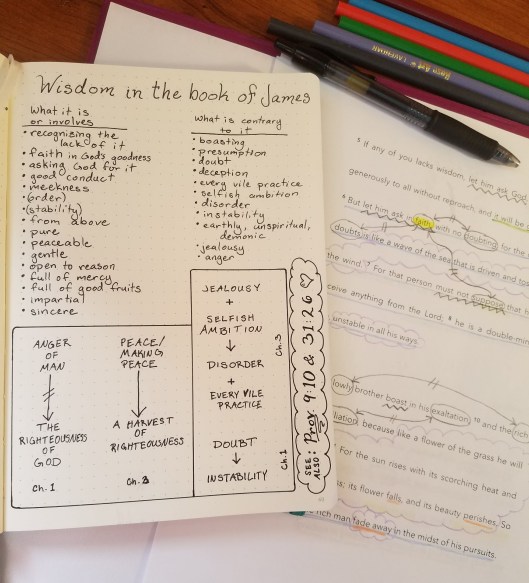
I have the book of James printed out so that I can highlight, circle, and underline to my heart’s content. My pages were already marked up before today’s time of study, so I began taking notes in my bullet journal based on patterns and connections I had observed previously.

wisdom book of james bible study

Jotting down all the words associated with wisdom in the book of James proved to be very helpful.  Some are prerequisites, like recognizing our lack of it, having faith in God’s goodness and unchanging nature, and asking Him for the wisdom we so desperately need. We can also see very clearly wisdom’s source: “from above”.

Many of the rest of the positive statements about wisdom help us to understand what it produces. Good conduct. Meekness. Purity. Peaceableness. Gentleness. Reasonableness. Mercy. Good fruits. Impartiality. Sincerity. Righteousness. These aren’t too far afield of the fruit of the spirit, now are they? It struck me just how relational most of these words are. Some uses of the word wisdom in the Old Testament imply doing things with skill. It seems a big part of what wisdom is in the book of James involves skillfully (and righteously) relating to other people.

There are also a few things we can discover about wisdom that aren’t directly stated. Since doubt and a lack of wisdom produce instability (James 1:5-6), we can infer that faith and wisdom produce stability, so that we aren’t tossed about by every wave. This has immediate relevance to how we hold up in times of trial and testing (that’s the context of these verses!).

Later in chapter three, we learn that two of the characteristics that are opposed to wisdom, jealousy and selfish ambition, lead to disorder, allowing us to infer that true wisdom will lead to order. I can’t help but relate this to the classical concept of ordering the affections, meaning this has much more to do with how our hearts are aligned (read: what we love most) than with the amount of clutter in our homes (though it’s wise to stay on top of that, too). Godly wisdom will help us to prioritize, and as we can see from the words James uses in this letter, people are higher on the list than things.

Many of the words James uses in chapter three illustrate what wisdom is not. These are every bit as instructive as the positive list–perhaps even more so considering how easy it is for us to assume we have wisdom by simply agreeing with its propositions. This intellectual assent can blind us to the ways in which our lives demonstrate the very opposite of godly wisdom. Spend some time with this list of what wisdom isn’t and ask yourself the question James posed to his readers: “Who among you is wise and understanding?”

20180426_085800.jpg

Wisdom Hits Home

This little letter is humbling. But that’s a good thing. It reminds us to throw ourselves on the grace of God offered to us through Jesus Christ, seeking Him as we plead for wisdom to live in a way that’s worthy of the gospel.

As this exhortation meets my daily life, I know I need to be grounded in the foundational truth that “the fear of the Lord is the beginning of wisdom.” Also, consistent with James chapter three’s focus on taming the tongue, it’s good to remember the example laid down in Proverbs 31:26: “She opens her mouth in wisdom, And the teaching of kindness is on her tongue.” My husband and children have a front-row seat to my application of godly wisdom. When it’s lacking, they feel the effects of it.

book of james wisdom proverbs

Ultimately, what I see in the book of James is this: To be wise and understanding is to be like Christ. Jesus is the answer to James’ question: “Who is wise and understanding among you?”

Seeking wisdom merely for our own benefit or as an intellectual exercise misses the point.

The heart of wisdom outlined in James chapters one and three speaks to every other issue in the epistle: trials, temptation, relating to others in either anger or peace, doing rather than just hearing the word of God, keeping ourselves unstained by the world, not showing partiality, putting hands and feet to our profession of faith by loving others in deed and truth, using words appropriately, loving the eternal God rather than the temporal world, using our money to bless others rather than take advantage of them, being humble before God and others, submitting plans to the Lord’s will, waiting for the day of the Lord, and praying for and lifting up the lowly.

Whew!  You bet I need God’s wisdom and grace for these things!

Seems to me that at the end of the letter of James, we ought to circle back around to the beginning:

“If any of you lacks wisdom, let him ask God, who gives to all generously and without reproach.”

Our good, gracious, dependable God will answer this prayer. He’s the one who has invited us to pray it, after all.


What have you been learning from the Word lately?

Self-Doubt, God-Doubt

15 Thursday Mar 2018

Posted by Lauren Scott in Living Faith

≈ 3 Comments

Tags

Christian life, Christian Women, doubt, faith, self-doubt, stress

We humans are funny creatures, we can look at our own performance and find it wanting and then look up to the heavens and ask, “God, are you even there?”

self doubt god doubt woman sad

I originally wanted to wax eloquent on this topic, but I’ve recently found myself smack in the middle of it.

Life has been a bit heavy lately.  February brought with it several weeks with a house guest, an impending but yet-unsettled job change, my grandma in the hospital, and a whooping cough scare in our family and close friends.  Just when things seemed to ease up, there’s more emotional heaviness, my husband’s grandma in the hospital, a running injury, a minor car accident, and my house is a wreck as we prepare for my husband to start working from home.

I can count my blessings, to be sure—the Lord has been good to us.  But the past few days as I’ve been trying to keep up with schooling the boys, supporting others, reorganizing all the things, and nursing my physical injuries, I’ve just come up short.

This out-of-control season, with its full load of stress—good and bad—has gotten to me.

I’m not strong enough to bear it.  I’m not together enough to catch up on the cleaning, the cooking, the financial planning, the interrupted school days, you name it.  It seems there are so many plates spinning and people needing and I’m failing them all.

Yesterday I couldn’t really enjoy anything.  I was dull to any feeling but sadness.  Emotionally needy.  Physically hurting.  Spiritually exhausted.

And my pride doesn’t like the feel of it all.

At times like these it’s easy to get discouraged.  My glaring limitations stare me down, and I allow my personal gloominess to cloud my view of the Sovereign God who loves me.

The truth is, I’m finite.  Limited.  Small.  That’s part of what it means to be a creature in contrast to the Creator.  And while it might shock me at times when I’m faced with my limits, God isn’t surprised.  “He is conscious of [my] frame, He is mindful that [I am] but dust.”

But all too often instead of looking up to see the One who is strong for me, I continue to look within and mourn my lack of God-like power over my circumstances.

When my self-confidence wanes, I find my wayward heart can project that same lack of confidence onto the Lord.  Have you ever done the same?

“Things aren’t going my way!  I can’t get control of this!  I can’t seem to get control of myself!  God, are You even there?”

That’s not exactly a rational train of thought, is it?

On our good days we might think of ourselves as “independent”, “self-sufficient”, “got-it-together”, “responsible”, “emotionally stable”, and, let’s be honest, just plain “awesome”.

And then when things fall apart, “I’m failing at everything.” “I’m a burden to others.” “I’m a hot mess.”  “I just can’t even.”

Been there?

Sometimes our confidence fails because it was misplaced to begin with.  Sometimes our faith falters because we took our eyes off the Lord long before things went sour.

I’m not necessarily saying the hard times and our failings are caused by this misplaced confidence (though sometimes that might be the case).  What I’m saying is that when our confidence is shaken, it may be that we’re upset with God not because He has failed us, but because we aren’t as awesome as we thought we were.

When we’re brought to the end of ourselves, the world’s counsel is often to dig deeper within. “Believe in yourself!”  “You’re stronger than you think!”  “You’ve got this!”  And while it’s healthy to silence the voices that accuse and condemn with the promises of forgiveness and life in Christ (see Romans 8!), we can’t ultimately combat our short-comings by looking within.  God doesn’t intend for our struggles to lead us to despair of ourselves and then stay there.

Check out the exhortation in Isaiah 40:26-31:

Lift up your eyes on high
And see who has created these stars,
The One who leads forth their host by number,
He calls them all by name;
Because of the greatness of His might and the strength of His power,
Not one of them is missing.

When you feel out of control, don’t project that uncertainty on the Lord by thinking that you’re the only one who can fix your situation.  Look up!  Your God is the sovereign Lord over all the universe!  He made and sustains the stars and He made and sustains you!

Why do you say, O Jacob, and assert, O Israel,
‘My way is hidden from the Lord,
And the justice due me escapes the notice of my God’?
Do you not know? Have you not heard?
The Everlasting God, the Lord, the Creator of the ends of the earth
Does not become weary or tired.
His understanding is inscrutable.
He gives strength to the weary,
And to him who lacks might He increases power.
Though youths grow weary and tired,
And vigorous young men stumble badly,
Yet those who wait for the Lord
Will gain new strength;
They will mount up with wings like eagles,
They will run and not get tired,
They will walk and not become weary.

When self-doubt strikes, don’t project that doubt onto the Lord by continuing to wallow in your own weaknesses and failures.  Look up!  Your God is strong and gives strength to the weary!

Are not two sparrows sold for a cent? And yet not one of them will fall to the ground apart from your Father. But the very hairs of your head are all numbered. So do not fear; you are more valuable than many sparrows.

When you’re afraid and think no one notices, don’t project human ignorance onto the Lord by assuming He’s forgotten you, too.  Look up!  Your God knows the hairs on your head, and He who watches over the sparrows cares even more for you!

I will lift up my eyes to the mountains;
From where shall my help come?
My help comes from the Lord,
Who made heaven and earth.

When help is hard to come by and your situation and yourself seem helpless, don’t project that hopelessness onto the Lord by forgetting to run to him with your need.  Look up!  Your God is your “refuge and strength, a very present help in trouble.” (Psalm 46)

While this season has been hard and humbling for me, bringing with it more than a fair share of tears, I’m riding the waves more smoothly than I have in the past because these truths have been much more at the ready and I’m quicker now to cast my cares on the Lord.

I’ve heard it said recently, “Trials can make you bitter or better.”  For the Christian, the “better” God intends for us is to be strengthened in our confidence in Him.

Our human resources may fail us, and while it humbles us to realize that we can’t ascribe greatness to ourselves, let’s not forget to ascribe to the Lord the greatness due to His name (see Psalm 29).  We’ll find our confidence will return when it is grounded in the right Person.  And we’ll find the next storm of self-doubt and disappointment, while still painful, will have less impact on our faith when it is firmly rooted in a God who doesn’t disappoint those who hope in Him.

Here’s to growing in grace.

In a Vision, I Walked… — A Poem on Isaiah

28 Wednesday Feb 2018

Posted by Lauren Scott in Guest Posts, Living Faith

≈ Leave a comment

Tags

Guest Post, Isaiah, poems, poetry

Here’s a guest post from my thoughtful and thought-provoking sister-in-law Abigail Scott. She’s been writing tight poems for a couple decades now (yes, she started quite early). I find this one of hers, inspired by the book of Isaiah, to be particularly moving.  Enjoy.

isaiah poem time past future

In a vision, I walked through the annals of time
And the past and the future all merged in one line
With the threads of the nations’ existence entwined
Like the strings of an instrument God had designed.
I saw many powers who reigned on the earth.
They were arrogant, loudly proclaiming their worth.
Yet they rose and they fell, like the swells of the tide
Each self-proclaimed lord overthrown in his pride.
Man repeatedly sought for a warrior to reign
To unite all the earth in one glorious name,
And they worshipped themselves and the work of their hands
So the Sovereign God wasted their works and their lands.
Yet the whispered refrain, resonating through space:
A call to the humble to worship by grace
And a promise that Yahweh would sovereignly raise
A Prince to bring peace, who is ancient of days.

Then I saw through the struggle, the war and the loot
From a root that was withered, God raised up a shoot.
While the world, in each palace, sought humanly might
The eternal King came among cattle at night.
For pride wages war and it antetypes trust
Which worships the God who has made us from dust.
The Creator thus came, weak and helpless on earth
Despised and rejected and lowly of birth.
In the suffering flesh, He came to us humble
And this was the form that caused proud men to stumble
For Greeks search for wisdom, Jews ask for a sign
But eternity’s King laid aside the sublime.
No sign did He offer, but three days of death
And the wisdom that yields up immortal God’s breath.
So the rulers of earth found Him quiet and still
Yet they never imagined the Sovereign God’s will
For they missed the refrain, resonating through space:
A call to the humble to worship by grace
And a promise that Yahweh would sovereignly raise
A Prince to bring peace as the ancient of days.
As a servant, He claimed what was His from the start:
The birthright to reign as the King in each heart.

Ah, but time leads the way to a permanent reign
That fulfills all the thrills of the whispered refrain.

And I saw, in my vision, the scope of all history
Not a line, but a circle, eternity’s mystery.
The Alpha, beginning, the ancient of days,
Once born as a man and thus knowing our ways,
A King who is gentle, and humble, a lamb
Will return as a lion, a sword in His hand
To execute justice and overthrow pride
Of the kingdoms that rise and that fall like the tide.
The beginning and end both meet in one place
In the person and work of the God of all grace
Who touched time in humility, born of the dust
To bow every knee to a King we can trust.
His reign is eternal, His crown won’t rescind
For the annals of time will conclude with this end:
The refrain, a crescendo that overturns space,
When the whole world will worship, forever, His grace,
His Sovereign compelling our eternal praise
For the Prince who brings peace as the ancient of days.

What’s in a Name? (Announcement!)

18 Thursday Jan 2018

Posted by Lauren Scott in Living Faith

≈ Leave a comment

It’s no secret that human beings like to name things.  We name our children, our pets, our businesses, our streets, our territories, our cars, our disorders, our churches, our ideologies, our families…you get the idea.

God made the first man and called him, well, “man” (Adam).  But after that, God gave this man a job.  Adam was to name all the creatures that the Lord brought before him.  He also named his female counterpart “woman, for she was taken out of man”.  And later, he gave her a more specific name:  Eve.

So it would seem we’ve carried on this naming practice uninterrupted ever since.

Apparently names can be important enough that sometimes God Himself intervenes.  Like when He told Abram and Sarai that they should start going by Abraham and Sarah.  Or when He changed Jacob’s name to Israel.  He’s even at times instructed that a baby should be given a particular name, as in the case of Ishmael and Isaac and Solomon, to name a few.

But what God-given name is greater than that of the Messiah, the Lord Jesus? His is the name above every name.


And then there are these silly little intangible things called blogs.  A collection of pixels in cyberspace that a person gets to name.  For a year now my own blog has been called Life Meets Jesus.  It’s a meaningful name, a good name.  But in the blogging world, your blog name is essentially your business name…you brand.  And in that light, it seems a bit trite for a mere human arranging words and pixels to slap the Greatest Name onto something so…miniscule? fallible? marketable?

Now, in my writing and attitude I strive to make much of Jesus, to bring Him glory.  But putting His name in what is effectively my brand name seems at best a bit presumptuous and at worst an irreverent attempt to sloganize the incomparable name of the King of kings.  Of course that hasn’t been my intention, but it has nevertheless been weighing on my heart for months.

“Did you see the latest post on Life Meets Jesus today? It’s about X…” and the conversation trails off into the details of whatever that post might be…maybe it was something overtly spiritual, maybe not.  But someone just rattled off the name of Jesus while thinking about my words rather than about His person.  I think I’d like to avoid inspiring that kind of situation.

This is one of those cases in which less is more.

I have no intention of dancing around spiritual issues, or even the precious name of Jesus in my writing—there will be no change in that regard.  But I am removing it from my blog title.  I’m not ashamed of His name; on the contrary, I exalt it.


So what will replace Life Meets Jesus?  Well, that’s taken quite a bit of time, meditation, and prayer to come up with.  I’ve actually had the name picked out since the middle of the fall:  Kept and Keeping.  A name that embodies the themes of two of my favorite passages of scripture: 1 Peter 1:3-9 and Romans 8.

It’s taken a bit more time to plan this switch and make it happen—and to sit on the new name for long enough that I felt confident it was the right one going forward, that it would be one I could keep.

I’m confident now that it is.

I hope that you’ll appreciate the change, and that you’ll explore all the meaning I see bottled up in this new name on the About page.  But even if you don’t like that I’ve changed the name of my blog or are completely indifferent to it, I have joy in knowing that I’m following through on something that the Lord has made clear to me.  The change was necessary, and here it is.

May you be blessed in this New Year and in the love of the blessed Lord and only Redeemer, Jesus Christ.

Soli Deo Gloria.

No Story is the Same, No Pain Ever Wasted

08 Friday Dec 2017

Posted by Lauren Scott in Guest Posts, Living Faith

≈ 3 Comments

Tags

Christian life, Guest Post, poems, poetry, suffering, trials

Here’s a guest post from my friend Tabitha Alloway who writes at Pursuing Logos.  Tabitha is a fellow homemaking, homeschooling wife, mother, and electrician–well, we don’t have that LAST part in common!  She’s also a long-time family friend.  Enjoy!

old-books-436498_1920.jpg

Have you ever started into a set of books by a particular author and found that before long you could predict the entire plot before you’d even cracked the next book open?

I remember a set like this from my teen years.  I fell in love with the G. A. Henty historical fiction series, and for a while I devoured every book I could get.

But slowly I realized my interest was fading.  Every book seemed to have the same plot; only the names, faces and times changed: Boy goes on adventures.  Boy goes to war.  Boy is captured.  Boy escapes.  Boy becomes hero.  Boy meets girl.  Boy settles down and lives happily ever after.

Sigh.  Very idyllic.

And so predictably formulaic.

Now I’m not knocking the series—I still like the books and I’m looking forward to the day my kids can enjoy them.  But it’s sometimes amusing (or annoying) to see an author embrace a seemingly one-track plot.  A good writer is able to spin each story in such a way that, while it will always reflect their own unique style and voice, the story itself is fresh and new.

I think of God as a Master Writer, scripting the days and circumstances of our lives, inscribing our stories page by page.  He’s the Master Composer, ordering the “rhythm and rhyme” of our lives as an ode of praise.  He is the Potter who shapes our lives for our good and His glory.

While certain themes shine through every story He writes—goodness, mercy, grace, redemption or justice—each one is uniquely different.

Have you ever been tempted to question or wonder what God is doing in your life when you find yourself in difficult circumstances and trying times?  Or even perhaps to envy the way God is working in the lives and circumstances of those around you, rather than humbly accepting what the Potter is doing in and with your life (see Jeremiah 18:1-6)?

I have.  I’ve been tempted many times, when finding myself in less-than-ideal circumstances, to compare my lot with that of others and to envy God’s plan for and ordering of the lives of those around me.

One morning a couple of months back, feeling burdened and discouraged by the weight of recent trials, I poured my heart out to the Lord about it all.  I opened the Word and my attention was drawn to the passages that spoke of giving thanksgiving, honor, worship, and praise to God; of investing our trust in Him because He is good.   Not exactly the typical comforting passages you might expect.  These precious words comforted by lifting my eyes.

I began to think of the stories of the saints of the Bible as well as the experiences of modern-day saints.  No two are exactly the same!  God works in such a wide variety of circumstances and ways to accomplish His will in each of His children’s lives.

Look at Hannah.  She prayed for a child, and God blessed her with one.  Yet many Christian wives through the ages have prayed with the same desperate desire for children and have been told “No.”

Jabez prayed that God would bless him and keep him from harm and pain.  God granted His wish.  Yet Job was permitted to experience unimaginable grief and pain in his lifetime.

Daniel was saved from the lions’ mouths.  But many believers in the early centuries of the church were torn apart and eaten by wild beasts.

Under the reigns of David and Solomon, the saints and prophets rejoiced with gladness and singing.  Under the reigns of Ahab and Manasseh, the saints and prophets suffered, and served their God in hard times and discouraging circumstances.

The apostle John lived a long life in service to Christ while Abel’s life was cut off prematurely.

Paul could have been tempted to envy the many believers around him who experienced miraculous, physical healings, while he himself was given a thorn in the flesh and denied its removal.

So many people.  So many stories.  All of them different.

Had God denied Hannah her wish, or Jabez his, would He still have been good?  Would His people have continued to trust in Him?  Was God’s work in the lives of Hannah, Daniel, and Jabez better, more kind, or wiser than in the lives of Job, or Jeremiah, or Paul?

According to Hebrews 11 we see that trust in God is not (and cannot be) rooted in our personal circumstances, but rather in the character of a faithful God Who is working in His children that which pleases Him, as He orders our lives for our good and His glory (see Romans 8).

The Word tells us elsewhere: “He is the Rock, His work is perfect: for all His ways are judgment: a God of truth and without iniquity: just and right is He” (Deuteronomy 32:4).  The Psalmist reminds us that “The Lord is righteous in all His ways, and holy in all His works” (Psalm 145:17).

In declaring his trust in the Lord, the prophet Habakkuk indicated it was not contingent on any circumstances: “Although the fig tree shall not blossom, neither shall fruit be in the vines; the labour of the olive shall fail, and the fields shall yield no meat; the flock shall be cut off from the fold, and there shall be no herd in the stalls: Yet I will rejoice in the Lord, I will joy in the God of my salvation.  The Lord God is my strength…” (Habakkuk 3:17-19).

We often see both Old and New Testament saints giving thanks to God even in the middle of painful circumstances.  While the personal testimonies and experiences are different, I imagine they would share one common sentiment: God is good.

20171201_080359

Photo Credit: Tabitha Alloway

One of my favorite hymns is Day by Day.  The first verse goes:

Day by day, and with each passing moment

Strength I find to meet my trials here;

Trusting in my Father’s wise bestowment,

I’ve no cause for worry or for fear.

He whose heart is kind beyond all measure

Gives unto each day what He deems best—

Lovingly, its part of pain and pleasure,

Mingling toil with peace and rest.

Some of the most precious portions of Scripture to me are those in which God reveals His own heart of compassion toward His people.  It’s the theme that brightens even the darkest story.  We’re all familiar with the passage in Lamentations that speaks of the faithfulness, mercy, and compassion of the Lord.  Then Jeremiah goes on to say, “But though He cause grief, yet will He have compassion according to the multitude of His mercies.  For He doth not afflict willingly nor grieve the children of men”.

God does not cause pain or withhold desire for no good purpose.

Isaiah breaks out in thanksgiving: “I will mention the lovingkindnesses of the Lord, and the praises of the Lord, according to all that the Lord hath bestowed on us…For He said, surely they are my people…In all their affliction He was afflicted…in His love and in His pity He redeemed them…” (Isaiah 63:7-9).

God sorrows in our sorrow; He is afflicted in our affliction.  We do not have a High Priest who   is insulated from our pain; He experiences it with us and has compassion on our weaknesses.

It is this God of love, kindness, and wisdom who composes my story and your story.  Do we trust Him to do what He deems best?  Are we content in His provision for and ordering of our life?

The Master Writer is weaving the days and circumstances of our lives into one story for His glory.  Every daily page whispers His goodness, and even the darkest chapters are traced with hope, pointing to the beauty of His eternal purpose.

And that eternal purpose hints at the fact that the Author’s story doesn’t end with us, with this life.  There is a “happily ever after” that’s already written, just awaiting publication.  If you know Jesus, aren’t you looking forward to reading that story?


Had You not granted Hannah’s wish

And given her a child…

Had You let Jabez feel anguish,

Not blessed with life so mild…


Had You not shut the lions’ mouths

When Daniel prayed to You…

Did You not save his friends, when, roused,

A despot gave death cue…


Had solitude been David’s lot

Instead of throne and crown…

Had Jacob not grasped riches sought,

Nor prosperity had found…


Had Hannah lifted empty arms

In worship to Your Name…

Had Jabez met some earthly harm

In showing forth Your fame…


Had Daniel died a martyr’s death

In service to his Lord…

Had fire snatched the faithful’s breath,

And death been their reward…


Had David sung in open fields

Instead of regal courts…

Had flocks and fields returned no yields

While Jacob sought the Source…


Your faithfulness would be the same,

Your goodness ever new,

Your mercy rich exalt Your Name,

And saints would hide in You.


You are the God of grieving Job,

Of joyful, dancing David.

Your ways and works across the globe

Will always be redemptive.


The God of weeping prophets and

The God of singing saints;

All things lie open in Your hand—

From You derive their fate.


You are the source of grace for Paul

When thorn afflicts him sore.

You save the cripple from a fall

And his weak legs restore.


You’re the God of brave queen Esther,

The God of humble Ruth;

To each his lot, Dispenser,

The One Source of all Truth.


In pain and gain, our love and loss

You are the Sovereign One;

You knew real sorrow at the cross

Now-risen, conquering Son.


You walked on earth in mankind’s shoes

You know heart’s deepest throb;

Appointing things as You so choose,

You hear the smallest sob.


You’ve cried and wept with broken heart,

Felt agony of pain;

When on the earth You shared our part,

Your loss became our gain.


To come to You a man must trust

You are the great I AM;

Your works are true and right and just,

And You reward the man.


Your ways are far past finding out,

No finite mind can see

Exactly what you are about—

Your great Eternity.


You are our life, our love, our light,

Our hope, our help, our haven,

Our Rock, Redeemer and our Right—

Praise God of highest heaven!

The Poverty of Pragmatic Gratitude and the Riches of True Thanksgiving

22 Wednesday Nov 2017

Posted by Lauren Scott in Living Faith

≈ 3 Comments

Tags

Giving Thanks, Gratitude, Thankfulness, Thanksgiving

Tomorrow is Thanksgiving Day in the United States, so naturally our minds as Americans are turned toward things like pilgrims, gratitude, turkey, thankfulness, football, sharing, pumpkins, family, contentment, and working over our Black-Friday-and-Cyber-Monday-shopping strategy.

C’est la Vie

The intended theme of this week’s celebration is a hot lifestyle topic these days.  Whether it’s Ann Voskamp’s challenge to list One Thousand Gifts or Positive Psychology’s attempt to study and promote behaviors that increase well-being, our public consciousness seems to be pretty aware of the importance of being thankful.

The fact is, studies have demonstrated that those who count their blessings are healthier, sleep better, feel closer to others, feel better about themselves, are less likely to be mean…the list goes on.  It would seem that acknowledging the importance of gratitude for these reasons is a no-brainer.

But the emphasis in much of our online discussion of gratitude and Thanksgiving (and consequently our own day-to-day thinking) is terribly skewed.

The Problem with Our Gratitude

One fallout of the secular, scientific, pragmatic, and pluralistic approach that dominates the discussion is that we have by-and-large separated gratitude from the giving of thanks.  Politically correct pop culture’s prevalent penchant for leaving God out of the mix means that we’re focused primarily on what we can get out of gratitude rather than on what we can give (and Who deserves that gift of thanks).

After all, how else can you convince naturally selfish human beings to practice a virtue than to sell that virtue in terms of self-help?  At least, that’s the impression I get when I see opening lines like these and read about why I should be thankful from the perspective of a kind of rational reductionism and evolutionary emptiness in this  article from Psychology Today.

Here’s the deal.  The researchers aren’t wrong about the benefits of “practicing gratitude”.  They’re wrong in holding those benefits out as the purpose for it.

Even when acknowledging that showing appreciation for others can improve relationships, the focus is ultimately on the power of gratitude to improve your own relationships, not on the blessing or benefit the other person receives when you give them thanks!  Our public conception of gratitude is disgustingly self-seeking!

What is this holiday of Thanksgiving, anyway?  Is it merely for conjuring up feelings gratitude?  Or are we settling for a few crumbs from the table when there is a much larger feast to be had?

Logically Speaking

If we are giving thanks, then there ought to be someone receiving that gift, right?  Thanksgiving implies that there are two recipients—first, those who have received a blessing have reason to give thanks, and secondly, if they give thanks, that thanks is received by the one who blessed them.

To illustrate this in human terms:  we often feel grateful for things we receive or kindness done to us.  But how often do we pause the frenetic pace of our lives to actually say “thank you”?  To write a thank you card (or even an email or text!) and send it?

DSC_0634

Scripture paints for us a vivid picture of the difference between mere gratitude and actual giving of thanks.  When Jesus healed ten lepers, as recorded in Luke 17:12-19, only one of them turned back to say thank you.  I’m sure the others felt gratitude.  How could they not?  But only one showed it, only one gave it.

Listing the things we are thankful for can indeed be a good practice (and to Mrs. Voskamp’s credit, she directs that thanks to God), but ultimately, if in our list-making we only feel gratitude and never actually give thanks, then the practice is, at the end of the day, self-serving.

Digging In

We know from what we’ve covered already that the world is snacking on dessert crumbs and missing the greater feast when it comes to gratitude and thanksgiving, but what is that bigger feast?  What does it look like to practice or celebrate Thanksgiving in a way that honors God?

Curious myself, I opened up E-sword on my computer and did a search on the words “gratitude”, “thanksgiving”, and “giving thanks”?

Interestingly, despite the current emphasis on having an “attitude of gratitude”, the words “gratitude” and “thankfulness”, that is, the nouns that describe the heart-felt disposition from which science tells us we may benefit, each only appear three times in my bible.  Colossians 2:7 speaks of our lives as Christ-followers “overflowing with gratitude“.  In 1 Timothy 4:4, we see food is being “received with gratitude“.  And in Hebrews 12:28 the exhortation to “gratitude” compels us to far more than a mere feeling:

Therefore, since we receive a kingdom which cannot be shaken, let us show gratitude, by which we may offer to God an acceptable service with reverence and awe;

The three mentions of the word “thankfulness” convey an idea of giving thanks in general, thanks toward a person, and thankfulness bound up with singing praise to God.

Then There’s the Really Good Stuff

But this holiday we celebrate isn’t called “Gratitude Day” or “Thankfulness Day”, is it?  It’s called “Thanksgiving” and it’s intended (obviously) as a day of “giving thanks”.  When I searched for those words in my Bible software, I found a real feast!

“Give thanks” appears approximately 75 times in the bible!  Forty-nine of those occurrences are in the book of Psalms—the songs of God’s people.  The overwhelming majority of times this phrase is used it includes to whom those thanks are given—and over 95% of the time the recipient is God.

Our November holiday’s namesake has twenty-eight biblical appearances, many of which occur in the Old Testament referring to the “sacrifice of thanksgiving to God”, both in the Law and in the Psalms.  Hebrews 13:15 echoes this theme in the New Testament:

Through Him then, let us continually offer up a sacrifice of praise to God, that is, the fruit of lips that give thanks to His name.

The vast majority of the time that the word “thanksgiving” shows up  in the New Testament, it is in reference to prayer–and it is always directed to God.  You’ll also find it eleven times in the Psalms (this is the most thanksgiving-full book).

In God’s word, “thanksgiving” is something brought, produced, given, found…  It’s associated with telling, calling, singing, praising, honoring, offering; with voice and melody; with sacrifice and prayer; with joy and gladness; with celebration and charity.  Giving thanks in the bible is clearly a rich and blessed practice!  But we’d be blind not to see that it is unequivocally about recognizing God’s goodness and provision, not merely making lists, conjuring up a feeling, or promoting our own or others’ well-being.

With Lifted Eyes

How then does this affect the way we celebrate Thanksgiving?  The way we approach having an “attitude of gratitude” year-round?

For starters, we ought to see that our motivation for giving thanks isn’t just for our own benefit, or because it creates a pleasant atmosphere for other people, or because it’s good to be mindful of our blessings so that we don’t become grumpy and materialistic.  While those things are certainly good and true, we ought not confuse the effects of giving thanks with the reason for doing it in the first place.

For Christians, and ultimately for all people whether they realize it or not, we ought to give thanks because it is the right response for creatures made in the image of a benevolent Creator.  Because God is worthy of our praise and thanksgiving–for who He is and for all that he has made, all that He sustains, and all that He supplies.  Everything we have to be thankful for flows from Him.

God isn’t just another thing on my gratitude list.  He’s the one I submit my list to in praise and worship and thankfulness.

What if?

What if our thanksgiving was characterized by what we see in scripture?  Giving thanks for all kinds of things—spiritual, physical, relational—first and foremost and overwhelmingly to our good and gracious God?  And what if we communicate that thanks that we offer to God to those whom He has used to be a vehicle of blessing to us?  As Paul opened many of his letters, “I thank my God for you!”

Let’s begin our Thanksgiving in the right place:  aiming our gratitude at the Lord rather than at our own idols of well-being–and thanking Him again and again when we find that doing so brings blessing.

Our pursuit of thankfulness amounts to more than mere self-care and self-improvement.  Let’s give thanks to God who is good and who is the Giver of all good things.  And let’s give thanks to those whom He has used to bring that good to your life.  In this way, we can joyfully celebrate Thanksgiving, knowing that we are living out the two greatest commandments:  by turning our own blessings into a blessing to God and to others.


For more thoughts on Thanksgiving, check out these articles:

Remember and Rejoice: Thanksgiving Meditations from the Book of Deuteronomy

Thanksgiving: A Holiday Made for Unsettling Times

Hands of the Aged

10 Friday Nov 2017

Posted by Lauren Scott in Living Faith

≈ 2 Comments

Tags

faith, poems, poetry

hand woman photography trunk old pattern finger tattoo sitting human arm muscle chest apron cool image hands fingers prayer age folded skirt resting cool photo wrinkled aged checkered joint abdomen wrinkles

Wrinkled and withered

From work and years

Pained yet praising

Through the tears


Wearied and weak

Yet stretched out to give

Bearing the marks

Of a life well lived


With wisdom and grace

Picking up the lowly

Lifted in worship

Spotless and holy


The hands of the aged

Shaking and slow

Still powerful for Jesus

With much seed to sow


Christ is your glory

Your joy is His praise

His word is your wisdom

Your stronghold His grace


O precious treasure

To know such as you

Who’ve lived long for Jesus

Believing the truth


May the young embrace you

And hold your tired hands

And learn from your living

While they have the chance


COPYRIGHT LAUREN SCOTT 2009
← Older posts
Newer posts →
  • View KeptandKeeping’s profile on Facebook
  • View lauren.keptandkeeping’s profile on Instagram
  • View keptandkeeping’s profile on Pinterest
  • View @laurenscott.keptandkeeping’s profile on YouTube
Lauren Scott

Lauren Scott

Christian. Wife. Mother. Homemaker. Home Educator. Blogger. Book Addict. Outdoorist.

View Full Profile →

Enter your email address to follow Life Meets Jesus and receive notifications of new posts by email.

Affiliate Disclosure

We are a participant in the Amazon Services LLC Associates Program, an affiliate advertising program designed to provide a means for us to earn fees by linking to Amazon.com and affiliated sites.

Hands-on Math Curriculum

RightStart™ Mathematics

Check Out Prodigies Music Curriculum!

music curriculum sale

Quality Video Curriculum

Top Posts & Pages

  • Five Refreshing Scriptures for Finishing Strong when You Feel Weak and Weary
    Five Refreshing Scriptures for Finishing Strong when You Feel Weak and Weary
  • [Real] Life After Instagram
    [Real] Life After Instagram
  • Versatile Basic Biscotti Recipe (Gluten Free / Dairy Free Option)
    Versatile Basic Biscotti Recipe (Gluten Free / Dairy Free Option)

Advent April Fool's Day April Fools Book Review Books Books Charlotte Mason Charlotte Mason Homeschool children Christian Classical Education Christian Classical Homeschool Christian Homeschool Christian life Christian mom Christian Parenting Christian Women Christmas Classical Education Classical Homeschool devotional education faith Guest Post Home and Family Home Education Homemaking homeschool encouragement homeschooling Jesus Living Books love marriage meditations micro book reviews motherhood Nature Nature Studies parenting poems poetry Practical Atheism Reading List Reflections Relationships trials

A WordPress.com Website.

  • Subscribe Subscribed
    • Kept and Keeping
    • Join 171 other subscribers
    • Already have a WordPress.com account? Log in now.
    • Kept and Keeping
    • Subscribe Subscribed
    • Sign up
    • Log in
    • Report this content
    • View site in Reader
    • Manage subscriptions
    • Collapse this bar
 

Loading Comments...