• Home
  • About
  • Living Faith
  • Home and Family
  • Home Education
  • Books
  • Recommended Resources
  • Media

Kept and Keeping

~ Rest in Grace, Labor in Love

Kept and Keeping

Author Archives: Lauren Scott

Purity Isn’t for Me

12 Friday Feb 2016

Posted by Lauren Scott in Living Faith

≈ Leave a comment

Tags

devotional, glory of God, love, marriage, meditations, Purity, sanctification, set apart life, singleness, the

Purity isn’t for me. No, really—it isn’t.

There seems to exist some disillusionment for those who have reached what we could call “the other side of purity”. I’ve seen an article or two from people in my own generation bemoaning the fact that saving one’s virginity for the wedding night just wasn’t all that it’s cracked up to be. The reality that came after saying “I do” just hasn’t seemed to measure up to the ideal they were promised by their parents and youth pastors. Somehow these people who once made a commitment to purity now regret following through with it.

But why?

Maybe they were given all of the practical considerations and potential blessings of purity as though they were promises: avoiding STDs and unwanted pregnancy, having the potential for a very special physical relationship in marriage free from comparison with and the baggage of past “experience”, having a sense of self-respect, keeping your parents and church leaders happy (because the Bible says so!), making sure you don’t waste your gift on someone who doesn’t really love you, and, let’s not forget “married sex is the best sex”. In the minds of all too many teens and young adults, this boils down to: you will be healthier and happier if you wait. None of those are necessarily bad considerations or potential outcomes, mind you, but perhaps, neither are they proper motivation for a lifetime of purity.

I would offer that those who are disillusioned with the results of waiting didn’t understand what purity is for in the first place. Their complaints seem to be along the lines of “It didn’t work out for me like I thought. It didn’t make me as happy as I thought it would.” But, as the title of this article suggests, purity—in the Christian sense—isn’t for me.

My husband and I were recently asked to speak to a local youth group about how the Lord worked to bring us together (especially since our story is quite different from the way many people go about finding a spouse), so the issue of purity has been fresh on my mind for the past several weeks.

One of the discussion questions my husband tossed out that night for the teens to consider is, I believe, a very fitting one for any godly discussion of purity: What is the most important thing in the world to you?

I’d be interested to hear answers to that question from those who regret their past purity.

Hopefully those who know the Lord Jesus Christ as their Savior would at least know that the answer ought to be God Himself, or some variation including loving, serving, or glorifying Him. After all, the Bible says “Whether you eat or drink or whatever you do, do all to the glory of God.” The Westminster Shorter Catechism suggests that the “chief end of man is to glorify God and enjoy Him forever.” Once you know that is the correct answer, it’s pretty easy to come up with—but a whole lot harder to say honestly, isn’t it?

Riding that train of thought a little further, the greatest commandment, according to Jesus, is this:

Love the Lord your God with all your heart, soul, mind, and strength.

Here’s something to consider: If this is the greatest commandment, perhaps we should understand God’s call to sexual purity in light of it. Could it be that the goal of those “lesser” commands is in fact to obey that first one? Let’s review a few passages and see:


Now flee youthful lusts and pursue righteousness, faith, love and peace, with those who call on the Lord from a pure heart. 2 Timothy 2:22


“Youthful lusts” stand in opposition to the pursuit of “righteousness, faith, love and peace”, and this is to be done with others who “call on the Lord”—the Lord and His goals for us seem to be the focus.


Finally, then, brethren, we request and exhort you in the Lord Jesus, that as you received from us instruction as to how you ought to walk and please God…that you excel still more…For this is the will of God, your sanctification; that is, that you abstain from sexual immorality…For God has not called us for the purpose of impurity, but in sanctification. So, he who rejects this is not rejecting man but the God who gives His Holy Spirit to you. 1 Thessalonians 4:1-8


We are exhorted to walk in a way that pleases God, here and also in Colossians 1:10. The strong message of this passage to the Thessalonians is that our sanctification, or being “set apart” unto God, is not only pleasing to God but is also somewhat synonymous with sexual purity. In other words, good luck being set apart for God’s purposes while clinging to sexual sin. Sexual purity is so important because sexual sin is so at odds with our greatest goal: loving and glorifying God.

And perhaps the strongest statement yet:


…the one who joins himself to the Lord is one spirit with Him. Flee immorality. Every other sin that a man commits is outside the body, but the immoral man sins against his own body. Or do you not know that your body is a temple of the Holy Spirit who is in you, whom you have from God, and that you are not your own? For you have been bought with a price: therefore glorify God in your body. 1 Corinthians 6:17-20


This passage sets up a two-fold view of our bodies:

1 – There is a sense in which our bodies have dignity and we can disgrace them by acts of sexual sin (“the immoral man sins against his own body”), so arguments for purity that involve a sense of self-respect and dignity are actually, in my opinion, rather appropriate according to this verse. But…

2 – The strongest point to be made in this passage, however, is not that we sin against ourselves, but, if we are Christians, that we sin against the very purpose for which we have been rescued by Christ—to be a set-apart vessel, a temple for the Holy Spirit. Sexual sin is clearly at odds with glorifying God in our bodies, because our bodies are not ultimately ours, but the Lord’s, for Him to fill and abide. What could be more dignifying than that?!?

In my study of these passages, among others, I don’t see God holding out any carrots in order to twist our arms into sexual purity. There isn’t any bait-and-switch, as if God were to say, “Do this and you will be happy, healthy, whatever you want—but eventually I’ll tell you that I really I just want you to glorify Me.” God’s word is actually quite straightforward. If these passages tell us anything, they tell us that purity isn’t about us, it’s about God.

So to those who are young and wondering if sticking it out for the long haul is worth it: yes, it is. Not because it will ensure “your best life”—now or later—but because it is God’s good will for you and it pleases and honors Him. The commitment to set apart your body for God’s service will be a testimony to a world that His ways are better than theirs and that you are willing to wait for God’s good gifts in His good time.

To those who are not so young anymore and wondering if marriage and family will ever happen for them or if they will have lived a life of purity “for nothing”: take heart, it is not for nothing. It is for God and for your eternal delight in Him far above anything else. This will speak volumes of the value of your God above anything this world can offer. It may be a hard and lonely road, and it may be that you don’t see a reward for it in this lifetime, but “God is not unjust so as to forget your work and the love which you have shown to His name” (Hebrews 6:10).

To those who have not lived a life of purity and wonder if they can somehow make up for their sins: no, you can’t. But Jesus already did. He died for sin—for all kinds of sin, including the most perverse and unfaithful. Look to the cross, cast your cares on Jesus, believing He died for your sin and rose from the dead. He lives now to intercede for all who trust Him. So trust Him. And dig into what God’s word says about how to live with a goal of pleasing Him—and walk now in purity because the death of Jesus has made you clean and His Holy Spirit gives you new life.

To those who are married and think that the pursuit of purity is behind them: it’s not. Purity is just as important in marriage as it is when single. The goal is still the same—to glorify God with our bodies—only, in marriage, this includes both nurturing our relationship with our spouse and guarding our minds and bodies from temptation to sin. The fight isn’t over; it just looks a little different.

And finally, to those who think that their commitment to purity before marriage has let them down: it was never meant to be the key to temporal happiness anyway, though it certainly can contribute to it. If you’re a Christian, purity wasn’t ultimately about you at all, but about God. Try not to be resentful towards those who may have misled you into believing the whole point was to be healthy and happy—they probably meant the best for you. Instead of looking back in resentment, open up God’s word to see more of what He has to say about it. If your attitude has been sinful, selfish, or self-righteous, repent. Jesus died for those things, too. And don’t let go of purity—just recognize it isn’t an end in itself or a means to merely temporal ends. It is a part of living life to the glory and enjoyment of God.

I have, of course, only barely scratched the surface when it comes to what the Bible says about sexual purity, nor have I even really shared my own experience in the matter, but I hope that I have at least demonstrated the central purpose for the Christian’s call to purity, which is the very purpose for life itself: to love and glorify our Creator God. If I have as my greatest aim something other than that, my lifelong commitment to purity will quite likely be fraught with disappointment. Because, after all, purity isn’t for me.


Whatever you do in word or deed, do all in the name of the Lord Jesus, giving thanks through Him to God the Father. Colossians 3:17


Amen.

Lauren’s Bible Reading Plan for Busy Moms

30 Wednesday Dec 2015

Posted by Lauren Scott in Living Faith

≈ Leave a comment

Tags

Bible Reading Plan, children, devotional, motherhood, New Years 2016, Seriously Satirical

I have done several kinds of Bible reading plans since I became a believer in my early teens. The first few times around it was difficult to find the discipline to read the Bible every day all year long, so I usually left off somewhere between February and September.

As I grew up, I became a bit more disciplined. In recent years, I have followed the reading plan I found in my day planner and Justin Taylor’s Plan for Shirkers and Slackers. Both are wonderful plans.

In the past year, however, that discipline has largely fallen apart in favor of working through some much-needed topical bible studies—when I could find the time. But when I finished the last study, it left a vacuum of sorts, both in my schedule and in my plan. As a result I turned to My Utmost for His Highest in the mornings.

Bless you, Oswald Chambers, for your brevity.

This devotional only takes about five minutes, and it has been a wonderful tool to spark prayer, meditation on scripture, and worship. Occasionally I also pull out The Valley of Vision as a further aid to prayer and worship. I plan on continuing with this, but at the same time it’s not the Bible, and I find myself hungering for more of God’s word in my daily fare.

But who has time for a devotional and several chapters of Bible reading before the kids get up and it’s time to make breakfast? I know some of you do—good for you! Keep it up! But others of us can’t afford to chip away at our sleep (whether in the morning or at night) due to our current season of life or health issues. Can I get an Amen?

One of the most difficult aspects of sticking to a Bible reading plan for us busy (and sleep-dependent) moms is the question of when we will do it and do it consistently. When it comes to developing habits we can stick with, it helps to attach our new habit to a habit that we already practice each day, like praying as a family before sending the kids to bed, drinking a glass of water as soon as we wake up, or taking medicine before a certain meal. With this principle in mind, I’ve created this Eight-Step process for establishing a Consistent Bible Reading Time. Here we go:

Lauren’s Bible Reading Plan for Busy Moms

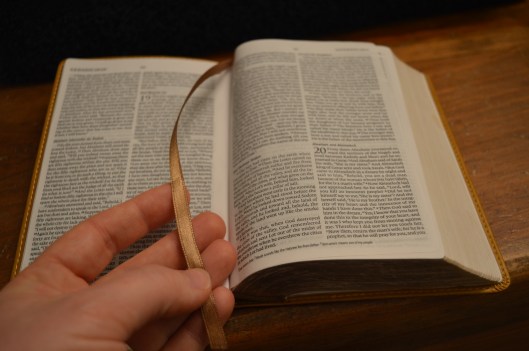
Step One: Locate a Bible (a compacted size may be preferable) and a Bookmark

Yes, you can find it.
DSC_0149
DSC_0128

Step Two: Place Bookmark in Bible

DSC_0131

It’s handy if the bookmark comes already attached!

Step Three: Locate the Toilet

DSC_0121

Step Four: Locate a Drawer or Basket near the Toilet and put the Bible in it

DSC_0124

You know, a place where you already keep necessary items.

Warning! Shelves or Baskets above the Toilet are not a Good Idea if you do not own a Water Proof Microban Bible. No, I don’t know this from Experience, but I do have a rather Vivid Imagination.

Wet book and razor blade | Flickr - Photo Sharing!

Step Five: When nature calls, or when the kids have driven you crazy and you need to Relieve Yourself of Burdens and Refuel Your Soul, go do your thing in the bathroom (locking the door behind you). But be sure to leave your Phone in your pocket and read your Bible instead.

Use these free images for your websites, art projects, reports, and ...

Step Six: When you are Done, be sure to mark your place with the Bookmark and put the Bible back in its special Drawer or Basket BEFORE you do anything to soil your hands. Just because we’re in a Common Place doesn’t mean we have to treat the Bible as Common—Keep. It. Holy.

DSC_0126

Step Seven: Flush and wash hands. (Of course.)

how to wash hands hand washing 150x150 Hand Washing Worksheets ...

Step Eight: Step back into the Domestic Mayhem with a Smile.

How To: Clean Your Granite Countertops | Granite Grannies

That’s it. Just read the Bible from front to back and use a book mark to keep your place. Or if you get bogged down in the Old Testament, read one book in the Old and then the next in the New Testament, using two book marks, and just go back and forth after each book until you’ve read the Old Testament once and the New Testament…more than once. You could even just start with a goal reading through the New Testament, or just the Gospels on repeat. Whatever your preference, my plan is all about finding the time to actually do it by anchoring it to something you find time for every day anyway.

My personal goal is to actually make it through the Bible in a year by reading it while I’m on the can, so I aim to read three chapters every time I sit down and I’m not-in-a-hurry. You can read different amounts each time or set a goal like I did. Either way, you’re redeeming that alone time and saturating your mind with truth. I’m pretty well convinced that it will work since I’ve read through several books simply by keeping them in the bathroom. In fact, when you’re done with this pass through the Bible, check out Loving the Little Years by Rachel Jankovic—my all-time favorite mommy bathroom book (short chapters, anyone?).

Now, I know this may not work for everyone…for those of you who are very regular you may never spend more than two minutes on the toilet. Take that minuscule period of time to count your blessings, favored ones. For the rest of us, we know we’ll be spending some considerable time in the bathroom—and especially on days when we just need a few more minutes of solitude while the kids are silently destroying something in another room (at least it won’t involve toilet paper this time, right?).

And just think! When you finally get up from reading the scriptures, and hopefully praying for God to give you grace to love your children as you should, you will be so much better prepared to not rip their precious little heads off when you find them painting the windows with peanut butter. Or flooding the kitchen and living room by emptying the water filter reservoir. (True story.) Imagine if you’d spent that time on your phone heathenishly playing meaningless games, scrolling endlessly through your news feed, or watching late night TV excerpts and the latest movie trailers on YouTube. You’d surely feel guilty and make the kids pay for it. But instead you were reading the bible. No guilt. No guilt at all.

…And hopefully no reactions you’ll later regret.

And who knows, perhaps sanctifying potty time will motivate you to consecrate the space more often (read: keep that porcelain throne spotless and shining—and maybe even light a candle. What could be more inviting?).

At any rate, I’m highly optimistic that this new Bible reading plan will go quite smoothly for me this year.

My Calling (and the Problem with the World)

16 Monday Nov 2015

Posted by Lauren Scott in Living Faith

≈ Leave a comment

Tags

Downhere, Internet, Music, My Calling, parenting, purpose

Sometimes we struggle to know what our calling is in life. Lately, God has been making it abundantly clear to me, first by showing me what it’s not.

God is not calling me to be a Facebook Crusader, as tempting as it may be sometimes when that politically-charged status or glaringly-wrong article pops up in my newsfeed and everything within me at that very moment is screaming “This! This is important! This is urgent! I must respond! I must set the record straight!” It’s hard to pry my anxious fingers away from the keyboard, but I must. God isn’t calling me to be a debater. He’s called me to be His. A servant and an encourager. A wife and a mother. So it naturally follows that the people that need my service and encouragement the most are the people who live with me—not the people sharing pixels with me on my computer screen.

Many times I have finally walked away from the screen at the end of a day in which I’ve wasted so much time and mental energy on things that aren’t any of my business, only to find that I have greater anxiety and insecurity (What if they misunderstood me? Did I say that in just the right way?), guilt and shame (Oh boy, look at those dishes piled up—I forgot about those.), and utter emptiness because I’ve been investing in ideas rather than in people (or at times I’ve confused the two). Lately, this emptiness has led me to see that I want Jesus more than I want more information, and to be pleasing Him more than to be understood by others. The story of Mary and Martha comes to mind. In all of Martha’s distraction, she had missed the most important part—sitting at the feet of Jesus, listening to Him, enjoying His presence. I’m thankful for the changes God is making in my heart, but still that sudden urge comes up sometimes as quickly as my newsfeed refreshes. With another post. Another article.

I love the free exchange of information. I love to share things I have found thought-provoking and interesting. And I’m not afraid of controversial subjects. But these things are not what I live for, they are not my calling, and the longer I live the more I realize that my time here is short, my opportunities to do what really matters are limited by my indulgence in the things that don’t.

At times these thoughts have led me to take a Facebook hiatus. I’m a bit of an all-or-nothing girl, so radical amputation has often been my modus operandi. But Facebook isn’t the problem. My “friends” on Facebook and their posts or the articles that come across the web aren’t the problem. My heart is.

On my most recent episode of “Someone is wrong on the internet”, I found myself at last pried away from the computer and finally unloading the dishwasher while grumbling, “There’s just so much wrong with the world!” Within a few minutes a song came to mind. It’s a good reminder that the problem I must pay the most attention to is…me.

My Cross to Bear

09 Monday Nov 2015

Posted by Lauren Scott in Living Faith

≈ 1 Comment

Tags

Cancer, devotional, discipleship, disease, Elisabeth Elliot, home church, insomnia, my cross to bear, trials

“So you want me to use this turkey meat, but what seasonings do I add to it to make it into sausage?” my sweet husband called up to me as I was closing my Bible and about to make the bed.

“Uh…” I said out loud with wide eyes, thinking, I never measure the herbs and spices, if I try to tell him a guess as to how much to put in, it’ll be more than my brain can handle this early in the morning and he won’t know where to find half of the spices anyway… “How about I come do that for you?”

A few minutes later I was dressed and downstairs, and he had the ground turkey already beginning to sizzle in the pan.

It was Sunday morning and we were getting ready for church. My disposition was remarkably cheerful this week. Sunday mornings can be the most stressful time of the week when you’ve got two small children to get ready, a meal to prepare, toys to pack, Bibles to load—and if you’re homeschoolers, it’s also the only day of the week that you actually have to be out the door by a specific time. Having a history of emotional Sunday mornings is part of what inspired my husband to take over the breakfast prep for me several years ago. Usually it involves pancakes or waffles, but this week it was sausage. Either way, having such a servant-hearted man is an incredible blessing.

But on this Sunday I may have been particularly happy because instead of having to make lunch to bring along with us, I had bought a frozen lasagna the day before and all I had to do was pull it out of the freezer and take it along to our friends’ house. (Who says you can’t ever buy peace of mind?)

Anyway, I’d just pop it in the oven at our friends’ house. Yes, that’s where we were headed. For church.

You see, we are a part of a small fellowship that meets in homes. This week church happened to be at a house only ten minutes down the road from us (perhaps another reason for the minimal stress of our morning). Other than the three year old coming downstairs in a white polo shirt and having to be instructed to wear something different (because I could do the math in my head: White Shirt + Lasagna = Disaster), getting ready and out the door was pretty smooth sailing.

The boys hopped in the van, I buckled up the three-year-old, my husband grabbed his guitar, threw it in the back, and we were set. We got in our seats, closed the doors, looked at the clock, looked at each other, and thought, “We’re early!”

Yes, indeed. It wasn’t yet 9:45 and we only had a ten minute drive to make. Sure, we’d like to have left sooner (maybe one day we’ll get there), and 9:55 is hardly early when the meeting is supposed to start at 10am, but this was progress, and progress is worth celebrating.

To our surprise, as we pulled into the rocky driveway ten minutes later, we found the parking area in the back of the house already full of vehicles. Apparently we were not so very early after all. Oh, well. At least all I had to do when we got inside was turn on the oven and sit down on the couch.

Nathaniel found a chair and set up his guitar while the boys and I found a place on a couch next to my sister-in-law. After singing praises and scripture songs, my father-in-law taught from Mark chapter 8. I was quite tired and admittedly had a hard time paying attention to the first section of verses he covered, but then I woke up a bit when he got to Jesus’ call of discipleship at the end of the chapter.

“Many Christians like to borrow this metaphor of taking up our cross and apply it to trials, saying ‘This trial—whether it be cancer or loss of a loved one—is my cross to bear.’ But that isn’t what Jesus is talking about. Those trials are involuntary—they happen to you. Jesus is making a call to His followers to do something voluntary—to deny themselves and take up their cross and follow Him. Even those who don’t follow Jesus experience trials like illness and loss. Those things are common to life, and certainly there are instructions for us in scripture about those things, but here Jesus calls us to deny ourselves for His sake—to be willing to endure whatever loss comes, not as a result of being human, but as a result of following Christ.”

I mulled over these words, trying to mesh this understanding with my own physical trials—a pregnancy related autoimmune disease and issues that accompany both it and its treatment—even as we moved on to another teaching, and then prayer and singing. After the meeting ended, we enjoyed some good discussion on the subject during lunch, fleshing out what “taking up our cross” might look like—living in obedience to Jesus even when it brings persecution or ridicule, loving Jesus more than this life even though our neighbors might think we’re lunatics, loving the lowly like Jesus did, spending time with them rather than seeking self-promotion and pridefully distancing ourselves from the needy. Our time of fellowship lingered into the evening before we all went home to prepare for the work week ahead.

That night I couldn’t sleep. As often happens when I so desperately need some shut-eye, my mind kept wandering to lesson plans and books and other nerdy and exciting things. Then I began to think again about Jesus’ words in Mark 8. “If anyone will deny himself and take up his cross and follow me…” And then I thought about my father-in-law’s comment that taking up our cross is not an involuntary thing, but a voluntary thing. Despite the practical application we had hashed out over lunch, I still wondered about its application to my trials. So if it’s not the disease and pain that’s my cross to bear, I thought, What is it?

I nudged Nathaniel, who was not quite asleep yet. “You know how your dad said that taking up our cross isn’t an involuntary thing like cancer?”

“Yeah.”

“Well, I was just thinking about it some more, and I still have a lot of questions. But I was thinking: Okay, so maybe my disease and whatever pain or other symptoms it causes aren’t my cross to bear, but maybe my choosing to joyfully serve others, to serve the Lord, in the face of that pain would be.”

“That sounds about right. I think that’d be a pretty good application of it.”

“I guess I’d be denying myself the ‘privilege’ of feeling sorry for myself or grumbling, choosing to be joyful instead. And not just for my sake. But for others.”

Nathaniel agreed.

After a pause I lamented, “That’s pretty convicting. That’s not what I usually do.”

We said our goodnights and my sweet, sleepy sounding-board husband drifted off as I lay contemplating this concept in light of the countless believers whose lives I have admired, and in light of Christ’s example. The people I have most looked up to for their faith and strength are those who have joyfully served others despite great physical pain, setbacks, and trials. The Lord Himself laid down His privileges, just in becoming a man! But even more so when He took upon Himself the wrath of God and the pain of public scorn and crucifixion, all the while praying, “Father, forgive them.” The cross wasn’t a hindrance to God’s plan, but the vehicle through which He would bring blessing to the whole world.

From what I can tell, my physical limitations and pains, should the Lord continue to choose not remove them, will be with me in this life whether I embrace them or not. So the ball is in my court: Will I shirk responsibility to respond joyfully and choose to grumble instead? Or will I take up the cross of humble surrender to the Lord’s will, seeking to rejoice in every circumstance and persevere in service to God and to others? On one side is a life of pain and inner turmoil with it. On the other is a life of pain overcome by the grace of God. One choice leads to bitterness and condemnation, the other to eternal joy and glory.

I let out a deep sigh, a kind of physical surrender to the supernatural peace of God that comes when at last we say, “Ok, I trust You.” And finally, too, a few moments later, I surrendered myself to restful sleep.

Here is what I read that evening from Elisabeth Elliot’s devotional, “Keep a Quiet Heart”, that prompted my late-night thoughts on this subject of taking up my cross. God is very kind to ordain even my reading schedule for His purposes and my benefit.

“The worst pains we experience are not those of the suffering itself but of our stubborn resistance to it, our resolute insistence on our independence. To be ‘crucified with Christ’ means what Oswald Chambers calls ‘breaking the husk’ of that independence. ‘Has that break come?’ he asks. ‘All the rest is pious fraud.’ And you and I know, in our heart of hearts, that the sword-thrust (so typical of Chambers!) is the straight truth.

If we reject this cross, we will not find it in this world again. Here is the opportunity offered. Be patient. Wait on the Lord for whatever He appoints, wait quietly, wait trustingly. He holds every minute of every hour of every day of every week of every month of every year in His hands. Thank Him in advance for what the future holds, for He is already there. ‘Lord, you have assigned me my portion and my cup’ (Psalm 16:5, NIV). Shall we not gladly say, ‘I’ll take it, Lord! YES! I’ll trust you for everything. Bless the Lord, O my soul!’”

~In the essay entitled Maybe this Year, page 51

I’ve many a cross to take up now,

And many left behind;

But present troubles move me not,

Nor shake my quiet mind.

And what may be to-morrow’s cross

I never seek to find;

My Father says, “Leave that to me,

And keep a quiet mind.”

~Poem by an anonymous author, page 52

“For those of us who are not at the moment in pain, may we not let slip any cross Jesus may present to us, any little way of letting go of ourselves, any smallest task to do with gladness and humility, any disappointment accepted with grace and silence. These are His appointments. If we miss them here, we’ll not find them again in this world or in any other.”

~ In the essay entitled Love’s Sacrifice Leads to Joy, page 68

Books Read from July 2014 to July 2015

07 Wednesday Oct 2015

Posted by Lauren Scott in Books

≈ 2 Comments

Tags

Books, cookbooks, Jesus Calling, micro book reviews, parenting, Reading List

It’s my goal each year to read at least twelve books. I’ve met this goal for the past several years, logging twenty this go-round, and I want to track and briefly review the books I’ve read for each year. Some books are great, some are not so great, but still were worth a read for me personally. I hope you’ll benefit from these micro-reviews.
Choosing Gratitude by Nancy Leigh DeMoss Many friends of mine had read One Thousand Gifts by Ann Voskamp over the past couple years. I can’t speak for or against that book, as I have not read it for myself, but it seemed to me that Choosing Gratitude was an attempt to produce a “more solid” alternative to Voskamp’s book on thankfulness. Nancy Leigh DeMoss’s book was encouraging and scripture-based to be sure, but I did not find it to be mind-blowingly challenging. There’s nothing wrong with that, and if you’re looking for an easy-to-read study on thankfulness this is a great book for you. However, having just read Knowing God by JI Packer before picking this book up, I might have had my taste buds trained for more meat.
The Abolition of Man by C S Lewis This was an incredible read (or listen, rather—we have the audiobook). Lewis examines a concept of universal morality and then reasons from it to the existence of God, while also examining the effect on humanity when we reject these things and analyze and deconstruct everything in our view. Highly, highly recommended.
The Great Divorce by C S Lewis Packaged together in the same audiobook was this work of allegory. It’s a bit strange, and its setting is not intended to be taken as theological truth, though by use of its setting it certainly dabbles in it. This is an imaginative examination of people’s rejection of Christ and all that heaven offers. As with The Screwtape Letters, this book is a gem more for its insight into human nature than for its apparent theology—much license is taken in that regard.
Winnie the Pooh and The House at Pooh Corner by A. A. Milne These two books come together in our Complete Collection of Winnie the Pooh, along with the collections of poems: When We Were Young and Now We Are Six. I’ve read these stories and poems to my children three times already, and we’ve actually just started through it all once more. Milne captures the wonder, imagination, and reasoning of a child beautifully on every page. Our family pretty much adores these stories.
Jesus Calling by Sarah Young Some will be surprised to see this on my list, but it was recommended to me by a friend during a very low point of struggle with chronic illness and depression. So at the time, it provided some needed encouragement, and I can see how many claim to have benefited from it. We need loving, encouraging words, and exhortations to trust in the Lord through our trials, but there is, sadly, great danger in the format. Putting words in Jesus’ mouth is nothing new, of course—even hymns have done this, even the Jesus Storybook Bible does this to some extent. But this is an entire book penned in Divine First Person. It may indeed provide some level of encouragement, but as far as being recommendable, I’d say no. You’d do much better with Keep a Quiet Heart by Elizabeth Elliott. (For a more thorough review of Jesus Calling, check out this one at Challies.com.)
The Paleo Approach by Sarah Ballentyne And here I must now admit to my little paleo food detour. Having an autoimmune disease, I was excited to read this tome (seriously, all 400-or-so textbook-sized pages of it), because it dealt directly with the problem of autoimmunity, providing both understanding and suggestions for improving the condition with diet and lifestyle changes (The Autoimmune Protocol, or AIP). The elimination diet it proposes is extremely strict and limiting, and I know this by experience…
The Paleo Approach Cookbook by Sarah Ballentyne This is the cookbook that accompanies the more science-y text listed above. I’ve found it interesting, and I’ve certainly gained some new recipes from this book, but I would recommend steering clear of the “Hidden Liver Meatloaf”—yeah, the liver isn’t so hidden after all.
The Autoimmune Paleo Cookbook by Mickey Trescott This is another recipe book that falls in line with the Autoimmune Protocol (AIP) outlined in The Paleo Approach. I think I actually use this cookbook more than the other. Each of them provide decent recipes with the very limited selection of foods that are on plan. I still use a handful of these recipes despite having thrown the AIP to the roadside because they are, indeed, very healthy, whole food recipes.
*Just a quick summary of my experience: The AIP didn’t reveal anything for me that a Whole30 hadn’t previously. I lost weight, some skin issues cleared up. But this time my bowels were in pain, far worse than before I did the AIP. I found things got way better after I reintroduced things like beans, and even grains. Being that my disease is in remission, it was difficult to say that the diet had any real effect on it specifically, so if you’re not currently facing the onslaught of your autoimmune disease, this may not be for you. If you do deal with daily debilitating pain or other continuous complications due to your autoimmune disease, it may be much more worth your while (maybe). My takeaway is that variety is a good thing. I may have some sensitivities, and I’ll watch for those as I move forward, but for now I’m enjoying all the food God has given me without major issues. I’d say the lifestyle factors of the AIP are more important for me than the dietary guidelines (though junk food is still clearly not helpful!).
Don’t Make Me Count to Three by Ginger Hubbard This is a wonderful book that makes a biblical case for both discipline and instruction. I love that it encourages using scriptural language as we correct our children, helping them to think biblically about their sin. Great read for Christian parents.
Diet Recovery by Matt Stone This was me rebounding from The Paleo Approach. This was a free e-book, and an interesting read. The main function in view here is restoring your metabolism after wrecking it on restrictive diets (especially calorie- and carb-restricted ones). I don’t think I wrecked my metabolism on the AIP, but I was looking for ammo against it as it had made my life pretty miserable (restricting a foodie is like taunting a pack of lions with fresh, raw meat—you will make them angry–strike that–hangry). The basic premise: EAT THE FOOD! Oh, and get LOTS of sleep.
A Faith to Grow On by John MacArthur I read this with my boys. It’s a good overview of the faith for youngsters, organized by theological topics. There are activity suggestions, but we didn’t do those as my kiddos are quite young. This is probably aimed more at kids from age seven to about twelve, so I will likely have my boys go through it independently when they are more established independent readers.
The Hobbit by JRR Tolkien Can I just bask for a moment in the thought of this book? I remember my dad reading The Hobbit to me as a child of probably eight years. Riddles in the Dark was my favorite chapter then, as I loved the clever riddles exchanged between Bilbo and Gollum. I can’t believe I had never read this classic tale for myself until this year!
Shopping for Time (How to Do It All and Not be Overwhelmed) by Carolyn Mahaney, Nicole Whitacre, Kristin Chesemore, and Janelle Bradshaw This was a decent book on time management. The title still makes me laugh, though—in part because I am not a “shopper” and in part because the promise of not being overwhelmed is a bit audacious! All in all, this was a good, short read, though I found that it didn’t have much new content in it for me, just a reminder to do what I already know to do (that is the hardest part, now isn’t it?).
Hope in God: A Bible Study on Depression by Kristie Gant If you struggle with depression or anxiety, or someone you love does, ignore everything else on this list and get this study!!! It is formatted to be used independently, or in counseling or a group setting, with options for a “quick study” through each section’s content or going deep and hitting all of the material in each lesson, whichever you are currently capable of doing. Each section covers what the scripture has to say on a particular topic, such as depression, anxiety, bitterness, and suffering loss, as well as one of the names of God, highlighting who He is and how we can hope in Him despite our circumstances. There is also plenty of soul-searching, in which God’s word was made to apply to the particular wrestlings of my heart. In my own struggle with depression, this has been one of the best tools for helping me to think biblically and rest my hope in the right place.
The Enemy Within by Kris Lundgaard This book was recommended to me along with the Hope in God study. It is an adaptation of two of John Owen’s works, Indwelling Sin and The Mortification of Sin. Indeed, thinking rightly about the sin in our own hearts is important to aligning our hearts with God’s word and finding the peace we long for in Christ our Savior. I found this a very helpful book, though most of its examples applied more readily to men than to me as a stay-at-home mom. I don’t fault the author for writing what he knows, and I still found it an incredibly useful book, making me want to read Owen for myself, but it has also sparked an idea in me of someday writing something in the same vein that applies more directly to the sins women struggle with most.
Educating the WholeHearted Child by Clay and Sally Clarkson This homeschooling resource has been around for something like 25 years. I have the updated version and have found it to be a huge help in fleshing out what homeschooling will look like in our home. I have read it through for myself and have been reading it through with my husband so that we can discuss it. Since Nathaniel was homeschooled with a very similar philosophy as what is presented in this book (discipleship focused, living books, etc), most of it gets a “Yeah, of course” response out of him, as if to say, “Why do we even need this book?” He probably doesn’t need it! But I do. And he sees that. Since I am coming at homeschooling without any experience with it, this book has been an invaluable inspiration and guide, and a great tool for discussing with my husband the holes in my understanding that I didn’t know existed!
The Happy Housewife’s Guide to Dealing with Picky Eaters by Toni Anderson I came across this ebook in one of those big bundles I purchased a while back. I found it a short, helpful read given our own experience with picky eaters.
Expert Lifemanship by Warren Wiersbe This was given to me by a friend who has struggled with disease and depression much like I have. She found it to be encouraging, and so have I. A lot of scriptural imagery is used both in the written encouragement and in the beautiful, full-page photographs. It seems a bit like a professional inspirational or self-help book of some sort, or at least like it is being sold as such, and then, surprise! It’s actually full of Bible.
The Heart of Anger by Lou Priolo This was a much-needed book on parenting. The primary focus is on biblically dealing with anger in children, but it of course rightly identifies common parenting mistakes that can lead to anger in children, and this is where I found its application so personally applicable. Praise God I have pretty normal little sinners, and nothing too out-of-control as of yet, but I can see my own sins and shortcomings could cause problems in the future. Thus, The Heart of Anger is good whether you’re in the thick of it with an angry child, or as a preemptive consideration for young parents like me. I imagine this is one I will be revisiting for its clear application of biblical truth to the hearts of parents and children alike.
Loving the Little Years by Rachel Jankovic This has to be the most frequently revisited parenting book I own. I can’t tell you how many times I’ve read it! The chapters are short, so it makes for a great bathroom book (you know, for when mommy needs to escape for just a few minutes). And each chapter, while humorous and encouraging, also works like a scalpel on my heart, helping me make sure I am doing rightly, loving fully, and seeing my children for who they are. LOVE this book!

How about you?  Have you read any of these titles?  What books have you found interesting in the past year?  Any that you’d like to recommend to me?

“The Stronghold of Obstinacy”

24 Thursday Sep 2015

Posted by Lauren Scott in Home and Family, Living Faith

≈ 1 Comment

Tags

boys, children, devotional, Jesus Storybook Bible, My Utmost for His Highest, Oswald Chambers

“I want to turn the internets off, so it won’t take so long,” my four-year-old said one afternoon as we walked back to the house from checking the mail.  I chuckled, knowing exactly what he was getting at.

“I will turn the internets off,” he continued.  “That will make me happy!  Ha, ha, ha, ha!  I really can turn them off.  That will be good.  You won’t spend time on them. Ah-ha, ha, ha, ha!”

This adorable diabolical scheming is a pretty precious view into the heart of my child–helping me to see what he sees when mama checks out of the living room and into cyberspace.

With that scenario playing in my mind, the reading in My Utmost for His Highest this morning was quite convicting.  Here is an excerpt:

Do you have anything to hide from God?  If you do, then let God search you with His light.  If there is any sin in your life, don’t just admit it, confess it.  Are you willing to obey your Lord and Master, whatever the humiliation to your right to yourself may be?

Never disregard a conviction that the Holy Spirit brings to you.  If it is important enough for the Spirit of God to bring it to your mind, it is the very thing He is detecting in you.  You were looking for something big to give up, while God is telling you of some tiny thing that must go.  But behind that tiny thing lies the stronghold of obstinacy, and you say, “I will not give up my right to myself”–the very thing God intends you to give up if you are to be a disciple of Jesus Christ.

Lately my greatest claim to myself has been my own self-determination.  I get very frustrated when my plans are foiled, and I spend my time according to my whims and pleasures–rather than according to my responsibilities and divinely-appointed interruptions, which are the clear will of God for my days.  Instead of serving my husband and children, or producing something useful or edifying for others, I flit time away online or just twiddling my thumbs, being nothing but a busybody–finding some skewed sense of urgency, importance, and needfulness in what I am doing when I am really accomplishing nothing but my own entertainment and self-indulgence.

Thinking that my time is my own is part and parcel to thinking my life is my own, only I deceive myself into thinking otherwise.

O God, please help me to number my days, that I may present to You a heart of wisdom, to be careful how to walk, not as unwise, but as wise, making the most of my time, which You have allotted to me, because the days are evil.  And may I do all of this knowing that I am not my own, I have been bought with a price–with the precious blood of Christ–set apart to live every moment for Your glory, accomplishing the works You have prepared for me.

As I was writing all of this down in my journal, the boys were listening to the Jesus Storybook Bible.  As it told the story of Jesus’ and His disciples’ last evening together in the upper room, there is a supposed conversation going on about the fact that no one had washed their feet:

…Someone had to wash away the dirt, but it was a dreadful job.  Who on earth would ever dream of volunteering to do it?  Only the lowliest servant.

‘I’m not the servant!’ Peter said.

‘Nor and I!’ said Matthew.

Quietly, Jesus got up from the table, took off his robe, picked up a basin of water, knelt down, and started to wash his friends’ feet…

Hearing voiced the loud and proud objections so common to my own heart, “I’m not the servant!” and then imagining the quiet humility of Jesus in contrast about brought me to tears.

My life is not my own.  My time is not my own.

May God break down that “stronghold of obstinacy” within me.

May I learn to be a servant.  May I learn to be like Jesus.

A Poem for My Man

15 Tuesday Sep 2015

Posted by Lauren Scott in Home and Family

≈ Leave a comment

Tags

anniversary, poems, poetry

I think this is the first acrostic poem I’ve ever done.  I wanted to write something for Nathaniel for our anniversary, so I did.

Nathaniel,

Now looking back on eight years past0586_ln

Amidst life’s joys and tears we’ve cast

Together our cares on Him;

Here we stand despite the storms we’ve seen

Aware of one indisputable thing:

Nothing we are in ourselves.

Intertwining of souls, sharing life’s greatest treasures

Every joy a picture of that Delight beyond measure

Let us continually seek Him together,

Nathaniel.

Called to Unlikely Service

06 Thursday Aug 2015

Posted by Lauren Scott in Home and Family, Living Faith

≈ Leave a comment

Tags

Cancer, Ecclesiastes, Embracing Obscurity, Man's Best Friend, Servanthood, Service, Who is my neighbor?

Most of the time we think God must call us to serve Him in ways that are consistent with the gifts and interests He’s given us. Take for example, say, a church bulletin board on which are posted numerous opportunities for service within the local body. If I were perusing the options listed, I’d probably consider signing up for teaching a ladies’ bible study, or washing the linens after church events, or making meals for those who are sick or who have just had babies. Those are right up my alley. I can outline a passage of scripture in order to teach it. I do laundry all the time, so what’s another load or two? And sharing good food with others brings me joy. You could call it my love language.

They all seem like reasonable options.

But sometimes we don’t get the luxury of a sign-up sheet. Sometimes the “call” to service isn’t a check-off list in which we get to choose our most preferred ministry style. Sometimes it’s chosen for us. Sometimes it’s just dumped into our laps. Sometimes what we feel called to do is not the same as what God is indeed calling us to right this very moment.

Such has been the case the past few weeks and months.

Confession: Neither my husband nor I are dog people. We like animals alright, and see the need for them to be sweetly cared for—but not by us. We aren’t so much into pets.

But about four months ago, our neighbor Carolyn found out that her husband George had cancer. Brain and lung cancer. And these neighbors, these friends of ours, have two little dogs that mean the world to them.

When I think of friends dealing with cancer, the first things I’m willing to sign up for are to pray for them, bring them meals, and offer to clean for them. While those things are certainly appreciated, what was the first thing we were actually asked to do?

Train their dogs to stay in their yard. Help bury the wire for the invisible-fence-and-collar system to keep the little pooches from getting out again.

Our neighbors were too busy with doctor’s visits, cancer-induced vomiting and headaches, brain surgery, radiation, and dealing with the myriad physical and emotional effects of being in the throes of an ongoing battle against cancer to do it themselves. So, Nathaniel and I, who had no experience training dogs, found ourselves being made useful to the Lord in an area in which we felt woefully under-prepared. To be sure, it was a good experience for us and for our boys to learn about caring for and training dogs. The boys loved it! But it was awkward feeling so under-qualified and knowing that surely there are other people out there who could do a much better job…

Eventually the situation with the dogs was solved, and our less-than-competent services were no longer needed. Praise the Lord He made good of it despite us.

Then there was good news. George’s cancer had all but disappeared! The treatments seemed to be working! He was going for walks around the neighborhood with Carolyn, and even mowing the lawn on his riding lawnmower. We praised the Lord!

But then there was a heart attack. And then pneumonia, which seemed to take him down harder than the cancer had.

And about three weeks ago, the vomiting and severe headaches returned. Something was wrong.

For about a week there was quiet suffering at home as George didn’t want to eat anything because of all the nausea and pain. On a Friday two weeks ago, they went in for a routine check-up with the oncologist at a hospital about an hour away. They haven’t been home since.

George’s cancer had spread to his neck. He had become so weak that he needed to be admitted to the hospital immediately. I got a call that day. It was Carolyn asking me if I could take care of the dogs for a few days. I’d go over to their house a couple times a day to feed and care for the dogs. It was a pleasant enough task, aside from the reminder of George’s failing health every time I entered their empty house.

That week things were very up and down for our friends in the hospital. I suppose you could say they were very up and down in our home, as well. Nathaniel had just arrived home on Sunday from a long business trip, and while we were thrilled to have him home, we had no choice but to welcome him into a gastrointestinal house of horrors. So for several days, I was wiping up puke and diarrhea off of the floor at home and then going over to another house to wipe pee off the floor when the dogs had an accident (which thankfully was only twice). Nathaniel and I didn’t get much sleep at night because the boys were having their issues two or three times a night.

It was at this moment that I had to laugh. I had just been reading a book called Embracing Obscurity, which examines the call of Christ to be lowly servants for His glory rather than seeking to build our own kingdoms of “ministry” for our own glory. It’s been a great read, quite challenging, and here I was seeing the “practical application” of what I was learning. Thanks for the object lesson, Lord! You washed the dirty feet of sinners. This is totally fitting work for one of Your followers. I get it.

The stomach virus finally left us alone and we had a beautiful Saturday working together as a family around the house, taking care of the dogs over at their house, and celebrating our oldest son’s birthday at the lake. But that night we received a distressing text from Carolyn. She wanted us to take the dogs into our home—she didn’t think they were safe at her house.

This was a bit confusing, and the next morning we called her to clarify. There was indeed a situation, so after deliberating (which included me listing all the reasons why it would be a bad idea, and then recognizing those reasons were rather selfish), we said we’d do it.

I mentioned before that we are not “dog people”. What I didn’t mention is that we had both long decided that if we ever were to have a dog, it would most definitely be an outside dog. Our neighbors’ dogs were very decidedly inside dogs. The irony here couldn’t be missed. God was taking one of the few things on our “never” list and asking us to move it to our “whatever you need” list. This was more than just “Come over and help with the dogs and then go back to the relative peace of your own home.” This was invading our space.

I remember when we were deliberating, Nathaniel said something quite insightful: “If we do this, it clearly won’t be for us. It will be out of service to them.” We’ve often talked with our children about the fact that merely helping others when you want to isn’t so helpful. It’s far greater to meet a real need when it arises. Here was our opportunity to practice what we preached. Yet again, we were being called to something that was a rather unlikely service for us. It didn’t fit. There were surely other people who could more easily have taken these dogs into their homes. But here we were—evidence that God doesn’t call the wise or powerful, or even the qualified. He stretches us beyond ourselves and qualifies us for the task by His grace.

So what was our first order of business as doggy foster parents? Well, it was a Sunday morning, so we took them to church! Being a part of a home church has its perks. 😉 And starting out with the dogs in someone else’s home (another dog-owner’s home, to be precise) seemed to ease the transition for us. The dogs were very well behaved, and our church family loved on them and prayed for our neighbors.

The past week has been challenging as I wake up to little ankle-biters that demand my attention more loudly and persistently than do my preschooler and kindergartener. The invasion of my space, and particularly when that space would normally be quiet, has been a kind of static interference in my days. While our sleep was interrupted last week with sick children, it has been interrupted this week by sad puppies who miss their people. Still, I’ve kind of gotten used to it. And we couldn’t have asked for sweeter, cuter, or better behaved dogs. Really, all things considered, caring for them in our home has been quite easy. It’s the caring about our neighbors that has been the hardest.

I finally heard this morning that George has only days to live at this point. We hope to visit him in the hospital before he dies.

There is indeed a time for everything. A time for rejoicing and a time for mourning. A time for serving with our strengths and a time for serving despite our lack of the same. A time for fighting for your life and a time for saying goodbye when your Heavenly Father calls you home.

God is good.

Please pray with us for our friends.

Many Christians estimate difficulties in the light of their own resources, and thus attempt little and often fail in the little they attempt. All God’s giants have been weak men who did great things for God because they reckoned on His power and presence with them.

~Hudson Taylor

Romans 1 and 2 Has Something for Everyone

06 Monday Jul 2015

Posted by Lauren Scott in Living Faith

≈ 3 Comments

Tags

Condemnation, Gospel, Homosexuality, Judging, Paul, Romans 1, Romans 2, self-righteousness, Sin, Something for Everyone, Supreme Court Ruling

It has been my intention on this blog to stay away from controversy for the sake of controversy and simply focus on encouraging my sisters in Christ to love the Lord, obey Him, think biblically, and live for His glory wherever He has placed them.

And so when my newsfeed exploded with hysteria last week after the Supreme Court ruling on same-sex marriage, while I made a few thoughtful posts about it (and quickly deactivated my Facebook account in order to avoid all the mess for a while), I thought I’d just not bring it up on the blog. Let this be a more peaceful place. An encouraging place without all the fuss.

And while I still want this blog to be a place of encouragement and peace, it has occurred to me that sometimes the most needful encouragement meets us in the place where we are most troubled and confused by the world around us.

Tackling Romans chapter one on this blog wasn’t on my agenda at all until I saw that, as I was about to start a new Bible-read-through plan this July, the first two readings just happened to be from two of the most hotly-contested passages of our day: Romans 1-2 and Genesis 1-3. Huh, that’s timely, I thought.

And so, with the boxing match of current public discourse as a backdrop, I have been meditating on one of the very passages at the heart of the debate being had among professing Christians: What is Romans chapter one talking about? Are homosexual acts sinful? Or are they permissible within “loving, committed relationships”? And what of the warning to those who judge in chapter two? Is there any room for judgment at all?

The Line-Up

What I have seen hashed-out online lately is a match between two very different interpretations. In the Left Corner we have the more recently-developed view that Paul had in mind some kind of abusive relationships that were common in his day but which are foreign to the way most people practice homosexuality today. Along with this often comes the assertion that the whole passage is focused primarily on idolatry and not the list of behaviors themselves. After all, “They exchanged the truth of God for a lie and worshiped and served the creature rather than the Creator, who is blessed forever. Amen.” I mean, it even has an “Amen” after it. This, they would say, was Paul’s main concern, not some behavioral by-product or object of idolatry. And besides, even if you read this passage as though homosexual acts are sinful, the opening paragraph of chapter two says, “You have no excuse, you who pass judgment… You who judge practice the same things.” So come off it already! Don’t judge!

In the Right Corner we see the old “tried-and-true” and “red, white, and blue” conservatives who read chapter one and see only homosexuality and its condemnation. Just one reading of this passage ought to deliver a knock-out punch, they figure, but alas, people have come up with all kinds of ways of doing interpretational gymnastics to avoid the obvious conclusion that homosexuality is sinful, because: a) “professing to be wise, they became fools” and b) “God gave them over to a depraved mind.” And let’s not forget this jab at the end of chapter one: “Though they know that those who practice such things are worthy of death, they not only practice them but give hearty approval to those who do.”

But is that the knock-out punch?

Sadly, when we debate issues such as this one, regardless of which “side” we’re on, we tend to resort to proof-texting, even when looking at and mostly sticking to a single passage (such as Romans 1) with our opponents. I believe that if we let Paul speak for himself, in his own context, we will have a much greater understanding of the situation and see that there have indeed been some blows landed by both sides, while the would-be knock-out punch, as far as Romans is considered, has been largely ignored.

Round One

Enter Paul, the referee of this boxing match. As we get started in this first round, or chapter, we’ll begin to see what he has to say, backing up to 1:15 to really get a feel for the context:

So, for my part, I am eager to preach the gospel to you also who are in Rome. For I am not ashamed of the gospel, for it is the power of God for salvation to everyone who believes, to the Jew first and also to the Greek.

Our competitors on the Right and Left are likely both nodding along with a verse that they have enjoyed memorizing out-of-context sometime in their youth: “For I am not ashamed of the gospel!” Never mind the details, I’m not ashamed! Woot! Go Jesus! Yay, gospel!

I think these verses are extremely important—not just as a quick shot for boosting our morale in standing up for our faith, but for understanding where Paul is going in his unfolding discussion. So please, keep this bookend in mind. The details here are invaluable: Paul is about to “preach the gospel” to his Roman audience, and he says this gospel is for all people—“to the Jew first and also to the Greek”. Suffice it to say that Paul has in mind an audience of both Roman Jews and Roman gentiles, and we can gather from verse 7, which directs the letter’s greeting to “the beloved of God in Rome, called as saints”, that these are believers in Jesus. Hold on to that fact as we move forward.

Now on to verses 17-20:

For in it [that is, the gospel], the righteousness of God is revealed from faith to faith; as it is written, ‘But the righteous man shall live by faith.’ For the wrath of God is revealed from heaven against all ungodliness and unrighteousness of men who suppress the truth in unrighteousness, because that which is known about God is evident within them; for God made it evident to them. For since the creation of the world His invisible attributes, His eternal power and divine nature, have been clearly seen, being understood through what has been made…

Chew on this for a moment. Paul says that the righteousness of God is revealed in the gospel, and His wrath is revealed from heaven. This passage is getting pretty legit. Righteousness and wrath. Seen in the Good News and the Creation. This is serious business. Not your typical lovey-dovey, feel-good message. This should get our attention. Paul is building up to something big, don’t you think?

…so that they are without excuse.

Whoa. No room for excuses? This is getting serious! But who are “they”??? To answer this question, we have to look back to verse 18, where we see who this pronoun “they” is referring to: “men who suppress the truth in unrighteousness”. So it would seem that the plain reading here is that the people who “suppress the truth of God” (which from this passage includes God’s “invisible attributes” and “eternal power and divine nature”), and who practice “unrighteousness and ungodliness,” are without excuse because of what God has revealed to them in His creation.

Now step back for a moment to consider Paul’s audience. Who are they again? Roman Jews and gentiles who have decided to follow Christ, right? So who’s cheering at this point? That’s right, the Jews. “Here, here! You tell them, Paul! We have always known the God who created everything, while the Greeks have long suppressed the truth in their wickedness! Totally tracking with you, Paul!” The gentiles, hopefully most of whom have left behind their former paganism and accompanying life of sin, may be feeling a sting of judgment, perhaps regret for where they’ve been, perhaps also, though, joy for having been rescued from the wrath of God mentioned here. Either way, both groups are attentive, the Jews to hear more affirmations of what they already believe, and the gentiles to find out, “Just where are we going with this?”

Next Paul expounds further on “they” in verse 21 through the end of the chapter one:

For even though they knew God, they did not honor Him as God or give thanks, but they became futile in their speculations, and their foolish heart was darkened. Professing to be wise they became fools…

Interjection from the Right Corner: “There it is! They think they’re so wise, but they’re fools!”

Left Corner: “Oh, yeah, you speak of yourselves. Just wait for it…”

Back to Paul:

and exchanged the glory of the incorruptible God for an image in the form of corruptible man and of birds and four-footed animals and crawling creatures.

Left Corner: “Told you this was about idolatry! Who’s foolish now? Take that!”

Right Corner: “Of course it’s talking about idolatry right now, but that’s just to show the root cause of what’s coming. Wait for it…”

Paul:

Therefore God gave them over in the lusts of their hearts to impurity, so that their bodies would be dishonored among them.

Right Corner: “See? We’re talking sexual immorality now!”

Paul:

For they exchanged the truth of God for a lie, and worshiped and served the creature rather than the Creator, who is blessed forever. Amen.

Left Corner: “Like I said before, idolatry. BOOM!”

Paul:

For this reason God gave them over to degrading passions; for their women exchanged the natural function for that which is unnatural, and in the same way also the men abandoned the natural function of the woman and burned in their desire toward one another, men with men committing indecent acts and receiving in their own persons the due penalty of their error.

Right Corner: “God gave them over to homosexuality—which Paul calls ‘degrading passions’—because of their idolatry! Don’t you see it? This kind of defiling behavior is a judgment from God. Not to mention the fact that AIDS and other STDs are alluded to in this passage…” SMACK!

Left Corner: “You’re just reading your conservative opinions into this passage. If we look at the historical context, ‘degrading passions’ and ‘indecent acts’ are clearly referring to something other than the loving, committed relationships that gays desire to have today. Plus, the textual context is still idolatry. Here it comes…”

Paul:

And just as they did not see fit to acknowledge God any longer…

Left Corner: “See? Told ya so.” BAM!

Right Corner: Eye-roll. “That didn’t even hurt.”

Paul:

…God gave them over to a depraved mind, to do those things which are not proper, being filled with all unrighteousness, wickedness, greed, evil; full of envy, murder, strife, deceit, malice; they are gossips, slanderers, haters of God, insolent, arrogant, boastful, inventors of evil, disobedient to parents, without understanding, untrustworthy, unloving, unmerciful;

Left Corner: “Yeah, I know a few people like that.” Glares at the Right Corner.

Right Corner:   “Yeah, I do, too.” Glares at the Left Corner.

Paul:

and although they know the ordinances of God, that those who practice such things are worthy of death, they not only do the same, but also give hearty approval to those who practice them.

Right Corner: BOOM!!!!!!!!!!!!!! “Don’t you see? Homosexual sins are worthy of death! And clearly we are not to ‘give hearty approval’ to them! This is a no-brainer!”

Left Corner: “What about that list Paul just ripped through in verses 29-31? Oh, did you forget about those sins?” UPPERCUT!

Whew! That’s quite a fight! Forgive me for allowing the passage to get highjacked by those debaters!

Please permit me for a moment to remind you that we are not the only audience to have heard this message. Remember our friends back in Rome? The Jewish and gentile believers Paul was writing to? They’ve been listening to Paul, too. The Jews have interjected a few times with “Three cheers!” and “Amen!” to all that Paul has said thus far. The gentile believers, while some have been freed from their past idolatry and sin, are sitting somewhat uncomfortably in their seats as they hear the quick, confident Amens coming from their Jewish brethren. Perhaps they’re thinking, “Thanks, Paul, this is really helping them to accept me in the Lord. Now they’ll never let me get over my past, nor will they ever stop insisting on my becoming Jewish. Sheesh.”

We need to remember for a moment that Paul wasn’t writing directly to our current political situation (nor, dare I say as a student of history, to a question of whether or not homosexual acts are permissible as long as we call them “loving and committed”). The Scriptures are, of course, timeless, but they were written in time to a particular audience with particular needs. So while they do have application to our lives, and indeed our every situation, we must take care that we do not merely use them to make a point, but search them out to understand what God is saying to His people. So, without further adieu, let’s move on to round, I mean, chapter two.

Round Two

Here’s how Paul kicks off the second chapter:

Therefore you have no excuse, everyone of you who passes judgment…

The Jewish believers in Paul’s audience must now be thinking, “Wait, what?” I suspect some in the Right Corner are thinking the same thing. The Left, of course, knew this was coming because it’s one of their favorite proof texts in this passage.

Paul keeps it coming through verse 3:

…for in that which you judge another, you condemn yourself; for you who judge practice the same things. And we know that the judgment of God rightly falls upon those who practice such things. But do you suppose this, O man, when you pass judgment on those who practice such things and do the same yourself, that you will escape the judgment of God?

Whoa, them’s fightin’ words. The Jewish Romans might be thinking now, “What’s going on? In chapter one it looked like Paul was on our side.” Ah, but Paul isn’t on anyone’s side. He is speaking forth the word of God. He has a purpose for all that he wrote in chapter one, but it wasn’t the purpose that you had, folks. Those who stand only to condemn others with what is written in chapter one have fallen for the bait Paul set for his Jewish listeners. Did you fall for it, too?

Those in the Left Corner feel pretty victorious at this point: “Told ya. You have no right to judge, you hypocrites!”

What’s this? Has the Left landed the knock-out blow?

Hardly. We aren’t even there yet.

If Paul’s purpose for writing chapter one wasn’t merely to decry the sins listed therein (though it does, in fact, decry them—all of them), then what is his purpose? What is he getting at?

This is where I think today’s discussion of this passage usually falls short. Both sides feel satisfied with their own “punches” even if the other side doesn’t feel that any were landed on them. Both usually walk away a little miffed but also a little more indignant, all the while missing the real gold to be mined in Romans. Instead of meditating on the word, they walk away rehearsing their punches.

And truth be told, both sides did land some legitimate punches. The problem is that neither side stops long enough to listen to Paul because they are far too busy using his words for their own purpose. Much, perhaps, like the Jews and Greeks in Rome.

Some less noble-minded Romans in Paul’s audience might have liked this sudden turn from talking about them (past or present) to talking about the Jews. Instead of hearing Paul’s rebuke of idolatry, immorality, and unrighteous attitudes and actions as it applied to them, they are now taking that passage and applying it to their competitors. Thus, as this letter is being read aloud in the ancient city of Rome, the hostility in the church there continues…

Is this Paul’s design? Is he trying to pit these two groups against each other? To make one group mighty uncomfortable and then make the other completely furious? What is he getting at?

Herein lies the problem with ending our discussion of Romans chapter one somewhere in chapter two. Most of the time, we’ll argue about what it means when Paul says, “you who judge practice the same things” and “Will you escape the judgment of God?” Maybe someone will even point out that “the kindness of God leads you to repentance” from 2:4. But we certainly don’t take our debate into the heart of Paul’s case against the Jews in the rest of chapter two—that would be totally off-topic, wouldn’t it?—so we miss much of their condemnation and the lessons to be learned from it, such as in verse 12: “For all who have sinned without the Law will also perish without the Law” (because, of course, chapter one established that these were “without excuse”), “and all who have sinned under the Law will be judged by the Law” (this would be what Paul introduced in 2:1-3); “for it is not the hearers of the Law who are just before God, but the doers of the Law will be justified.” Or perhaps in verses 21-24: “You, therefore, who teach another, do you not teach yourself? You who preach that one shall not steal, do you steal? You who say that one should not commit adultery, do you commit adultery? You who abhor idols, do you rob temples? You who boast in the Law, through your breaking the Law, do you dishonor God? For ‘the name of God is blasphemed among the Gentiles because of you,’ just as it is written.”

Ouch.

But this isn’t it yet. We haven’t quite gotten to the knock-out punch. But we’re close. So very close. Hang with me.

You see, wrangling about Paul’s words, drawing our own conclusions without hearing his conclusion isn’t doing justice to the scriptures.

So just tell us! What is his conclusion? I’m glad you asked.

Round Three

Let us begin Round Three. That is, let us look at chapter three, where Paul concludes this first, very foundational portion of his message to the Romans.

At first Paul consoles the freshly beaten-down Jews: “Then what advantage has the Jew? Or what benefit is circumcision? Great in every respect. First of all, that they were entrusted with the oracles of God…” And he asserts in 3:3-8 that, though the unrighteousness of their ancestry and even their own current sorry state may give opportunity for God’s righteousness to be demonstrated, their unrighteousness is still unrighteousness, and God is still just in His judgment.

Now here comes the kicker in verse 9:

What then? Are we [Jews] better than they [the Greeks]? Not at all; for we have already charged that both Jews and Greeks are all under sin…

Did you catch that? Paul just told us what he accomplished in both chapters one and two. This is hugely important if we are to interpret these passages as they were intended. “We have already charged that both Jews and Greeks are all under sin.” That’s it. That’s the knock-out punch. All the comments about Paul’s judgment of idolatry? True. All the comments about the sinfulness and shame of homosexual lust and acts? True. The insistence that Paul was only speaking of abusive, promiscuous, or idolatrous homosexual acts? Well, that one needs to be called what it is: rubbish. And historically and intellectually dishonest. But let’s continue: The accusation that many of us all-too-easily gloss over the list of sins in 1:29-31 that also come from being “given over”? True. The assertion that all who practice these things will be judged? True—whether we were the ones giving “hearty approval” or the ones speaking out against them. Paul’s argument that merely teaching what is right and having a religious heritage will not rescue you on Judgment Day? True.

Here is something very important we need to realize: neither “side” has landed the knock-out punch. Only Paul has. And he’s landed it on all of us. The title of this article is “Romans 1 and 2 Has Something for Everyone” for a very specific reason. There is only one thing that Paul gives to all of us in these first two, and even two-and-a-half chapters. Have you figured out what it is yet? That’s right. It’s condemnation.

Paul opens his letter to the Romans, a likely-divided group of Jewish and Greek believers, by leveling the playing field so that he can deliver the good news, the gospel of salvation which is for all people.

So as we engage on “issues”, let’s not lose sight of the much, much bigger picture: The truth that Paul wanted to drive home in order to calm the bickering among God’s people. The truth that he labored so carefully and logically and diligently to deliver so that we would, all of us, see our desperate need for redemption.

And so, in the closing remarks of Round Three (Romans 3:10-31), Paul ties together this condemnation with the believer’s new standing in Christ, bringing peace between two groups of people whose previous dealings have also been described by Paul in Ephesians as “enmity”:

’There is none righteous, not even one; There is none who understands, there is none who seeks for God; All have turned aside, together they have become useless; There is none who does good, There is not even one’. … Now we know that whatever the Law says, it speaks to those under the Law, so that every mouth may be closed and all the world may become accountable to God; because by the works of the Law no flesh will be justified in His sight; for through the Law comes the knowledge of sin. But now apart from the Law the righteousness of God has been manifested, being witnessed by the Law and the Prophets, even the righteousness of God through faith in Jesus Christ for all those who believe; for there is no distinction; for all have sinned and fall short of the glory of God, being justified as a gift by His grace through the redemption which is in Christ Jesus; whom God displayed publicly as a propitiation in His blood through faith. This was to demonstrate His righteousness… so that He would be just and the justifier of the one who has faith in Jesus. Where then is boasting? It is excluded. …Do we then nullify the Law through faith? May it never be! On the contrary, we establish the Law.

Let all of that sink it. Re-read it if need be. That is where Paul has been heading all along.

Did you catch some wording in there that reminded you of our first bookend back in chapter one? “The righteousness of God has been manifested…”, “even the righteousness of God through faith…”, and “to demonstrate His righteousness”? What has Paul done with man-the-creature’s righteousness? He has abolished it. The immoral gentiles are called unrighteous, ungodly, truth-suppressors, fools, dishonored, indecent, in error, of depraved mind. But the would-be righteous Jews, the only people on earth who had been entrusted with the Law of God, are likewise called out for practicing the same things, being stubborn, unrighteous, unrepentant, storing-up-wrath, selfishly ambitious, disobedient, the cause of God’s name being blasphemed. The only righteousness upheld is God’s. In fact, there should be no mistaking it: the only righteousness to be found is God’s.

Knocked Senseless to Become Sensible

Now that we’re all laid out on the floor of the boxing ring with our eyes looking above (where they should be), let’s go ahead and swing full-circle and again discuss how any of this is relevant on a Christian woman’s blog. Like I said, my goal is to encourage my sisters in Christ to glorify God in all they do, and a part of that includes thinking biblically. While this Supreme Court ruling may not affect many of us directly, it has sparked a lot of discussion within the church–and within our own families. So most of us have been thinking at least somewhat about this topic. Many of us have either been celebrating sin or loudly protesting while ignoring our responsibility to vigilantly hate and put to death our own sins and to carefully and rightly divide God’s word.

There are, to be sure, many saints who are older and wiser than I am who have known these truths and been living them for much longer than I have been alive. I hope this has simply been a refreshing and encouraging read to you, and I welcome your wisdom to be added to this discussion.

But for those of us still defending ourselves, it is my prayer that we would have an ear to hear what Paul says to all of us. Refusing to repent of our own sin or way of thinking about sin is a grave mistake, regardless of what side we would have most-closely identified with at the start of this discussion.

I hope this article has challenged you to see God’s word for what it is, and not only through the lens of our current situation, not only as a tool for proving a point. Every passage of God’s word is powerfully instructive to every one of us. Romans chapter one (and two) is not just meant for “sinners”.

Well, I suppose it is, so long as we all recognize ourselves in that category.

As a wife and mother, I have found it helpful to examine this passage and to mine out its treasures so that I can renew my mind in God’s word rather than continue to allow it to be conformed to the “world” of opinion that bombards my newsfeed (whether that be a liberal or conservative “world”—God’s word is higher than those distinctions and their feeble boundaries). A fresh understanding of God’s truth, as it applies both to homosexual sin and my own pet sins and blind spots (be it my cursory glossing-over of the list in chapter one, or being unloving or unmerciful towards my husband and children), helps me to see that the only hope for “them” is the only hope for me—the glorious, infinite righteousness of God in Christ Jesus. And it reminds me that while there is a universal condemnation of sin—and even a universal condemnation of sinners—there is also a universal declaration of love in the gospel—“For God so loved the world” and “While we were yet sinners, Christ died for us”—which is equally capable of taking repentant sinners, both of the outwardly-idolatrous-and-immoral sort and of the self-idolatrous-and-righteous sort, and making both into something completely new.

Hallelujah.

*Though this article is rather long, it is not an exhaustive treatment of this subject (it is not intended to be).  So if you would like to take another look at this passage and read a perhaps more straight-forward and less interrupted-by-a-boxing-match handling of today’s common arguments, may I also suggest this article:  https://carm.org/does-romans-1-condemn-homosexuality *

Things I’ve Learned in Our First Year of Homeschooling

19 Friday Jun 2015

Posted by Lauren Scott in Home Education

≈ 5 Comments

Tags

education, expectations, faithfulness, homeschooling, math, sanctification

My husband and I each knew we’d homeschool our kids before we ever met and married. And while in one sense you could say we’ve been “homeschooling” all along since our first child was born, it has only been this past year—when my oldest turned five—that we have “officially” begun to get our feet wet with more intentional schooling. Having looked forward to teaching my children at home for many years, I felt quite confident and had certain high expectations. Below, I reveal how it all has panned out.193

Things I’ve Learned in Our First Year of Homeschooling:

Homeschooling is both easy and hard. It is both delightfully fun and, at times, painfully stressful. It seems it is like any other worthwhile pursuit. It takes time.   It takes work. Blood, sweat, and tears. And prayer—lots and lots of prayer. I knew it would be work, but now I know it is work!

Daily discipline is probably the hardest thing. We don’t exactly at this point have our days perfectly laid out. I don’t even have our meals ready at the same time each day (working on that)! But this work is worth it, and I know the discipline will come in time, with practice. That’s essentially what discipline is, isn’t it? Practicing the right things over and over and over. Training (myself, in this case) to do what is right and to do it at the appropriate time. I’m learning right along with my kids.

I have so much more respect and appreciation for classroom teachers. I volunteered to teach a Spanish class for our homeschool co-op. I only had a class of about 14 children, but they ranged in age from five to nine years old. I can now sympathize with my public and private school counterparts on a few things:

1) Lesson planning takes a lot of work! I only had to plan five 45-minute classes—and they were spread out with at least a week between each one—but it was still a lot of work! I’m sure it gets easier to find a rhythm once you’ve done the same class for more than one year and have already done much of the preliminary planning, but I now have a small taste of just what goes into preparing for a class (minus any regulatory paperwork—you have my deepest sympathy, there).

2) Even when you think you’ve made the perfect plans, kids can highjack your attention and throw you all kinds of wrenches! Not the least of which is simply saying straight-up, “I really don’t want to do that.” I know how to handle those kinds of situations with my own children, but in a classroom setting?!?!? Which leads me to…

3) Maintaining discipline and order in the classroom is extremely challenging. I’m not sure if the fact that these were young homeschooled kids made this aspect more or less difficult.

4) Maintaining the interest and attention of students, especially when each one may be at a different level of development or understanding, is quite difficult.

5) It is truly a delight when you hear from parents that a kid loved your class, has been practicing what he’s learned, thinks you’re the best teacher ever, and can’t wait for the next class! Yeah, so that one isn’t a negative. That’s what every teacher wants to hear! And it makes those moments when you want to pull your hair out worth it.  Whether it’s in a public, private, or co-op classroom, consider this my hat tip to you, my teacher friends.

Sometimes my personality and preferences will clash with what my child needs. I was excited at first about the math curriculum we had chosen because it offered so much hands-on learning, which both my husband and I thought was important for forming a basic understanding of math and how it works. What I didn’t expect was the semi-scripted lessons telling me I had to cut this out, make copies of that, and grab a small pile of different manipulatives or stacks of cards each day to accompany our lessons. Nor did I foresee the fact that my desire for efficiency would struggle with the concept of doing something with manipulatives just for the sake of “experiencing” math. Yes, I get that the purpose is for the child to have a greater understanding, but is it really necessary for him to make nearly forty “hundreds cards” that he will only use once?

The concepts and strategies taught in this curriculum are different than I learned growing up, and they feel a bit extraneous at times.   I’m a bit more of a math traditionalist, and I liked math just fine that way. Numbers and symbols are concrete to me, so working with abstractions early on just seemed insane.  But, I’m learning that…

Math is more than facts and rules. And it’s more fun this way. The goal, I have slowly come to realize, is to learn the concepts and the facts while simultaneously gaining a deep understanding and appreciation for them—and we’re even learning to do more mental math than I’m used to doing as an adult! So I now see the value in all the “extras” that fill up our lessons.

It is an opportunity to die to myself in service to another. I’m not particularly patient, and I like to get from point A to point B in the shortest amount of time possible. So the lessons still sometimes annoy me. And while homeschooling certainly affords me the freedom to build or find a curriculum that works for both my teaching style and my child’s learning style (read: I don’t HAVE to stick with this curriculum!), I am also responsible to do what I truly feel is best for my child, even if it means I have to swallow my pride, deny my own tendency toward laziness and high efficiency (the two go together, don’t they?), and press on with a program that my child enjoys and which is indeed challenging him to think in new ways and make his own discoveries as he explores the world of mathematics.

I can’t wait until we can switch over to Saxon 54 (our plan all along) and my boys can work independently on math in a more disciplined and traditional way, but what we’re doing now will give them a great grasp on the how and why of math, which I think will be a great foundation on which to build! The struggle is worth it. I can learn to adapt for their sakes.

A little stick-to-it-iveness goes a long way. I started and stopped this particular math curriculum twice already (“trying” it the first two times involved one two-week stint in the beginning before giving up on part-whole circles, and another four-day “trial” five months later). This third time around, I’m motivated by the fact that if we’d just paused at part-whole circles, given it a week to be mastered, and then jumped right back in, we’d be on to the next grade-level by now.

My attitude changes everything. I let on right away my disgust for the cheesy little kids songs used to teach some early math equations, how to write numbers, etc. For the record, I’m not a fan of most little kids’ music. I found that very quickly my children shared my sentiment, and we gave up on the songs. When the program introduced part-whole circles before introducing written math equations, I stiffened up, made a bewildered face, said, “What?!?”, and then my son didn’t like them either (and probably lost any interest in trying to figure them out). And this is why we threw in the towel the first time. I think my attitude made all the difference in the world.

Now, having reintroduced things a second and third time with a much better attitude, and having worked with my son to conquer part-whole circles (we did introduce equations first), he now comments on how much he loves part-whole circles (and now we all seem to love those cheesy math songs! Both my boys beg for me to put the cd on!). I set the tone. I can be the greatest help or the greatest hindrance to my child’s learning. Attitude is everything.

What I assumed would be the easiest subject turned out to be the most difficult. I’m not done with that math curriculum yet! Can you see that math has been my Achilles’ heel this year? I sure didn’t expect that when I started the year with a child who loved math and seemed to be pretty good at it! But neither of us had done a formal curriculum, so we each had quite the learning curve. That boy still loves math and is indeed good at it, but I have had to learn that just because he’s got a good mind for it doesn’t mean he will pick everything up on the first try (or even the second). He’s only five for crying out loud! The process is still line upon line, precept upon precept, a little here, a little there. My prideful expectation that my son would be a supernatural wiz kid in math and always understand everything the first time I introduced it to him had to be slammed down. Not because my son is any dummy, but because I was being the dummy! Math has been the hardest subject for me, not for him, because it has been the thing that has most upset my expectations. Praise God for upsetting my expectations!

Treating this as a practice year has been incredibly important for my sanity. My son’s birthday falls right on the cutoff date. He could have started kindergarten this year in the public schools, and if we were sending him there, we’d have signed the waiver to keep him home an extra year so that he’d be the oldest in his class rather than the youngest. So, that’s just what we did as homeschoolers—instead of filing an Intent to Homeschool form, we just filed our paperwork to waive kindergarten. But as far as I was concerned, we were starting kindergarten at home. So I jumped in with a great reading program, that math curriculum I have already loved on so much in this article, and a plan to read lots of good books together. While we’ve really had a successful year, and there was math learning going on in the five months after we initially dropped the curriculum (mostly learning and practicing addition and subtraction facts with dollar store workbooks—not a bad method, might I add), I still felt like I had cheated my son of so much more in math since I didn’t stick with the program. I wish I had just done it. Take a break where needed for extra practice, but then keep going. But I didn’t. And here we are starting up again in lesson twenty-something at the end of the school year. Never mind that it’s at an advanced kindergarten/traditional first grade level. Never mind that many kids would be starting kindergarten at five and half or nearly six years old—so the only reason I feel behind is because of where my son’s birthday falls relative to an arbitrary start date. I still felt like I was behind.

Then Nathaniel and I discussed what we should do with the paperwork this year. I had already been treating my son as a kindergartener in our homeschool group, even though we waived kindergarten as far as the state was concerned. We could file our first Intent to Homeschool form this summer with a kindergarten designation or a first grade designation. Our homeschool group wanted us to give them the same designation. So I was torn. But as we discussed it and as I heard from another mom who has all her babies in either July or August, she just always signed them up as the lowest grade level that fit their age. That way, they could go at their own pace, as far ahead as they needed to be, but if they weren’t advanced or were even a little slow in some areas, they could also proceed at their own pace without undue pressure. So we made the decision then and there to declare our son as starting kindergarten next year.

It’s such an arbitrary designation, really, but it has taken a huge weight off of my shoulders! Instead of feeling like I had to scrap any hopes of picking up where we left off with the math program because we were already too far behind, it freed me to evaluate the situation in terms of: What do I really think would be the best course of action so that my son will really get it when it comes to math? What will give him the best foundation? Taking the pressure off of me to keep up with some mythical standard I had set up for myself allowed me to focus on my child and take that pressure off of him as well. What a beautifully freeing thing!

Summer Break is there for a reason. I had originally thought we’d school year-round. I thought if we kept at it all year, then we could just take breaks whenever “life” happened throughout the year. And while that is a wonderful blessing of homeschooling, I have found in this our first year that, as we move into the summer months, “life” just tends to happen more often. There are more outdoor activities, swimming lessons, late family evenings, road trips to take, and home projects demanding our attention. So, even though we are somewhat continuing our more formal studies (math and reading, in particular), summer has broken up our routine of its own accord, and I am just going to roll with it and enjoy summer as a fun time to learn especially by doing, and by doing fun things together as a family. And I certainly don’t mind the down time beside the pool while the boys learn to swim. 😉

Even when life slows us down, we still have put in a lot of work this year. My oldest son has learned to read. My youngest has decided he knows how to read, too, but that’s another story. The boys have developed a love for science and history and telling stories and building their own enormous creations out of their train set and Legos and blocks and toilet paper rolls. We have enjoyed and memorized several poems and passages of scripture. We have settled into our math program and are enjoying it, firmly committed this time, and growing in our understanding together. We’ve gotten plugged in to our local homeschool group and have thoroughly enjoyed the new relationships it is providing. And, to whom it may concern, we have logged well over 180 days of school. Not bad for a “practice” run. 😉

How about you? What do you remember from your first year of homeschooling? And what lessons have you learned along the way since then? I’d love to hear from you!

← Older posts
Newer posts →
  • View KeptandKeeping’s profile on Facebook
  • View lauren.keptandkeeping’s profile on Instagram
  • View keptandkeeping’s profile on Pinterest
  • View @laurenscott.keptandkeeping’s profile on YouTube
Lauren Scott

Lauren Scott

Christian. Wife. Mother. Homemaker. Home Educator. Blogger. Book Addict. Outdoorist.

View Full Profile →

Enter your email address to follow Life Meets Jesus and receive notifications of new posts by email.

Affiliate Disclosure

We are a participant in the Amazon Services LLC Associates Program, an affiliate advertising program designed to provide a means for us to earn fees by linking to Amazon.com and affiliated sites.

Hands-on Math Curriculum

RightStart™ Mathematics

Check Out Prodigies Music Curriculum!

music curriculum sale

Quality Video Curriculum

Top Posts & Pages

  • Ten Tips for Frugal Homeschooling
    Ten Tips for Frugal Homeschooling
  • Wise Women Build Up, Part One: Godly Wisdom
    Wise Women Build Up, Part One: Godly Wisdom
  • Book Review: Mama Bear Apologetics
    Book Review: Mama Bear Apologetics

Advent April Fool's Day April Fools Book Review Books Books Charlotte Mason Charlotte Mason Homeschool children Christian Classical Education Christian Classical Homeschool Christian Homeschool Christian life Christian mom Christian Parenting Christian Women Christmas Classical Education Classical Homeschool devotional education faith Guest Post Home and Family Home Education Homemaking homeschool encouragement homeschooling Jesus Living Books love marriage meditations micro book reviews motherhood Nature Nature Studies parenting poems poetry Practical Atheism Reading List Reflections Relationships trials

A WordPress.com Website.

  • Subscribe Subscribed
    • Kept and Keeping
    • Join 173 other subscribers
    • Already have a WordPress.com account? Log in now.
    • Kept and Keeping
    • Subscribe Subscribed
    • Sign up
    • Log in
    • Report this content
    • View site in Reader
    • Manage subscriptions
    • Collapse this bar
 

Loading Comments...