• Home
  • About
  • Living Faith
  • Home and Family
  • Home Education
  • Books
  • Recommended Resources
  • Media

Kept and Keeping

~ Rest in Grace, Labor in Love

Kept and Keeping

Author Archives: Lauren Scott

The Word Became Flesh, Part Three

23 Friday Dec 2016

Posted by Lauren Scott in Living Faith

≈ Leave a comment

Tags

Advent, Christmas, God with us, Jesus, John chapter one, Word became flesh, Word of God

This is the final post in a series on the Incarnation with meditations from John chapter one.  Read the rest of the series here:  Intro, Part One, Part Two. 

It’s interesting to think that if there is a personal God who is jealous for our worship, and if Jesus is anything less than God, we Christians are in a world of hurt for worshiping Him as God.  And yet, if His claims are true–if Jesus really is Emmanuel, God with us, then we are equally as bad off if we reject Him in favor of worshiping only the Father, as the Jews of Jesus’ day were inclined to do.

He came to His own and His own did not receive Him.

To worship a mere man is preposterous.  Indeed it is treasonous. And to bow down before a tiny baby as the magi did is laughable.

Unless somehow God becomes a man.  Unless somehow that baby was more than just a baby.

But if we stop to think about the incarnation, and if we’re honest with ourselves, it’s about the most unthinkable thing, isn’t it?  The only way we can reckon it even being possible is to say that “with God all things are possible” and that “He does whatever He pleases”.

So often people seem to meditate on the fact that God would become a baby.  We’re reminded of the smallness of His stature, the utter dependence upon His mother, the poverty of His earthly family.

But the marvel of the incarnation is not so much in the tininess of the Infant nor in the lowliness of His socioeconomic status, as consequential as these may seem to us, but rather that He would become human at all.

Would we lose our wonder if He had indeed walked upon the scene as a fully-grown, handsome, rich, powerful ruler?  Those earthly things might impress us, but they don’t impress God.  The gap between the rich and poor, the greatest and the weakest of our world as it is applied to the birth of Christ is a rather silly consideration in light of the infinite gap between the majesty, sufficiency, and immensity of our Creator and mankind’s collective vulgarity, dependence, and feeble littleness.

His humility and condescension would have been on display even if He had come as the most impressive of men, simply for having clothed Himself with flesh and blood.

But we are a bit dense and our values quite backwards, so in keeping with the lowliness of becoming like us, He showed us that the Mighty One of heaven needed nothing of earthly riches, power, or glory.  He was content to empty Himself of the heavenly riches, power, and glory so that He might be like those He came to save.

We see in Jesus, the Word of God, all the perfections of character that are in God Himself; we see what it means to be Emmanuel, God with us.  And we see what it means to be a truly great human being–in the only human life with which God is well pleased.  His is a greatness so far beyond our reach that in the light of the incarnation and the life of Jesus Christ on earth, we see our desperate need for God to enter into our dark mess in order to pull us out of it.

The people who walk in darkness will see a great light.  Isaiah 9:2

In Him was life, and the life was the Light of men.  The Light shines in the darkness, and the darkness did not comprehend it.

He came to His own, and His own did not receive Him. 

But as many as received Him, to them He gave the right to become children of God, even to those who believe in His name. 

And so He came.  The glory, the humility of the incarnation is not so much that Jesus was born small and poor, but that He was born into our world at all.

And so we are invited to come.  And see.  And receive.  And worship this One to whom not only the wise men but also the angels of heaven bow down.

And the Word became flesh and dwelt among us, and we saw His glory, glory as of the only begotten of the Father, full of grace and truth. 

Merry Christmas.

The Word Became Flesh, Part Two

22 Thursday Dec 2016

Posted by Lauren Scott in Living Faith

≈ Leave a comment

Tags

Advent, Christmas, Jesus, John chapter one, Word became flesh, Word of God

This is Part Two in a series of meditations on the incarnation from John chapter one.  If you are new to the series, check out the Intro and Part One. 

How are we to know God?  Psalm 19 describes how the heavens are telling the glory of God, and how His word works in the heart of man.  Psalm 119 is another ode to the word of God, while Psalm 104 praises the Lord for His creation.  Romans 1 teaches that His invisible attributes are seen in all that He has made.

And yet…

The Word became flesh and dwelt among us…

The Creator now converges with creation.  The Infinite enters into finitude.  God becomes a man.

But unlike the written word of God which is powerful and yet not personal, and unlike the Creation which reveals aspects of God’s nature but is not inhabited by Him in any sort of pantheistic sense–no, unlike how God had revealed Himself in His word and in Creation, He has now revealed Himself in a Man–in whom all the fullness of deity dwells in bodily form (Colossians 2:9).  This cosmic intertwining of the spiritual with the material, the eternal with the temporal, is the chief way in which God has chosen to reveal Himself.

“He’s a person not a plan,” Michael Card reminds us.  Jesus isn’t just a ticket into heaven.  He’s the reason you want to be there, the One who created you, the One with whom your soul, if awakened, longs to be.

Jesus isn’t just a means to an end, but He is Himself the beginning and the end, the Alpha and the Omega.

How does this impact the way we view that Babe in the manger, so seemingly small, so apparently needy?

The Word became flesh and dwelt among us…

Have you caught your breath yet?

More tomorrow…

Part Three

The Word Became Flesh, Part One

21 Wednesday Dec 2016

Posted by Lauren Scott in Living Faith

≈ Leave a comment

Tags

Advent, Christmas, Jesus, Lamb of God, meditations, Son of God, Word became flesh, Word of God

This is Part One in a Series of meditations on the incarnation from John chapter one.  If you missed the intro post, you can find it here. 

Jesus is the Word of God.  I’ve been meditating on John chapter one for a while now (months, actually), and I can’t get passed this description.

Words are essential to clear communication.  But written words alone can’t always give us a completely accurate picture.  Ever sent an email that was completely misinterpreted by someone because your tone and inflection was taken in a totally unintended way?

In Jesus we have a picture of what God is like and who He is–in words, in deeds, in emotion, everything.  We don’t exactly have a visual because we are those who believe without having actually seen Him (1 Peter 1:8, John 20:29).  (Cheesy nativity scene pictures admittedly don’t help, but alas I have succumbed.)  Nothing seen can truly define the unseen God anyway.  Maybe that’s why the bible didn’t come complete with an inspired painting of the Lord.

Still, in Jesus Christ, we have the ultimate representation, the ultimate communication about God.

God, after He spoke long ago to the fathers in the prophets in many portions and in many ways, in these last days has spoken to us in His Son, whom He appointed heir of all things, through whom also He made the world. And He is the radiance of His glory and the exact representation of His nature, and upholds all things by the word of His power.  Hebrews 1:1-3

This Word was not only spoken or written, but it was translated into real, live humanity.  To be seen.  To be touched.  To be felt.  To be heard.

The Word became flesh and dwelt among us, and we saw His glory, glory as of the only begotten from the Father, full of grace and truth.  John 1:14

But more than a mere representation, more than just a communication, the scripture demonstrates that this Word has been around since the beginning.  This Word was with God.  This Word was God.  Emmanuel, God with us, isn’t just a platitude or a nice meaning for a nice person’s name.  It describes the very essence of the incarnation itself.

It tells us who Jesus is.

More to come tomorrow.  But for now, I’d love to hear your thoughts.  Have you ever longed for God to show Himself to you?  Second Corinthians 4:6 says “For God, who said, ‘Light shall shine out of darkness,’ is the One who has shone in our hearts to give the Light of the knowledge of the glory of God in the face of Christ.” How does this compare with the description of Jesus in John chapter one?  How does this meet our longing, at times, to see God? 

Part Two   Part Three

The Word Became Flesh: A Short Series of Meditations on the Incarnation from John Chapter One

20 Tuesday Dec 2016

Posted by Lauren Scott in Living Faith

≈ Leave a comment

Tags

Advent, Christmas, Jesus, John chapter one, Lamb of God, meditations, Son of God, the Incarnation, Word became flesh, Word of God

The opening of the Gospel of John is a grand invitation to “come and see” who this Jesus, this “Word” and “Light” and “Son of God”, is.  The first sentences to leave the apostle’s pen are some of the most poetic and yet absolute statements about Christ in all of scripture:

In the beginning was the Word,

and the Word was with God,

and the Word was God.

He was in the beginning with God.

All things came into being through Him,

and apart from Him nothing came into being that has come into being.

Three verses, six strong assertions.  They are foundational statements–not merely about this man Jesus, but also about the nature of God Himself and the relationship of Jesus to all of Creation.

This isn’t a passage to gloss over.  It is rich with grandeur.  To simply nod and move on doesn’t seem right.  I have to weigh these statements because they are heavy.

Who is this Jesus?  Do I believe the things John is saying about Him?  Do I also accept the testimony of John the Baptist that “this is the Son of God, the Lamb of God who takes away the sins of the world”?

The apostle John says that “His own did not receive Him.”  Jesus warns in the Sermon on the Mount that few actually believe and follow Him.  And so I have to ask myself these questions and not rush past them.  I have to take time to ponder, to let it all sink in.

But as many as received Him, to them He gave the right to become children of God, even to those who believe in His name, who were born not of blood, nor of the flesh, nor of the will of man, but of God.  (John 1:12-13)

So the invitation is to come and see–and believe.  Come and see–and become a child of God.  Come and see–and receive grace upon grace.

The Word became flesh and dwelt among us, and we beheld His glory, glory as of the only begotten from the Father, full of grace and truth.  (John 1:14)

I invite you to join me in meditating on the incarnation over the next few days leading up to Christmas.  Let us sit for a while in John chapter one as we prepare to welcome and celebrate the One who has come and is coming again.  

Part One   Part Two   Part Three

Great Joy

07 Wednesday Dec 2016

Posted by Lauren Scott in Living Faith

≈ Leave a comment

Tags

Advent, Christmas, G. K. Chesterton, Great Joy, Jesus, Journaling, Joy, Music, Reflections, Rejoice

This is a journal entry from a few weeks ago that seemed appropriate given the theme of joy that characterizes the Advent and Christmas season (or the painful lack of joy some suffer more acutely at this time of year).  I hope that this will encourage and strengthen your heart as it has mine.

Creative Joy

There’s a GK Chesterton quote I have written in my home management binder that got me thinking the other day…

Because children have abounding vitality, because they are in spirit fierce and free, therefore they want things repeated and unchanged. They always say, ‘Do it again’; and the grown-up person does it again until he is nearly dead. For grown-up people are not strong enough to exult in monotony.  But perhaps God is strong enough to exult in monotony.  It is possible that God says every morning, ‘Do it again’ to the sun; and every evening ‘Do it again’ to the moon.  It may not be automatic necessity that makes all daisies alike; it may be that God makes every daisy separately, but has never got tired of making them.  It may be that He has the eternal appetite of infancy; for we have sinned and grown old, and our Father is younger than we.

In Genesis we read that God created everything.  And He said it was good.

As humans we delight in our own creative works—how much more, then, does God?

If our greatest project to date is broken or corrupted, if our best artwork goes unappreciated, we may lose heart, but even though God’s good creation has been broken and corrupted by sin and unappreciated by His creatures, He does not lose heart.  He is being creative still in working all things together according to His will and pleasure.  Like a master chess player takes great joy and delight in taking whatever move his opponent makes and using it to his advantage.  Or how a composer uses all the instruments, notes, dynamics, and dissonance to make a beautiful piece of music.  Contrary to how I might imagine Him at times, God has great joy!  He isn’t some brooding but somehow benevolent grandpa in the sky.  He is a divine, cosmic orchestrator, enjoying and delighting in His own work!

Contagious Joy

Psalm 16 ends with a rather exuberant declaration:

In Your presence is fullness of joy;

In Your right hand there are pleasures forever.

At one time in my life I read this verse and thought that the joy to be found in God’s presence was in the heart of the creature delighting in God, but my view was strained because while I had imagined that those who are in God’s presence must somehow be moved to great joy, I still imagined God Himself as somehow still quite austere, even stoic and grave.  But that is not how the scriptures paint Him.  He is holy and righteous.  But He is also love and peace and delight.

If the believer’s love to God is made possible because He first loved us (1 John 4:19), and because He Himself IS love (v. 16), then it seems quite plausible that our joy and delight in Him stems from His own joy and delight in Himself and in His works.

If joy and laughter are contagious, as I am told, then our joy in the presence of God need not be somehow mustered up within us—we need only to see Him as He is, and then we will be like Him (1 John 3:1-3).

As for this side of eternity, where we do not currently see the Lord face to face, we have this promise from Jesus in John 17:  “these things I speak in the world so that they may have My joy made full in themselves.”  He has given us His word for our joy in this life—not merely as a tool so that we can conjure up our own joy, but so that we would have His joy made full in us.

All of these meditations brought this hymn to mind.  I particularly like the arrangement found here.

Thou lovely Source of true delight,
Whom I unseen adore;
Unveil Thy beauties to my sight,
That I may love Thee more.

Thy glory o’er creation shines;
But in Thy sacred Word,
I read in fairer, brighter lines,
My bleeding, dying Lord.

’Tis here, whene’er my comforts droop,
And sins and sorrows rise,
Thy love with cheerful beams of hope,
My fainting heart supplies.

Jesus, my Lord, my Life, my Light,
O come with blissful ray;
Break radiant through the shades of night,
And chase my fears away.

Then shall my soul with rapture trace
The wonders of Thy love;
But the full glories of Thy face
Are only known above.

Continual Joy

God is not merely unmoved or unsurprised when things on earth seem chaotic, upended, or just plain bad.  Our blessed God is joyfully working out His plans through it all.  He is delighting in His children, His creation; and He rejoices when a wayward one comes home to Him through faith and repentance (Luke 15:7).  Though God hates and grieves our sin, and though He sympathizes with our weaknesses and even weeps with those who are broken, no tragedy on earth will steal away His joy—nor, by extension, our joy if it is rooted in Him.

As you hold fast to your faith in Christ, through this season and the years to come, may you serve Him with gladness, awaiting with expectation the day when you hear, “Well done…enter into the joy of your master.” (Matthew 25:21)

Rejoice!  And be glad!

These are my own meditations and not meant as a thorough treatment of this subject.  If you want a much better biblical analysis of this topic (seriously, so much better), check out this article at Bible.org:  The Joy of God.  I found this article as I was getting ready to post my own and loved it! 

A Drop from a Bucket

08 Tuesday Nov 2016

Posted by Lauren Scott in Living Faith

≈ Leave a comment

Tags

Be Still My Soul, Clinton, Drop from a bucket, Election 2016, Election Day, Election Day 2016, God is big, God's patience, Hope in this election, Isaiah 40, Judging, judgment, justice, mercy, November 8, Political Angst, political apathy, Trump, trusting God with the future, Voting Day

Today is Voting Day in the United States of America.  And it feels rather antwp-1478618074571.jpgiclimactic.

I’m really quite over this year’s campaign cycle with all of its scandal and intrigue.  I already voted last week.  And I get to watch a little cutie participate in his first spelling bee tonight instead of watching the results, so I couldn’t be more content.

Writing a blog post about Election Day was not on my to-do list.

But as I meditated on God’s word yesterday morning, I noticed a few things that I hope will be an encouragement to those still in the throes of political angst and fear.

Isaiah 40:15 says:

Behold, the nations are like a drop from a bucket, And are regarded as a speck of dust on the scales; Behold, He lifts up the islands like fine dust.

My husband and I (along with countless other believers throughout the ages) have loved Isaiah chapter 40 for the way it weighs things on God’s scales in order to give us a hint at just how big God is and how tiny we (and all of our cares) really are.

If “the nations” (meaning far more than just the US of A) are like a drop from a bucket, a speck of dust on the scales, then how much do you think a single leader from a single country affects God?  I’m inclined to think He’s not impressed by them in the slightest and wouldn’t even take notice of them except that He chooses to.

This means that none of what is happening right now moves God—none of it surprises Him or causes Him concern as though He would think, “Oh no, how will My plans prevail now?”

Not even the “most powerful man [or woman] on earth” shows up on His scales.

And yet He condescends to care for the lowly.  Chew on that for a moment.  Or a lifetime.

Even when we know these things it’s still hard sometimes not to wonder at God’s apparent “absence” from the affairs of men.  Why won’t He stand in the way when the wicked are rising to power?  Why won’t He bring justice swiftly?

Sometimes I think we don’t quite know what we’re asking for.  These are hard questions, and their answers are ultimately beyond my ability to give, but I do know that God has promised to bring justice one day.

God’s tarrying, His apparent restraint of His power in the here-and-now, is due to His great patience, as we see in 2 Peter 3:9

The Lord is not slow about His promise [to bring final judgment and restoration], as some count slowness, but is patient toward you, not wishing for any to perish but for all to come to repentance.

And let’s not forget that following the depravity described in Romans chapter one we find this challenging question in chapter two:

Do you think lightly of the riches of His kindness and tolerance and patience, not knowing that the kindness of God leads you to repentance?

So how many of the wicked, corrupt leaders of our day is He planning on bringing to repentance?  There is some hope for them in God’s patience—and if for them, how much more for the common man?

When we beg God for justice against the wicked, we are asking for Him to bring His judgment—a relief to those who trust Him, whose sins are forgiven … and the ultimate horror to those who do not, who persist in their sin and have not turned to Him.  Romans 9:22-24 gives us just a peak into the relationship between God’s wrath and His patience, His justice and His mercy:

What if God, although willing to demonstrate His wrath and to make His power known, endured with much patience vessels of wrath prepared for destruction? And He did so to make known the riches of His glory upon vessels of mercy, which He prepared beforehand for glory, even us, whom He also called, not from among Jews only, but also from among Gentiles.

God’s patience is a tremendous good to those who turn to Him, but it means greater judgment to those who continue to spurn Him and harden their hearts like Pharaoh did in the days of Moses.

Bringing this back down from the lofty heights of theology, how does this affect those of us twiddling our thumbs as we await tonight’s election results?  I have a few questions for consideration:

Should God be patient, restraining Himself even when the wicked rise to power?

Or should He somehow “rig” our elections so that we can live as comfortably as possible?

Is there perhaps more at stake in His game plan than we can see from our limited vantage point?

Can a speck of a speck or a drop of a drop tell the One who uses the earth as a footstool how it should go down?

Does the worry of a grain of sand change the tides of the ocean?

I’m praying we can rest in the justice, mercy, and sheer hugeness of our great God.


Be still, my soul: the Lord is on thy side.
Bear patiently the cross of grief or pain.
Leave to thy God to order and provide;
In every change, He faithful will remain.
Be still, my soul: thy best, thy heavenly Friend
Through thorny ways leads to a joyful end.

Be still, my soul: thy God doth undertake
To guide the future, as He has the past.
Thy hope, thy confidence let nothing shake;
All now mysterious shall be bright at last.
Be still, my soul: the waves and winds still know
His voice Who ruled them while He dwelt below.

Be still, my soul: the hour is hastening on
When we shall be forever with the Lord.
When disappointment, grief and fear are gone,
Sorrow forgot, love’s purest joys restored.
Be still, my soul: when change and tears are past
All safe and blessèd we shall meet at last.


Leaves Falling

30 Sunday Oct 2016

Posted by Lauren Scott in Home and Family

≈ Leave a comment

Tags

autumn, fall foliage, fall poem, leaves falling, Nature, Nature Studies, Outdoors, poems

Leaves falling213

Gently

Fluttering

Swirling in the wind

Yellow, Green, Orange, Red

And brown

Making a crunchy carpet

For little feet

To stomp,

Kick

And crinkle

Piled high they become

A sea

A castle

A bed


112

Copyright 2016 Lauren Scott

Embracing Short Lessons

27 Tuesday Sep 2016

Posted by Lauren Scott in Home Education

≈ 2 Comments

Tags

Charlotte Mason, children, Children are born persons, education, For the Children's Sake, homeschooling, motherhood, Right Start Math, Short Lessons, Struggling Learner, Teaching Math, Teaching Reading

I had an a-ha moment today.

And who would have thought that it would come from two very different experiences happening on the same day?

195

I’ve posted before about the initial struggles I had with our math curriculum.  Since that first-year learning curve, it’s been pretty smooth sailing.  Until this week.

Our curriculum made some huge leaps this week, as far as I’m concerned.  My oldest son struggled with two separate lessons that took his addition skills and subtraction skills up a few notches.  And by a few notches, I mean like FIVE.  There were some tears, and I decided to split his work for one lesson over two days.  “Short lessons” is one of many principles of education promoted by Charlotte Mason, a British educator at the turn of the 20th century, whose methods I have been reading about in For the Children’s Sake.

We would revisit his worksheet tomorrow, I said. In the mean time, I did some digging.

Looking back over our lessons, I realized that while the jump in addition may simply be larger than I agree is appropriate (at least for a child who is young-for-grade-level), the leap in subtraction was mostly difficult for two reasons:

  1. I didn’t exactly understand what I was to be teaching, since it is something that simply isn’t taught in a traditional approach to elementary math (let me know if any of you are used to learning to mentally subtract two-digit numbers with borrowing BEFORE learning the pencil-and-paper algorithm, k?).  Once I did MY homework, however, and began to really understand the strategies for myself, I realized that I had made things more complicated than they were intended to be. 
  2. The curriculum did not focus on subtraction for nearly 30 lessons!  Sure, there was occasional practice in a warm up or on a review sheet, but the concepts were not discussed in the slightest.  I had to realize that the lessons alone were NOT sufficient to prepare my son for the challenge of mental subtraction with borrowing.  But, as I examined my text book, they weren’t intended to.  Our curriculum, you see, is more than lessons–it includes many suggested math games and facts practice sheets.  The lessons introduce new material.  The games provide the bulk of the practice.  But we rarely played the games if they weren’t already included in a lesson’s activities.

My conclusion from this negative experience is that I’ve been too focused on getting to the next lesson.  Or to the next child on a given day.  My son is slow to get his work done, so we’ve not had time leftover for games.  Instead of seeing that as a hint to slow down, take a day off for a “Game Day”, and build the skills that would help him work faster, I’ve plowed forward, getting us further in the book but not necessarily further in skills and understanding.

As all of that was sinking in this morning, I had the pleasure of a very positive experience with my younger son.

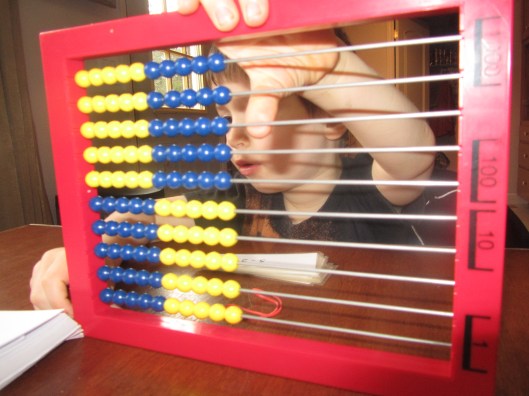
Today I got to introduce my five-year-old to “one-thousand”.  Place value may not seem that exciting to adults, but when you’re five, and you’re the little guy, it’s pretty exhilarating to finally feel like you are catching up with your big brother.  After the concepts were introduced, one of the exercises was to write in his math journal “5000 dogs”, “8000 pigs”, “3000 cats”, etc.  This little man is just beginning reading lessons, and we’ve been stuck pretty much at the beginning.  He often forgets his letters and their sounds, and the idea that sounds, once identified, can be blended together to form words has been pretty much lost on him.

But today…

I helped him say each sound of each word in turn, then write the correct letter.  He actually guessed the letters correctly most of the time.  Then we worked on sounding out the words he’d written.  He blended sounds together rather painlessly for the first time ever!

We were both thrilled!

He happily copied his name and the words “can read!” right next to where I had written them on his paper.  A math lesson turned into our most successful reading lesson yet!

We were so excited and felt so full that it seemed silly to do anything more!  In the past, if we had made some progress on reading I would have thought “more is better” and pressed on to do the next lesson–or at least tried to re-focus us on finishing the math lesson.  But today I realized that the joy of learning is the ultimate goal.  And I saw very clearly how pushing for more would have ruined the moment for both me and my son.

It made me wonder:  How often has my son had a “moment” in his learning, but I didn’t detect it?  How often have I squelched his joy in learning by trying to move ahead too quickly?

With my oldest’s recent painful math lessons, I saw how my desire to “finish this today” and “check off a box and move on” over the past several months has done him a disservice.  We would have done much better to have played more games by insisting on less arbitrary “progress”.  Behold, the negative effects of ignoring Charlotte Mason’s concept of short lessons.

Once I got around to my second-born, I was ready to put the rubber to the road, and we had the incredibly awesome experience of seeing the joy of learning spill over into the rest of the day because we didn’t bury it in any more school work.

Less is more.  Especially when you’re five.  And maybe even in your thirties, but that’s another post for another day.

We are forging ahead, but our destination is now a more distant consideration.  Stopping to smell the proverbial roses along the way is now on my list of “objectives”.

I have learned today that I am teaching a child, my child–not a subject or a curriculum.  I’ve heard others say that before, but now I own it by experience.

Any other teachers or homeschool mamas out there?  Have you had this “a-ha” moment, too?  If you’re into Charlotte Mason’s philosophies, how has implementing the principle of short lessons helped you and your students?

Books Read 2015-2016

15 Thursday Sep 2016

Posted by Lauren Scott in Books

≈ 2 Comments

Tags

Books, Bradley Method, childbirth, CS Lewis, devotional, Elisabeth Elliot, homeschooling, Laura Ingalls Wilder, Little House, micro book reviews, My Utmost for His Highest, Oswald Chambers, Own Your Life, Story of the World, Susan Wise Bauer, Suzanne Collins, The Hunger Games, Unbroken, Valley of Vision

This post contains affiliate links. If you make a purchase through one of these links, I may receive a commission at no additional cost to you. 

I’m a little late in posting this, but here are the books I’ve enjoyed over the past year (June to July).  I hope you’ll enjoy some of them, too.

Embracing Obscurity by Anonymous  No, this isn’t a book written by the infamous group Anonymous, it’s a book written by a Christian author who decided to practice what they preach.  I found this to be a great read, challenging the pride and selfish ambition that I wrestle with from time to time.  A great read for any disciple of Jesus, but perhaps especially for those in or pursuing some form of leadership.  I heartily recommend it.

Own Your Life by Sally Clarkson  Do not come to this book expecting a Bible Study.  It is most definitely a self-help book.  If you come expecting something along the lines of John MacArthur, you will be disappointed.  If you come expecting the fluff and gospel-neglect of Joel Osteen, you will be very, very pleasantly surprised by the God-glorifying, scripture-filled content that Sally brings.  I don’t mean this as criticism, but since many of my friends are in Christian circles that prefer books that read like bible studies and may have an aversion to self-help books, I’m trying to give you a perspective from which to approach this book and really appreciate it for what it is.  Sally makes many assertions that are more philosophical than they are directly backed up by scripture.  She herself writes much more like a philosopher than like a Bible teacher.  She borrows a lot of language from the current self-care trend.  This may be a bother to some, even a concern, but the central message of the book and its emphasis on taking responsibility while simultaneously trusting everything to the Lord is indeed a rock-solid exhortation.  So, if you need the encouragement and inspiration, this is a great book.  Just don’t treat it like scripture (not that you should treat any work by fallen man as such).  I feel blessed to have happened to enjoy this book while simultaneously reading Embracing Obscurity, reviewed above, which I believe balances the message of this book quite well.  In fact, I would recommend that you read them together so that you can hold in tension Sally’s idea of “dreaming dreams for the glory of God” with Embracing Obscurity’s challenge to make sure we are building God’s kingdom and not our own.  Really, reading these two books together is a win-win situation, in my opinion.

Unbroken: A World War II Story of Survival, Resilience, and Redemption by Laura Hillenbrand  When I attended my ten year high school reunion a few years ago, one of my former classmates recommended this book to me.  I wasn’t disappointed.  This riveting true story follows Louis Zamperini from his troublesome youth, to the 1936 Olympic Games in Germany, to a fateful flight over the Pacific in WWII.  As a Japanese POW Louie is completely broken—or is he?  Read this book.  If you think you know the story because you watched the movie, you really have missed so much.  Read this book.  It will move you to the core.

The Silver Chair, The Magician’s Nephew, and The Last Battle by CS Lewis  I finally finished the Chronicles of Narnia this year!  Not much else to say except that these were a lot of fun to read and quite encouraging and thought provoking.

Paddle to the Sea by Holling C. Holling  This was on several homeschool booklists, so it caught my attention.  Paddle is a picture book following the adventures of a boy’s wood-carved model canoe as it journeys through the Great Lakes and out to sea.  My boys loved it and picked up quite a bit of geography.

Assistant Coach’s Manual  by Susan Bek  I’ve had the privilege of attending two births as a doula in the past eighteen months, and Lord willing I will get to attend another within the week.  I benefited greatly from taking classes in the Bradley Method of Natural Childbirth to prepare for the birth of my two sons.  I found the training and support invaluable.  One day I may pursue certification as a class instructor and doula, but for now I’m staying up on the subject through reading and supporting some of my friends as they welcome their children into the world.  Thus, this book.  It is a great resource for those coming alongside a woman and her husband who are using the Bradley Method.  It is an “assistant coach’s” manual because the husband is to be his wife’s primary coach.

Farmer Boy by Laura Ingalls Wilder  In my listening to podcasts from the Circe Institute, I jotted down a mental note when David Kern recommended introducing little boys to the Little House series with Farmer Boy because it follows the boyhood story of Almanzo Wilder and is replete with descriptions of rich, enticing farm food.  Hat tip to Mr. Kern for the excellent recommendation.  My boys were sucked into the whole series after we listened to Farmer Boy on audio from our library.

Keep a Quiet Heart by Elisabeth Elliot  I have come back to this book again and again for refreshment and encouragement–and let’s face it, tough love.  Elisabeth Elliot brings timeless wisdom to the struggles women face.  Timeless, of course, because her thoughts are so saturated by the word of God.

CS Lewis on Joy  This wasn’t a book written by CS Lewis as much as it was a collection of excerpts from several of his works, all relating to the subject of joy, and all packaged neatly into a coffee-table-ready little book complete with classical artwork.  Can’t say I’d recommend it, because all it really did was make me want to read more of Lewis’s works in their entirety, but I did enjoy it.  Not bad for a quarter at a garage sale anyway.

For the Children’s Sake by Susan Shcaeffer Macaulay  It’s no secret on this blog that our family homeschools, and it’s no secret in the world of Charlotte Mason homeschooling that For the Children’s Sake is a classic.  I think my mother-in-law read it when my husband was little.  My mom gave it to me for Christmas this year since it was on my wish list, so I gave it a read for the first time this winter.  So much of it clicked with me.  I even started up a Schole Sisters group with a few local homeschool moms this spring, and Macaulay’s book is the first one we’re reading together (which means I’m reading it for a second time now).  A friend of mine has already written an excellent review here.

The Hunger Games, Catching Fire, and Mockingjay by Suzanne Collins  This was my second pass through this trilogy, and I did it in a week.  I didn’t have quite the same sense of PTSD at the end of Mockingjay that I did the first time I read it (that entire novel in one night).  This story and its characters and themes stick with me.  And for good reason—these are themes and characters that have compelled human interest for millennia.  This is not just another young adult series.  I think these books will stand the test of time.  If you’ve read them before but missed the rich historical and literary allusions, why not pick them up again and see them with new eyes?

Little House in the Big Woods by Laura Ingalls Wilder  I think I read this back in third grade, but this year I read it aloud to my boys.  A fun read and a great way for kids to imagine life in the latter half of the 19th century.  My seven-year-old just picked it up to read it for himself this fall.

My Utmost for His Highest by Oswald Chambers and The Valley of Vision: A Collection of Puritan Prayers and Devotions edited by Arthur Bennett  These two books were my daily companions over the past year.  Chamber’s classic devotional was often times very edifying and sometimes simply something I read.  Many of his exhortations were challenging—to pray, to surrender completely to Christ, to love Him supremely.  Overall a great read, though some entries were simply a little too disconnected with the face value meaning of scripture for me to really “get” them.  On those days, I simply read and moved on.  One thing is for sure, by the time I finished a year of reading Chambers everyday, I was eager to simply read the Scriptures for myself.  I don’t mean this as a fault to Chambers—in fact it should be more to his credit for whetting my appetite for more of God’s word.  After all, man shall not live on devotionals alone, but on the very word of God.  In addition to Utmost, The Valley of Vision was a very encouraging guide in personal prayer and worship.  Many times I find I don’t have the words.  These puritan prayers helped me in the discipline of praising and depending upon the Lord, even when my flesh was weak and my mind would rather wander.  I will probably revisit this book in the future.

The Story of the World, Volume One:  Ancient Times by Susan Wise Bauer  This is another gem from our homeschool reading.  Our whole family has enjoyed this overview of ancient history written for elementary aged students.  We are reading through the four-volume series together, and then the plan is for our boys to read it a second time for themselves.  There are activity books available to flesh this out into a very full history curriculum, but for now we are simply enjoying them together and looking up the places we read about on our inflatable globe (the best kind of globe as far as little boys are concerned).

What have you been reading lately?  Have any recommendations for me?

Of Children and Angels: A Thought Experiment

14 Tuesday Jun 2016

Posted by Lauren Scott in Home and Family

≈ 1 Comment

Tags

children, children and angels, do not despise, love, meditations, motherhood, parenting, thought experiment

cherubs

Ditto by Raffael, public domain

Imagine with me, if you will, that your children are little cherubs instead of mere humans.  (I know, I know, this is an inaccurate view of both children and of angels, but bear with the thought experiment.)

Suppose your little cherubs, instead of being in your care every day and every night, were instead entrusted to your care only during the day, and you were to return them to their heavenly Father every evening.  What would they report to Him?

Would they climb up on His lap, throw their arms around Him and say, “Oh, Father, I had the most wonderful day!  This ‘mother’ you have given me is so kind!  She is so much like You!”

Or would the child perhaps say through a sniffle, “Oh, Father!  She yelled and yelled and yelled!  I wanted her to see my picture, but she was too busy.  I wanted her to play with me, but she had ‘work’ to do.  And when I cried, she yelled and scolded me even more.  Oh, I wish I could just be with You.”

Or perhaps, “Oh, Father, today was rough.  I disobeyed ‘mother’ and she spanked me.  She told me to talk to You about it, too.  I’m sorry.  She said she would talk to You, too, since she yelled when she didn’t want to.  I guess we both need You.  Will You help ‘mother’ and me to be more like You?”

Or perhaps, “Umm… Hi.  Do You really love me?  This woman who You gave me to isn’t very nice.  She says she loves you and that I should, too, but she ignores me, and when she doesn’t ignore me, she hits me.  And I don’t even know what I did wrong.  Are You even there?”

Point being:  If we could imagine the report our children would give to God each day were they to literally go and sit on His lap, how would that change the way we treat them?  And besides a report that could be given, how does our behavior coupled with our claims to follow Christ add up in their little heads?  Do we put a stumbling block in front of them?  Do we upset their faith by our lack of self-control?

Or do we, by both consistent love and consistent training (and confessing humility when it is–so often–needed), demonstrate the heart of the God who gave His own Son so that these precious little ones could someday call Him Father?

Now, the Bible is clear—children are not angels—angels are more like bright, shining, terrifying mighty-men than like the silly little cherub images that humanity has conjured up.  But Jesus does say in Matthew 18:10,

See that you do not despise one of these little ones, for I say to you that their angels in heaven continually see the face of My Father who is in heaven.

Directly preceding this verse is the exhortation to pluck out our eye or cut off our hand if it causes us to sin.  Do we take Jesus’ command to “not despise” our children this seriously?  What gets in the way of loving our children the way we ought?  Are we willing to part with whatever it is?  For their sake?  For the sake of the glory and gospel of Christ?  In the very fear of God?


← Older posts
Newer posts →
  • View KeptandKeeping’s profile on Facebook
  • View lauren.keptandkeeping’s profile on Instagram
  • View keptandkeeping’s profile on Pinterest
  • View @laurenscott.keptandkeeping’s profile on YouTube
Lauren Scott

Lauren Scott

Christian. Wife. Mother. Homemaker. Home Educator. Blogger. Book Addict. Outdoorist.

View Full Profile →

Enter your email address to follow Life Meets Jesus and receive notifications of new posts by email.

Affiliate Disclosure

We are a participant in the Amazon Services LLC Associates Program, an affiliate advertising program designed to provide a means for us to earn fees by linking to Amazon.com and affiliated sites.

Hands-on Math Curriculum

RightStart™ Mathematics

Check Out Prodigies Music Curriculum!

music curriculum sale

Quality Video Curriculum

Top Posts & Pages

  • Five Refreshing Scriptures for Finishing Strong when You Feel Weak and Weary
    Five Refreshing Scriptures for Finishing Strong when You Feel Weak and Weary
  • Wisdom in the Book of James
    Wisdom in the Book of James
  • Wise Women Build Up, Part One: Godly Wisdom
    Wise Women Build Up, Part One: Godly Wisdom

Advent April Fool's Day April Fools bible Book Review Books Books Charlotte Mason Charlotte Mason Homeschool children Christian Classical Education Christian Classical Homeschool Christian Homeschool Christian life Christian Parenting Christian Women Christmas Classical Education Classical Homeschool devotional education faith Guest Post Home and Family Home Education Homemaking homeschool encouragement homeschooling Jesus Living Books love marriage meditations micro book reviews motherhood Nature Nature Studies parenting poems poetry Practical Atheism Reading List Reflections Relationships trials

A WordPress.com Website.

  • Subscribe Subscribed
    • Kept and Keeping
    • Join 178 other subscribers
    • Already have a WordPress.com account? Log in now.
    • Kept and Keeping
    • Subscribe Subscribed
    • Sign up
    • Log in
    • Report this content
    • View site in Reader
    • Manage subscriptions
    • Collapse this bar
 

Loading Comments...