• Home
  • About
  • Living Faith
  • Home and Family
  • Home Education
  • Books
  • Recommended Resources
  • Media

Kept and Keeping

~ Rest in Grace, Labor in Love

Kept and Keeping

Tag Archives: homeschooling

Finding Cheap or FREE Resources for Bird Nature Study

25 Tuesday Jul 2017

Posted by Lauren Scott in Books, Home Education

≈ 5 Comments

Tags

Ambleside Online, Arkansas Birds, Birds, Books, Burgess Bird Book, children, Creation, education, Free Nature Study Resources, Handbook of Nature Study, homeschooling, Nature, Nature Studies

Amazon links are affiliate links, meaning that if you make a purchase through that link, I will earn a few pennies, nickels, and dimes.  I only link to products I would happily recommend even if no compensation were possible.  🙂 

DSC_0003 (2)

Our family doesn’t completely follow the Ambleside Online (AO) free curriculum, but we pull heavily from it for our book list, among many other things.

One of those other things is their Nature Study schedule.  If I want to pick a particular topic of nature study for us to focus on for a while, why not start with their suggested schedule and tweak it along the way, if need be?  This way there is less choice-fatigue for me and I can find some community around what we are studying, whether with other AO families I know in real life, on the AO forums, or on the Facebook group.

DSC_0005 (2)

This summer and fall is for the birds, so I’ve been doing a bit of research and collecting materials that will prepare me to assist and inform my children in their own observation and enjoyment of our feathered friends over the next several months.

I’ve seen a lot of materials for purchase on the interwebs, and many of them were quite tempting, but I wanted to see what was available to me for free before punching in credit card numbers.

First, I searched my own shelves. 

We already own the Handbook of Nature Study, which will serve us for many years and topics to come, making the purchase price slim over the long haul.

DSC_0008 (2)

Birds are covered on pages 27-143.  The pictures are not the most impressive, but this book is chock full of information so that you, the parent, can be a literally walking resource for you children on the trail.  Types of birds, parts of birds, migration of birds, lessons with suggested questions, pictures, diagrams, and even related poetry are included.  I plan to read this section for my own knowledge and make a few notes on particular questions or topics to raise while I’m out with the kids.

Remember, the purpose of Nature Study is to get the child in touch with the world and creatures God has made and to enjoy it.  The Handbook of Nature Study is NOT a textbook of information you have to cram into your precious children’s little heads.  It’s a tool to aid the work of observation that the kids ought to be doing and delighting in on their own.

I found another volume that I may reference over the next few months:  Living with Wildlife: How to Enjoy, Cope with, and Protect North America’s Wild Creatures Around Your Home and Theirs.  I don’t think there’s much to say about this book now since the title is so descriptive!  We found this gem at a library cast-off sale for probably about 50 cents.

DSC_0013 (2)

The point here isn’t so much that any of you need THIS book, but that if you keep your eyes open, you may find something similar.  If I didn’t have the Handbook of Nature Study, this book (or some other like it) would suffice quite nicely.  Birds are covered on pages 180-252, if any of you by chance come across this guide or find it at your library.  There aren’t so many pictures or diagrams, and it’s not aimed at teachers or parents to instruct their children, but the information is valuable and would do the trick of providing a parent with both a general and some specific knowledge of birds.

My oldest has read many chapters in The Burgess Bird Book for Children, one of the great selections found on the AO booklist.

DSC_0010 (2)

It’s a narrative introduction to all kinds of birds, with animals talking and acting consistent with their particular habits and personalities.  Each chapter covers a different bird, and we may just read one here and there for fun if we’re interested.

My mom gave us a laminated Pocket Naturalist Guide of Arkansas Birds for Christmas several years ago.  This guide isn’t particularly detailed, but it does provide color pictures of a variety of birds, including their Latin names, size, and an occasional special note.  Listed on the back are bird viewing areas and sanctuaries, as well as a state regional map.

DSC_0014 (2)
DSC_0015 (2)

For very young children, a laminated field guide is almost a necessity!  Even when they can’t read, they love feeling like real explorers with a guide in their pack that they can pull out at will.  And you as the parent love feeling like it won’t be destroyed on the first expedition!  If you don’t live in Arkansas, you can look up the Pocket Naturalist field guide for birds in your state.

Even just one or two of the above resources is more than enough to get started with nature study.  Actually, all you really need to do to get started is step outside and pay attention, and maybe take along a notebook and a pencil!  But we’ve been at this for several years now and I wanted to add to our resource collection (and convince myself that I didn’t need to buy anything new or shiny in order to do so).

So…where did I go for new FREE resources? 

I went online.

Many of the paid resources I’ve seen lately were all ebooks and video courses anyway, so I thought I’d search in the same format–starting with websites specific to my home state of Arkansas.

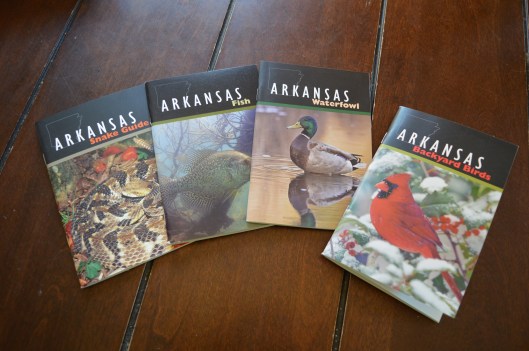
The Audubon Society of Arkansas and the Arkansas Game and Fish Commission have a wealth of free resources for studying birds, among many other kinds of wildlife!  There’s a searchable database where you can find pictures, details, and songs of birds when you search by color, size, habitat, and more.  The Game and Fish Commission provides free printable brochures on birds and so much more, but they will also send you a hard copy for free if you send them your mailing address!

DSC_0016 (2)
DSC_0017 (2)

If you’re outside of Arkansas, check out the corresponding organizations for your state.
DSC_0019

All I asked for was the Arkansas Backyard Birds booklet, but they sent the other three as well!  I suppose they figured someone like me would eventually ask for more booklets and they could save on shipping by sending them all at once.

There are two more ways I’d like to complement our focus on birds, and both can be achieved without spending a dime.

I’d like us to improve our artistic abilities in the area of drawing birds, so that our nature journal entries can better represent what we see out in the field.  Enter YouTube.  There are TONS of FREE video tutorials to help us hone our skills.  I think we’ll get a start with watercolor painting a saucy little wren like the ones we see every day around our house.

Finally, one of the greatest gifts I can imagine giving my children when it comes to nature study is to tie God’s truth to what they see.  The heavens are declaring the glory of God, and I want them to see it.  I just read the Sermon on the Mount this morning, and I think we’ll incorporate Matthew 6:26 into our memory work as we observe the winged creatures around us:

Look at the birds of the air, that they do not sow, nor reap nor gather into barns, and yet your heavenly Father feeds them. Are you not worth much more than they?

I hope this has been helpful to you, my friends.

Do you have any other super awesome free resources for bird nature study?  If you’ve studied birds already with your kids, what did your family enjoy most?

Five Things: “Special Events”

05 Friday May 2017

Posted by Lauren Scott in Home and Family, Home Education

≈ 2 Comments

Tags

children, engagement, homeschooling, marriage, motherhood, Nature, pink eye remedy, Scholé Sisters, Special Events, The Friday Five

Here’s some of what we’ve been up to lately:

  1. My boys recently participated in their first musical stage play, “No Strings Attached: The Musical Adventures of Pinocchio.”  They had a fantastic time playing 19th-century school boys, donkeys, a marionette, and singing fish.  They were the youngest in the production, so the five-hour-long dress rehearsal was pretty exhausting for them (and their parents), but they absolutely had a blast.  IMG_0001 (2)
    When the last performance was over, our five-year-old shed a few tears.  I assured him that he would have the opportunity to be in another play sometime, but he was quite upset that it would likely not be Pinocchio again.  “I like THIS play!”
    He later had a dream that they did the play again, and he reported the following morning with a beaming smile, “It was the most wonderful dream!”
  2. Pink eye isn’t exactly the kind of visitor that you usually want to celebrate as a “special event,” but it’s been a guest at our house for a couple weeks this spring so it’s at least worth a mention.  We’ve had pretty good luck getting rid of it by mixing a 1/2 teaspoon boric acid in one cup boiled water.  001Once it has completely cooled, you can place a few drops into each eye.  We had our kiddos lay down on a table and close their eyes while we dripped a bit of the water onto each eye near the tear duct.  Then they could open their eyes so that the water could come in.  This is way easier than holding a spoon over open and very frightened eyes.
  3. I invited my local Scholé Sisters group over for a Nature Study Day at our place. DSC_0101 We live on seven mostly-treed acres, have a creek running through our property, and last fall seeded a part of our land for wildflowers.  We feel so blessed to have such a lovely slice of creation right outside our door, and it was so much fun to share it with friends!  DSC_0110We identified trees and flowers, had a picnic lunch, and the kids spent the rest of the time playing in the creek.  DSC_0142.JPGHaving other curious moms around with their various field guides also meant that we now know a little bit more about what’s growing on our land than we did before.
  4. We also had our last day of co-op classes a week ago.  In the first hour, my youngest got a cookie in his Hands-on-Science class, and my oldest enjoyed a cupcake complete with his own personally-decorated edible stamp for his Stamping Through History class.  As if that weren’t enough of an end-of-year celebration, the much-anticipated Book Club Party awaited them after recess.  Each family was to choose a favorite book and bring a snack and an activity to share with the whole elementary group.  We settled on Stuart Little the morning of, and I like to think our little table-top presentation turned out alright considering the high level of procrastination.  laurens-phone-5-2017-271.jpgAfter so much excitement the kids fell fast asleep in the van while I ran errands.
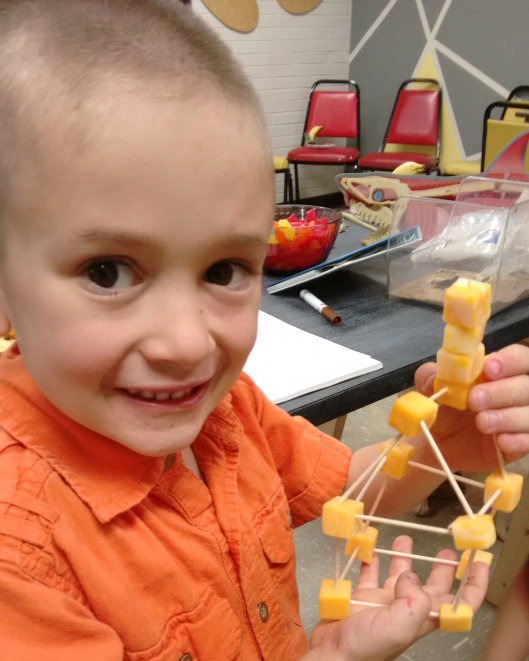
    Unfortunately when we got to the library and I actually had to get out of the van and take the kids with me, my little guy didn’t wake up happy and said he didn’t feel that well.  I knew we only needed to go inside for five minutes, so I carried him–the five-year-old on my right arm, purse and bag of books on my left.  Well, that did it, apparently.  Just as we stepped up to the front door of the public library the poor little man puked all over my left side.  And my purse.  And on the bag of books.  And all over the steps.

    Lauren's Phone 5-2017 284

    Maybe eating all those cheese cubes after an equally large amount of sugary treats wasn’t such a good idea after all.

    Again, I wouldn’t normally consider sharing a puke story as part of a “special event,” but how often do I get to be “that mom” with the sick kid who just made a horrid mess for everyone else to walk through?  I’m at least hoping this was a “special” occasion–and not a new norm.
    And, when I think about it, I am so incredibly thankful that the mess happened outside where a kind man washed it off with a few buckets of water.  A few more steps and it would have been inside the library itself: on the carpet, smelling up the whole place for who-knows-how-long.  Or it could have happened in the van.  God was merciful.  And I was thankful.  With no fever and the sick feeling lasting only about six hours, I also thanked the Lord that this was apparently just a response to way too much junk food and not a virus.
    Our last day of co-op sure was fun–a real blowout!

  5. This isn’t a last-but-not-least kind of #5.  No, this is a save-the-best-for-last #5.  Ten years ago today it was Saturday.  I was studying for the last finals week of my senior year of college.  Later that afternoon, I played paintball with a few friends, including this guy named Nathaniel.  After the game we all returned to campus and discussed dinner plans.  My dad had told me to go to a local Italian restaurant to try a few dishes so he could plan for an after-graduation lunch for our family and close friends when they would all be up for the ceremony the following weekend, so I lamented that I wouldn’t be joining the group for dinner.  Nathaniel said he had a project to work on.  We all parted ways.
    But an hour later Nathaniel asked if he could borrow my camera for this project of his.  I obliged.
    After cleaning up for the evening, I grabbed some books to study at a local coffee shop after dinner and headed to the restaurant.  I asked for the manager, just as my dad had instructed, and she curiously led me to a table in the back.  A table set for two.  A table where a cleaned-up Nathaniel sat with his Bible open to the verse that says, “He who finds a wife finds a good thing…”
    After a few nervous words and a question from him, I said, “Yes.”  And he said he loved me for the first time.  He pulled out a ring and my camera.A “project”, huh?!?
    If I had known what his "project" was, I would have probably worn some make-up. ;-)
    If I had known what his “project” was, I would have probably worn some make-up. 😉
    IMG_1605

How about you?  Any special happenings or celebrations lately?  Any “special” visitors or messes?

Books Read in 2016–The Wrap-up

31 Tuesday Jan 2017

Posted by Lauren Scott in Books

≈ 1 Comment

Tags

Books, children, education, homeschooling, micro book reviews, Reading List

This post contains affiliate links. If you make a purchase through one of these links, I may receive a commission at no additional cost to you. 

wp-1485921038498.jpg

In past years I have shared the books I’ve read based on an academic calendar, because when I started recording what I was reading I was using a planner that followed that format.  I’ve since decided it makes more sense to post my micro book reviews as a round up of all the books I’ve read in a calendar year.

Which brings me to this post.  The transition had to happen sometime, and it’s happening now.  So, without further adieu, I give you the books I’ve read in the latter half of 2016.  If you’d like to see the eight other books I read in 2016, they are at the bottom of my 2015-2016 post.

Pride and Prejudice by Jane Austin  I made the mistake, dare I say, of picking up this novel around 4 o’clock one afternoon when I heard that it would soon be discussed on the Circe Institute’s Close Reads podcast; and, since my husband was traveling and would not be home that evening, had the opportunity (and by compulsion took it) to read the entire thing in one night.  Once upon a time five or more years ago I had tried to read Pride and Prejudice, but found it to be nothing more than the screenplay of the A&E film version of the story, so I didn’t make it more than a few chapters before I felt there was no need of reading it.  Having not seen the movie adaptation in several years, when I picked it up this time the banter and character development of the film which was even more prevalent in the book drew me in at once.  As Miss Elizabeth Bennet learned, so have I:  some things, upon second evaluation, are found to have much more merit than we may judge them to have at the first.  Plainly stated:  I very much enjoyed this book and regretted having not read it in its entirety much sooner.  (The article that provoked my reading was “Don’t Follow Your Heart”.  I highly recommend it and the podcast discussion of the novel.  It was great fun!)

Courtesy in Christ: An Ettiquette Handbook for Christian Teens by Diane Pickup  I found this on our shelf one day and my curiosity got the best of me.  I have little boys, so training them in courtesy is on my bucket list for them.  I enjoyed how the author tied acts of courtesy and consideration to scriptural attitudes and commands to put the needs of others before our own.

The Wind in the Willows by Kenneth Grahame Listening to the Close Reads podcast also led me to this interesting read.  It’s a children’s story, but not just a children’s story.  Some of the vocabulary is very challenging for a children’s book (or for the adult reader, if I’m honest).  But I enjoyed the challenge of figuring out new words as I followed the wanderings of Mole and Ratty and the mischievous escapades of their foolish friend Toad.  The discussion on Close Reads explored similarities between The Wind in the Willows and The Hobbit, The Illiad, and even Shakespeare.  Grahame’s skill in writing and thematic depth make this a thoughtful book for adults, and maybe especially young adults ready to leave home for the first time but who find themselves longing for it once they’re gone.  I do have a major caveat, however:  chapter seven “The Piper at the Gates of Dawn” involves Mole and Rat finding a lost little friend with the pagan deity Pan—and they worship him.  While I think some generalized lessons can be drawn from this chapter with its wonder and awe, and while I think that it’s placement by Grahame in the center of the book is perhaps significant, the rest of the story line can be enjoyed without it.  My husband and I agree that there is so much wealth of children’s literature out there that we don’t feel any urgent need for our children to read The Wind in the Willows.  If we do read it out loud as a family while our children are young, we will skip chapter seven.  Most likely, however, we may save this as a fun return to childish anthropomorphism when our boys are in their late teens, where the themes may be particularly meaningful and when our boys could take on chapter seven as an exercise in practicing discernment.

Pinocchio by Carlo Collodi  On a much lighter note, we listened to the audio version of this classic on a road trip this year.  Our boys, 4 and 6 at the time, gobbled it up!  What does it mean to be a real boy?  What are the consequences of having your own way and ignoring those who give you wise counsel?  These questions are addressed in a very outrageously funny, though sometimes violent story.  I highly recommend this story, though parents should consider the age-appropriateness of some of the darker elements (Pinocchio kills the cricket, a cat’s paw is bitten off, Pinocchio is hung by his neck from a tree, etc).  For our kids, these were effectively shocking—they grabbed the attention—without causing any bad dreams or inspiring violent play.

Little House on the Prairie by Laura Ingalls Wilder  We read Little House in the Big Woods in the first half of 2016, so naturally we moved on to the next in the series.  We enjoyed following Laura’s family as they traveled to Kansas and set up their home and everything they needed from scratch.  We all gained some perspective from imagining a life in which all of your family’s belongings fit on a simple covered wagon.  And since we live in the country, there have been ample connections for us to make—they set up a garden, and we started our first garden last year; they had to dig a trench in order to protect their home from a prairie fire, and we have discussed fire safety measures like that as well. All in all, this is a series that no child should miss.

What was your favorite read from 2016?  What’s on your list for this year? 

Embracing Short Lessons

27 Tuesday Sep 2016

Posted by Lauren Scott in Home Education

≈ 2 Comments

Tags

Charlotte Mason, children, Children are born persons, education, For the Children's Sake, homeschooling, motherhood, Right Start Math, Short Lessons, Struggling Learner, Teaching Math, Teaching Reading

I had an a-ha moment today.

And who would have thought that it would come from two very different experiences happening on the same day?

195

I’ve posted before about the initial struggles I had with our math curriculum.  Since that first-year learning curve, it’s been pretty smooth sailing.  Until this week.

Our curriculum made some huge leaps this week, as far as I’m concerned.  My oldest son struggled with two separate lessons that took his addition skills and subtraction skills up a few notches.  And by a few notches, I mean like FIVE.  There were some tears, and I decided to split his work for one lesson over two days.  “Short lessons” is one of many principles of education promoted by Charlotte Mason, a British educator at the turn of the 20th century, whose methods I have been reading about in For the Children’s Sake.

We would revisit his worksheet tomorrow, I said. In the mean time, I did some digging.

Looking back over our lessons, I realized that while the jump in addition may simply be larger than I agree is appropriate (at least for a child who is young-for-grade-level), the leap in subtraction was mostly difficult for two reasons:

  1. I didn’t exactly understand what I was to be teaching, since it is something that simply isn’t taught in a traditional approach to elementary math (let me know if any of you are used to learning to mentally subtract two-digit numbers with borrowing BEFORE learning the pencil-and-paper algorithm, k?).  Once I did MY homework, however, and began to really understand the strategies for myself, I realized that I had made things more complicated than they were intended to be. 
  2. The curriculum did not focus on subtraction for nearly 30 lessons!  Sure, there was occasional practice in a warm up or on a review sheet, but the concepts were not discussed in the slightest.  I had to realize that the lessons alone were NOT sufficient to prepare my son for the challenge of mental subtraction with borrowing.  But, as I examined my text book, they weren’t intended to.  Our curriculum, you see, is more than lessons–it includes many suggested math games and facts practice sheets.  The lessons introduce new material.  The games provide the bulk of the practice.  But we rarely played the games if they weren’t already included in a lesson’s activities.

My conclusion from this negative experience is that I’ve been too focused on getting to the next lesson.  Or to the next child on a given day.  My son is slow to get his work done, so we’ve not had time leftover for games.  Instead of seeing that as a hint to slow down, take a day off for a “Game Day”, and build the skills that would help him work faster, I’ve plowed forward, getting us further in the book but not necessarily further in skills and understanding.

As all of that was sinking in this morning, I had the pleasure of a very positive experience with my younger son.

Today I got to introduce my five-year-old to “one-thousand”.  Place value may not seem that exciting to adults, but when you’re five, and you’re the little guy, it’s pretty exhilarating to finally feel like you are catching up with your big brother.  After the concepts were introduced, one of the exercises was to write in his math journal “5000 dogs”, “8000 pigs”, “3000 cats”, etc.  This little man is just beginning reading lessons, and we’ve been stuck pretty much at the beginning.  He often forgets his letters and their sounds, and the idea that sounds, once identified, can be blended together to form words has been pretty much lost on him.

But today…

I helped him say each sound of each word in turn, then write the correct letter.  He actually guessed the letters correctly most of the time.  Then we worked on sounding out the words he’d written.  He blended sounds together rather painlessly for the first time ever!

We were both thrilled!

He happily copied his name and the words “can read!” right next to where I had written them on his paper.  A math lesson turned into our most successful reading lesson yet!

We were so excited and felt so full that it seemed silly to do anything more!  In the past, if we had made some progress on reading I would have thought “more is better” and pressed on to do the next lesson–or at least tried to re-focus us on finishing the math lesson.  But today I realized that the joy of learning is the ultimate goal.  And I saw very clearly how pushing for more would have ruined the moment for both me and my son.

It made me wonder:  How often has my son had a “moment” in his learning, but I didn’t detect it?  How often have I squelched his joy in learning by trying to move ahead too quickly?

With my oldest’s recent painful math lessons, I saw how my desire to “finish this today” and “check off a box and move on” over the past several months has done him a disservice.  We would have done much better to have played more games by insisting on less arbitrary “progress”.  Behold, the negative effects of ignoring Charlotte Mason’s concept of short lessons.

Once I got around to my second-born, I was ready to put the rubber to the road, and we had the incredibly awesome experience of seeing the joy of learning spill over into the rest of the day because we didn’t bury it in any more school work.

Less is more.  Especially when you’re five.  And maybe even in your thirties, but that’s another post for another day.

We are forging ahead, but our destination is now a more distant consideration.  Stopping to smell the proverbial roses along the way is now on my list of “objectives”.

I have learned today that I am teaching a child, my child–not a subject or a curriculum.  I’ve heard others say that before, but now I own it by experience.

Any other teachers or homeschool mamas out there?  Have you had this “a-ha” moment, too?  If you’re into Charlotte Mason’s philosophies, how has implementing the principle of short lessons helped you and your students?

Books Read 2015-2016

15 Thursday Sep 2016

Posted by Lauren Scott in Books

≈ 2 Comments

Tags

Books, Bradley Method, childbirth, CS Lewis, devotional, Elisabeth Elliot, homeschooling, Laura Ingalls Wilder, Little House, micro book reviews, My Utmost for His Highest, Oswald Chambers, Own Your Life, Story of the World, Susan Wise Bauer, Suzanne Collins, The Hunger Games, Unbroken, Valley of Vision

This post contains affiliate links. If you make a purchase through one of these links, I may receive a commission at no additional cost to you. 

I’m a little late in posting this, but here are the books I’ve enjoyed over the past year (June to July).  I hope you’ll enjoy some of them, too.

Embracing Obscurity by Anonymous  No, this isn’t a book written by the infamous group Anonymous, it’s a book written by a Christian author who decided to practice what they preach.  I found this to be a great read, challenging the pride and selfish ambition that I wrestle with from time to time.  A great read for any disciple of Jesus, but perhaps especially for those in or pursuing some form of leadership.  I heartily recommend it.

Own Your Life by Sally Clarkson  Do not come to this book expecting a Bible Study.  It is most definitely a self-help book.  If you come expecting something along the lines of John MacArthur, you will be disappointed.  If you come expecting the fluff and gospel-neglect of Joel Osteen, you will be very, very pleasantly surprised by the God-glorifying, scripture-filled content that Sally brings.  I don’t mean this as criticism, but since many of my friends are in Christian circles that prefer books that read like bible studies and may have an aversion to self-help books, I’m trying to give you a perspective from which to approach this book and really appreciate it for what it is.  Sally makes many assertions that are more philosophical than they are directly backed up by scripture.  She herself writes much more like a philosopher than like a Bible teacher.  She borrows a lot of language from the current self-care trend.  This may be a bother to some, even a concern, but the central message of the book and its emphasis on taking responsibility while simultaneously trusting everything to the Lord is indeed a rock-solid exhortation.  So, if you need the encouragement and inspiration, this is a great book.  Just don’t treat it like scripture (not that you should treat any work by fallen man as such).  I feel blessed to have happened to enjoy this book while simultaneously reading Embracing Obscurity, reviewed above, which I believe balances the message of this book quite well.  In fact, I would recommend that you read them together so that you can hold in tension Sally’s idea of “dreaming dreams for the glory of God” with Embracing Obscurity’s challenge to make sure we are building God’s kingdom and not our own.  Really, reading these two books together is a win-win situation, in my opinion.

Unbroken: A World War II Story of Survival, Resilience, and Redemption by Laura Hillenbrand  When I attended my ten year high school reunion a few years ago, one of my former classmates recommended this book to me.  I wasn’t disappointed.  This riveting true story follows Louis Zamperini from his troublesome youth, to the 1936 Olympic Games in Germany, to a fateful flight over the Pacific in WWII.  As a Japanese POW Louie is completely broken—or is he?  Read this book.  If you think you know the story because you watched the movie, you really have missed so much.  Read this book.  It will move you to the core.

The Silver Chair, The Magician’s Nephew, and The Last Battle by CS Lewis  I finally finished the Chronicles of Narnia this year!  Not much else to say except that these were a lot of fun to read and quite encouraging and thought provoking.

Paddle to the Sea by Holling C. Holling  This was on several homeschool booklists, so it caught my attention.  Paddle is a picture book following the adventures of a boy’s wood-carved model canoe as it journeys through the Great Lakes and out to sea.  My boys loved it and picked up quite a bit of geography.

Assistant Coach’s Manual  by Susan Bek  I’ve had the privilege of attending two births as a doula in the past eighteen months, and Lord willing I will get to attend another within the week.  I benefited greatly from taking classes in the Bradley Method of Natural Childbirth to prepare for the birth of my two sons.  I found the training and support invaluable.  One day I may pursue certification as a class instructor and doula, but for now I’m staying up on the subject through reading and supporting some of my friends as they welcome their children into the world.  Thus, this book.  It is a great resource for those coming alongside a woman and her husband who are using the Bradley Method.  It is an “assistant coach’s” manual because the husband is to be his wife’s primary coach.

Farmer Boy by Laura Ingalls Wilder  In my listening to podcasts from the Circe Institute, I jotted down a mental note when David Kern recommended introducing little boys to the Little House series with Farmer Boy because it follows the boyhood story of Almanzo Wilder and is replete with descriptions of rich, enticing farm food.  Hat tip to Mr. Kern for the excellent recommendation.  My boys were sucked into the whole series after we listened to Farmer Boy on audio from our library.

Keep a Quiet Heart by Elisabeth Elliot  I have come back to this book again and again for refreshment and encouragement–and let’s face it, tough love.  Elisabeth Elliot brings timeless wisdom to the struggles women face.  Timeless, of course, because her thoughts are so saturated by the word of God.

CS Lewis on Joy  This wasn’t a book written by CS Lewis as much as it was a collection of excerpts from several of his works, all relating to the subject of joy, and all packaged neatly into a coffee-table-ready little book complete with classical artwork.  Can’t say I’d recommend it, because all it really did was make me want to read more of Lewis’s works in their entirety, but I did enjoy it.  Not bad for a quarter at a garage sale anyway.

For the Children’s Sake by Susan Shcaeffer Macaulay  It’s no secret on this blog that our family homeschools, and it’s no secret in the world of Charlotte Mason homeschooling that For the Children’s Sake is a classic.  I think my mother-in-law read it when my husband was little.  My mom gave it to me for Christmas this year since it was on my wish list, so I gave it a read for the first time this winter.  So much of it clicked with me.  I even started up a Schole Sisters group with a few local homeschool moms this spring, and Macaulay’s book is the first one we’re reading together (which means I’m reading it for a second time now).  A friend of mine has already written an excellent review here.

The Hunger Games, Catching Fire, and Mockingjay by Suzanne Collins  This was my second pass through this trilogy, and I did it in a week.  I didn’t have quite the same sense of PTSD at the end of Mockingjay that I did the first time I read it (that entire novel in one night).  This story and its characters and themes stick with me.  And for good reason—these are themes and characters that have compelled human interest for millennia.  This is not just another young adult series.  I think these books will stand the test of time.  If you’ve read them before but missed the rich historical and literary allusions, why not pick them up again and see them with new eyes?

Little House in the Big Woods by Laura Ingalls Wilder  I think I read this back in third grade, but this year I read it aloud to my boys.  A fun read and a great way for kids to imagine life in the latter half of the 19th century.  My seven-year-old just picked it up to read it for himself this fall.

My Utmost for His Highest by Oswald Chambers and The Valley of Vision: A Collection of Puritan Prayers and Devotions edited by Arthur Bennett  These two books were my daily companions over the past year.  Chamber’s classic devotional was often times very edifying and sometimes simply something I read.  Many of his exhortations were challenging—to pray, to surrender completely to Christ, to love Him supremely.  Overall a great read, though some entries were simply a little too disconnected with the face value meaning of scripture for me to really “get” them.  On those days, I simply read and moved on.  One thing is for sure, by the time I finished a year of reading Chambers everyday, I was eager to simply read the Scriptures for myself.  I don’t mean this as a fault to Chambers—in fact it should be more to his credit for whetting my appetite for more of God’s word.  After all, man shall not live on devotionals alone, but on the very word of God.  In addition to Utmost, The Valley of Vision was a very encouraging guide in personal prayer and worship.  Many times I find I don’t have the words.  These puritan prayers helped me in the discipline of praising and depending upon the Lord, even when my flesh was weak and my mind would rather wander.  I will probably revisit this book in the future.

The Story of the World, Volume One:  Ancient Times by Susan Wise Bauer  This is another gem from our homeschool reading.  Our whole family has enjoyed this overview of ancient history written for elementary aged students.  We are reading through the four-volume series together, and then the plan is for our boys to read it a second time for themselves.  There are activity books available to flesh this out into a very full history curriculum, but for now we are simply enjoying them together and looking up the places we read about on our inflatable globe (the best kind of globe as far as little boys are concerned).

What have you been reading lately?  Have any recommendations for me?

Things I’ve Learned in Our First Year of Homeschooling

19 Friday Jun 2015

Posted by Lauren Scott in Home Education

≈ 5 Comments

Tags

education, expectations, faithfulness, homeschooling, math, sanctification

My husband and I each knew we’d homeschool our kids before we ever met and married. And while in one sense you could say we’ve been “homeschooling” all along since our first child was born, it has only been this past year—when my oldest turned five—that we have “officially” begun to get our feet wet with more intentional schooling. Having looked forward to teaching my children at home for many years, I felt quite confident and had certain high expectations. Below, I reveal how it all has panned out.193

Things I’ve Learned in Our First Year of Homeschooling:

Homeschooling is both easy and hard. It is both delightfully fun and, at times, painfully stressful. It seems it is like any other worthwhile pursuit. It takes time.   It takes work. Blood, sweat, and tears. And prayer—lots and lots of prayer. I knew it would be work, but now I know it is work!

Daily discipline is probably the hardest thing. We don’t exactly at this point have our days perfectly laid out. I don’t even have our meals ready at the same time each day (working on that)! But this work is worth it, and I know the discipline will come in time, with practice. That’s essentially what discipline is, isn’t it? Practicing the right things over and over and over. Training (myself, in this case) to do what is right and to do it at the appropriate time. I’m learning right along with my kids.

I have so much more respect and appreciation for classroom teachers. I volunteered to teach a Spanish class for our homeschool co-op. I only had a class of about 14 children, but they ranged in age from five to nine years old. I can now sympathize with my public and private school counterparts on a few things:

1) Lesson planning takes a lot of work! I only had to plan five 45-minute classes—and they were spread out with at least a week between each one—but it was still a lot of work! I’m sure it gets easier to find a rhythm once you’ve done the same class for more than one year and have already done much of the preliminary planning, but I now have a small taste of just what goes into preparing for a class (minus any regulatory paperwork—you have my deepest sympathy, there).

2) Even when you think you’ve made the perfect plans, kids can highjack your attention and throw you all kinds of wrenches! Not the least of which is simply saying straight-up, “I really don’t want to do that.” I know how to handle those kinds of situations with my own children, but in a classroom setting?!?!? Which leads me to…

3) Maintaining discipline and order in the classroom is extremely challenging. I’m not sure if the fact that these were young homeschooled kids made this aspect more or less difficult.

4) Maintaining the interest and attention of students, especially when each one may be at a different level of development or understanding, is quite difficult.

5) It is truly a delight when you hear from parents that a kid loved your class, has been practicing what he’s learned, thinks you’re the best teacher ever, and can’t wait for the next class! Yeah, so that one isn’t a negative. That’s what every teacher wants to hear! And it makes those moments when you want to pull your hair out worth it.  Whether it’s in a public, private, or co-op classroom, consider this my hat tip to you, my teacher friends.

Sometimes my personality and preferences will clash with what my child needs. I was excited at first about the math curriculum we had chosen because it offered so much hands-on learning, which both my husband and I thought was important for forming a basic understanding of math and how it works. What I didn’t expect was the semi-scripted lessons telling me I had to cut this out, make copies of that, and grab a small pile of different manipulatives or stacks of cards each day to accompany our lessons. Nor did I foresee the fact that my desire for efficiency would struggle with the concept of doing something with manipulatives just for the sake of “experiencing” math. Yes, I get that the purpose is for the child to have a greater understanding, but is it really necessary for him to make nearly forty “hundreds cards” that he will only use once?

The concepts and strategies taught in this curriculum are different than I learned growing up, and they feel a bit extraneous at times.   I’m a bit more of a math traditionalist, and I liked math just fine that way. Numbers and symbols are concrete to me, so working with abstractions early on just seemed insane.  But, I’m learning that…

Math is more than facts and rules. And it’s more fun this way. The goal, I have slowly come to realize, is to learn the concepts and the facts while simultaneously gaining a deep understanding and appreciation for them—and we’re even learning to do more mental math than I’m used to doing as an adult! So I now see the value in all the “extras” that fill up our lessons.

It is an opportunity to die to myself in service to another. I’m not particularly patient, and I like to get from point A to point B in the shortest amount of time possible. So the lessons still sometimes annoy me. And while homeschooling certainly affords me the freedom to build or find a curriculum that works for both my teaching style and my child’s learning style (read: I don’t HAVE to stick with this curriculum!), I am also responsible to do what I truly feel is best for my child, even if it means I have to swallow my pride, deny my own tendency toward laziness and high efficiency (the two go together, don’t they?), and press on with a program that my child enjoys and which is indeed challenging him to think in new ways and make his own discoveries as he explores the world of mathematics.

I can’t wait until we can switch over to Saxon 54 (our plan all along) and my boys can work independently on math in a more disciplined and traditional way, but what we’re doing now will give them a great grasp on the how and why of math, which I think will be a great foundation on which to build! The struggle is worth it. I can learn to adapt for their sakes.

A little stick-to-it-iveness goes a long way. I started and stopped this particular math curriculum twice already (“trying” it the first two times involved one two-week stint in the beginning before giving up on part-whole circles, and another four-day “trial” five months later). This third time around, I’m motivated by the fact that if we’d just paused at part-whole circles, given it a week to be mastered, and then jumped right back in, we’d be on to the next grade-level by now.

My attitude changes everything. I let on right away my disgust for the cheesy little kids songs used to teach some early math equations, how to write numbers, etc. For the record, I’m not a fan of most little kids’ music. I found that very quickly my children shared my sentiment, and we gave up on the songs. When the program introduced part-whole circles before introducing written math equations, I stiffened up, made a bewildered face, said, “What?!?”, and then my son didn’t like them either (and probably lost any interest in trying to figure them out). And this is why we threw in the towel the first time. I think my attitude made all the difference in the world.

Now, having reintroduced things a second and third time with a much better attitude, and having worked with my son to conquer part-whole circles (we did introduce equations first), he now comments on how much he loves part-whole circles (and now we all seem to love those cheesy math songs! Both my boys beg for me to put the cd on!). I set the tone. I can be the greatest help or the greatest hindrance to my child’s learning. Attitude is everything.

What I assumed would be the easiest subject turned out to be the most difficult. I’m not done with that math curriculum yet! Can you see that math has been my Achilles’ heel this year? I sure didn’t expect that when I started the year with a child who loved math and seemed to be pretty good at it! But neither of us had done a formal curriculum, so we each had quite the learning curve. That boy still loves math and is indeed good at it, but I have had to learn that just because he’s got a good mind for it doesn’t mean he will pick everything up on the first try (or even the second). He’s only five for crying out loud! The process is still line upon line, precept upon precept, a little here, a little there. My prideful expectation that my son would be a supernatural wiz kid in math and always understand everything the first time I introduced it to him had to be slammed down. Not because my son is any dummy, but because I was being the dummy! Math has been the hardest subject for me, not for him, because it has been the thing that has most upset my expectations. Praise God for upsetting my expectations!

Treating this as a practice year has been incredibly important for my sanity. My son’s birthday falls right on the cutoff date. He could have started kindergarten this year in the public schools, and if we were sending him there, we’d have signed the waiver to keep him home an extra year so that he’d be the oldest in his class rather than the youngest. So, that’s just what we did as homeschoolers—instead of filing an Intent to Homeschool form, we just filed our paperwork to waive kindergarten. But as far as I was concerned, we were starting kindergarten at home. So I jumped in with a great reading program, that math curriculum I have already loved on so much in this article, and a plan to read lots of good books together. While we’ve really had a successful year, and there was math learning going on in the five months after we initially dropped the curriculum (mostly learning and practicing addition and subtraction facts with dollar store workbooks—not a bad method, might I add), I still felt like I had cheated my son of so much more in math since I didn’t stick with the program. I wish I had just done it. Take a break where needed for extra practice, but then keep going. But I didn’t. And here we are starting up again in lesson twenty-something at the end of the school year. Never mind that it’s at an advanced kindergarten/traditional first grade level. Never mind that many kids would be starting kindergarten at five and half or nearly six years old—so the only reason I feel behind is because of where my son’s birthday falls relative to an arbitrary start date. I still felt like I was behind.

Then Nathaniel and I discussed what we should do with the paperwork this year. I had already been treating my son as a kindergartener in our homeschool group, even though we waived kindergarten as far as the state was concerned. We could file our first Intent to Homeschool form this summer with a kindergarten designation or a first grade designation. Our homeschool group wanted us to give them the same designation. So I was torn. But as we discussed it and as I heard from another mom who has all her babies in either July or August, she just always signed them up as the lowest grade level that fit their age. That way, they could go at their own pace, as far ahead as they needed to be, but if they weren’t advanced or were even a little slow in some areas, they could also proceed at their own pace without undue pressure. So we made the decision then and there to declare our son as starting kindergarten next year.

It’s such an arbitrary designation, really, but it has taken a huge weight off of my shoulders! Instead of feeling like I had to scrap any hopes of picking up where we left off with the math program because we were already too far behind, it freed me to evaluate the situation in terms of: What do I really think would be the best course of action so that my son will really get it when it comes to math? What will give him the best foundation? Taking the pressure off of me to keep up with some mythical standard I had set up for myself allowed me to focus on my child and take that pressure off of him as well. What a beautifully freeing thing!

Summer Break is there for a reason. I had originally thought we’d school year-round. I thought if we kept at it all year, then we could just take breaks whenever “life” happened throughout the year. And while that is a wonderful blessing of homeschooling, I have found in this our first year that, as we move into the summer months, “life” just tends to happen more often. There are more outdoor activities, swimming lessons, late family evenings, road trips to take, and home projects demanding our attention. So, even though we are somewhat continuing our more formal studies (math and reading, in particular), summer has broken up our routine of its own accord, and I am just going to roll with it and enjoy summer as a fun time to learn especially by doing, and by doing fun things together as a family. And I certainly don’t mind the down time beside the pool while the boys learn to swim. 😉

Even when life slows us down, we still have put in a lot of work this year. My oldest son has learned to read. My youngest has decided he knows how to read, too, but that’s another story. The boys have developed a love for science and history and telling stories and building their own enormous creations out of their train set and Legos and blocks and toilet paper rolls. We have enjoyed and memorized several poems and passages of scripture. We have settled into our math program and are enjoying it, firmly committed this time, and growing in our understanding together. We’ve gotten plugged in to our local homeschool group and have thoroughly enjoyed the new relationships it is providing. And, to whom it may concern, we have logged well over 180 days of school. Not bad for a “practice” run. 😉

How about you? What do you remember from your first year of homeschooling? And what lessons have you learned along the way since then? I’d love to hear from you!

Newer posts →
  • View KeptandKeeping’s profile on Facebook
  • View lauren.keptandkeeping’s profile on Instagram
  • View keptandkeeping’s profile on Pinterest
  • View @laurenscott.keptandkeeping’s profile on YouTube
Lauren Scott

Lauren Scott

Christian. Wife. Mother. Homemaker. Home Educator. Blogger. Book Addict. Outdoorist.

View Full Profile →

Enter your email address to follow Life Meets Jesus and receive notifications of new posts by email.

Affiliate Disclosure

We are a participant in the Amazon Services LLC Associates Program, an affiliate advertising program designed to provide a means for us to earn fees by linking to Amazon.com and affiliated sites.

Hands-on Math Curriculum

RightStart™ Mathematics

Check Out Prodigies Music Curriculum!

music curriculum sale

Quality Video Curriculum

Top Posts & Pages

  • Five Refreshing Scriptures for Finishing Strong when You Feel Weak and Weary
    Five Refreshing Scriptures for Finishing Strong when You Feel Weak and Weary
  • [Real] Life After Instagram
    [Real] Life After Instagram
  • Versatile Basic Biscotti Recipe (Gluten Free / Dairy Free Option)
    Versatile Basic Biscotti Recipe (Gluten Free / Dairy Free Option)

Advent April Fool's Day April Fools Book Review Books Books Charlotte Mason Charlotte Mason Homeschool children Christian Classical Education Christian Classical Homeschool Christian Homeschool Christian life Christian mom Christian Parenting Christian Women Christmas Classical Education Classical Homeschool devotional education faith Guest Post Home and Family Home Education Homemaking homeschool encouragement homeschooling Jesus Living Books love marriage meditations micro book reviews motherhood Nature Nature Studies parenting poems poetry Practical Atheism Reading List Reflections Relationships trials

A WordPress.com Website.

  • Subscribe Subscribed
    • Kept and Keeping
    • Join 171 other subscribers
    • Already have a WordPress.com account? Log in now.
    • Kept and Keeping
    • Subscribe Subscribed
    • Sign up
    • Log in
    • Report this content
    • View site in Reader
    • Manage subscriptions
    • Collapse this bar
 

Loading Comments...