I wanted to hop on here today to let you know that I recently had the privilege of being a guest on Scholé Sisters, a podcast for classical Christian homeschool moms who want to “learn and grow as they help their children learn and grow.” I’ve been listening to Scholé Sisters since show one (or rather episode SS#00) dropped NINE years ago. To say I’ve been blessed by these ladies over the years would be an understatement. So you can imagine my delight at the opportunity to chat with Brandy and Mystie on their most recent episode, SS#152: School Choice–Freedom isn’t Free.
State funding for private education–including homeschooling–is a hot topic these days. If it isn’t in your state yet, it’s likely on its way. The rhetoric and intentions may sound noble, and in the short-term it may seem like a great deal: free homeschooling! And given the amount of money some states are handing out, you may be able to quadruple (or more) your current purchasing power.
But is it all it’s cracked up to be? Is there a catch?
The simple answer is: No, it’s not. And yes, there is. You’ll find there’s far more than one catch. There’s a whole slew of strings attached and unintended (or intended?) consequences. “Free” homeschooling does not equal homeschool freedom.
The thorough answer is: listen to the podcast. 🙂 It’s a long one, but well worth it, I promise!
If you are wondering why I would dedicate space on this blog to such an issue, why I would light up my social media accounts with it, then I think you’ll appreciate hearing my story–how I got involved in researching this issue last May, and how it became personal very, very quickly.
The podcast covers my experience with a “school choice” program rolling out in my home state of Arkansas, as well as Brandy’s experience in California and now in Texas. We also discuss key principles that you can use to evaluate any “school choice” legislation or programs in your own state (or country).
The details may differ from state to state, but the basic principles remain the same.
I strongly encourage you to give this episode a listen. The future of homeschooling and private Christian education in America may very well depend upon our understanding of these principles–and our courage to act upon them…or not.
Be sure to follow me on Facebook and Instagram. More memes and videos forthcoming. 😉
[In case anyone is wondering, I still stand by everything I’ve said before about Instagram. Please don’t take my presence as an encouragement for you to hop on if you aren’t already there. My only motivation to be back on IG is to help get the word out about *this issue*. If that doesn’t tell you how important this is, I don’t know what will.]
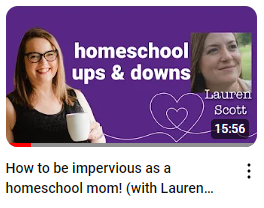
I recently had the privilege of chatting with Mystie Winckler on her Simplified Organization Podcast, sharing the story of how I really learned to be an impervious homeschool mom during my oldest son’s challenging fourth grade year. As soon as the recording was over my mind filled with further thoughts and clarity on the subject, which, in my limited experience with podcasts, seems to be par for the course. At any rate, I’d like to share the concept of imperviousness with you for your benefit so that the story I tell on Mystie’s podcast will make that much more sense and be that much more helpful.
I first heard about imperviousness many years ago from Mystie herself, who heard it from Cindy Rollins before that. Despite having been introduced to the concept early in our homeschool journey, it took me some time to wrap my head around it.
So what does it mean to be impervious? Here’s the definition from Webster’s:
Impervious: 1a: not allowing entrance or passage : impenetrable Ex: ‘a coat impervious to rain’ b: not capable of being damaged or harmed Ex: ‘a carpet impervious to rough treatment’ 2: not capable of being affected or disturbed Ex: ‘impervious to criticism’
The essential idea when applied to parenting and homeschooling is to not let your kids get to you. You are committed to doing what is right for your kids without being thrown off course by their ups and downs, whining or talking-back, disobedience or tantrums, pleading or puppy-dog eyes.
This doesn’t mean you’re cold and heartless, it just means that you are in control of yourself rather than letting your kids take the reigns or knock you off-kilter. Kids aren’t born with self-control, so you’ve got a long head-start on them in developing it; and if you are a regenerate follower of Jesus Christ, you have the Holy Spirit to produce that fruit in you.
Be controlled by the Spirit, not by your kids. (See Ephesians 5:18 and laugh with me at the loose parallelism that I just made.)
Imperviousness absolutely ought to come with love, joy, peace, patience, kindness, goodness, faithfulness, gentleness, and self-control (Galatians 5:22-23). Though in the moment, when you’re tested by all the fuss your children can muster, it can feel a lot more like holding back a wave of frustration and mommy-tantrums than like “smooth and easy days” (I’m looking at you, Charlotte). 😉
From my own experience, I will offer that imperviousness—a bit of emotional separation from your kids—is actually an important step toward having genuine fruit of the Spirit grow in your relationships with your children.
It’s tempting to think that the more we detach from our kids’ emotions, the less able we will be to sympathize with them and offer the emotional support that they may need. But in reality, if my emotions aren’t under control, if they are instead reactive or reflective of my child’s emotions, then I’m not providing the stable anchor for my child in the midst of his turbulent sea.
Once I was able to see my son’s ups and downs without joining him in them or reacting to them, I was then able to calmly call him to do his duty and also calmly comfort him when learning to overcome his particular challenges was really hard.
Imperviousness is sometimes referred to as “being the wall” for our kids. Setting a course or a standard and sticking to it no matter how our kids bump up against us. But take note that being a wall doesn’t require being angry. In fact, getting upset actually means that our wall is likely to move—either to give way to our kids or to fall on them and crush them. That’s not imperviousness in either case.
When our kids are on an emotional roller coaster, we don’t need to get on the roller coaster with them. We can help them calm down and do the work only when we ourselves remain calm and stay off of the wild ride that they’re on.
In the podcast with Mystie, I tell the story of my oldest son’s fourth grade year, which was a painful learning process for us both. My lack of imperviousness around math led to a need for intervention—my husband helped set us on a course that provided more distance between me and my son’s day-to-day math performance. As a result, we both grew by leaps and bounds that year, and we have reaped the benefits of it ever since (that 10-year-old is now 15!). I learned to be truly impervious in what was for me the place of greatest testing. Make sure you get the full story by listening to (or watching) the podcast, and then consider these take-aways from my experience:
Even when you have an idea of how to be impervious as a mother, don’t be surprised if you find yourself tested in a particular area. I could be impervious in a lot of settings, but math was my Achilles’ heel. Watch out for that one specific area that trips you up. “Therefore let him who thinks he stands take heed that he does not fall.” 1 Corinthians 10:12
Impatience is the opposite of imperviousness. Maybe imperviousness can have other opposites, too, but in my case, the real emotional upheaval was around the fact that I couldn’t speed up the learning process to meet my expectations. My expectations and attitude had to change before I could provide the stability my son needed.
Natural consequences and/or an impersonal standard are tools that can make imperviousness a little easier to practice. When your kids are reeling against the direction you’ve given or are asking for things to be different, it’s a lot easier to hold your ground when you have already clearly communicated your expectations and have even written them down somewhere. You don’t have to flex your authority when you can simply appeal to the law of the land (or maybe just your house) and tell them that if you do x you get y (whether that’s a positive or negative reinforcement). Direct disobedience needs discipline, authority isn’t something to be afraid of, but well-established expectations and consequences can help with most other scenarios. (Listen to the podcast for the specific steps we took in this department!)
One important element of imperviousness is that you can see beyond more than just today. We can expect that there will be ups and downs in our day-to-day experience, but we need to remember that we’re playing the long-game (something my husband has had to remind me of often).
When Mom lacks imperviousness, Dad may be a good source of it! Dads (not always but often) can come at a parenting situation with greater emotional distance. Sometimes their approach seems harsh/too strict to us as moms, but sometimes that’s exactly what is needed. Value what Dad brings to your parenting team.
If you find yourself in the middle of a crazy season because you’ve gotten on the roller coaster ride with your kids or have provided some of the loopty-loops yourself, it’s ok. You’re normal. Course correct as soon as you can—preferably before outside intervention is necessary! Hold the line. But don’t wallow in your past mistakes. To quote Mystie: “Repent. Rejoice. Repeat.”
There CAN be peace on the other side of your worst homeschooling mistakes. God is merciful and gracious. And He can heal what is broken. Confess and repent, rejoice in the Lord, and pursue joyful-yet-impervious fellowship with your kids as you guide them through their home school years and beyond.
I hope my story and these considerations can help you in your parenting and homeschool journey. God is faithful. Look to Him for the fruit of the Spirit each day, and trust Him for the fruit He will produce in you and your children over the long haul. Steady your heart to provide a stable, impervious mama for your kiddos. You and they will be better for it.
Here’s the podcast link, one last time:
And if you want another peek into my story, here’s an article I wrote while in the middle of that challenging season: Ideals and the Daily Grind.
Have you ever heard the term “impervious” before? Have you had a seriously challenging season with one of your children? How did you handle it?
This post contains affiliate links. If you make a purchase through one of these links, I may make a commission at no additional charge to you.
I have done some form of Morning Time with my boys for something like ten years. It looks a little different now that they are 13 and 11 this year instead of 3 and 1, when I likely started with a song, a scripture, and a calendar at the kitchen table. For one thing, my youngest is no longer restrained in a high chair (though there were a few years where he would be upside down on the couch or literally climbing onto my shoulders as I read aloud that I might have wished for that high chair again!).
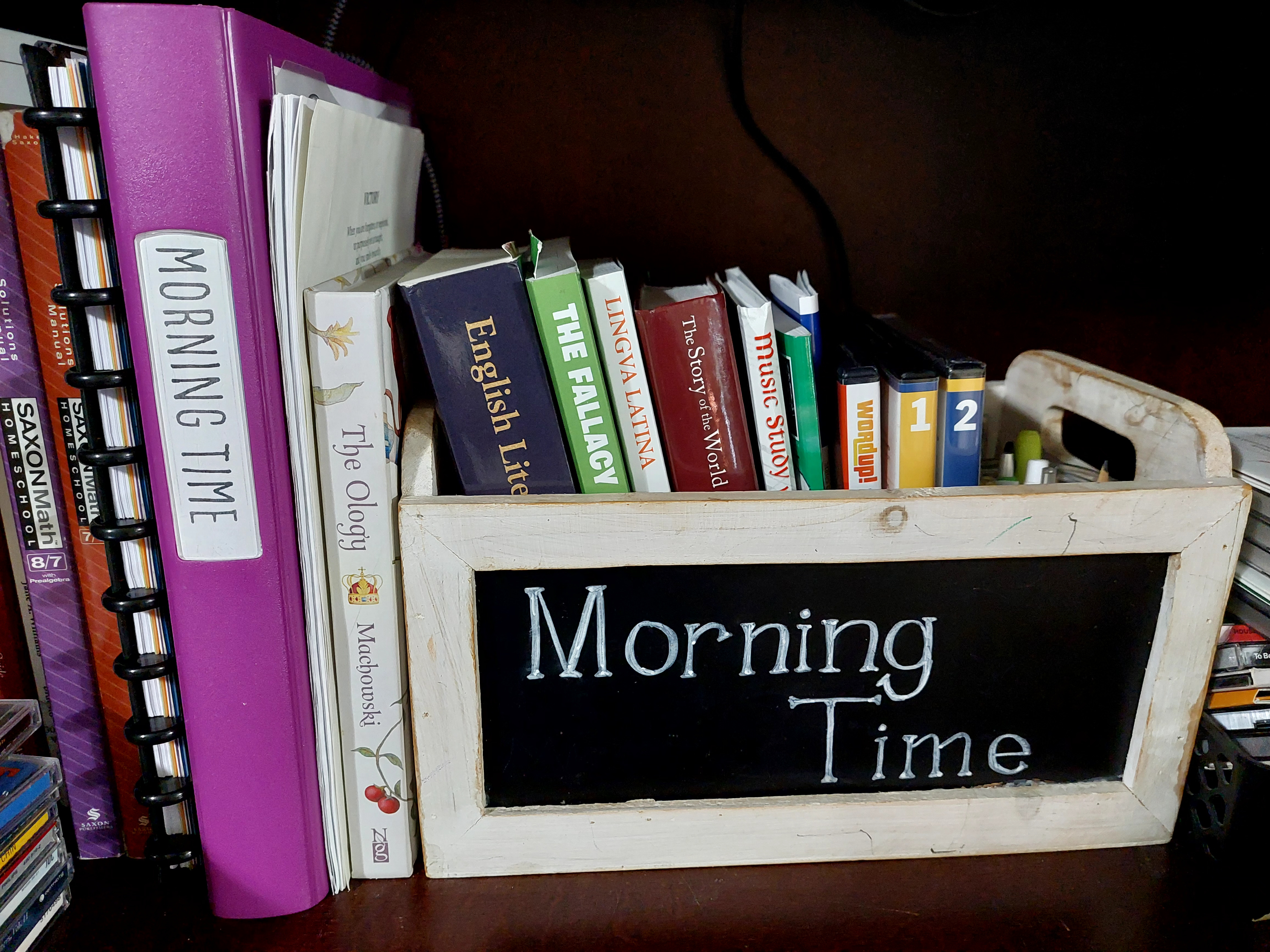
This Morning Time Box has seen a lot of action over the years!
Latin
This year we are continuing our study of Latin with Visual Latin 1. We did the first 20 lessons last year and the plan is to finish Level 1 by Christmas so that we can start Visual Latin 2 next semester. I made it through the first 20 lessons last year without doing the worksheets myself (thanks to many hours of college-level Spanish), but this year I have printed off lessons 21-30 so that I can get in the same translation practice that my boys are doing. The grammar is a bit more complicated now, so it’s easier for me to keep track of it if I’m doing the work, too. And as an added bonus, I can very easily check the boys’ work without having to pull up the answer key pdf every time.
On lighter days in Visual Latin, we’ll sprinkle in some reading from Lingua Latina and perhaps also from Familia Mala (“Bad Family”…this book doesn’t shy away from the fact that the Roman myths are a hot mess).
Read Alouds
Just finished at the start of the year:
Cue drum roll… We have finally finished reading The Story of the World Volume 4: Modern Times by Susan Wise Bauer. It’s crazy to think we’re done with the whole series. I think we’ve actually read Volumes One and Two twice. This series goes down as one of our family all-time favorites. My kids would ask me even on the weekend: “Read Story of the World while we play Legos?” This has been a great adventure through chronological world history.
We also recently finished The Fallacy Detective. This was a big hit with my boys–a fun read with often-entertaining examples and exercises. I’ve tried to make a point to my sons that being able to identify logical fallacies is fun and useful, but 1) it isn’t to be used to tear others down, and 2) fallacies make up a small, small fraction of the study of logic–we have yet to begin to cover all of what logic actually is. We’ll take a break this year before heading into formal logic when my oldest is in 8th grade. The Fallacy Detective has certainly whet their appetite for it.
New reads this year:
I pre-read The Ology a few years ago but it’s finally making it into our rotation this year. I think it would have been great to read sooner, but I think it will still be a good, simple treatment of theology for us to enjoy and discuss this year.
In our home, we love books by H. E. (Henrietta Elizabeth) Marshall, having enjoyed Our Island Story (British history), This Country of Ours (US history), and Scotland’s Story in the boys’ independent elementary studies. This year I decided we could start reading her book English Literature for Boys and Girls together. I’m eager to read it myself, and sometimes the best way to make that fit in my schedule is to read it aloud. 🙂 The boys are excited to hear again from a beloved author, and I’m excited for us to venture into the world of British Lit–more deeply than I ever did in school!
Other Riches
I’m in the process of starting a co-op with some local families, so we’ll be covering hymns, Scripture memory, folk songs, poems, artist study, composer study, and nature study in community this year!
There’s also a book club time and my boys (who are both in the “older kids” group) will be studying Shakespeare, one play each semester. This fall, it’ll be The Tempest.
I’ll try to work our co-op selections into our daily Morning Time. But as the kids are getting older and our Latin studies require a daily commitment, this will be more sporadic than regular (has our Morning Time ever been more than sporadic? Hmmm…). One of the reasons for the co-op, after all, is because it is hard to make space for all of these beautiful things!
Want some inspiration for Morning Time in your home? Over the summer, I enjoyed reading Pam Barnhill and Heather Tully’s new book Gather. It’s a beautiful compilation of thoughts, practices, and examples from their own homeschools, and it’s chock full of lovely photos of other homeschool families (of all sizes!) who enjoy learning together. It’s like one of those “day in the life” blog posts, only there’s a book’s worth of it and you can actually hold it in your hands. Tangible book lovers, rejoice!
What about you? Do you do Morning Time? Or something like it at another time of day? What are your plans for this school year?
Amazon links are affiliate links. If you make a purchase through one of these links, I may receive a commission at no additional cost to you. I make no money from links to Christian sellers, but I encourage you to support them over Amazon whenever possible.
“What Bible curriculum do you use for grade x?”
It’s a question I get from time to time, and it never ceases to make me squirm a little.
Why, you may ask? Well, because the idea of “Bible curriculum,” and especially for a particular “grade level,” is foreign to me.
Now of course I’m aware of the fact that “Bible curriculum” and “Bible classes” exist in Christian school settings, but I’ve always wrinkled up my nose a bit thinking about the Bible being made to fit the mold of an academic subject, added on to a school day like just another textbook or workbook to get through. What affect does that have on the way kids approach the Scriptures? And do they give grades for those classes? What does that teach?
Our approach to the Bible looks a lot less like school and a lot more like discipleship. Reading the Bible together has been a part of our family culture since before our children were born. We haven’t ever felt a need to make sure we added Bible to the kids’ schooling because they’ve been getting Bible with their breakfast since they were tiny.
In fact, while every part of school is informed by the Scriptures, we like to keep the Bible itself separate from “school” in a sense so that they don’t get the impression that a day off of school is a day off from devotion to the Lord.
But what does that look like? And how can you get started with this holistic family discipleship model of Bible learning if it’s foreign to you?
Well, let’s start with why.
Our Why: Created Reality and Biblical Goals
Our children are precious creations of our Heavenly Father–and they are precious gifts entrusted to us as parents. We desire to give them access to the Truth that God has revealed in His Word so that they can grow in wisdom and stature and in favor with God and man, that they would begin to know and love their Creator.
Ultimately, we desire that our children would trust in the Lord Jesus Christ for salvation from their sins and that they would love and serve Him all their days–for their good and God’s glory, both in this life and in the life to come. We don’t ultimately control this outcome. But we can be faithful to train our children in the way they should go.
Our Why Dictates Our How: Holistic Family Discipleship
Given the nature of our children, the nature of our relationship to them as their parents, and the nature of our goal (that they would have a relationship with God), it follows then that we ought to teach them in a way that is first and foremost relational. And decidedly not academic.
This means that interaction with the Scriptures comes woven into the fabric of our every day lives. There are no worksheets nor tests, no grades nor grade levels.
This doesn’t mean we don’t use printed materials to aid our children’s learning (I will link to some below), but we need to remember that the greatest resources we have to instruct our children in the ways of the Lord are His Word, His Holy Spirit, and our own lives lived alongside and before our children.
God’s Word: We must be in the bible ourselves and we must offer the Scriptures to our children.
The Holy Spirit: We must be seeking God to be at work both in us and in our children–apart from Christ we can do nothing. We may have had a direct role in bringing about our children’s physical life, but the spiritual life is of the Spirit–we cannot manufacture it in our kids. Prayer is indispensable.
Our Own Lives: We must model for our children what it means to believe the Word of God, to study it, to meditate on it, to practically submit our lives to it, and to receive both correction from it when we fail and comfort from it when we repent.
What does this actually look like?
Family Bible Time (what some call Family Worship)
Our current family Bible reading pattern, which we’ve had going for several years, is Proverbs at breakfast and Gospels at supper.
Now, this doesn’t mean each one happens every day. The reason we read the Bible over breakfast and dinner is because we often don’t read the Bible over breakfast and dinner. This is a scattering of seeds, not mechanical planting.We aim for faithfulness and perseverance rather than anything that resembles perfect consistency. But in keeping up the habit, we pretty reliably hit at least one of these each day, sometimes both. And before it was Proverbs and Gospels, we read slowly through the entire Bible at meal times–it may have taken a decade, but we kept going. The reason we’re in Proverbs and the Gospels right now is because the primary needs of our children are to receive instruction and correction according to God’s wisdom and to receive Jesus the Messiah as their Savior.
While we eat breakfast, my husband will read a few verses from the chapter of Proverbs that matches the calendar date (since there are conveniently 31 chapters in Proverbs), either selecting these verses ahead of time or asking for the kids to randomly select a number. He reads a verse and asks what it means. The kids give it their best shot and then we all discuss the meaning. He asks if they can think of any examples (a child may not use his brother as a negative example–this is a necessary rule, folks!). It has been fun over the years to hear the examples the kids come up with–sometimes from a fable, from literature, from a Bible story, from a movie. They are learning about wisdom and foolishness and learning how to identify each.
After Proverbs, we recite the Shema and the Lord’s Prayer. We switched up this recitation time over the holidays last year in order to recite and memorize Mary’s Magnificat. Now that we have the placeholder for recitation, we may use the time for other passages when they seem fitting.
Our evening Family Bible Time involves my husband reading from a passage of Scripture (currently Luke) at mealtime and then asking a few questions:
What did we learn? This is a good time for kids to either pick one thing that stuck out to them or simply narrate what they heard.
What can we worship God for? Sometimes, when we’ve been in the prophets, the answer is usually “That God was so patient and gave so many warnings.” Now that we’re in the first few chapters of Luke, the answer is usually “For sending Jesus to save us.” Sometimes the answer is different, but it’s no problem to worship God for the same things over and over again–in fact, it’s right to do so. Once answered, we pray and praise God based on what we saw in the passage–even if it’s simply for preserving the genealogy of Christ (which is pretty amazing when you think about it). Sometimes there may not be an obvious answer. When we were in the middle of Job as a family, it was admittedly hard to find any answer from the text–so we felt Job’s desolation a bit but worshipped God anyway.
What can we do with what we have learned? This is where we pay attention to the right response(s) to what we have read. Sometimes it is simply to worship as we did in the second question. Sometimes there is a command that we ought to obey. Sometimes there is something for which we ought to be thankful, something that ought to amaze us, something that ought to cause us to care for others, an example to follow or an example not to follow.
Now, these questions aren’t magical. They’re just the tools we have used for discussing the Bible as a family and for attempting to respond to it properly. Sometimes the kids are fully engaged and wow us with their insight. But sometimes the kids aren’t super excited to answer. Sometimes we get blank stares. But we don’t read the Bible and ask the questions in order to get perfect responses from our kids. We do it so that they are regularly interacting with the Scriptures and learning by modeling how to respond to them. It’s not perfect, but it is worthwhile. We are planting seeds.
Other Applications and Resources
The seeds we plant in Family Bible Time are watered by a lot of other practices and experiences.
We pray together as a family before meals and before bed. We try to remember to include intercession: to pray for neighbors, friends, family members, etc–sometimes on a weekly rotation so we don’t forget (but let’s be honest, we sometimes forget and go for long stretches with just basic bedtime prayers).
We have also made sure to include Bible time for our children to enjoy independently, even from a very early age by listening: Dove Tales (with cassettes–yes, we inherited these from my in-laws), Jesus Story Book Bible (with CDs), and a dramatized audio Bible from Faith Comes by Hearing. Now that our boys are 11 and 9, they are expected to read a chapter of the Bible first thing in the morning before coming downstairs for breakfast. This doesn’t mean it always happens, but that’s the goal and the general habit.
We’ve also enjoyed watching videos by The Bible Project–edifying for parent and child alike.
This emphasis on the Word of God being integrated into all of life means that it also influences our school day–just not in the graded-Bible-curriculum sort of way.
We have enjoyed singing many hymns in our Morning Time (currently singing along with this channel), and we have also enjoyed music by Sovereign Grace Kids (from a Christian seller). Even as adults, when we listen to music with lyrics, we generally choose music that is spiritually edifying. Our kids take this in as well.
The Scriptures inform the other books we choose–and how we read them–whether literature, tales, history, poetry, nature, etc.
The Scriptures make it into our kids’ copy work and dictation, too (that’s language arts).
Keeping It Real
We don’t do all of these things all the time. The most regular parts of our every day life are family Bible time, listening to hymns and other spiritual songs, family prayer, and good discussions on all kinds of things as we go about our days together. And these discussions aren’t just aimed at our kids. My husband and I discuss books, current events, and so many things with each other, seeking to apply God’s Word and His wisdom to everything we encounter. Our kids are audience to these adult conversations, too.
The aim is holistic, not check-list driven. And it is gloriously free from pressure to “get through it” on any kind of annual school schedule (thank God!).
The point of this post isn’t to say we’ve got it down, nor to set any kind of expectation for anyone else. The point is to demonstrate the many ways in which we can spiritually nurture and disciple our children–without boxed curriculum. And to remind all of us (myself included) that we may sow seeds, but the Lord causes the growth. Our dependence upon Him is central to our efforts at training up our children in the ways of the Lord.
All of the things we do have begun as small habits. A little here, a little there. If you are just starting to bring Scripture into your home and homeschool, don’t be discouraged or overwhelmed. Pick one thing. One habit that you and your children can enjoy. Plant a seed. And then another. Water where you can. The Lord causes the growth.
I hope this post has helped to somewhat answer the “What do you use for Bible curriculum?” question. It’s not a short answer, but I hope it may encourage some to think outside that proverbial box … of curriculum. 😉
How do you nurture your children in God’s Word? What resources have you found helpful?
This post contains affiliate links. If you make a purchase through one of these links, I may receive a commission at no additional cost to you.
In my last post, I shared Why We Homeschool, and part of our WHY included the freedom to choose HOW.
I explained a bit of our story–how my husband was homeschooled and how I went to public school. And I shared our mission statement:
Since before they were born, my husband Nathaniel and I have purposed to bring our children up in the nurture and admonition of the Lord and to educate them at home by means of whole/living books, meaningful work and life experiences, and disciplined habits of wisdom and personal responsibility—for school and for life and ultimately for eternity.
In this post, I’ll give a little more of our story and begin to flesh out just how we have come to do what we do–and how we think about it, summarizing Charlotte Mason and classical philosophies as best I can.
A Little More of Our Story…
That mission statement above was written recently, but it pretty well describes what our aims have been from the beginning, owing much to what Nathaniel’s family passed down and to his experience with the literature-based Robinson Curriculum.
Our initial trajectory found further inspiration nearly six years ago when an older mom-friend at the local homeschool co-op first introduced me to the ideas of Charlotte Mason and Christian classical education (yes, both at the same time–it’s taken me years to sort them out! Ha!).
We were already legally homeschooling our five-year-old at this point–attempting to use my mother-in-law’s KONOS unit studies curriculum. Think: a text-only Pinterest board in a three-inch binder (though I’m sure it’s more up-to-date these days). I had already found that, rogue that I am, I took the subject matter we were supposed to cover in KONOS, ignored the binder and its overwhelming amount of options completely, and simply went to the library to check out as many quality books as I could find for us to read aloud on a given subject.
I’m not a crafty mom, nor do I like Pinterest.
While carting books home from the library for our immediate needs, I began to explore Charlotte Mason via Ambleside Online and some of my friend’s Well Trained Mind materials (which are Classical, too).
Somewhere in that first year I also acquired Educating the WholeHearted Child, an excellent resource on Christian homeschooling, by Clay and Sally Clarkson–and I found Charlotte Mason quotes littered throughout.
Hmmm…Interesting. The wheels were spinning.
Half way into our second year, now invested in a couple of those Well Trained Mind materials and a practice called Morning Time (recommended by my friend and expanded upon by Pam Barnhill), I found myself tuning in to a new podcast called Scholé Sisters, “a casual conversation…” for “the classical homeschooling mama who seeks to learn and grow while she’s helping her children learn and grow.”
Inspired by the podcast to “find your sisters,” I invited the friend who had started this mess 😉 as well as a few others to form our own book club and read Susan Schaeffer Macaulay’s For the Children’s Sake–arguably the Charlotte Mason gateway drug.
At this point my research perhaps turned into somewhat of an addiction.
I began to see that Charlotte Mason’s ideas about books, habit training, and real-life learning lined up with so much of what we were already doing–and they challenged me to grow further out of my push-through-to-the-next-thing mindset that I’d acquired in my own school years.
I also began to explore classical education a bit, but never really hopped on the Trivium-as-stages Train. I was delighted to find in further listening and research that the “stages” application of Grammar, Logic, and Rhetoric was a gross oversimplification–classical education, as I had hoped, has far more to offer.
Since that first year where I didn’t-really-follow-KONOS, we haven’t used any sort of all-in-one curriculum (though I have borrowed a lot from Ambleside Online and we do use curriculum for math). We appreciate the educational philosophy of Charlotte Mason and Christian classical education, and we choose materials eclectically guided by a lot of the principles from these philosophies.
So, what exactly are they?
Hello, Charlotte
Charlotte Mason, a British educator who lived at the turn of the 20th century, describes education as “an atmosphere, a discipline, and a life.” Atmosphere refers to the naturally occurring environment of the child—the home in which they live, the people they live with, the world outside their front door. This also includes the attitudes that they pick up from, say, their parents.
Discipline refers to the formation of habits, whether personal cleanliness, academic, or other habits of character. Again, who we are as parents teaches a lot!
Life might be a bit confusing. By life Mason means “living ideas,” or knowledge that is vital. This kind of knowledge is found by being in living touch with the world around us and especially by being presented with a rich curriculum that puts us in touch with the knowledge made available in books—and particularly books of literary quality rather than dry textbooks which can often strip knowledge of its delight. When Charlotte Mason mamas speak of living books, they’re in this realm of “education is a life.”
Our mission statement corresponds with this framework for education: “…meaningful work and life experiences…” — a big part of atmosphere. “…disciplined habits of wisdom and personal responsibility…” — discipline. “…whole/living books…” — and there’s the life.
Now, that’s Charlotte Mason on a very general level. She also has a list of 20 principles and six volumes in which she develops her philosophy and method. Some of the key elements include training the habit of attention, growing in self-education, narrating back what one has heard or read after just one reading, spending time outside in nature, studying a wide range of beautiful things, and resisting the urge to over-teach so that the child does the work of thinking for him/herself. But that’s just scratching the surface.
When I list Charlotte Mason as part of how we homeschool, I mean that we are happily influenced by her ideas, but I do not mean that I follow her method anything near completely. Her principles resonate with me and challenge me to be a better mom, but I implement them very much in our own way. And that’s perhaps why I sometimes feel that we fit more easily within Classical education (a philosophical umbrella with arguably various methods up for grabs) than we do in a strictly Charlotte Mason approach (a philosophy with a prescribed method to go with it). But they really do meld together well in our home!
Hello, Classical
Christian classical education aims at wisdom and virtue and at cultivating an appreciation for what is true, good, and beautiful. It emphasizes an ancient and long-standing educational tradition that has been abandoned in the past 150 years or more, but it’s making a strong comeback today. Training in The Seven Liberal Arts of Grammar, Logic, Rhetoric (the arts of language); Arithmetic, Geometry, Astronomy, and Music (the mathematical arts) is a key part of the curriculum. But this isn’t the sum total of learning, either. Other elements in this tradition include training in piety, gymnastic, music (in more than a mathematical sense), common and fine arts, sciences and history and philosophy–with Christian theology as both the guide and the goal.
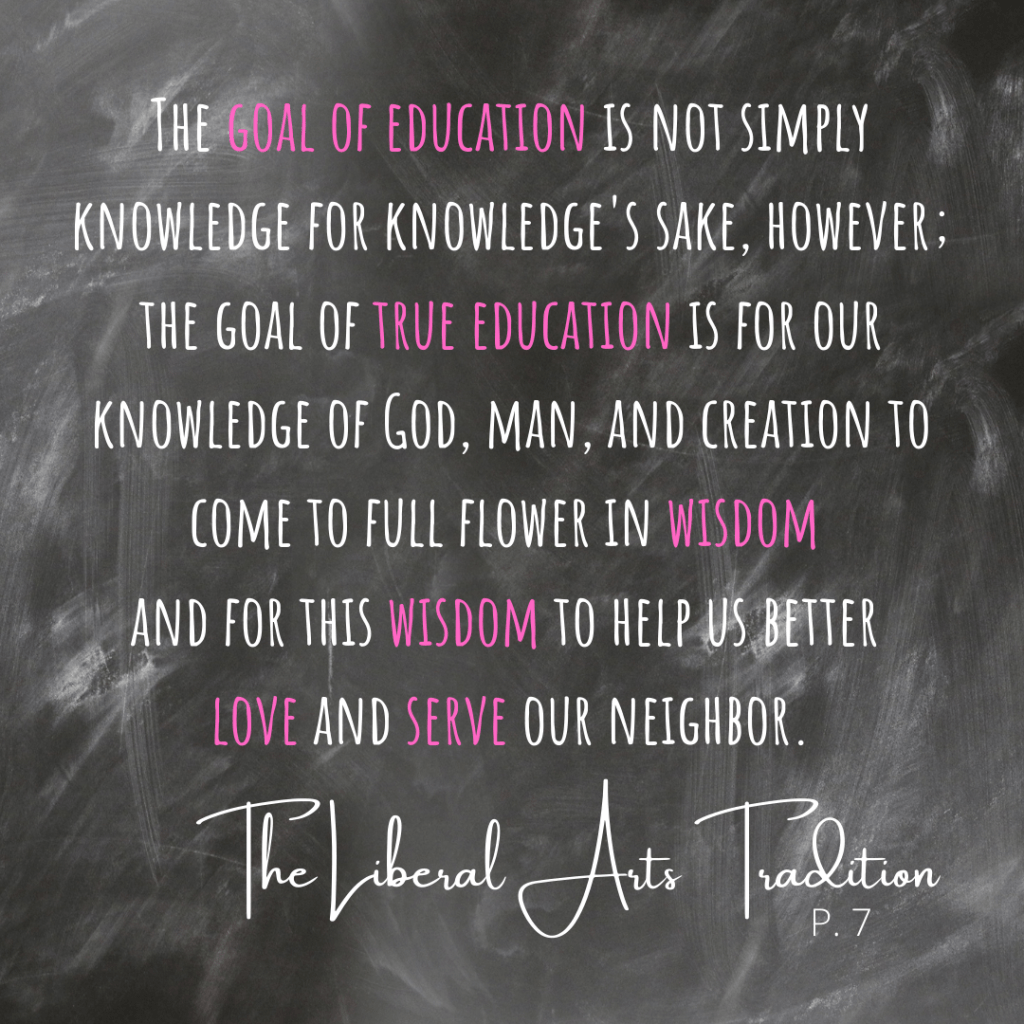
There is a learning curve here, especially since the words I just used to tell you what’s included in a classical education all have older definitions and understandings that are either completely abandoned or else eclipsed by the way we understand them today. There are helpful resources out there, though. Podcasts like the Scholé Sisters, Ask Andrew, and Cafe Schole have been helpful. As for reading, these articles at the Circe Institute can get you started, and the booklet Introduction to Classical Education is a helpful overview. But once you’re ready to dive into a thorough treatment of Christian classical education, be sure to grab The Liberal Arts Tradition (revised edition) by Kevin Clark and Ravi Scott Jain. This book ties all the pieces together with lots of historical references so that you come away with a better and deeper understanding of the whole paradigm and where it all comes from. There’s also a short glossary of key words and concepts at the back of the book that’s a very handy reference!
Charlotte Mason and classical both aim at a holistic education that respects the nature of the child as made in God’s image. As such, children ought to be nurtured and educated in body, mind, and soul–and primarily by those that love them most. Today’s secular school system doesn’t acknowledge the soul of the child, so it falls short even when it aims at a holistic education.
Some of what we do will sound flowery, but that’s because our focus isn’t just on academic skills—it’s on all of life enjoyed and lived to the glory of God—and this includes a lot of things that are both enriching in an enjoyable way and pay dividends academically, too. What we do is academically rigorous, but in a very different way.
We’ve found that both Charlotte Mason and Christian classical education each resonate with our priorities and direction, while also giving a greater depth and breadth to our efforts than we knew was possible.
Do you have to follow either of these philosophies or methods to homeschool you kids well and raise them in the ways of the Lord? No. The best way to do that is to be humbly and constantly immersing yourself and your children in God’s word, believing it and living by it together in your everyday, everywhere life. But both classical and Charlotte Mason philosophies can be extremely helpful to that end–not only for the way they give you many positive things to implement in your teaching, but also for the way they challenge you to peel back the layers of negative influence from our modern, materialistic education system.
Stay tuned for more in this series as I begin to post specifically about how we handle various subjects in our homeschool (without actually concerning ourselves much with “teaching all the subjects”).
In case you missed it, here’s the first post in the series: Why We Homeschool.
This post contains affiliate links. If you make a purchase through one of these links, I may receive a commission at no additional cost to you.
Join us as we indulge in a little foolishness!
What kind of foolishness do we find in living books? And what role does it play in our favorite stories? In this chat we take a tour of literary folly: starting with the childish charm of Frog and Toad; to the growth away from foolishness in coming-of-age novels like Anne and Little Britches (and the lack of such growth in Tom Sawyer); and finally to the full-grown foolishness that wields its destructive power in Austen and Shakespeare.
Growth from foolishness to maturity often comes by way of trial–in literature and in our own lives. As we consider the characters in the stories we read, we find insight and inspiration for navigating the crises we face with wisdom and courage.
When it comes to fleeing danger, where’s the line between wisdom and selfishness? In facing danger head-on, what’s the difference between courage and foolhardy recklessness? We hope you’ll join us and find encouragement–both for your family’s literary adventures and for the real challenges you face in these trying times.
For Easy Navigation:
00:00 – 00:54 Introduction 00:54 – 03:48 Charming, Childish Foolishness 03:48 – 04:52 Foolishness Grows Up a Bit 04:52 – 14:53 Foolishness to Maturity in Coming-of-Age Novels
14:53 – 27:46 Manifestations of Folly in Austen and Shakespeare
27:46 – 37:20 Facing our Current Crisis with Wisdom and Courage
37:20 – End Wrap Up
Books Mentioned
The Bible, especially the book of Proverbs 🙂
Winnie the Pooh by A. A. Milne
Paddington Bear by Michael Bond
The Wind in the Willows by Kenneth Graham
Frog and Toad by Arnold Lobel
The Adventures of Tom Sawyer by Mark Twain
Anne of Green Gables by Lucy Maud Montgomery
Little Britches by Ralph Moody (audiobook linked below)
Lately I’ve wrestled with my assumptions about how homeschooling ought to be experienced–both by me and my children. There’s this tension between the “freedom” that we have as homeschoolers along with the “delight” that we want to nurture … and the painfully hard job of holding the line while a child has to do the work of growing into maturity. You can’t do it for them. You can’t soften the blow. You can’t lift the weight.
Well, you can try. But it might not be good for them. Despite not measuring up to the Instagram ideal, the daily grind–with all of its bumps, boredom, and blunders–is good for kids.
We’re beginning to wrestle with these things now that our oldest is ten and carrying more responsibilities. And it’s hard. It’s really hard. Not because he’s rebellious or anything. Just because it means he has to grow up a bit, this child who’s still bummed that he aged-out of child care at our homeschool support meetings two years ago. He’d rather be in there with the 7-and-under crowd just like he’d rather continue doing all of his math and language lessons with me.
But he has to grow up.
And I have to let him.
Pictured below: My sweet 10 year old boy couldn’t sleep due to bug bites, and instead of throwing a pity party (which he very easily might have done) he decided to start on his math before I even came into the kitchen for the morning. This is new territory, folks! This is growing up!!! I made sure to reward him with a cup of tea. 😉
I think of all the ways I could have prepared us better for this transition to greater responsibility and greater independence. There’s much room for improvement and repentance, and I just get to mourn the gap because my baby, my youngest, just turned eight–it’s not like I have kindergartners that I can “do better” with.
But then my husband tells me that I’ve done great. That this transition is hard. Period. (He would know. He was homeschooled.) You could have done some things better, but here we are–and he’s going to get stronger from this trial precisely because it’s hard, precisely because it’ll teach him to pray–as long as we hold the line.
My husband is right, of course. For all the failings, we’ve done well. And are doing well. I don’t measure up to my ideals and neither do my children. No surprise there, really, if I’m honest with myself.
This reminds me of that ideal that is not idealistic. That we’re raising children to become adults. Adults who have to work hard. Adults that will make mistakes and have to correct them–whether in math or driving or work or relationships.
Turns out in bringing up my boys I’m being brought up, too. The higher ideal–for all of us–is growth in maturity, ultimately in Christ.
Praise God I haven’t gotten it all right! I’d be an arrogant sourpuss if He’d allowed me to get it all right! No. There is no perfect ideal in parenting or education. The only Perfect Ideal is Jesus Christ Himself. So the best we can do is look to Christ and hold on. Hold the line of faith as we hold the practical standards for our kids, standing firm as they learn to stand firm themselves, dependent more and more upon the Lord–and less and less upon us.
This. Is. Good.
Hard but good.
True growth, and thus the ability to experience greater “freedom” and “delight,” comes when we submit to the work set before us, choosing to bear up under the weight God has assigned rather than to shirk it or complain. Our children grow the same way we do–if we let them.
How about you? What hurdles or struggles are you and your children facing this year? Can you recognize the “hard but good” in it? How has it forced you to rely more upon the Lord? I’d love to hear from you.











 Kept and Keeping