• Home
  • About
  • Living Faith
  • Home and Family
  • Home Education
  • Books
  • Recommended Resources
  • Media

Kept and Keeping

~ Rest in Grace, Labor in Love

Kept and Keeping

Tag Archives: Christian growth

Contentment Doesn’t Grow in a Vacuum

14 Saturday Sep 2024

Posted by Lauren Scott in Living Faith

≈ 3 Comments

Tags

Christian contentment, Christian growth, Christian life, Christian Suffering, Contentment, devotional, faith, trials

This post contains an affiliate link. If you make a purchase through this link, I may make a commission at no additional cost to you. Thank you for supporting my blog!

“I can do all things through Him who strengthens me.”

Philippians 4:13 is an oft-quoted bible verse. Here’s what people often mean by it:

“I can win at sports because Jesus gives me strength!”

“I can stand up to the bully through Christ who strengthens me!”

It’s like a meme that pre-dated the internet.

But the context of this beloved verse, as some of you well know, doesn’t lend itself to the kind of blank check that ‘90s Christian T-shirt manufacturers would like you to believe.

The apostle Paul isn’t facing giants, he’s practicing contentment. Here’s the verse in context:

10 But I rejoiced in the Lord greatly, that now at last you have revived your concern for me; indeed, you were concerned before, but you lacked opportunity. 11 Not that I speak from want, for I have learned to be content in whatever circumstances I am. 12 I know how to get along with humble means, and I also know how to live in prosperity; in any and every circumstance I have learned the secret of being filled and going hungry, both of having abundance and suffering need. 13 I can do all things through Him who strengthens me. 14 Nevertheless, you have done well to share with me in my affliction.

Paul wrote this section of his letter to the Philippians to thank them for sending a gift to help meet his needs, to support him in his ministry. But he wants them to know that he’s more thankful for their hearts than for the gift itself. He’s learned to be content, whether “being filled or going hungry, …having abundance and suffering need.”

Here in the wealthy West, we might need to stop and really consider what that meant for the apostle Paul. For reference, he shares some of his resume in 2 Corinthians 4:7-18.

Paul didn’t learn contentment by sitting in a comfy chair, sipping a latte, and meditating on the idea of it. He learned contentment through trials and practice. The apostle James shares the same principle in his epistle:

Consider it joy, my brethren, when you encounter various trials, knowing that the testing of your faith produces endurance. And let endurance have its perfect work…

So how do we, in a world full of modern conveniences and comforts, grow in contentment?

woman window christian contentment trials
Getaways are great, but real contentment will follow us back into the fray.

Learning Contentment through Giving Thanks in All Circumstances

To be content means to be satisfied, happy, or pleased with what you have. So at the most basic level, we can learn contentment by stopping to recognize what we have—and that it has been graciously given to us by a good God.

When times are good, look around and give thanks for the Lord’s provision. When times are bad, do the same. It might be harder, but there is always something for which we can give thanks. Even if you have to start with the fact that you’re alive.

Sometimes it’s easier to practice this when things are either extraordinarily good or extraordinarily bad. It can be harder to recognize the goodness of God in our everyday mundane lives as we simply go with the flow and try to keep up with the pace of life. This is why, in any season, it is worthwhile to sit down and look around you. Take it in. And give thanks. Audibly, in a journal, expressed towards God and towards others: Give thanks.

Learning Contentment through Trials

Sometimes the Lord provides ample opportunity to grow in contentment through the trials we experience. Going through some really hard trials at the turn of the year has made some of our more recent challenges both harder and yet also easier to face. While we’re somewhat blindsided by each one that comes up, we’re also at least somewhat practiced at suffering and looking to the Lord in our need. When the last hard season has hardly even ended and you’re faced with another, it’s a lot. But the endurance muscles are still warm from use. They might be tired, but they at least know the drill.

We don’t automatically get contentment from our trials, however. The Apostle Paul had to “learn” contentment. And James reminded his readers to “consider it joy” when they faced trials. Mere meditation on the sidelines of life isn’t going to produce contentment in us without that contentment being tested in some way. But biblical meditation is essential if those trials are to produce real contentment in the Lord.

This is not and either-or proposition. It’s both-and.

So go ahead and enjoy your coffee as you dig into God’s word, hide it in your heart, and pray for God’s Spirit to empower you to grow in contentment. Just don’t imagine that sitting comfortably with your Bible is the end-game or even all of the means. Welcome God’s invitation to grow in faith, trust, endurance, and contentment with each new trial you face. And bring the Scriptures into your everyday moments, reminding yourself of Truth right in the middle of the challenges you’re facing.

Learning Contentment through Fasting

Even in easier seasons, however, there are practical ways we can grow in contentment. We can “discipline [ourselves] for the sake of godliness.” We don’t have to wait for the trials to come. We don’t have to seek them out, but it can be a good thing to practice dealing with less comfort than we’re used to.

In fact, Jesus expected His followers to do just that. In the Sermon on the Mount, He didn’t say, “If you fast…” He said “When you fast…” (Matt. 6:16-18)

Fasting is one of those spiritual disciplines that we maybe prefer to forget exists. If you’re starting to get uncomfortable, rest assured I’m stepping on my own toes, too.

Christians are not called to deny themselves for the sake of being super religious or having something to boast about (Jesus condemns those motives!). The point is to turn down those things that compete with the Lord and to turn our hunger and our desires toward Him, knowing that He is the One who can really satisfy our souls and meet our deepest needs.

Another purpose in fasting is to express grief or desperation in prayer. If I look around and think that the world is a big hot mess right now, but I keep stuffing my face at all hours like nothing is wrong, am I really concerned about what’s going on or am I just shrugging my shoulders and moving on to my next meal?

It’s hard to eat when you’re grieving. When you’ve lost someone or long for something so deeply that it hurts. Am I willing to make myself uncomfortable [at least some of the time] so that my prayers come with an earnestness that reflects a heart that grieves over a fallen world?

One very practical result of saying “no” to a meal or two is the realization that we can, in fact, survive on less than we usually consume. We can learn to be satisfied with less by the practice of fasting.

Learning Contentment through Putting Others First; “Put off” and “Put on”

Now, short of fasting (or perhaps in addition to fasting), we can look for opportunities to put the needs and desires of others ahead of our own. Do you take the biggest slice of cake or offer it to someone else? Do you rush in for the best seats or look for others you can honor above yourself?

Whether we eat or drink or whatever we do, we ought to do it for the glory of God. (1 Corinthians 10:31) If there’s an area where you can’t bring yourself to say no for a short while, or where you can’t bear the thought of someone getting the better deal, that’s probably an area where you need to learn contentment. Confess it, pray about it, yes. But then “bear fruit in keeping with repentance” (Matthew 3:8).

Roll up your sleeves and give or share in that area rather than simply trying to muster enough willpower to forgo the thing to no real purpose. Look for opportunities to celebrate the good things others have rather than defaulting to envy. And give thanks for what the Lord has given you rather than muttering about what you don’t have. As the Apostle Paul exhorts us in Ephesians chapter 4: “put off” the old and “put on” the new.

Learning Contentment through “Roughing It” a Bit

Aside from direct commands around thanksgiving, fasting, and putting others first, it’s possible and profitable to stretch yourself in other tangible ways. We’re getting into extra-biblical territory here, so take this as an invitation to think creatively about your own situation rather than feeling like you have to copy-and-paste. 😉

My family is into backpacking. We enjoy being out in God’s creation, hiking, and sleeping under the stars. But it isn’t always a walk in the park. And that’s also part of why we do it.

Our lives in the West can be so comfortable and controlled and disconnected from how people have had to live and survive for most of human history. It can be argued that we are weaker for it—physically, mentally, and perhaps even spiritually.

How ready am I for discomfort if I spend everyday of the year in a temperature-controlled box? If all of my furniture is selected to be aesthetically pleasing and super comfy? These are wonderful modern conveniences (for which we should give thanks!), but we do learn from what we live.

How ready am I to kneel down and serve others if I have carefully manicured hair, nails, and everything? If I am not used to getting dirty—ever?

When we go backpacking as a family, we often sit on rocks or the ground. We sleep in hammocks or on mats …on the ground. We hike in the heat. We sleep in the cold. We take care of our business in the woods. We don’t have access to indoor running water for days.

We have to gather and filter our drinking water. Sometimes it tastes great, other times, not so much. We have to bring our own food, so it’s a different kind of fare than we eat at home. We’ve learned first-hand the Proverb that “A sated man loathes honey, But to a famished man any bitter thing is sweet.” (Proverbs 27:7) Because just about any backpacking food tastes amazing after walking ten to fifteen miles in a day.

We don’t know what the future holds for us or for our sons. But we’d like to think that we are preparing our boys to serve the Lord in whatever capacity He calls them to. If they need to hike into the mountains to reach isolated villagers in some foreign country, well, they’ll have at least a little bit of training under their belts.

You may not need to get into backpacking. That’s not the point. But maybe you can find ways to stretch yourself, to step out of your comfort zone.

Go outside on a day when the weather isn’t ideal. Sit on the floor rather than a chair sometimes, if you are able. Walk outside barefoot just to try it out and see if your feet get less sensitive over time. Go for a long walk or do some other kind of exercise that gets your heart rate up.

To kind of flip the script, I would argue that these things are actually good for us beyond just the development of contentment and character. These things are healthy. Our attachment to comfort can rob us of more than just contentment if we don’t take some initiative to step out of our modern boxes and pursue a different path than the usual way-of-least-resistance to which we’re all so accustomed.

Learning Contentment through Christian Biography

If you need some inspiration and perspective, try reading or listening to stories of Christians who have served and suffered for the Lord throughout church history.

When I listened to Faithful Women and their Extraordinary God by Noel Piper earlier this year, I was struck by how believers who knew that persecution was coming, knew that they would be thrown into prison and barely be given enough to survive…these believers began to fast ahead of their suffering. We might think we’d need to “tank up” in order to last longer. But these precious saints wanted to “tank up” in a different way. They wanted to know the nearness of God in their trial before the worst of it came to them. They wanted to be practiced at depending upon the Lord for strength so that they would not give in to their torturers.

Our family backpacking is still just a field trip compared to that.

But this is the kind of perspective we gain when we read the stories of those who have gone before us: a “cloud of witnesses” like in Hebrews 11 who encourage us to run the race with endurance a la Hebrews 12:1-3.

Contentment Isn’t Learned in a Vacuum

Contentment isn’t a static virtue–it moves with us or it isn’t there at all. It doesn’t grow in a vacuum, sequestered away from real life. It’s a deep joy and satisfaction in the Lord that leads us to give thanks to Him in all things (1 Thess. 5:16-18), to put the needs of others ahead of our own, and to endure all kinds of circumstances, whether “being filled and going hungry, both of having abundance and suffering need” with joy–for the sake of Christ and His kingdom.

I hope you can gather from this article that aside from the straightforward biblical call on our lives, I’m not prescribing any particular practice of self-denial, as though backpacking (or whatever form of roughing it appeals most to you) is some kind of biblical ideal. But I am trying to say that merely creating a Bible-centered Zen garden away from all the noise of ordinary life isn’t the biblical ideal either. We might imagine that we will grow more content in a frictionless, vacuum-like environment, but that’s a peace that’s based on having the just-right environment, not a peace that grows in the heart, as a fruit of the Spirit, in the midst of all of life’s joys and sorrows.

How have you seen the Lord work contentment in your heart through trials? Or through voluntary fasting or other forms of self-denial?

Gardening: A Prescription for Perfectionists

18 Thursday Mar 2021

Posted by Lauren Scott in Living Faith

≈ 1 Comment

Tags

Christian growth, Christian life, Christian Parenting, Garden, Garden Therapy, Gardening, Perfectionism, Recovering Perfectionist

It’s garden-planting time where I live. And that means I’m spending more time outside in the cool air and warm sunshine with my hands in the dirt. Time outside often gives me space to think, and time in the garden gives me a lot to think about–including the attitudes that I bring with me.

I can be a bit of a perfectionist. Wanting to get things just right. Spending way too much time researching a subject until I know it thoroughly enough to not mess it up (as if that were somehow possible). Perfectionism is a kind of obsession over performance and results. While it focuses on improvement and promises fulfillment, it actually tends to get in the way of both.

gardening cure perfectionist perfectionism

When I walk out into the garden and away from my other chores and plans and projects, I’m confronted by something very outside of myself. It’s easy to assume that my home and my work and my plans are all somehow a kind of extension–or at least a reflection–of who I am. But when I walk outside, I encounter something obviously other. There’s a wild beauty to things that grow. And in the presence of this wild beauty, I’m less tempted to delusions of control over it. Instead I’m drawn into wonder.

By the time I’m out planting our first seeds, the snow has just melted and revealed that under a thick blanket of frozen white, our daffodils have not only been surviving but actually growing–green and tall. And I didn’t do a thing to make this happen. I’m in awe of their happy refusal to stay dormant in our recent and unseasonable cold snap. Arguably not the perfect conditions. Yet they respond to the call to perk up–a call that doesn’t come from me or my plans.

daffodils in snow spring garden

Stepping outside of the four walls of my home usually gets me out of the four walls of my perfectionistic, all-or-nothing head. You could say that going outside prepares the soil of my heart to receive seeds of truth. To that soil, the garden adds images, active reminders of those seeds, of that truth.

As I plant and marvel at seeds in the dirt, my Father sows and tends seeds in my heart.

Here are a few of them:

  • Not every seed will sprout. When you have an all-or-nothing mentality, it can be discouraging to know that if I plant just one seed it may not work out. Planting more seeds than the number of plants I intend to grow feels potentially wasteful. I don’t ultimately control germination. I can help it along, but I mostly have to sit and wait and see. And be generous enough with my seeds to see something come to life. If I’m seeking perfect outcomes and efficiency, I might be upset that I won’t get a return on every little bit of my investment. But that’s just reality. God calls me to generously plant seeds anyway.
  • But somehow seeds DO sprout. We’ve been at this gardening thing for at least six years and yet it never fails to amaze me when tiny bits of green pop out of the ground where we planted seeds a few days or weeks before. God is good. He made this beautiful process and I get to take part in it. How much more delightful when God is at work in human hearts and invites me to participate and marvel at His work?
  • Frost may come and kill. Sun may scorch and burn. Those precious little seedlings that do sprout are up against the elements. I do what I can to protect and provide for them, but I cannot shield them from everything. In fact, a measured exposure to the elements is actually part of the process for these little plant babies to grow strong and learn to stand up on their own. Oh, how this speaks to me as a mama!
  • It pays to be firmly rooted. That exposure to the elements can benefit the plant only if it has a good root system–both for taking in water and nutrients from the soil and for keeping the plant sturdy enough not to topple over. When we transplant tomato seedlings, we burry about three quarters of the plant! It feels like a setback. Like we’ve now put ourselves behind in terms of growing a nice, big plant. But that apparent setback results in greater health and fruitfulness.
  • Bugs may devour. Vigilance is required. Whether it’s squash bugs or tomato hornworms or aphids, we’re always on guard. This is not a once-and-done thing, as though picking all of the bugs off in one day would keep us from having problems the rest of the season. A perfect sprint doesn’t work here, but rather faithful watchfulness. And even still, we will lose some fruit and some leaves to pests. That’s how we know they are there.
  • Pruning is hard. Cutting off potentialities doesn’t feel good. But we don’t have infinite space in the garden (nor does each plant have infinite resources). Despite aiming for high-intensity growing methods, there are still, by nature, limits within which we must work. Refusing to stay within the limitations of nature results in stunted growth and disease. That perfectionistic tendency to push for more-and-better often ignores the reality of limitation. If we don’t cull the excess seedlings, if we don’t prune the lower and non-productive branches, we aren’t helping our plants. I, like my plants, am finite. I, like my plants, have limitations. Culling and pruning are necessary and good.
  • Results will vary. With all these variables of seed conditions and weather and pests, it should be obvious that I can’t perfectly predict the outcome. I can’t guarantee the results. Sure, I plan carefully and consider quantities needed in advance. But the results simply aren’t that much in my control. We may get a lot, we may get a little. Our harvest may be beautiful or riddled with holes. Related to this fact…
  • Imperfect fruit still eats. In the store, when I’m putting down money for fruits and veggies, I inspect every piece, making sure I get the most perfect and untainted produce possible for my dollar. But when I’m harvesting out of the garden, a tomato that is only half-eaten by a worm is still good for half a tomato. A couple of these “bad tomatoes” can dress a salad or tacos. A bunch of them can make a batch of salsa or a tomato pie. It requires more work to make the most of the imperfect gifts from the garden, but they are gifts nonetheless. It’s an opportunity to grow in both thankfulness and resourcefulness–two things that I might miss if I continued to always insist on “perfect” produce.
  • God causes the growth. This is the real “capital T” truth. And it’s the truth that runs through the rest of these bullet points. I’m not in control, God is. I’m not on the throne, He is. I may plant the seeds and provide what I can, but God causes the growth. The reason gardening is so powerfully instructive, so beautifully corrective of my perfectionistic tendencies, is because it visually, tangibly illustrates the truth that God is the Creator and Sustainer of all things, and that He simply invites me to participate with Him in His beautiful work.

We read in the scriptures truth about God, truth about the world, and truth about ourselves. We know we are to respond to it properly. But sometimes the truth takes time to sink in. And sometimes it takes living the metaphor.

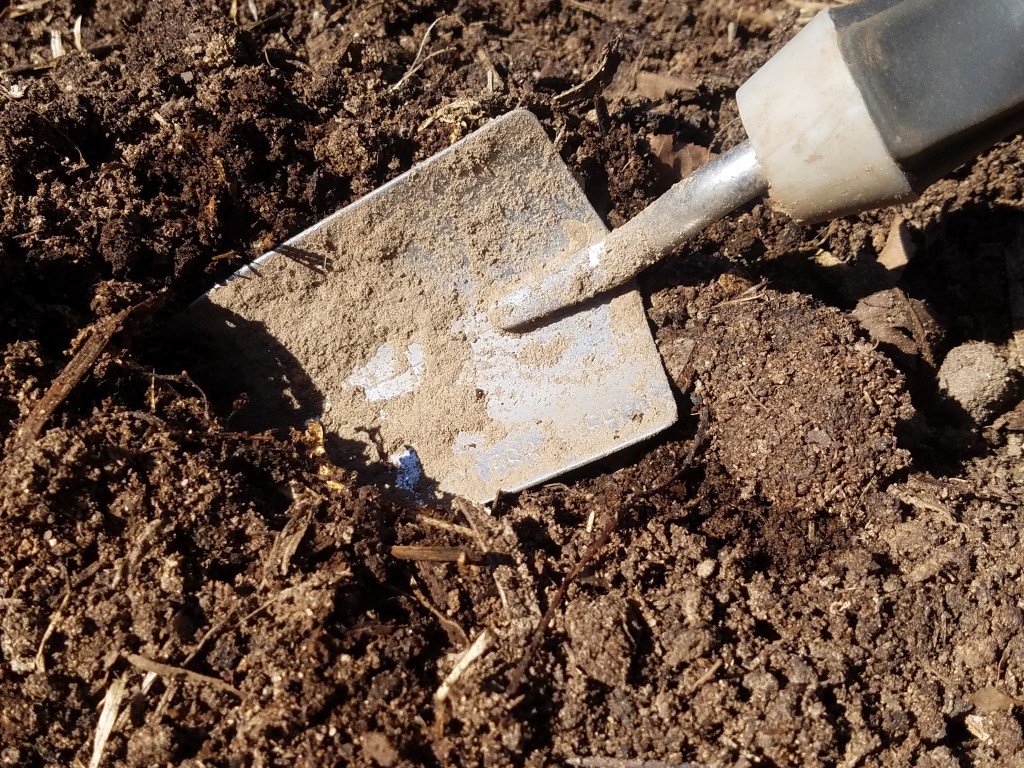
  • shovel dirt garden sprouts

When God created Adam and Eve, He placed them in a garden. He told them to “cultivate it and keep it.” The Hebrew words in this phrase from Genesis 2 mean something along the lines of “work or serve it and guard or attend to it.” Working in a garden was part of the original earthly paradise. And I think it’s interesting to note that God’s calling here is not to make things grow–that was His job. His children were simply to work and guard, to serve and attend. Basically, to show up and care for it.

It’s the same for me, whether in the garden or in life. My responsibilities, beyond staying firmly rooted in Christ and His Word, come down to these:

  • Faithfully sow
  • Faithfully water
  • Faithfully tend
  • Expectantly watch
daffodils spring garden growth

Every time I wander out into the garden, it’s an invitation to enter into the metaphor, to contemplate the truth beautifully woven into the fabric of Creation.

Here are a few of the scriptures that bring my garden time to life:

And He was saying, “The kingdom of God is like a man who casts seed upon the soil; and he goes to bed at night and gets up daily, and the seed sprouts and grows—how, he himself does not know. The soil produces crops by itself; first the stalk, then the head, then the mature grain in the head. Now when the crop permits, he immediately puts in the sickle, because the harvest has come.” Mark 4:26-29

“I am the true vine, and My Father is the vinedresser. Every branch in Me that does not bear fruit, He takes away; and every branch that bears fruit, He prunes it so that it may bear more fruit. You are already clean because of the word which I have spoken to you. Remain in Me, and I in you. Just as the branch cannot bear fruit of itself but must remain in the vine, so neither can you unless you remain in Me. I am the vine, you are the branches; the one who remains in Me, and I in him bears much fruit, for apart from Me you can do nothing. John 15:1-5

I planted, Apollos watered, but God was causing the growth. So then neither the one who plants nor the one who waters is anything, but God who causes the growth. 1 Corinthians 3:6-7

I’ll sign off with a quote my husband found in a gardening article some time back. He shared it with me, and I’ve made a point of hanging on to it.

The principle value of the garden . . . is to teach . . . patience and philosophy, and the higher virtue – hope deferred, and expectations blighted, leading directly to resignation, and sometimes to alienation. The garden thus becomes a moral agent, a test of character, as it was in the beginning.

–Charles Dudley Warner, My Summer in the Garden (found at this website: http://www.leereich.com/2012/06/every-time-i-go-near-my-apple-and-plum.html)

Post script: The day I started writing this article, I realized that our refrigerator went out. Nothing was cold. All the ice had completely melted. My day was not my own. We had to change gears, adjust, adapt. Within 30 minutes of wiping up the floor, I managed to drop a quart jar half full of coffee as I was attempting to put it in a cooler. Coffee splashed all over the floor, the fridge, and the cooler, requiring me to wipe up everywhere-again-and-then-some. I found myself saying, “Well! This is the day!” And then I laughed. And started singing, “This is the day that the Lord has made…We will rejoice and be glad in it,” inviting my kids to smile and laugh along with me. Yes, my friends, God is good. He graciously allows us many imperfections–and uses them to capture our hearts…if we but recognize the invitation.

Gardening is just one way God reminds us we’re not in control, that seeking to be perfect in ourselves is a fool’s errand. How else do you feel His gentle nudge?

  • View KeptandKeeping’s profile on Facebook
  • View lauren.keptandkeeping’s profile on Instagram
  • View keptandkeeping’s profile on Pinterest
  • View @laurenscott.keptandkeeping’s profile on YouTube
Lauren Scott

Lauren Scott

Christian. Wife. Mother. Homemaker. Home Educator. Blogger. Book Addict. Outdoorist.

View Full Profile →

Enter your email address to follow Life Meets Jesus and receive notifications of new posts by email.

Affiliate Disclosure

We are a participant in the Amazon Services LLC Associates Program, an affiliate advertising program designed to provide a means for us to earn fees by linking to Amazon.com and affiliated sites.

Hands-on Math Curriculum

RightStart™ Mathematics

Check Out Prodigies Music Curriculum!

music curriculum sale

Quality Video Curriculum

Top Posts & Pages

  • Five Refreshing Scriptures for Finishing Strong when You Feel Weak and Weary
    Five Refreshing Scriptures for Finishing Strong when You Feel Weak and Weary
  • Wisdom in the Book of James
    Wisdom in the Book of James
  • 30 Day Dress Challenge Recap
    30 Day Dress Challenge Recap

Advent April Fool's Day April Fools Book Review Books Books Charlotte Mason Charlotte Mason Homeschool children Christian Classical Education Christian Classical Homeschool Christian Homeschool Christian life Christian mom Christian Parenting Christian Women Christmas Classical Education Classical Homeschool devotional education faith Guest Post Home and Family Home Education Homemaking homeschool encouragement homeschooling Jesus Living Books love marriage meditations micro book reviews motherhood Nature Nature Studies parenting poems poetry Practical Atheism Reading List Reflections Relationships trials

A WordPress.com Website.

  • Subscribe Subscribed
    • Kept and Keeping
    • Join 171 other subscribers
    • Already have a WordPress.com account? Log in now.
    • Kept and Keeping
    • Subscribe Subscribed
    • Sign up
    • Log in
    • Report this content
    • View site in Reader
    • Manage subscriptions
    • Collapse this bar
 

Loading Comments...