
Tags
Books, Christian Classical Education, Christian Classical Homeschool, Classical Education, Classical Homeschool, Home Education, Homer, homeschooling, reading the classics, The Iliad
This post contains affiliate links. If you make a purchase through one of these links, I may make a commission at no additional cost to you. Thank you for supporting my blog!
This is a guest post from my good friend, Tabitha Alloway. We both have high schoolers this year, and they’re both going to read some Homer. While I’ve read The Iliad and The Odyssey recently so that I can be in conversation with my son about what he is reading, Tabitha has gone a step further and actually written out her thoughts, which I have found both interesting and helpful! I hope you will, too. Here’s Tabitha with Part 1:
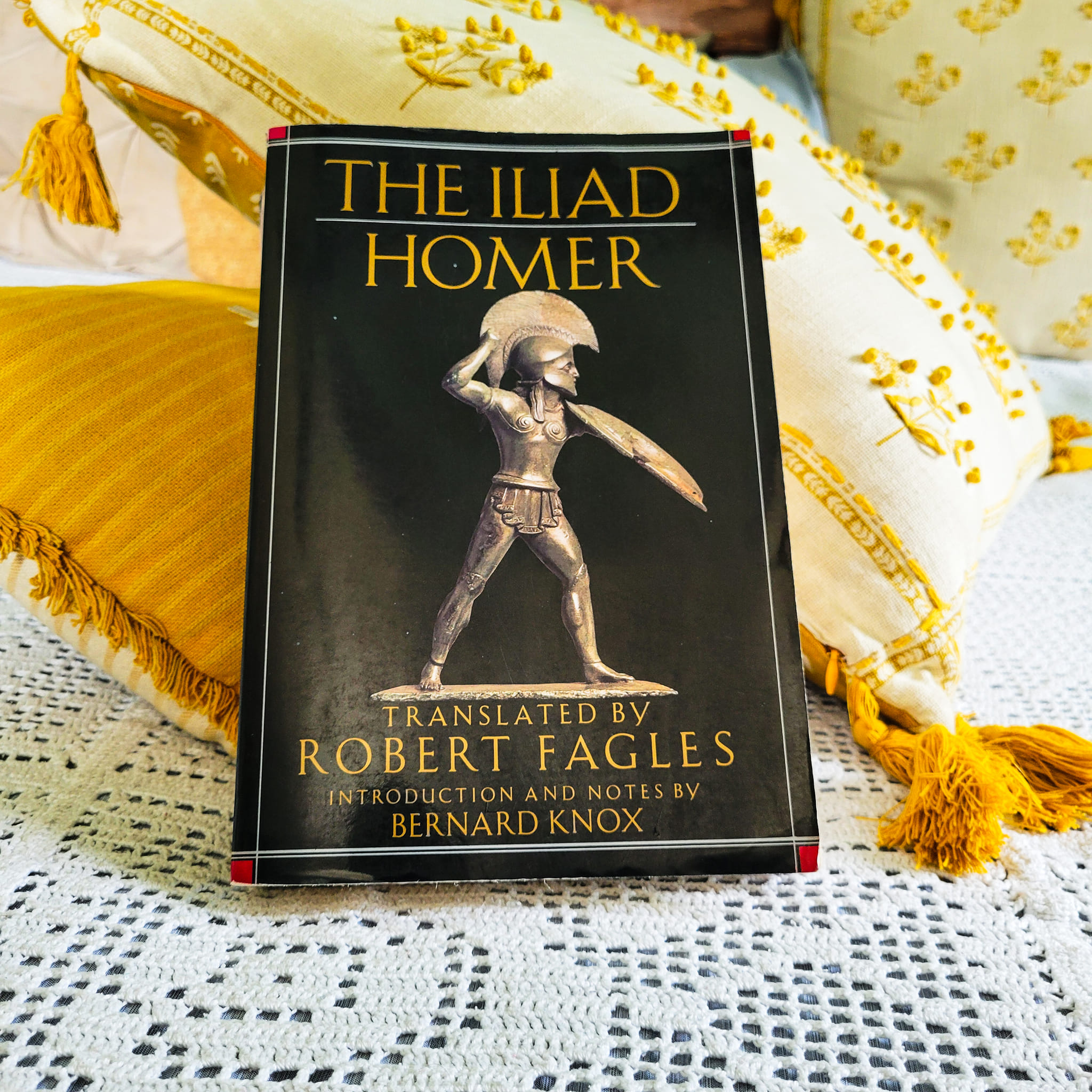
“Rage—”
The opening word of The Iliad captures the whole tenor of this Homeric epic: wrath, hatred, strife,
envy, pride, the clash of wills—of both gods and mortals. Rage drives the heroes to great acts of
courage… and rage brings ruin and death.
Beginning with a description of the anger of Achilles, Homer introduces us in the opening lines of the poem to the quintessential Greek hero: a mortal man born of the gods, fated to suffer tragedy, who will accomplish supernatural feats.
When his pride is wounded over an insult by King Agamemnon, Achilles swears he will no longer help the Greek army—already nine years into the siege of Troy—till tragedy befalls them. No generous offer of gifts, restitution of wrongs, or desire to reconcile on the part of Agamemnon can move him.
When a party of men conveys Agamemnon’s offer of peace and begs him to let his “heart-devouring
anger go,” he explodes,
“… Die and be damned for all I care!…
His gifts, I loathe his gifts…
I wouldn’t give you a splinter for that man.”
Odysseus, one of the three men sent with the message, rebukes,
“Achilles—
he’s made his own proud spirit so wild in his chest,
so savage, not a thought for his comrades’ love…
You—the gods have planted a cruel, relentless fury in your chest!…”
Odysseus returns to King Agamemnon with these words: “The man has no intention of quenching his
rage.”
Later, Apollo himself expresses disgust over Achilles’s anger:
“That man without a shred of decency in his heart…
his temper can never bend and change—like some lion
going his own barbaric way, giving in to his power,
his brute force and wild pride, as down he swoops
on the flocks of men to seize his savage feast.
Achilles has lost all pity!…”
This stubborn pride costs Achilles his dearest friend, Patroclus:
With Achilles out of the fight, the tide of war turns in favor of the Trojans. After seeing the devastation inflicted by their enemies, Patroclus implores Achilles to let him join the battle if he will not do so himself. Consenting, Achilles sends Patroclus out with his own suit of armor.
Patroclus achieves a victory on the battlefield, but is killed when he pursues the Trojans back to their
city. The news devastates Achilles. In his grief, he cries out,
“If only strife could die from the lives of gods and men and anger that drives the sanest man to flare in outrage—
bitter gall, sweeter than dripping streams of honey,
that swarms in people’s chests and blinds like smoke—”
He resolves to beat down “the fury mounting inside” him, “down by force.” At last he is able to set aside
his personal grievances in order to avenge his friend’s death. A formal display of reconciliation between
Agamemnon and Achilles reveals that neither party takes full responsibility for their acts. Both blame
their bad behavior on the gods. Nonetheless, Achilles is back in the fight.
But rather than overcoming his fury, he merely finds a new target for it—the Trojans, and Hector in
particular.
Now his bloody rampage begins. He slaughters mercilessly, with cruelty and joy. He mocks and taunts, hates—and loves hating. “God-like Achilles” descends to the lows of a murderous animal, with so much hostility in his heart he cares not if he dies.
Achilles was born of a goddess and a mortal. Knowing her son was fated for an untimely death, his mother attempted to avert the inevitable by holding him by his heel and dipping him into the River Styx when he was an infant. He was made invulnerable everywhere the water touched him. His heel, which was not submerged, became his one point of weakness. It is Paris who later brings down the mighty warrior—with a poisoned arrow to his heel.
But Achilles’s true heel, his vulnerability, is his inability to control his spirit and check his wrath. “He that hath no rule over his own spirit is like a city that is broken down, and without walls,” wrote the wise man (Proverbs 25:28).
The conquer and sack of Troy after the death of Achilles mirrors the defeat in his own heart, the
pillaging of his soul.
The great hero is a conquered man, driven by his feelings and passions rather than guided by reason
and wisdom. He has no walls of self-control, no defenses against his own pride that poisons him long
before Paris’s arrow flies to its mark. His spirit ravaged by rage, he falls. His “cruel, relentless fury”
nearly burns to ashes his very humanity, just as the Greek fires will later blacken the streets of Troy.
And yet, for a moment in the saga, before he reaches his end, his fury relents–and Achilles finds room in his proud, bitter heart for mercy…
More in this series:
Reflections on The Iliad, Part 2: Humanity and Hospitality
Reflections on The Iliad, Part 3: Some Thoughts on Greek Thought
Reflections on The Iliad, Part 4: Glory, Honor, Immortality, and the Folly of the Gospel
Other posts from Tabitha:
No Story is the Same, No Pain Ever Wasted
Introducing the Living Books Consortium
 Kept and Keeping
Pingback: Reflections on The Iliad, Part 2: Humanity and Hospitality | Kept and Keeping
Pingback: Reflections on The Iliad, Part 3: Some Thoughts on Greek Thought | Kept and Keeping
Thank you both for writing and sharing this. My son has just read The Iliad and I am referring back to this article for some talking points to discuss with him. Your time and thoughts are appreciated.
LikeLike