I wanted to hop on here today to let you know that I recently had the privilege of being a guest on Scholé Sisters, a podcast for classical Christian homeschool moms who want to “learn and grow as they help their children learn and grow.” I’ve been listening to Scholé Sisters since show one (or rather episode SS#00) dropped NINE years ago. To say I’ve been blessed by these ladies over the years would be an understatement. So you can imagine my delight at the opportunity to chat with Brandy and Mystie on their most recent episode, SS#152: School Choice–Freedom isn’t Free.
State funding for private education–including homeschooling–is a hot topic these days. If it isn’t in your state yet, it’s likely on its way. The rhetoric and intentions may sound noble, and in the short-term it may seem like a great deal: free homeschooling! And given the amount of money some states are handing out, you may be able to quadruple (or more) your current purchasing power.
But is it all it’s cracked up to be? Is there a catch?
The simple answer is: No, it’s not. And yes, there is. You’ll find there’s far more than one catch. There’s a whole slew of strings attached and unintended (or intended?) consequences. “Free” homeschooling does not equal homeschool freedom.
The thorough answer is: listen to the podcast. 🙂 It’s a long one, but well worth it, I promise!
If you are wondering why I would dedicate space on this blog to such an issue, why I would light up my social media accounts with it, then I think you’ll appreciate hearing my story–how I got involved in researching this issue last May, and how it became personal very, very quickly.
The podcast covers my experience with a “school choice” program rolling out in my home state of Arkansas, as well as Brandy’s experience in California and now in Texas. We also discuss key principles that you can use to evaluate any “school choice” legislation or programs in your own state (or country).
The details may differ from state to state, but the basic principles remain the same.
I strongly encourage you to give this episode a listen. The future of homeschooling and private Christian education in America may very well depend upon our understanding of these principles–and our courage to act upon them…or not.
Be sure to follow me on Facebook and Instagram. More memes and videos forthcoming. 😉
[In case anyone is wondering, I still stand by everything I’ve said before about Instagram. Please don’t take my presence as an encouragement for you to hop on if you aren’t already there. My only motivation to be back on IG is to help get the word out about *this issue*. If that doesn’t tell you how important this is, I don’t know what will.]
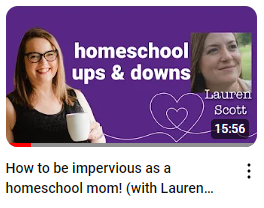
I recently had the privilege of chatting with Mystie Winckler on her Simplified Organization Podcast, sharing the story of how I really learned to be an impervious homeschool mom during my oldest son’s challenging fourth grade year. As soon as the recording was over my mind filled with further thoughts and clarity on the subject, which, in my limited experience with podcasts, seems to be par for the course. At any rate, I’d like to share the concept of imperviousness with you for your benefit so that the story I tell on Mystie’s podcast will make that much more sense and be that much more helpful.
I first heard about imperviousness many years ago from Mystie herself, who heard it from Cindy Rollins before that. Despite having been introduced to the concept early in our homeschool journey, it took me some time to wrap my head around it.
So what does it mean to be impervious? Here’s the definition from Webster’s:
Impervious: 1a: not allowing entrance or passage : impenetrable Ex: ‘a coat impervious to rain’ b: not capable of being damaged or harmed Ex: ‘a carpet impervious to rough treatment’ 2: not capable of being affected or disturbed Ex: ‘impervious to criticism’
The essential idea when applied to parenting and homeschooling is to not let your kids get to you. You are committed to doing what is right for your kids without being thrown off course by their ups and downs, whining or talking-back, disobedience or tantrums, pleading or puppy-dog eyes.
This doesn’t mean you’re cold and heartless, it just means that you are in control of yourself rather than letting your kids take the reigns or knock you off-kilter. Kids aren’t born with self-control, so you’ve got a long head-start on them in developing it; and if you are a regenerate follower of Jesus Christ, you have the Holy Spirit to produce that fruit in you.
Be controlled by the Spirit, not by your kids. (See Ephesians 5:18 and laugh with me at the loose parallelism that I just made.)
Imperviousness absolutely ought to come with love, joy, peace, patience, kindness, goodness, faithfulness, gentleness, and self-control (Galatians 5:22-23). Though in the moment, when you’re tested by all the fuss your children can muster, it can feel a lot more like holding back a wave of frustration and mommy-tantrums than like “smooth and easy days” (I’m looking at you, Charlotte). 😉
From my own experience, I will offer that imperviousness—a bit of emotional separation from your kids—is actually an important step toward having genuine fruit of the Spirit grow in your relationships with your children.
It’s tempting to think that the more we detach from our kids’ emotions, the less able we will be to sympathize with them and offer the emotional support that they may need. But in reality, if my emotions aren’t under control, if they are instead reactive or reflective of my child’s emotions, then I’m not providing the stable anchor for my child in the midst of his turbulent sea.
Once I was able to see my son’s ups and downs without joining him in them or reacting to them, I was then able to calmly call him to do his duty and also calmly comfort him when learning to overcome his particular challenges was really hard.
Imperviousness is sometimes referred to as “being the wall” for our kids. Setting a course or a standard and sticking to it no matter how our kids bump up against us. But take note that being a wall doesn’t require being angry. In fact, getting upset actually means that our wall is likely to move—either to give way to our kids or to fall on them and crush them. That’s not imperviousness in either case.
When our kids are on an emotional roller coaster, we don’t need to get on the roller coaster with them. We can help them calm down and do the work only when we ourselves remain calm and stay off of the wild ride that they’re on.
In the podcast with Mystie, I tell the story of my oldest son’s fourth grade year, which was a painful learning process for us both. My lack of imperviousness around math led to a need for intervention—my husband helped set us on a course that provided more distance between me and my son’s day-to-day math performance. As a result, we both grew by leaps and bounds that year, and we have reaped the benefits of it ever since (that 10-year-old is now 15!). I learned to be truly impervious in what was for me the place of greatest testing. Make sure you get the full story by listening to (or watching) the podcast, and then consider these take-aways from my experience:
Even when you have an idea of how to be impervious as a mother, don’t be surprised if you find yourself tested in a particular area. I could be impervious in a lot of settings, but math was my Achilles’ heel. Watch out for that one specific area that trips you up. “Therefore let him who thinks he stands take heed that he does not fall.” 1 Corinthians 10:12
Impatience is the opposite of imperviousness. Maybe imperviousness can have other opposites, too, but in my case, the real emotional upheaval was around the fact that I couldn’t speed up the learning process to meet my expectations. My expectations and attitude had to change before I could provide the stability my son needed.
Natural consequences and/or an impersonal standard are tools that can make imperviousness a little easier to practice. When your kids are reeling against the direction you’ve given or are asking for things to be different, it’s a lot easier to hold your ground when you have already clearly communicated your expectations and have even written them down somewhere. You don’t have to flex your authority when you can simply appeal to the law of the land (or maybe just your house) and tell them that if you do x you get y (whether that’s a positive or negative reinforcement). Direct disobedience needs discipline, authority isn’t something to be afraid of, but well-established expectations and consequences can help with most other scenarios. (Listen to the podcast for the specific steps we took in this department!)
One important element of imperviousness is that you can see beyond more than just today. We can expect that there will be ups and downs in our day-to-day experience, but we need to remember that we’re playing the long-game (something my husband has had to remind me of often).
When Mom lacks imperviousness, Dad may be a good source of it! Dads (not always but often) can come at a parenting situation with greater emotional distance. Sometimes their approach seems harsh/too strict to us as moms, but sometimes that’s exactly what is needed. Value what Dad brings to your parenting team.
If you find yourself in the middle of a crazy season because you’ve gotten on the roller coaster ride with your kids or have provided some of the loopty-loops yourself, it’s ok. You’re normal. Course correct as soon as you can—preferably before outside intervention is necessary! Hold the line. But don’t wallow in your past mistakes. To quote Mystie: “Repent. Rejoice. Repeat.”
There CAN be peace on the other side of your worst homeschooling mistakes. God is merciful and gracious. And He can heal what is broken. Confess and repent, rejoice in the Lord, and pursue joyful-yet-impervious fellowship with your kids as you guide them through their home school years and beyond.
I hope my story and these considerations can help you in your parenting and homeschool journey. God is faithful. Look to Him for the fruit of the Spirit each day, and trust Him for the fruit He will produce in you and your children over the long haul. Steady your heart to provide a stable, impervious mama for your kiddos. You and they will be better for it.
Here’s the podcast link, one last time:
And if you want another peek into my story, here’s an article I wrote while in the middle of that challenging season: Ideals and the Daily Grind.
Have you ever heard the term “impervious” before? Have you had a seriously challenging season with one of your children? How did you handle it?


 Kept and Keeping