I was in 8th grade when I found out the world was broken. The Columbine High School Massacre shook a nation, and it shook me, too.
Sure, growing up in Texas, I had been vaguely aware of the 1993 Waco Siege and a bit more aware of the Oklahoma City Bombing since it provoked a moment of silence before one of my 10U softball games.
But when you’re 14 and your conversion to Christ is less than a year old, the martyrdom of would-be peers like Cassie Bernall and Rachel Scott tends to leave an imprint.
“Do you believe in God?”
“Yes, I do.”
Bang.
Just a few years later, the world broke again.
It was September 11, 2001, and I had just walked into my Junior English class. There was a bit of a commotion and a student turned on the TV in the upper corner of the room, opposite the door, so I had a perfect view as I walked in. There was a tall building with smoke coming out of it. We watched with confusion, incredulity, and horror as a second plane ran into the other tower on live TV.
A girl in one of my classes shrieked that her dad was flying that day. She was a wreck until she found out he wasn’t on one of those planes.
Our US government test was canceled that afternoon. Instead, we watched and discussed history in the making, with room for questions, grief, and silence.
Just as my 14 year old self took courage from the stories of students who lost their lives at Columbine, I also followed stories of heroism from 9/11. Of particular note was Christian husband and father Tod Beamer. He was one of the men who left the illusory safety of his passenger seat to fight his plane’s hijacker. This is the plane that crashed in a field rather than, say, the White House. His widowed wife tells the story in the book Let’s Roll.
These are the moments and stories we never forget.
You remember the images. You remember where you were standing when the news broke and your world broke with it.
Today’s remembrance of 9/11 follows in the fresh wake of another world-breaking moment.
I won’t soon forget where I was standing yesterday afternoon when Charlie Kirk was murdered. I was in the kitchen, about to process some chicken and prepare enchiladas for our church’s youth who would arrive at our house in a few hours. I picked up my phone to check Instagram, and at the top of my feed was a simple text post from Allie Beth Stuckey announcing the shooting and pleading for prayer.
My first thought was, “Oh, God. Not Charlie Kirk.” You might have expected political violence against some of the more abrasive and loud-mouthed conservative figures. But Charlie was a devout Christian, outspoken but incredibly patient and willing to engage in dialog with anyone. “Not Charlie.”
Tears and many prayers followed.
Prayers and tears while cooking taco meat and rolling enchiladas. I asked the boys to put on a good album of Christian music while they cleaned and I cooked. I hadn’t told them yet. Still processing the event and food and prayer after prayer after prayer.
But when the report came out that Charlie had died, and the boys could likely see that something had been eating at me or at least had me distracted, I finally told them. Right there in the kitchen, standing next to the kitchen table.
The words didn’t come easily. But they came. So did the stunned faces, the look of shock and sadness.
Yesterday my 8th grader found out the world was broken, if he didn’t know that already.
Because yesterday a good man got shot for speaking truth. It’s the same thing that happened to Cassie Bernall and Rachel Scott, just on a grander and more sophisticated scale.
Promote free speech and civil discourse by living it.
Clearly articulate conservative moral and political views.
Speak up for the unborn.
Promote biblical marriage and family life.
Unashamedly proclaim the gospel.
Bang.
A young woman widowed. Two precious children left without a father. A nation of young people touched by the violence against a man who touched their lives.
What are we to do? There’s anger, there’s grief. What does the Scripture say?
Be angry and yet do not sin.
Weep with those who weep.
Pray for the widow and orphan.
Pray for those who persecute you.
Speak the truth in love.
Do not be ashamed of the gospel: the world is broken, and we know the only Healer.
Yes, we can do that. By the grace of God, we can do all of that. I can encourage my sons in that.
But I’m also thankful that I had responsibilities to feed other people yesterday evening. To pull me away from the news updates, the doom scrolling, the negative spiral and back into the physical world of embodied service and life in community.
We welcomed our friends last night, shared a meal, read and reflected on the Sermon on the Mount, prayed with our teens, and then as parents and leaders, prayed for our teens. What a healing balm on such a tragic day. We just did the usual thing, nothing loud and fancy—we gathered as believers in Christ, practicing the ordinary means of grace.
And I think that’s where I’ll leave this. Where do we go from here? We go to the Word and all of the most basic Christian disciplines—both in our solitude and in community. We run to Jesus, pleading that He might produce the fruit of His Spirit in us. And we go about our ordinary, everyday obedience to Christ, rolling up our sleeves and our enchiladas, refusing to abandon our post, refusing to shy away from the hard conversations, refusing to compromise the truth, prayerful and Christ-exalting in all of it.
And maybe, just maybe, instead of being more afraid because of yesterday’s events, we’ll do it all with even more courage and boldness because of Charlie Kirk’s example.
“The blood of the martyrs is the seed of the church.” —Tertullian
Some are called to serve Christ on the front lines by reaching young people on college campuses. And some of us are called to serve Christ on the front lines by raising our own young people before they land on a college campus.
So to the mamas out there: Hold the line. Make that meal. Arrange those flowers. Love your husband. Love your children. Call that friend. Provide the physical sustenance that brings people together for fellowship around the spiritual sustenance of the Word of God.
And pray for Erika Kirk as she seeks to do the same—without Charlie by her side.
The following article and the other two in this series are talks that I gave at a women’s retreat in my area. The theme was “Pioneer Women”, and the scriptures were chosen for me. It was a fruitful exercise for me and a delight to get to share some insights from God’s Word with the lovely ladies who gathered to hear it. I hope you’ll find it to be an encouragement to you, as well. Building on the foundation of Godly Wisdom, and the life of Good Works that God calls us to, this third and final article discusses a Christian woman’s Gracious Words that ought to flow from hearts that have been redeemed by the love of God through the gospel of Jesus Christ.
Before we wrap up this series, let’s recap where we’ve been:
We want to pursue wisdom, asking God for it and searching for it in His Word—and we want to use that godly wisdom to glorify God by building up our household—caring for the people and things that God has entrusted to us.
We want to walk in the good works that God has prepared for us. Godly wisdom helps us to discern what works are truly good and worth our time, and we know that godly wisdom is rooted in the fact that our salvation rests fully on the work of Christ—not our own works. We love because He has first loved us. With faith and hope in Jesus, and with assurance of His incredible love for us, we can roll up our sleeves and do good to others in His name.
But Our Words Can Make or Break Our Service
We know that serving others can be messy. When we help those in need, we often become aware of things in their lives that they are ashamed of. The places they need help are often places of pain.
This is actually the context for today’s passage on the tongue. Our verse is 1 Timothy 3:11, but I’m going to get a run at it, starting with verse eight:
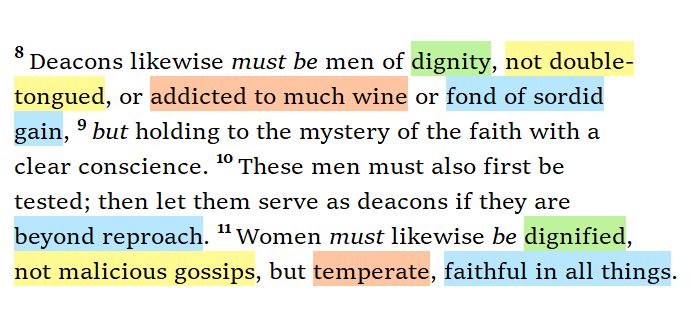
Deacons likewise must be men of dignity, not double-tongued, or addicted to much wine or fond of sordid gain, but holding to the mystery of the faith with a clear conscience. These men must also first be tested; then let them serve as deacons if they are beyond reproach. Women must likewise be dignified, not malicious gossips, but temperate, faithful in all things.
The word deacon means “servant.” This can take a lot of forms, from serving tables (Acts 6) to managing finances to visiting the sick and needy. Many commentators see the women in this passage as the wives of deacons, since the word for woman is the same in Greek as the word for wife. However you take it, it’s clear that the bible holds high standards for both men and women who serve in the church, and that standard is the kind of Christian maturity that we all ought to be aiming toward.
A woman who helps her husband in the service of God’s people, or who does real service in the church, whether married or not, needs to be someone who can be trusted. Are you a trustworthy friend and helper? Or does your mouth share what ought to be kept private? This takes wisdom and discretion, and we all will get it wrong sometimes (James 3). Each time we fail in our speech is an opportunity to confess it to the Lord and to anyone else where necessary, to repent of that sinful speech, and trust fully in the Lord Jesus who died to pay the penalty for that sin.
A High Calling
Now, let’s look a bit closer at 1 Timothy 3:11, complete with color-coding to help us see what’s there. 🙂
It’s interesting to note that the characteristics held up for the women in our verse mirror most of those listed for the men:
Both are to be “dignified,” or honorable, so that when they serve in an official capacity for the church, they represent it and the Lord Jesus Christ well.
While it says women are to be “temperate,” the men also are to “not be addicted to much wine”—both are to be self-controlled and not under the influence of alcohol, so that they are able to serve with good, sober judgment at all times.
The call for women to be “faithful in all things” mirrors the men’s calling to be “beyond reproach”—so that no charges of misconduct can be brought against them.
The need for a deacon to be “not fond of sordid gain”, that is, ill-gotten or unjustly acquired wealth, fits here, too. When you are active in service, you may be entrusted with money either to give to those in need or to purchase things for service projects. “Faithful in all things” certainly would have an impact on how a man or woman handles money.
The same mirroring pattern holds for gossip. Women are not to be “malicious gossips.” And the men are not to be “double-tongued,” talking nice to someone’s face but saying something quite different behind their back.
Gossip
So what is gossip? Well, in our passage, the Greek word translated gossip is “diabolos.” The majority of the time this word is used in the New Testament, it is translated “devil”—referring to our enemy, the accuser of the brethren, the slanderer of our good and gracious God.
Our world today may wink at gossip as though it isn’t a big deal, or may even celebrate it by publishing it in tabloids, posting it on social media, or promoting it as “news.” But we’re warned in Scripture that gossip is a devilish and destructive behavior.
Here’s a definition of gossip from Matthew Mitchell, a pastor invested in biblical counseling: He says that gossip is “Bearing bad news behind someone’s back out of a bad heart. …We gossip because our sinful hearts are attracted to negative stories much like moths to a flame.”
Ouch! But isn’t there truth in that statement? Have you ever wondered why the news focuses so much on bad news? Why most viral social media posts are angry rants? The human heart is drawn to this stuff.
If we are to become wise women whose speech is characterized by gracious words, we need to learn how to resist gossip from the heart—not just try to stop damaging words at our lips, but learning to renew our hearts and minds by the help of God’s Holy Spirit.
Out of the overflow of the heart, the mouth speaks, Jesus told us.
In Philippians 4:8, Paul tells us to think about whatever things are true, honorable, right, pure, lovely…if there is anything of good repute, if there is excellence, or anything worthy of praise, think about these things.
That’s a pretty good filter both for what we take in and for what we dish out.
Gossip can include passing on a scandalous news story that you haven’t verified—or one that you have verified but simply isn’t necessary. It can include divulging private matters that someone entrusted to you in confidence—and in such cases, it’s a breech of trust that can not only hurt the person you’re speaking about, but it can also do lasting damage to your relationship. And the person you shared that juicy morsel with—how likely are they to trust you in the future? They already know that you talked about your other friend behind her back.
Searching Our Hearts
Here are some questions we can ask ourselves to keep our hearts and our tongues in check. These are borrowed from a recent podcast episode on gossip by Marci Farrell, at Thankful Homemaker:
Questions to ask yourself:
Is it time to say this?
Am I the right person to say this?
Is it necessary? (Will it really help/give grace?)
Is it kind?
Is it true?
A question I would add is this:
Why do I want to share this? Am I making myself feel or look better by sharing someone else’s shame?
How can I speak graciously and honestly about this person without divulging things that ought to remain private?
Where to watch out for gossip:
Social media
When seeking counsel
Prayer requests
Sharing conflict
Venting
Caveat: We may need a trusted husband or friend or mentor with which to share the details of our lives and the wrestlings of our hearts—just make sure they are trustworthy and not prone to morbid interest in gossip or to repeating what they hear. I remember sharing something with a friend in college, and her response was, as she assumed, to join me in bashing the other person. But that wasn’t what I was doing, nor was it what I wanted from her. She demonstrated that she was not a godly, trustworthy friend. A good and godly friend will sympathize with you without taking on an ungodly attitude on your behalf. Look for that in a friend, and seek to be that kind of friend for others.
Here are two other caveats that we can’t go into detail on today, but that I’d still like to briefly state:
1) There’s a difference between a hard word and a harsh word. We can’t control how someone will respond when we bring a needed reproof (a hard word). But we can control how we deliver it—by being gracious rather than harsh.
A gentle answer turns away wrath, But a harsh word stirs up anger.
Proverbs 15:1
2) There’s also a big difference between everyday wise restraint of our speech and reporting a crime. Talk to the wise older women and leaders in your church for help knowing when it is time to speak up and get help. If there’s real danger, please reach out to someone who can help.
Gracious Words Build Up Children
To bring this all home, I want to illustrate the deep impact our words can have. Let’s think for a moment about our long-ago pioneer woman. Let’s imagine that her family lives out on the plains where their nearest neighbors are 50, maybe 100 miles away, back in a time when that kind of journey would take a couple days. Her husband and her children would be the only people around on a daily basis. And that means that the words she spoke to them would make up just about all that they heard from anyone. There would be no video or audio recordings. No telephones. No one else to speak words of life to her husband and children. What if she spoke bitterly and sarcastically toward her husband and impatiently and critically toward her children? What if she filed all of her complaints against her husband to the children? And what if she did them same when reporting on the children to their father?
The man and the children might try to encourage each other, but what has mama contributed to their hearts and minds? What atmosphere has she created in her home?
We have so many entertainments and noisy diversions today that we might imagine that the impact of our words is less critical than in bygone days (but it’s not). And with all of our personalized distractions, it’s possible to hurt others by our lack of speech: completely ignoring the people in our homes, each of us more attached to a device or screen than we are to one another. We can do harm both by destructive words and by checking out.
Children not only learn to talk from their parents, they also build their inner script off of what they hear from their parents. I believe it was Sally Clarkson who first made me aware of this particular power of mothers. We set the tone for our children’s hearts and minds, fueling their inner dialog, or what some call “self-talk.” I’ve seen this work out beautifully. My pastor and his wife have some incredibly joyful daughters. I can see so much of their mother’s words and attitudes in them. But I also have a friend whose mother spoke words of poison into her soul. And the impact has been disastrous, wreaking havoc in my friend’s life ten, twenty years into adulthood. There are very real and long-lasting consequences to the words we speak in our homes.
It’s not that we can’t, by the grace of God, overcome the difficult and sometimes downright devilish words that have been spoken around us or to us or about us. By God’s grace and the power of His Spirit, we can put off the old and put on the new, we can fill our hearts and minds with Scripture, turn our thoughts to what God says is true, be nourished by friends and mentors who speak God’s truth over us. But isn’t it better, if it is in our power, especially if we are mothers, to lay that kind of foundation for our families in the first place?
Reading the bible to the children, helping them memorize scripture, singing songs and hymns, telling good, heroic stories, calming them when they’re scared, teaching them to turn their thoughts to what is true and good, praying with them, lovingly teaching them all the practical skills of everyday life, calmly disciplining and then redirecting them when they misbehave…
Our attitudes and words in all of these activities make up the air that our children breathe.
Gracious Words Build Up Husbands
And this is true for anyone we share our home with, including our husbands, if we’re married. Our words to our husbands either strengthen our relationship, put it on ice, or tear it down. What are you doing in your words to your husband? Typically, a wife’s opinion and treatment of her husband matters to him more than what anyone else thinks of him or says to him. Use that power for good. Build him up with gracious, encouraging words. Thank him for what he does for your family—both at work and at home. If he plays with the children, encourage and celebrate it. Remind him why you fell for him in the first place and tell him what you still love about him today. Like the pioneer husband on the plains, he won’t get that kind of encouragement from anyone else but you—and he shouldn’t.
Whomever you live with or near—a roommate or sibling, a neighbor down the street or down the hall—what impact can your gracious words have on them? For their good and for the sake of the gospel of Jesus? Let’s align our hearts with God’s truth and use our words to proclaim and show forth His goodness to those around us—in our homes, in our churches, and wherever else we may go.
God, in the beginning, You spoke and created all things. And you said that it was all GOOD. Only You have true words of life, so help us to run to You, to cling to Your life-giving Word. And Father, please put Your Word into our hearts and minds, and may it also pour out of us into the lives of others, that our words would be in line with Your words, Your truth, Your goodness. May the teaching of kindness be on our lips. Amen.
Have you read all three posts in this series? What has spoken to your heart when it comes to living out Godly Wisdom, Good Works, and Gracious Words? Have you prayerfully put any of this into practice?
I recently had the privilege of chatting with Mystie Winckler on her Simplified Organization Podcast, sharing the story of how I really learned to be an impervious homeschool mom during my oldest son’s challenging fourth grade year. As soon as the recording was over my mind filled with further thoughts and clarity on the subject, which, in my limited experience with podcasts, seems to be par for the course. At any rate, I’d like to share the concept of imperviousness with you for your benefit so that the story I tell on Mystie’s podcast will make that much more sense and be that much more helpful.
I first heard about imperviousness many years ago from Mystie herself, who heard it from Cindy Rollins before that. Despite having been introduced to the concept early in our homeschool journey, it took me some time to wrap my head around it.
So what does it mean to be impervious? Here’s the definition from Webster’s:
Impervious: 1a: not allowing entrance or passage : impenetrable Ex: ‘a coat impervious to rain’ b: not capable of being damaged or harmed Ex: ‘a carpet impervious to rough treatment’ 2: not capable of being affected or disturbed Ex: ‘impervious to criticism’
The essential idea when applied to parenting and homeschooling is to not let your kids get to you. You are committed to doing what is right for your kids without being thrown off course by their ups and downs, whining or talking-back, disobedience or tantrums, pleading or puppy-dog eyes.
This doesn’t mean you’re cold and heartless, it just means that you are in control of yourself rather than letting your kids take the reigns or knock you off-kilter. Kids aren’t born with self-control, so you’ve got a long head-start on them in developing it; and if you are a regenerate follower of Jesus Christ, you have the Holy Spirit to produce that fruit in you.
Be controlled by the Spirit, not by your kids. (See Ephesians 5:18 and laugh with me at the loose parallelism that I just made.)
Imperviousness absolutely ought to come with love, joy, peace, patience, kindness, goodness, faithfulness, gentleness, and self-control (Galatians 5:22-23). Though in the moment, when you’re tested by all the fuss your children can muster, it can feel a lot more like holding back a wave of frustration and mommy-tantrums than like “smooth and easy days” (I’m looking at you, Charlotte). 😉
From my own experience, I will offer that imperviousness—a bit of emotional separation from your kids—is actually an important step toward having genuine fruit of the Spirit grow in your relationships with your children.
It’s tempting to think that the more we detach from our kids’ emotions, the less able we will be to sympathize with them and offer the emotional support that they may need. But in reality, if my emotions aren’t under control, if they are instead reactive or reflective of my child’s emotions, then I’m not providing the stable anchor for my child in the midst of his turbulent sea.
Once I was able to see my son’s ups and downs without joining him in them or reacting to them, I was then able to calmly call him to do his duty and also calmly comfort him when learning to overcome his particular challenges was really hard.
Imperviousness is sometimes referred to as “being the wall” for our kids. Setting a course or a standard and sticking to it no matter how our kids bump up against us. But take note that being a wall doesn’t require being angry. In fact, getting upset actually means that our wall is likely to move—either to give way to our kids or to fall on them and crush them. That’s not imperviousness in either case.
When our kids are on an emotional roller coaster, we don’t need to get on the roller coaster with them. We can help them calm down and do the work only when we ourselves remain calm and stay off of the wild ride that they’re on.
In the podcast with Mystie, I tell the story of my oldest son’s fourth grade year, which was a painful learning process for us both. My lack of imperviousness around math led to a need for intervention—my husband helped set us on a course that provided more distance between me and my son’s day-to-day math performance. As a result, we both grew by leaps and bounds that year, and we have reaped the benefits of it ever since (that 10-year-old is now 15!). I learned to be truly impervious in what was for me the place of greatest testing. Make sure you get the full story by listening to (or watching) the podcast, and then consider these take-aways from my experience:
Even when you have an idea of how to be impervious as a mother, don’t be surprised if you find yourself tested in a particular area. I could be impervious in a lot of settings, but math was my Achilles’ heel. Watch out for that one specific area that trips you up. “Therefore let him who thinks he stands take heed that he does not fall.” 1 Corinthians 10:12
Impatience is the opposite of imperviousness. Maybe imperviousness can have other opposites, too, but in my case, the real emotional upheaval was around the fact that I couldn’t speed up the learning process to meet my expectations. My expectations and attitude had to change before I could provide the stability my son needed.
Natural consequences and/or an impersonal standard are tools that can make imperviousness a little easier to practice. When your kids are reeling against the direction you’ve given or are asking for things to be different, it’s a lot easier to hold your ground when you have already clearly communicated your expectations and have even written them down somewhere. You don’t have to flex your authority when you can simply appeal to the law of the land (or maybe just your house) and tell them that if you do x you get y (whether that’s a positive or negative reinforcement). Direct disobedience needs discipline, authority isn’t something to be afraid of, but well-established expectations and consequences can help with most other scenarios. (Listen to the podcast for the specific steps we took in this department!)
One important element of imperviousness is that you can see beyond more than just today. We can expect that there will be ups and downs in our day-to-day experience, but we need to remember that we’re playing the long-game (something my husband has had to remind me of often).
When Mom lacks imperviousness, Dad may be a good source of it! Dads (not always but often) can come at a parenting situation with greater emotional distance. Sometimes their approach seems harsh/too strict to us as moms, but sometimes that’s exactly what is needed. Value what Dad brings to your parenting team.
If you find yourself in the middle of a crazy season because you’ve gotten on the roller coaster ride with your kids or have provided some of the loopty-loops yourself, it’s ok. You’re normal. Course correct as soon as you can—preferably before outside intervention is necessary! Hold the line. But don’t wallow in your past mistakes. To quote Mystie: “Repent. Rejoice. Repeat.”
There CAN be peace on the other side of your worst homeschooling mistakes. God is merciful and gracious. And He can heal what is broken. Confess and repent, rejoice in the Lord, and pursue joyful-yet-impervious fellowship with your kids as you guide them through their home school years and beyond.
I hope my story and these considerations can help you in your parenting and homeschool journey. God is faithful. Look to Him for the fruit of the Spirit each day, and trust Him for the fruit He will produce in you and your children over the long haul. Steady your heart to provide a stable, impervious mama for your kiddos. You and they will be better for it.
Here’s the podcast link, one last time:
And if you want another peek into my story, here’s an article I wrote while in the middle of that challenging season: Ideals and the Daily Grind.
Have you ever heard the term “impervious” before? Have you had a seriously challenging season with one of your children? How did you handle it?
This post contains affiliate links. If you make a purchase through one of these links, I may make a commission at no additional cost to you. Thank you for supporting my blog!
This is a longer book review than I usually write on Goodreads, so I thought I’d share it here. When I take the time to give a more thorough review, it’s often because I think the book is valuable and that at least some people probably ought to read it, but it also likely means I have some considerations that I think readers ought to keep in mind in order to sift through it and apply it rightly. Mama Bear Apologetics is one such book. In this case, there are some things to “chew and spit” from the book, even as the book itself teaches moms how to “chew and spit” what they encounter in the world today.
My rating: 4 of 5 stars I give this 4 stars, but that’s rounded up from 3.5.
While I am a mother, I am not the target audience for Mama Bear Apologetics. I’ve been around the block a few times when it comes to apologetics. The authors are writing to moms who aren’t so familiar with it. But I was excited to see this title in Hobby Lobby and wanted to preview it to see how useful it would be for younger moms I know.
Verdict: The content chapters are very good at briefly covering the various isms and issues of our day–I’m thankful that a book like this exists. I’d say it is useful to its purpose but with a few very important caveats, especially concerning the introductory chapters.
Most foundationally, while I understand wanting to stress the importance of apologetics, there were some problems in how the authors laid it out in the first two chapters. They talked about apologetics as “foundational”. They cited the sad statistics of how few professing Christian teens actually read their bibles (among other stats). But then a few pages later they said that reading the bible (along with Sunday school, etc) isn’t enough–we need apologetics. There’s a disconnect here, folks. If only 5% of professing Christian teens today read the bible, and that’s down from 8% in 1991, then the most foundational problem is that teens aren’t actually in the Word. And what’s more, those teens from 1991 (or the decade or two after that) are parents today–so we have biblically illiterate parents as well as teens. If apologetics gets people to dig into their bibles more, great. But the foundational issue is not a lack of apologetics. The foundational issue is a lack of a foundation–in the Scriptures.
To be fair, the author of chapter two does say: “We need to remain in God’s Word and in regular prayer to Him. After all, we can’t defend Scripture if we don’t know it.” But 1) this was one statement in a sea of overemphasis on apologetics, 2) it still makes bible reading subservient to apologetics (“we can’t defend…”) instead of reading it for its most foundational purpose–to know and love God, and 3) it still only refers to the parents and not the training of the children to read the Bible for themselves.
It may feel to some like I am splitting hairs here, but it is incredibly important to put things in their proper order! Jesus is worthy of devotion no matter what goes on in the world around us. And His Word is precious to us because it is how we grow in knowledge of our God and how we can serve Him. Then we can learn to defend against enemy attacks because we prize what we are defending. We only arm ourselves with apologetics because there is something worth defending and holding onto for its own sake. I trust that the authors agree with this, but I sure wish they had taken the time to allude to the real foundation and give a brief outline of core Christian teachings and basic spiritual disciplines before diving into the rest of their content. A little less cutesy talking down to moms would probably have provided the space needed.
Connected to this inordinate emphasis on apologetics is the idea that apologetics is needed–and even apologetics curriculum!–for very, very young children. Everything in me screams, “No!” Children need to be steeped in the Word of God. Their first instruction needs to be the positive teaching of Christian faith and practice in reference to the Bible and their everyday life, not instruction in reference to the wrong ideas in the world. A closing thought from one of the authors at the end said that in reading this book, “you have taken your first step toward teaching yourself and training your children to love God with their minds. Bravo!” The encouragement intended is not lost on me, but a book like this is not the first step, friends. Confess your sins and trust in Jesus for salvation. Read God’s word, memorize it and meditate on it (THIS is how you train or renew your mind). Participate in local church fellowship, baptism, and the Lord’s supper. Teach and share these things with your children and pray for the Lord to work. The ordinary means of grace are the first steps and they are the step after that and the step after that and the step after that–even as you add some apologetic training to your ordinary, faithful Christian lives.
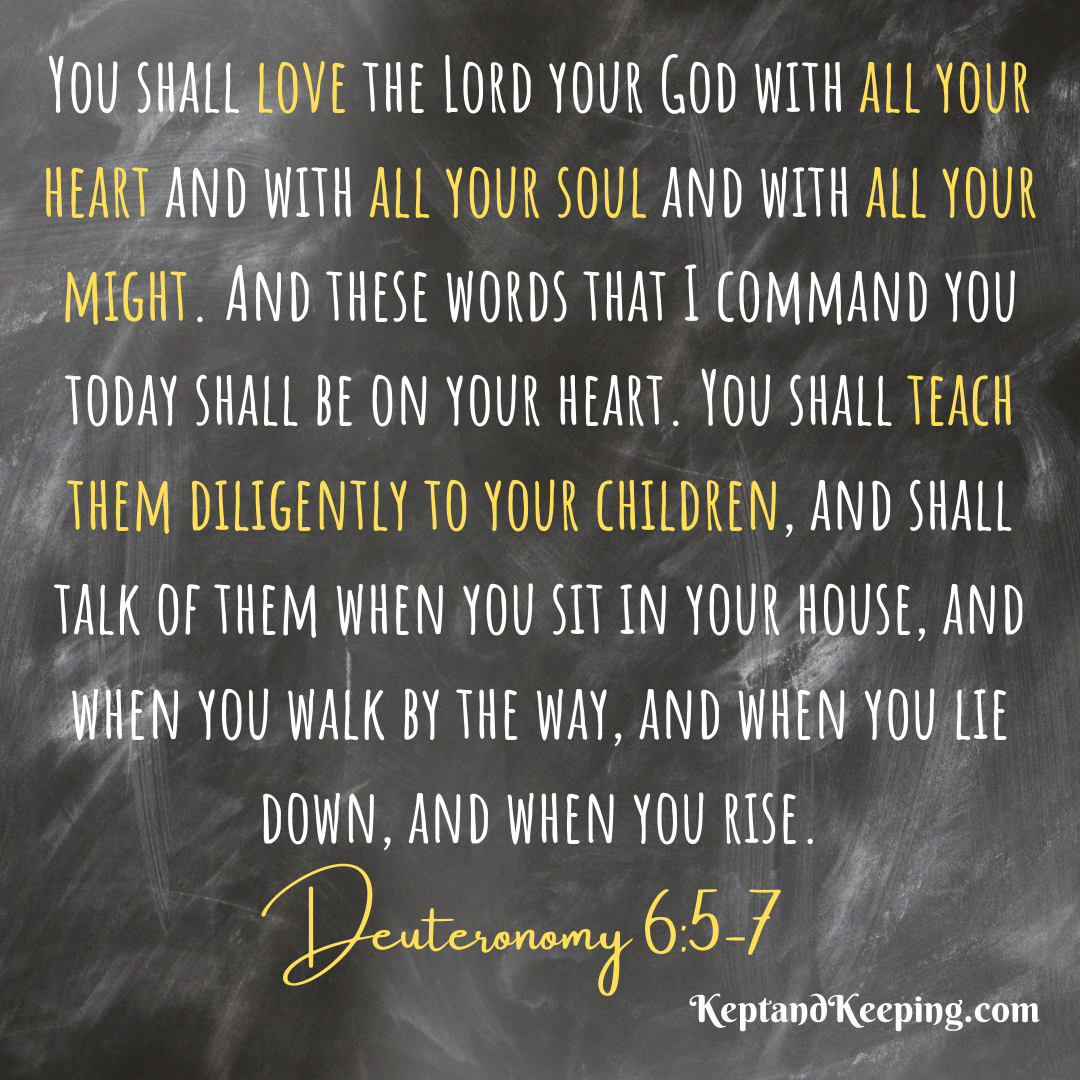
In chapter two, there’s a bullet point tip to “Carve Out Regular Family Time to Study”. This sounds great on the surface, but it’s not a direct call to read the bible together as a family, it’s a call to go through apologetic resources (which is fine if you’re already doing the basics, but it’s sidestepping the obvious if you aren’t). And if you need an example to help you get started, “we can look to…other faith systems that have successfully established certain routines within their families. Islam, Mormonism, and Orthodox Judaism prescribe specific times each day during which they stop to pray, study their religious texts, or disciple their kids.” My friends, we don’t need to look elsewhere for how to train up our children, as interesting and instructive as an outside comparison may be. Our point of reference ought to be Deuteronomy 6:4-9 and Ephesians 6:1-4 and the countless examples of faithful Christians who have been intentional about training up their children in the ways of the Lord for centuries to the present day. Not to mention countless modern books encouraging parents in their role of discipling their children. Why not recommend one of those books in passing? Why not call parents to their duty in reference to scriptural command rather than in reference to fear of the culture?
The above examples are real point-of-reference problems in the book (almost all from the introductory material in chapters one and two). As much as I love the content chapters on the issues of our day, the way in which the entire discussion is framed falls short–readers ought to take this into consideration. Seek out positive examples of Christian training and instruction in the home–from real, live godly people and solid books. Apologetics is only one small but important part of the whole, and unfortunately that isn’t communicated well in Mama Bear Apologetics.
Most of the rest of the book was very good and helpful. The chapters on Discernment and Linguistic theft were great. As were those on Self-Helpism and Naturalism.
But Chapter 7 on Skepticism (agnosticism and atheism) contains encouragement for Christians to embrace a “healthy skepticism”. This is clever, perhaps, but I don’t see the Scriptures promoting any kind of skepticism. Wisdom and discernment and turning away from lies, yes. Taking captive every thought, yes. But not “skepticism.” I think this is a poor word choice when there are Christian virtues and scriptural language that could be forwarded instead. There are great points in this chapter about being willing to wrestle openly with doubt and questions, but please take care not to promote “skepticism” to your children. I couldn’t pray along with those words in the scripted prayer at the end of the chapter.
The chapters on Postmodernism and Moral Relativism are pretty good, but after the chapter on Emotionalism I felt like I needed a break from the book.
Switching between writers mid-chapter (especially in the chapter on Emotionalism), was confusing at times and made for a less than great reading experience. I didn’t care for the overly-caricatured tone throughout the book, either. Everything is in “mama bear” terms, and it gets a little old and cheesy (even for a seasoned mother!). And some of the illustrations just didn’t work logically. I put the book down about half way through due to these frustrations, but I am glad I picked it back up several months later to finish it. I found the latter half (chapters on Pluralism, New Spirituality, Marxism, Feminism, and Progressive Christianity) to contain better writing and argumentation and to be a bit more serious in tone.
While I don’t believe we need to “advocate for a healthier feminism” just like I don’t believe my kids need to be “healthy skeptics,” the general handling of all of these isms was really very good.
Bottom line for young moms: This book can help you get a handle on the big ideas competing for hearts and minds in our world today, and if you have kids in public school where they encounter these ideas early, or if one or more of your kids are 10+, it can equip you to practically start and navigate conversations with your children.
But if you only have little ones, there isn’t anything to do with this information yet other than to learn it yourself. Your young children primarily need you to do the normal (traditional) Christian things: pray with and for your children, read the bible to them, sing hymns and praise songs and scripture set to music, memorize key bible verses, learn to give instruction with loving patience, but also teach them to obey and to repent and to believe and trust in Jesus’ death, burial, and resurrection. Love them and their father well, teaching them to be respectful by your example. Be faithful members of a biblically-solid local church. Love God and your neighbor. Live out your faith alongside your children and before them. Teach them ordinary life skills. All of the above, laid down little by little, is the best foundation you can give them. You’ve got time to learn and grow yourself in all of these things, so don’t parent scared. Be faithful in these “little” things, and when it comes time to tackle tough issues or formally teach your kids apologetics, trust the Lord that you’ll all be ready for it–and trust in the Lord that He will be there with you.
Some time ago both my boys were sick. And then one of them had mostly recovered.
One thing you ought to know about my boys is that they do an awful lot around the house, so when they’re sick, I have to pick up the slack, and some things just don’t get done.
Photo by Vika Glitter on Pexels.com (This is not my son, in case anyone was wondering. 😉 )
It’s His Turn!
This time it was the compost bin that hadn’t been taken care of. I told my recently-recovered son that it was time for that thing to be cleaned. It was nasty, let me tell you. It stank. There were gnats and gnat larva. Ew.
My recently-recovered son, at that moment, decided to protest.
“[My brother] was supposed to do it last Monday, before we were sick, and he didn’t. I shouldn’t have to do it. It’s his turn.”
I raised an eyebrow: “[Your brother] is sick. And today is his birthday. The compost bucket needs to be cleaned out, and you can do it.”
He balked and wanted to “explain” the situation further, so I employed the mom look.
He quickly said, “Ok, I’ll do it.”
Mom look: 1
Middle school boy: 0
He did do it. And he did a great job.
Fair vs. Right
Later, as I was relating this story to my husband, I began to put my finger on what my son’s response meant. He was responding in a very natural and understandable way. But it wasn’t right. Why?
In the moment when he objected to my request, he was focused on fairness instead of righteousness. As it turns out, while those two ideals can overlap at times, they are actually quite different.
A quick look at Merriam Webster’s can help us see the difference.
Fair : 1 a : marked by impartiality and honesty : free from self-interest, prejudice, or favoritism… B(1) : conforming with the established rules : ALLOWED (2) : consonant with merit or importance : DUE a fair share
When it comes to the case my son was making, he was in line with that last part of the definition. He didn’t think that taking out the compost on that particular day was his fair share. He knows we try to divvy up the chores in our home reasonably and equitably, not dumping all of the responsibility on any one person, not letting one brother off the hook and forcing the other to play Cinderella.
And while it can be reasonable to appeal to such precedent at times, there is something higher than fairness. Consider the dictionary entry for righteous:
Righteous : acting in accord with divine or moral law : free from guilt or sin 2 a: morally right or justifiable
That definition matches our common English use of the term. In the Bible, however, “righteous” or “righteousness” seems to carry a more active and positive connotation—it’s more than merely not breaking divine or moral laws. When Jesus, in the Sermon on the Mount, tells his listeners that their righteousness is to surpass the scribes and Pharisees, He elaborates on that point in the verses that follow. He not only gives instruction to keep oneself pure or from transgressing the law (Matt. 5:21-37), but He also calls His followers to go far beyond mere technical obedience to law in order to show radical love to others—even to our enemies (Matt. 5:38-47).
Self-righteousness is often focused only on the “without guilt” or “racking up points” idea of righteousness—it focuses on keeping score for oneself. And it often doesn’t mind making a fuss when it doesn’t get what it thinks it deserves.
True, biblical righteousness (the practical kind believers are to grow in, not the only-in-Christ theological kind that we receive by faith) thinks of God and others and not one’s own winning streak. It does what is just and good concerning duty to God and others. It implies judging rightly (according to God’s law and/or the needs of a situation) and acting in accordance with that judgment.
Fairness is Good. Righteousness is Better.
If my other son hadn’t still been sick, I might have agreed with my recently-recovered son that it was right for his brother to pick up the slack that he himself had left behind. Even if it was his birthday. That would have been both right and fair.
But when one of our number is out for the count, the right thing to do is serve them, or serve in their place. To go the extra mile. To give the cloak off of our back.
Love covers a multitude of sins. And spills. And forgotten or just-didn’t-get-to-it chores.
This is, of course, not just about middle school boys and their excuses. We can respond to the obvious needs around us with the same attitude, can’t we?
We may complain that it isn’t fair for us to have to do whatever it is that needs to be done right now. Maybe it is unfortunate, even unfair. But that doesn’t change the fact that the thing needs done and that God has given us eyes to see it.
Will we whine like a teenager over fairness when it conveniently serves our interests … or will we simply do what’s right to the glory of God and the good of those around us?
If we’re paying attention, we’ll probably begin to see that this question pops up on the daily.
Do you ever see your own attitudes reflected back at you by your children? Those moments can be comical and convicting! Share your story in the comments below.
Mother-in-law stories. Many of us have them, for better or for worse. I’ve got one that might just shock you.
My microwave oven gets cleaned pretty regularly these days, but it has not always been this way. In fact, it used to get pretty horrendously filthy due to my neglect. That is, until my mother-in-law butted-in several years ago and insisted that I keep it clean.
How did she insist upon this, you may ask? Well, I’ll tell you.
She had the nerve to notice that the microwave was dirty, and then, often without saying a word, she would clean it for me.
That’s it, folks. The nerve!
She would do this nearly every time she came over to my house. She never nagged me, she just did it. I began to feel bad that she was doing what ought to have been my job. “You don’t have to do that!” I would insist. But she would just smile, shrug, and brush it off—and still clean the microwave.
Mothers-in-law can be stubborn, can’t they?
The only way I could win this one was to actually keep the microwave clean so that she wouldn’t have to clean it.
Initially, her love and my shame mixed together in my heart and mind to start the habit, and over time, I began to appreciate having a clean microwave for myself.
And, as mothers-in-law are wont to notice things, mine took notice, too.
“It’s clean! Well! Good job!”
This kind of thing wasn’t a new habit for her. She’d already been commenting on the state of the bathroom when she’d visit: “Your bathroom is always so clean!”
Persistent with that manipulation, isn’t she?
Never mind that she was usually there when we were hosting our house church, so I had cleaned the bathroom the day before–or even just that morning. She wouldn’t hear those excuses, either. She still insisted that I was doing well.
She’s stubborn, I tell you. Through and through.
—————
I sure hope your mother-in-law is sweet and stubborn in all the same ways as mine. But if she isn’t, instead of playing the comparison game, how about take some notes? I know I am. I have a pretty good idea what kind of mother-in-law I want to be some day. Maybe I can practice being that kind of mentor and friend now…
There’s a place for tough love, to be sure. Sometimes a timely rebuke or even a shaking of the shoulders is necessary. But there are other times in a young woman’s life that the most effective means of Titus-two mentorship come from simply showing up, cleaning something, and praising what she’s doing well.
And if she tries to evade the compliment or prevent you from helping, just smile, shrug, and keep at it. Be stubborn in the best kind of way.
That’s how my mother-in-law convinced me to keep my microwave clean. And I’m thankful that she did.
This post contains affiliate links. If you make a purchase at one of these links, I may make a commission at no additional charge to you. Thank you for supporting my blog!
Charlotte Mason’s writings have been such a blessing to me–a tool in God’s hands to shape my mother’s heart into what it ought to be, chiseling away at rough edges and teaching me to love what is truly good and right and beautiful.
To date, I have read four out of Charlotte Mason’s six volumes that make up her Home Education Series: Volume One: Home Education, Volume Two: Parents and Children, Volume Four: Ourselves, and Volume Six: Toward a Philosophy of Education. I wish I had blogged through each of these over the years. I think it would have been valuable to force myself to do a written narration of each chapter all along the way. But it isn’t too late to start that habit! So here is my first installment. Maybe it will be a good refresher–or an introduction!–to you, my readers. I’d love to hear your thoughts.
Volume Three, Chapter One: Docility and Authority in the Home and the School
Miss Mason opens her book on School Education with a discussion of two key principles: authority (as authorized rule) and docility (as teachable obedience).
She notes that most adults at the time of her writing were raised under rather autocratic and arbitrary rule by their parents. There is a kind of sturdiness that comes from an entire society upholding the rule of authority by parents, even to the fault of upholding arbitrary rule, but the benefits of this system have their limits. Children, for example, may bear their fears and other burdens all on their own without helpful direction if there is not a means by which they can share their struggles and questions with their parents.
Miss Mason notes that rationalistic philosophers from Locke to Spencer have etched away at this notion of arbitrary authority (and the idea of the divine right of kings) by elevating the idea of individual reason.
When Locke promoted the rationality of the individual, he did not do so in a materialist philosophic vacuum. He developed his ideas with a view to Christian religion and virtue. But, Miss Mason argues, people picked up the lone idea of individual reason trumping all and left behind the insistence upon training that reason in what is good. An extreme example of this is the excessive and myopic (and bloody) rationalism of the French Revolution.
The likes of Mr. Spencer (an educationalist cited throughout the chapter by Miss Mason) promote parental authority only as it serves to throw off all authority. Why? Because Spencer recognizes that to throw off God’s authority is to throw off all other authority. Or, conversely, to diminish parental authority is to chip away at God’s. This is the kind of “liberation” that the extreme rationalist wants.
As Miss Mason puts it, “So long as men acknowledge a God, they of necessity acknowledge authority, supreme and deputed.”
One movement’s excesses may be tamed by another’s…and also replaced by a new set of vices. So the old arbitrary authority might be slightly corrected by rationalism…and then thrown off in a fury when that rationalism proceeds on into its own excess.
But what is best for children?
There is an Almighty God with whom we have to do. And He has set parents in the place of authority over their children. Not to wield it arbitrarily but to do so responsibly under God’s authority. As Charlotte Mason sums it up at the end of the chapter:
“We know now that authority is vested in the office and not in the person; that the moment it is treated as a personal attribute it is forfeited. We know that a person in authority is a person authorised; and that he who is authorised is under authority. The person under authority holds and fulfils a trust; in so far as he asserts himself, governs upon the impulse of his own will, he ceases to be authoritative and authorised, and becomes arbitrary and autocratic.”
More Quotes from Chapter One
Here are a few other quotes I appreciated from this chapter:
“The evolution of educational thought is like the incoming of the tide. The wave comes and the wave goes and you hardly know whether you are watching ebb or flow; but let an hour elapse and then judge. … After all allowances for ebb and flow, for failure here and mistake there, truer educational thought must of necessity result in an output of more worthy character.” Vol. 3 p. 3-4
So the test of our philosophy of education will be the character it produces in our children (and perhaps also in ourselves, eh?).
~~~
“But it is much to a child to know that he may question, may talk of the thing that perplexes him, and that there is comprehension for his perplexities. Effusive sympathy is a mistake, and bores a child when it does not make him silly. But just to know that you can ask and tell is a great outlet, and means, to the parent, the power of direction, and to the child, free and natural development.” Vol. 3 p. 4-5
I especially appreciated how this quote illustrated the ideal of open communication between child and parent. The parent’s thoughts are not the only ones that count. It is not an abdication of parental authority to be capable of hearing a child’s sincere questions and helping them to sort out what confuses them. In fact, a parent that so knows their child’s heart is in a much better position to wisely direct it. And a child given such a safe place to be heard can grow and develop in a healthy, “free and natural” way.
~~~
Speaking of Spencer: “he repudiates the authority of parents because it is a link in the chain which binds the universe to God.”
My how we see this today, don’t we?
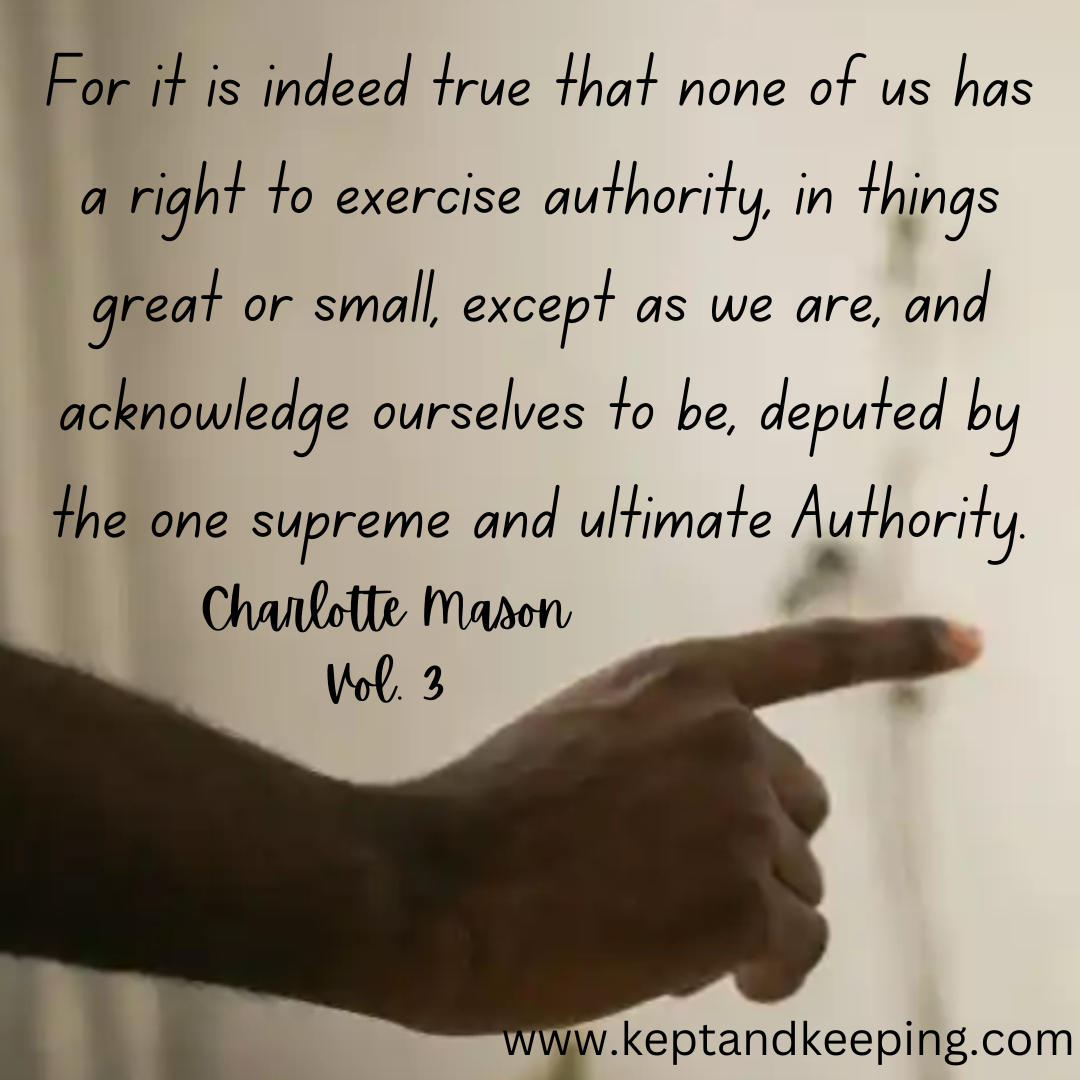
She then continues: “For it is indeed true that none of us has a right to exercise authority, in things great or small, except as we are, and acknowledge ourselves to be, deputed by the one supreme and ultimate Authority.” Vol. 3 p. 7
~~~
Echoing St. Augustine: “Nothing less than the Infinite will satisfy the spirit of a man. We again recognize that we are made for God, and have no rest until we find Him…” Vol. 3 p. 9
~~~
A warning against the wrong kind of liberty: “We all have it in us to serve or to rule as occasion demands. To dream of liberty, in the sense of every man his own sole governor, is as futile as to dream of a world in which apples do not necessarily drop from the tree, but may fly off at a tangent in any direction.” Vol. 3 p. 10
~~~
Here’s a good word on how damaging, reductionist ideologies form in a person:
“Some such principle stands out luminous in the vision of a philosopher; he sees it is truth; it takes possession of him and he believes it to be the whole truth, and urges it to the point of reductio ad absurdum. [reduction to absurdity]” Vol. 3 p. 11
Key Takeaways for the Parent-Teacher
My parental authority is given me by God (as “deputed authority”). I cannot exercise it properly if I do not first recognize that I myself am under authority—authorized by Someone above me, namely God.
Children by nature have questions. Wise authority leaves room for this—and even welcomes questions and expressions of genuine confusion about the world or even parental expectations as organic opportunities to guide the child in the way they should go.
Don’t get swept away with the latest tide, especially when one concept is elevated to the exclusion of all else. Parenting and educational fads may come and go, but the proof of their wisdom will be in the kind of character they produce over the long haul.
Have you read Volume Three lately? Or been meditating on Charlotte Mason’s principles of authority and docility (they make up the third of her 20 principles)? I’d love to have you weigh in with your thoughts in the comments!
Amazon links are affiliate links. If you make a purchase through one of these links, I may receive a commission at no additional cost to you. I make no money from links to Christian sellers, but I encourage you to support them over Amazon whenever possible.
“What Bible curriculum do you use for grade x?”
It’s a question I get from time to time, and it never ceases to make me squirm a little.
Why, you may ask? Well, because the idea of “Bible curriculum,” and especially for a particular “grade level,” is foreign to me.
Now of course I’m aware of the fact that “Bible curriculum” and “Bible classes” exist in Christian school settings, but I’ve always wrinkled up my nose a bit thinking about the Bible being made to fit the mold of an academic subject, added on to a school day like just another textbook or workbook to get through. What affect does that have on the way kids approach the Scriptures? And do they give grades for those classes? What does that teach?
Our approach to the Bible looks a lot less like school and a lot more like discipleship. Reading the Bible together has been a part of our family culture since before our children were born. We haven’t ever felt a need to make sure we added Bible to the kids’ schooling because they’ve been getting Bible with their breakfast since they were tiny.
In fact, while every part of school is informed by the Scriptures, we like to keep the Bible itself separate from “school” in a sense so that they don’t get the impression that a day off of school is a day off from devotion to the Lord.
But what does that look like? And how can you get started with this holistic family discipleship model of Bible learning if it’s foreign to you?
Well, let’s start with why.
Our Why: Created Reality and Biblical Goals
Our children are precious creations of our Heavenly Father–and they are precious gifts entrusted to us as parents. We desire to give them access to the Truth that God has revealed in His Word so that they can grow in wisdom and stature and in favor with God and man, that they would begin to know and love their Creator.
Ultimately, we desire that our children would trust in the Lord Jesus Christ for salvation from their sins and that they would love and serve Him all their days–for their good and God’s glory, both in this life and in the life to come. We don’t ultimately control this outcome. But we can be faithful to train our children in the way they should go.
Our Why Dictates Our How: Holistic Family Discipleship
Given the nature of our children, the nature of our relationship to them as their parents, and the nature of our goal (that they would have a relationship with God), it follows then that we ought to teach them in a way that is first and foremost relational. And decidedly not academic.
This means that interaction with the Scriptures comes woven into the fabric of our every day lives. There are no worksheets nor tests, no grades nor grade levels.
This doesn’t mean we don’t use printed materials to aid our children’s learning (I will link to some below), but we need to remember that the greatest resources we have to instruct our children in the ways of the Lord are His Word, His Holy Spirit, and our own lives lived alongside and before our children.
God’s Word: We must be in the bible ourselves and we must offer the Scriptures to our children.
The Holy Spirit: We must be seeking God to be at work both in us and in our children–apart from Christ we can do nothing. We may have had a direct role in bringing about our children’s physical life, but the spiritual life is of the Spirit–we cannot manufacture it in our kids. Prayer is indispensable.
Our Own Lives: We must model for our children what it means to believe the Word of God, to study it, to meditate on it, to practically submit our lives to it, and to receive both correction from it when we fail and comfort from it when we repent.
What does this actually look like?
Family Bible Time (what some call Family Worship)
Our current family Bible reading pattern, which we’ve had going for several years, is Proverbs at breakfast and Gospels at supper.
Now, this doesn’t mean each one happens every day. The reason we read the Bible over breakfast and dinner is because we often don’t read the Bible over breakfast and dinner. This is a scattering of seeds, not mechanical planting.We aim for faithfulness and perseverance rather than anything that resembles perfect consistency. But in keeping up the habit, we pretty reliably hit at least one of these each day, sometimes both. And before it was Proverbs and Gospels, we read slowly through the entire Bible at meal times–it may have taken a decade, but we kept going. The reason we’re in Proverbs and the Gospels right now is because the primary needs of our children are to receive instruction and correction according to God’s wisdom and to receive Jesus the Messiah as their Savior.
While we eat breakfast, my husband will read a few verses from the chapter of Proverbs that matches the calendar date (since there are conveniently 31 chapters in Proverbs), either selecting these verses ahead of time or asking for the kids to randomly select a number. He reads a verse and asks what it means. The kids give it their best shot and then we all discuss the meaning. He asks if they can think of any examples (a child may not use his brother as a negative example–this is a necessary rule, folks!). It has been fun over the years to hear the examples the kids come up with–sometimes from a fable, from literature, from a Bible story, from a movie. They are learning about wisdom and foolishness and learning how to identify each.
After Proverbs, we recite the Shema and the Lord’s Prayer. We switched up this recitation time over the holidays last year in order to recite and memorize Mary’s Magnificat. Now that we have the placeholder for recitation, we may use the time for other passages when they seem fitting.
Our evening Family Bible Time involves my husband reading from a passage of Scripture (currently Luke) at mealtime and then asking a few questions:
What did we learn? This is a good time for kids to either pick one thing that stuck out to them or simply narrate what they heard.
What can we worship God for? Sometimes, when we’ve been in the prophets, the answer is usually “That God was so patient and gave so many warnings.” Now that we’re in the first few chapters of Luke, the answer is usually “For sending Jesus to save us.” Sometimes the answer is different, but it’s no problem to worship God for the same things over and over again–in fact, it’s right to do so. Once answered, we pray and praise God based on what we saw in the passage–even if it’s simply for preserving the genealogy of Christ (which is pretty amazing when you think about it). Sometimes there may not be an obvious answer. When we were in the middle of Job as a family, it was admittedly hard to find any answer from the text–so we felt Job’s desolation a bit but worshipped God anyway.
What can we do with what we have learned? This is where we pay attention to the right response(s) to what we have read. Sometimes it is simply to worship as we did in the second question. Sometimes there is a command that we ought to obey. Sometimes there is something for which we ought to be thankful, something that ought to amaze us, something that ought to cause us to care for others, an example to follow or an example not to follow.
Now, these questions aren’t magical. They’re just the tools we have used for discussing the Bible as a family and for attempting to respond to it properly. Sometimes the kids are fully engaged and wow us with their insight. But sometimes the kids aren’t super excited to answer. Sometimes we get blank stares. But we don’t read the Bible and ask the questions in order to get perfect responses from our kids. We do it so that they are regularly interacting with the Scriptures and learning by modeling how to respond to them. It’s not perfect, but it is worthwhile. We are planting seeds.
Other Applications and Resources
The seeds we plant in Family Bible Time are watered by a lot of other practices and experiences.
We pray together as a family before meals and before bed. We try to remember to include intercession: to pray for neighbors, friends, family members, etc–sometimes on a weekly rotation so we don’t forget (but let’s be honest, we sometimes forget and go for long stretches with just basic bedtime prayers).
We have also made sure to include Bible time for our children to enjoy independently, even from a very early age by listening: Dove Tales (with cassettes–yes, we inherited these from my in-laws), Jesus Story Book Bible (with CDs), and a dramatized audio Bible from Faith Comes by Hearing. Now that our boys are 11 and 9, they are expected to read a chapter of the Bible first thing in the morning before coming downstairs for breakfast. This doesn’t mean it always happens, but that’s the goal and the general habit.
We’ve also enjoyed watching videos by The Bible Project–edifying for parent and child alike.
This emphasis on the Word of God being integrated into all of life means that it also influences our school day–just not in the graded-Bible-curriculum sort of way.
We have enjoyed singing many hymns in our Morning Time (currently singing along with this channel), and we have also enjoyed music by Sovereign Grace Kids (from a Christian seller). Even as adults, when we listen to music with lyrics, we generally choose music that is spiritually edifying. Our kids take this in as well.
The Scriptures inform the other books we choose–and how we read them–whether literature, tales, history, poetry, nature, etc.
The Scriptures make it into our kids’ copy work and dictation, too (that’s language arts).
Keeping It Real
We don’t do all of these things all the time. The most regular parts of our every day life are family Bible time, listening to hymns and other spiritual songs, family prayer, and good discussions on all kinds of things as we go about our days together. And these discussions aren’t just aimed at our kids. My husband and I discuss books, current events, and so many things with each other, seeking to apply God’s Word and His wisdom to everything we encounter. Our kids are audience to these adult conversations, too.
The aim is holistic, not check-list driven. And it is gloriously free from pressure to “get through it” on any kind of annual school schedule (thank God!).
The point of this post isn’t to say we’ve got it down, nor to set any kind of expectation for anyone else. The point is to demonstrate the many ways in which we can spiritually nurture and disciple our children–without boxed curriculum. And to remind all of us (myself included) that we may sow seeds, but the Lord causes the growth. Our dependence upon Him is central to our efforts at training up our children in the ways of the Lord.
All of the things we do have begun as small habits. A little here, a little there. If you are just starting to bring Scripture into your home and homeschool, don’t be discouraged or overwhelmed. Pick one thing. One habit that you and your children can enjoy. Plant a seed. And then another. Water where you can. The Lord causes the growth.
I hope this post has helped to somewhat answer the “What do you use for Bible curriculum?” question. It’s not a short answer, but I hope it may encourage some to think outside that proverbial box … of curriculum. 😉
How do you nurture your children in God’s Word? What resources have you found helpful?
“David Dancing before the Ark” by James Tissot. The ephod might have been a simple robe like this, or it might have been a loincloth.
Last night as I was making dinner I put on a Fernando Ortega CD.
My seven-year-old began moving to the music, something reminiscent of interpretive dance and ballet, though he has had no instruction and has seriously no chance at all of picking up such graceful moves from his parents.
At the end of “All Creatures of our God and King” my son announced that he wanted to dance to that song for next year’s talent show.
My initial reaction was less than enthusiastic. I’m a rather reserved person. I’d be somewhat embarrassed for him if he did something like that, something so…so…contrary to our culture’s gender stereotypes. I wouldn’t want him to be labeled or made fun of.
And then it hit me: I was responding in my mind like Michal did to David.
And David was dancing before the Lord with all his might, and David was wearing a linen ephod. So David and all the house of Israel were bringing up the ark of the Lord with shouting and the sound of the trumpet.
Then it happened as the ark of the Lord came into the city of David that Michal the daughter of Saul looked out of the window and saw King David leaping and dancing before the Lord; and she despised him in her heart.
My precious boy was dancing before the Lord, in jeans and no shirt, joyfully moving his feet and lifting his hands to heaven, rejoicing in a song of praise that he has long loved. Not unlike David danced before the Lord to celebrate the return of the Ark of the Covenant to Jerusalem.
And I was thinking about what other people would think of it if they saw it. Not unlike Michal, who despised David for his exuberant worship and criticized him with biting sarcasm.
My son wasn’t the one missing something–I was.
“I will celebrate before the Lord,” David responded. “I will be more lightly esteemed than this!”
Oh for the freedom to express our love for the Lord, giving Him the worship that He is due without allowing the fear of man to hinder us.
Am I willing to be undignified in the views of the world? Am I willing to come to God as a joyful child? Without reserve? Without concern?
Am I willing to give my children the freedom to do so?
My boy may not remember this idea by the time the talent show comes around next year, but I at least am taking his example to heart.
Has the Lord ever taught you a lesson through the simple, unreserved faith of your children? Please share in the comments below!
Imagine with me, if you will, that your children are little cherubs instead of mere humans. (I know, I know, this is an inaccurate view of both children and of angels, but bear with the thought experiment.)
Suppose your little cherubs, instead of being in your care every day and every night, were instead entrusted to your care only during the day, and you were to return them to their heavenly Father every evening. What would they report to Him?
Would they climb up on His lap, throw their arms around Him and say, “Oh, Father, I had the most wonderful day! This ‘mother’ you have given me is so kind! She is so much like You!”
Or would the child perhaps say through a sniffle, “Oh, Father! She yelled and yelled and yelled! I wanted her to see my picture, but she was too busy. I wanted her to play with me, but she had ‘work’ to do. And when I cried, she yelled and scolded me even more. Oh, I wish I could just be with You.”
Or perhaps, “Oh, Father, today was rough. I disobeyed ‘mother’ and she spanked me. She told me to talk to You about it, too. I’m sorry. She said she would talk to You, too, since she yelled when she didn’t want to. I guess we both need You. Will You help ‘mother’ and me to be more like You?”
Or perhaps, “Umm… Hi. Do You really love me? This woman who You gave me to isn’t very nice. She says she loves you and that I should, too, but she ignores me, and when she doesn’t ignore me, she hits me. And I don’t even know what I did wrong. Are You even there?”
Point being: If we could imagine the report our children would give to God each day were they to literally go and sit on His lap, how would that change the way we treat them? And besides a report that could be given, how does our behavior coupled with our claims to follow Christ add up in their little heads? Do we put a stumbling block in front of them? Do we upset their faith by our lack of self-control?
Or do we, by both consistent love and consistent training (and confessing humility when it is–so often–needed), demonstrate the heart of the God who gave His own Son so that these precious little ones could someday call Him Father?
Now, the Bible is clear—children are not angels—angels are more like bright, shining, terrifying mighty-men than like the silly little cherub images that humanity has conjured up. But Jesus does say in Matthew 18:10,
See that you do not despise one of these little ones, for I say to you that their angels in heaven continually see the face of My Father who is in heaven.
Directly preceding this verse is the exhortation to pluck out our eye or cut off our hand if it causes us to sin. Do we take Jesus’ command to “not despise” our children this seriously? What gets in the way of loving our children the way we ought? Are we willing to part with whatever it is? For their sake? For the sake of the glory and gospel of Christ? In the very fear of God?



















 Kept and Keeping