
• Home
  • About
  • Living Faith
  • Home and Family
  • Home Education
  • Books
  • Recommended Resources
  • Media

Kept and Keeping

~ Rest in Grace, Labor in Love

Kept and Keeping

Tag Archives: motherhood

Book Review: Adorned by Nancy DeMoss Wolgemuth

23 Thursday Nov 2023

Posted by Lauren Scott in Books, Home and Family

≈ 1 Comment

Tags

Christian Women, Home and Family, marriage, motherhood, Titus 2

This post contains affiliate links. If you make a purchase through one of these links, I may make a commission at no additional cost to you. Thank you for supporting my blog!

I just finished listening to this book and wanted to write a review before I forgot what I’d heard!

Adorned: Living Out the Beauty of the Gospel Together by Nancy DeMoss Wolgemuth

My rating: 4 of 5 stars
(More like 3.5 rounded up.)

This was a good and edifying read/listen. Wolgemuth brings much-needed exhortation to women–young and old, married or single–to step up and reach out to make the Titus 2 vision of life-on-life discipleship of Christian women a reality.

This is a pretty thorough treatment of Titus 2:3-5 and the broader context of Paul’s letter to Titus, with an emphasis on adorning the gospel and with plenty of examples and support from other passages of scripture as well. It’s written with a very accessible tone and a heart that clearly loves the Lord Jesus and God’s people.

I thought the chapter on slander was particularly good.

I give this book 4 rather than 5 stars for a few reasons, however.

While the treatment is thorough, it is also pretty wordy. It could have been a shorter book.

The two chapters on sobriety and a sound mind/self-control overlapped a lot, and each felt like an opportunity to spring-board into a laundry list of any and all possible ways a woman might be enslaved to something or be lacking in self-control. One warning area was being overly desirous of sex–even in the proper context of marriage. While this might be a problem in some rare? cases, it seems strange to warn against this but not spend much energy in the rest of the book on promoting the enjoyment of this good gift of God as a part of a healthy marriage. Flirtatious behavior was also in the bad column but not mentioned as a healthy and fun part of marriage. Protecting the purity of your marriage involves fueling the home fires. This was almost entirely neglected.

I’m sure these kinds of practical lists (like the chart on self-control) can be helpful to some readers, but I think they may also be stretching far beyond what Paul had in mind in his letter, not to mention they may be unbalanced or biblically incomplete.

The application of a passage should not be confused for the original intent. I think the author could have clarified the meaning of Paul’s words a bit more before diving into the many possible applications that are a step (or a few!) removed from Paul’s obvious meaning.

For example: “not enslaved to much wine” is pretty self-explanatory, but Wolgemuth begins the chapter on this phrase by talking about all of the secondary applications (basically any form of excess or idolatry). She does get around to dealing with drunkenness/drinking, and she does a good job for the most part, but she doesn’t really ever paint a picture of a godly woman who can enjoy a drink on occasion. The only stories we read of are negative experiences with alcohol or of someone who could righteously enjoy alcohol deciding to give it up for the sake of someone else (which is fine–wonderful even!, but still only shows one side of how godly people could handle it). There are also a ton of questions that lead the reader to question whether it is ever ok to drink. I’m actually not against these questions–they can be good to consider. But lacking a positive example, it feels unbalanced and would likely lead some readers to view those who do drink responsibly with suspicion. The weight of the chapter was just far beyond what Paul’s words to Titus had to say. The author did recommend reading other authors who disagree with her on this point, so I really think she attempted to handle this subject carefully and with all good faith. I respect her convictions and intentions– I’m not too far removed from them myself.

Again, on the whole, this is a very good book. It could be beneficial and edifying for individual study or in a discipleship relationship or small group. BUT when it comes to fleshing out the details, young married women (the target audience of Titus 2:4-5) will need older women who have been married for the long haul to speak more deeply into their lives about (among other things) the good gift of sex in marriage and how to enjoy one another and keep that gift alive–through pregnancies, illnesses, rough seasons, etc.

The strength of this book is that Wolgemuth can speak to a broad range of experience for women–including singles. The weakness is that she has only been married for one year at the time of writing this book, at age 58. And Titus 2:4-5 is directly speaking to young married women. Broadening the focus for all kinds of women means watering down what can be given to that target audience. This doesn’t make this a bad book, it just means it probably shouldn’t be the only book a young woman reads on Titus 2. And it underscores the need for real-life mentorship, which Wolgemuth herself rightly emphasizes over and over.

One last note: since I listened to the audio book, I found the chapter organization to be a bit confusing. I expected (and honestly would have preferred for) the chapter topics to follow the order in which they occurred in Titus 2. But they don’t. They are organized a little differently: A Woman Under God (doctrine and reverence), A Woman Under Control (slander, excess, self-control, purity), and A Woman Under Her Roof (home and family relationships). The rather primary encouragement to younger women to love their husbands and children gets put off until part three. Once I looked up the table of contents, I was fine. But for a while there, I was concerned. Hopefully this note helps anyone who plans to listen to the audiobook rather than read a physical copy.

View all my reviews

Addendum: Another part of the book that lacked much practical application was the area of homemaking. The chapter was good, but it stayed big-picture and didn’t really get into the nitty-gritty details of keeping home. If you’re looking for a book with a biblical view of home that will also show you how to roll up your sleeves and manage it well, check out Mystie Winckler’s new book: Simplified Organization: Learning to Love What Must Be Done. It is FANTASTIC. (See my review of that book on Amazon.)

Have you read Adorned? What were your thoughts? Have you read any other good books on Titus 2 lately?

Narrating through School Education, Ch. 1: Docility and Authority Pt. 1

28 Saturday Oct 2023

Posted by Lauren Scott in Home and Family, Home Education

≈ 1 Comment

Tags

Charlotte Mason, Charlotte Mason Homeschool, Charlotte Mason Philosophy, Christian Parenting, Educational Philosophy, Home Education, homeschooling, motherhood, Parental Authority, parenting

This post contains affiliate links. If you make a purchase at one of these links, I may make a commission at no additional charge to you. Thank you for supporting my blog!

Charlotte Mason’s writings have been such a blessing to me–a tool in God’s hands to shape my mother’s heart into what it ought to be, chiseling away at rough edges and teaching me to love what is truly good and right and beautiful.

To date, I have read four out of Charlotte Mason’s six volumes that make up her Home Education Series: Volume One: Home Education, Volume Two: Parents and Children, Volume Four: Ourselves, and Volume Six: Toward a Philosophy of Education. I wish I had blogged through each of these over the years. I think it would have been valuable to force myself to do a written narration of each chapter all along the way. But it isn’t too late to start that habit! So here is my first installment. Maybe it will be a good refresher–or an introduction!–to you, my readers. I’d love to hear your thoughts.

Charlotte Mason Philosophy School Education volume 3

Volume Three, Chapter One: Docility and Authority in the Home and the School

Miss Mason opens her book on School Education with a discussion of two key principles: authority (as authorized rule) and docility (as teachable obedience).

She notes that most adults at the time of her writing were raised under rather autocratic and arbitrary rule by their parents. There is a kind of sturdiness that comes from an entire society upholding the rule of authority by parents, even to the fault of upholding arbitrary rule, but the benefits of this system have their limits. Children, for example, may bear their fears and other burdens all on their own without helpful direction if there is not a means by which they can share their struggles and questions with their parents.

Miss Mason notes that rationalistic philosophers from Locke to Spencer have etched away at this notion of arbitrary authority (and the idea of the divine right of kings) by elevating the idea of individual reason.

When Locke promoted the rationality of the individual, he did not do so in a materialist philosophic vacuum. He developed his ideas with a view to Christian religion and virtue. But, Miss Mason argues, people picked up the lone idea of individual reason trumping all and left behind the insistence upon training that reason in what is good. An extreme example of this is the excessive and myopic (and bloody) rationalism of the French Revolution.

The likes of Mr. Spencer (an educationalist cited throughout the chapter by Miss Mason) promote parental authority only as it serves to throw off all authority. Why? Because Spencer recognizes that to throw off God’s authority is to throw off all other authority. Or, conversely, to diminish parental authority is to chip away at God’s. This is the kind of “liberation” that the extreme rationalist wants.

As Miss Mason puts it, “So long as men acknowledge a God, they of necessity acknowledge authority, supreme and deputed.”

One movement’s excesses may be tamed by another’s…and also replaced by a new set of vices. So the old arbitrary authority might be slightly corrected by rationalism…and then thrown off in a fury when that rationalism proceeds on into its own excess.

But what is best for children?

There is an Almighty God with whom we have to do. And He has set parents in the place of authority over their children. Not to wield it arbitrarily but to do so responsibly under God’s authority. As Charlotte Mason sums it up at the end of the chapter:

“We know now that authority is vested in the office and not in the person; that the moment it is treated as a personal attribute it is forfeited. We know that a person in authority is a person authorised; and that he who is authorised is under authority. The person under authority holds and fulfils a trust; in so far as he asserts himself, governs upon the impulse of his own will, he ceases to be authoritative and authorised, and becomes arbitrary and autocratic.”

More Quotes from Chapter One

Here are a few other quotes I appreciated from this chapter:

“The evolution of educational thought is like the incoming of the tide. The wave comes and the wave goes and you hardly know whether you are watching ebb or flow; but let an hour elapse and then judge. … After all allowances for ebb and flow, for failure here and mistake there, truer educational thought must of necessity result in an output of more worthy character.” Vol. 3 p. 3-4

So the test of our philosophy of education will be the character it produces in our children (and perhaps also in ourselves, eh?).

~~~

“But it is much to a child to know that he may question, may talk of the thing that perplexes him, and that there is comprehension for his perplexities. Effusive sympathy is a mistake, and bores a child when it does not make him silly. But just to know that you can ask and tell is a great outlet, and means, to the parent, the power of direction, and to the child, free and natural development.” Vol. 3 p. 4-5

I especially appreciated how this quote illustrated the ideal of open communication between child and parent. The parent’s thoughts are not the only ones that count. It is not an abdication of parental authority to be capable of hearing a child’s sincere questions and helping them to sort out what confuses them. In fact, a parent that so knows their child’s heart is in a much better position to wisely direct it. And a child given such a safe place to be heard can grow and develop in a healthy, “free and natural” way.

~~~

Speaking of Spencer: “he repudiates the authority of parents because it is a link in the chain which binds the universe to God.”

My how we see this today, don’t we?

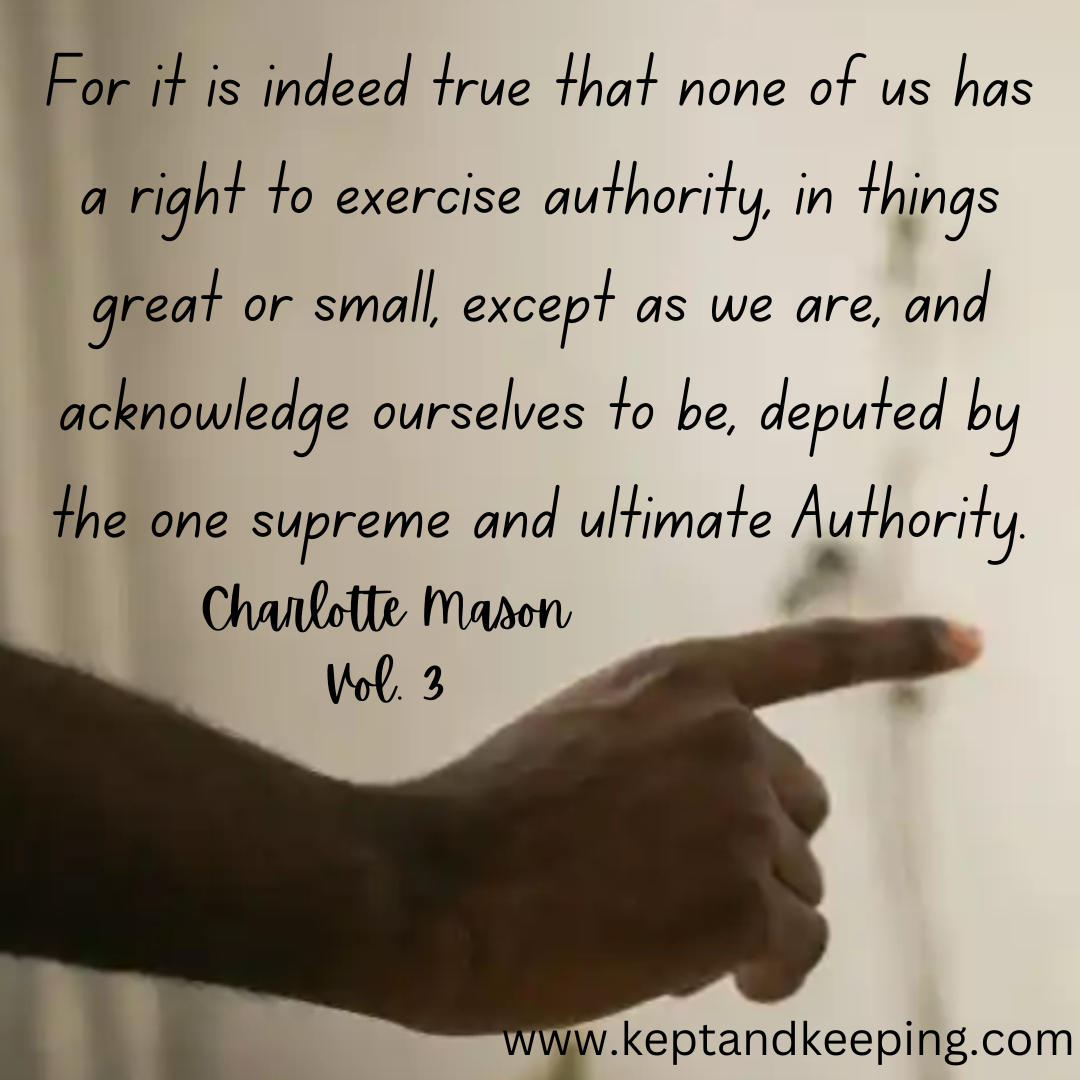
She then continues: “For it is indeed true that none of us has a right to exercise authority, in things great or small, except as we are, and acknowledge ourselves to be, deputed by the one supreme and ultimate Authority.” Vol. 3 p. 7

Charlotte Mason philosophy authority parenting quote

~~~

Echoing St. Augustine: “Nothing less than the Infinite will satisfy the spirit of a man. We again recognize that we are made for God, and have no rest until we find Him…” Vol. 3 p. 9

~~~

A warning against the wrong kind of liberty: “We all have it in us to serve or to rule as occasion demands. To dream of liberty, in the sense of every man his own sole governor, is as futile as to dream of a world in which apples do not necessarily drop from the tree, but may fly off at a tangent in any direction.” Vol. 3 p. 10

~~~

Here’s a good word on how damaging, reductionist ideologies form in a person:

“Some such principle stands out luminous in the vision of a philosopher; he sees it is truth; it takes possession of him and he believes it to be the whole truth, and urges it to the point of reductio ad absurdum. [reduction to absurdity]” Vol. 3 p. 11

Key Takeaways for the Parent-Teacher

My parental authority is given me by God (as “deputed authority”). I cannot exercise it properly if I do not first recognize that I myself am under authority—authorized by Someone above me, namely God.

Children by nature have questions. Wise authority leaves room for this—and even welcomes questions and expressions of genuine confusion about the world or even parental expectations as organic opportunities to guide the child in the way they should go.

Don’t get swept away with the latest tide, especially when one concept is elevated to the exclusion of all else. Parenting and educational fads may come and go, but the proof of their wisdom will be in the kind of character they produce over the long haul.

Have you read Volume Three lately? Or been meditating on Charlotte Mason’s principles of authority and docility (they make up the third of her 20 principles)? I’d love to have you weigh in with your thoughts in the comments!

Resting on God

31 Tuesday May 2022

Posted by Lauren Scott in Living Faith

≈ Leave a comment

Tags

Christian life, devotional, Homemaking, motherhood, rest

I’m in the midst of a rather busy season. We still have three weeks left in our homeschool year, but summer, with its mowing, gardening, and adventuring, is already in full swing.

As the work picks up outside, mess and clutter build up inside, too. New projects create new piles, and sometimes it’s hard to walk through the house without tripping over something.

I might like to have my plans accomplished and tied up with a bow, but that doesn’t happen very often. I might like to have my whole house cleaned and organized at one time–even just the first floor all at one time!–but that feels like a distant dream and not a soon-to-be-had reality.

So when I sat at my desk to pray this morning after sleepily popping a couple pans of baked oatmeal into the oven, I gave thanks for all I could. And then I pulled out the Valley of Vision and read a prayer, one that happened to speak to me ever so sweetly even as it prompted me to speak to God. I would reproduce it here for you, but I want to respect copyrights, so I’ll link to it instead. The prayer is titled Resting on God. I hope you’ll find it an encouragement like I did.

As I roll up my sleeves and get busy with the day’s work, I’m going to try to keep these truths at the forefront of my mind. Join me?

The mind of man plans his way,
But the Lord directs his steps.

Proverbs 16:9

The counsel of the LORD stands forever, The plans of His heart from generation to generation.

Psalm 33:11

My soul, wait in silence for God only,
For my hope is from Him.
He only is my rock and my salvation,
My stronghold; I shall not be shaken.
On God my salvation and my glory rest;
The rock of my strength, my refuge is in God.
Trust in Him at all times, O people;
Pour out your heart before Him;
God is a refuge for us. 

Psalm 62:5-8

Come to Me, all who are weary and heavy-laden, and I will give you rest. Take My yoke upon you and learn from Me, for I am gentle and humble in heart, and you will find rest for your souls.”

Jesus in Matthew 11:28-29

Encouraging Resources for Christian Moms

01 Sunday May 2022

Posted by Lauren Scott in Home and Family, Living Faith

≈ Leave a comment

Tags

biblical womanhood, Christian life, Christian mom, Elisabeth Elliot, motherhood

Amazon links are affiliate links. If you make a purchase through one of these links, I may make a small commission at no additional charge to you.

This spring has been full of life: with garden work, schooling, spring cleaning, taxes, and adventures. I just wanted to hop on here today to share some of the wonderful things that I’ve been enjoying (mostly in my earbuds) lately. I’m on a bit of biblical womanhood kick, and whatever the world may bemoan about that subject, I’m incredibly refreshed by reminders of what God has both called me to and given me grace for in this life as a woman made in His image.

The Simplified Organization Podcast by Mystie Winckler (also available as YouTube videos). Mystie interviews Christian moms to get their best tips for parenting and home management to the glory of God. There’s a great variety of topics and tips. The practical and the spiritual don’t have to be kept in separate categories. 🙂 That’s what I love so much about this podcast (and other resources from Mystie)–not just life hacks, but real help toward godly faithfulness in both our homes and our hearts.

Fruitful Homemaker Podcast This is hosted by Emily Drew, a young mom (and fellow Arkansan!) who interviews older women in the faith. I love that she’s seeking to bring the Titus 2 wisdom of truly older women forward for today’s younger women to hear! Some notable guests include Martha Peace, Nancy Wilson, and Abigail Dodds.

Women Encouraged Podcast, Good Theology: As Mothers – with Nana Dolce This particular episode came recommended by a sweet new mom at my church. It’s a great encouragement to think carefully about what we believe and how that affects the relationships in our home–especially our lives lived out before our kids.

Dwell Podcast: Pouring from a Full Pitcher and The Difference between Peace and Self-Care These two episodes were a breath of fresh air from moms who (two out of three of them) have raised all their children and can now share a great deal of perspective on the long, hard seasons of motherhood and homeschooling.

Let Me Be a Woman by Elisabeth Elliot. This is an old classic–one I read in my early twenties and then lent to a friend…never to be seen again. I finally repurchased the book last year, and reading it the last month or so has been such a breath of fresh air in the midst the smoggy mess made by our culture’s current state of confusion.

Speaking of the current state of things, since finishing Let Me Be a Woman, I’ve begun listening to That Hideous Strength by C. S. Lewis. This third book of Lewis’ Space Trilogy confronts totalitarian scientism and many of the themes addressed in The Abolition of Man. It may seem like a strange addition to a list of “encouragement for moms,” but I’ve found it to be great food for thought. Elisabeth Elliot tells about being a woman. Lewis shows it. His character Jane wrestles through it, and Lewis, as the author, lets her be a woman. I’m not done with the book, but I’m finding it quite instructive and freeing, as I tend to have some of the same modern-woman hang-ups as Jane.

What encouragement have you found lately, mama? Not just to get through the long days of noise and messes, but what has been encouraging you to thrive in you role as a wife and mother? What resources help you lift up your eyes (Psalm 121)?

Titus 2 and the Dunbar Number: Social Limits and Priorities

24 Friday Sep 2021

Posted by Lauren Scott in Home and Family, Living Faith

≈ 4 Comments

Tags

Christian life, Christian Women, Home and Family, Intentional Living, motherhood, priorities, Relationships, Social Connections, social media, The Dunbar Number, Titus 2

I’ve been on a bit of a minimalist kick lately, decluttering my house, my closet, my recipes, my priorities, you name it. While I don’t necessarily hold to minimalism as a whole-life philosophy, I find that it does offer some necessary push-back to our modern tendencies to be “ever expanding,” whether that be in our possessions, resources, opportunities, or social connections.

On that last item, social connections, I recently read an article explaining the theory of what’s called the Dunbar Number. A British anthropologist named Robin Dunbar posited (after some research on primates and combing through human records) that the greatest number of meaningful connections any one person can hold at a given time is about 150.

Titus two dunbar number social connections family

I have to admit I had quite the confirmation bias response to this article, because not too long ago I was explaining to my husband that I have social limits, and I simply cannot keep up with all-the-people, and I certainly don’t have energy for continually adding to the number of all-the-people to whom I feel some measure of social obligation.

With interest and perhaps some of that confirmation bias running through my veins, I decided I’d see where my current number of connections stood. I pulled out my brain dump notebook and began to write down all of the people with whom I have some meaningful or working connection. I started with family. That easily reached over 30 people. Then it was long-standing friends. You know, the people you may or may not see each year but whom you are committed in some way to maintaining for the long haul: again, over 30. Neighbors came to about 20. Homeschool connections almost 30. Church connections (which is small right now because we’re still new at our local church): about 15. And then I listed those who are a bit more distant but still qualify under this idea of meaningful connection: 60 or more. If you just add up the rounded numbers I’ve listed, that makes 185, more than the Dunbar Number (150). No wonder I feel a bit overwhelmed and like I can’t add any more.

But guess what kinds of people I didn’t add to any of those lists of contacts? For the most part, I didn’t include online-only relationships. There are seven ladies who make the cut because they are part of an online stand-up/accountability group. Other than those ladies, every other person on the list has some real-life, meaningful or workable connection (or has had in the past and therefore they are on the list).

What this little exercise demonstrated for me was twofold: One, there isn’t really any room for me to build or even maintain relationships on social media or other online platforms. No wonder I feel a little overwhelmed trying to keep up. Two, even these connections that I wrote down are pushing the limit, and I need to prioritize.

Now, Dunbar’s theory itself has prioritization built in. He suggests that any one person can have only about 5 people in their inner circle—these are loved ones, your most trusted and closest kind of friends (large families can adjust this number accordingly, IMO). Next up are “good friends,” of which you can maintain about 15 (or just ten more than the 5 closest friends we already mentioned). There are about 50 that can be called “friends” in a meaningful way before our own capacity is stretched enough to make the term “friend” less meaningful (I’m looking at you, Facebook). And then the next jump is up to that limit of 150 meaningful contacts. Beyond that, the study claims we could have face-recognition of up to 1500 people–but not meaningful relationships. I can’t say I’ve taken the time to test the limits on that last one.

Now, all of this should be taken with a grain of salt. The Dunbar Number is a theory, not gospel nor scientific law. But it is interesting, isn’t it?

I’ve titled this article “Titus 2 and the Dunbar Number,” so it’s about time I brought this back around. As Christians, we know that the greatest commandments are to love God with all our heart, soul, mind, and strength and to love our neighbor as ourselves. And while Jesus insisted that anyone who we find in need of our help can be considered our neighbor (see the parable of the good Samaritan), in today’s times, we tend to be over-exposed to people and needs via the internet and social media, skewing our sense of responsibility away from our nearest neighbors and toward those far from us.

The impact here is both quantitative in that we’re compelled to give emotional energy toward more people than we have capacity for and qualitative in that we’re tempted to prioritize (at least in the moment) people far away from us, for whom we are not most responsible. The issue here isn’t that caring for people far away is bad (it’s good to be concerned for people in different places than we are), it’s just unnatural to have a constant reminder of them and to be pulled away from the people literally right in front of us or across the street. The combination of those quantitative and qualitative elements makes for a rather big challenge, especially if we take seriously the call to “love our neighbor.” We’re left asking Jesus for clarification, “Who is my neighbor?”

This is where Titus 2 comes in. Some people hate this passage because they see it as limiting women to the home, keeping them barefoot and pregnant, etc. But I think we can see it in a different light. Here it is for your consideration:

Older women likewise are to be reverent in their behavior, not malicious gossips nor enslaved to much wine, teaching what is good, so that they may encourage the young women to love their husbands, to love their children, to be sensible, pure, workers at home, kind, being subject to their own husbands, so that the word of God will not be dishonored.

Titus 2:3-5

If we are to love God and love people, the first place that we ought to practice that God-honoring people-love is within our own households. What Titus 2 (and a few other passages) implies to me is that this temptation to concern and even distract ourselves with people “out there” isn’t something only modern social media mavens have experienced. Even women in the first century needed the reminder that a love that isn’t fulfilling its duty at home first is a hypocritical love that can lead to the gospel being blasphemed, the good news being spoken of as if it’s bad.

Now before anyone throws stones because they think I’m promoting “the patriarchy,” let me be the first to say that this principle holds true for men as well. It’s why elders are supposed to be good managers of their own households before they are recognized as leaders in the church (1 Timothy 3:1-7, Titus 1:5-9). It’s why a man that doesn’t provide for his own is called “worse than an unbeliever” (1 Timothy 5:8). The call to prioritize the people right in front of us is universal. This responsibility to one’s own household is why singleness is, for some, an effective state to be in for the sake of ministry to others: because the man or woman who isn’t tied down has more time and energy to devote to the Lord, which may include serving others beyond the home in a way that the married person simply can’t (1 Corinthians 7:32-35). But that’s more the exception than the norm for believers. Most of us are called to marry and build families to the glory of God.

So the reminder in Titus 2 to love your husband and love your children and focus on the work that must be done to keep the home running well isn’t slavish or limiting. It’s a sane call to put first things first. The calling toward home and family doesn’t necessarily preclude other callings, but it does take precedence over them.

And, if you think about it, all of this makes sense in light of Dunbar’s thoughts on human social capacity. We each may vary in terms of our social capacity, and some of us may need to cut back while others may need to stretch themselves. But at the end of the day, we all have limits. And we all have to choose how we will use the limited resources we’ve been given.

How about you? Do you feel our modern connected world pulls your attention away from the folks that matter most to you?

We may not need to dump online community and resources altogether, but might it be helpful to imagine what our priorities would look like if those things didn’t exist. Join me for a thought experiment?

If the internet didn’t exist, what would you want your family life to look like? How might you prioritize your husband? Your children? If you are in a different stage of life: your roommate, parents or siblings, or extended family?

If the internet didn’t exist, what would you do to get to know your neighbors? To be a blessing to them?

If the internet didn’t exist, what would you do to get to know the people at your church better? How might you reach out to discover needs and meet them? In your church and your local community?

If the internet didn’t exist to make long distance relationships many-and-easy, who would you 100% want to keep in touch with–even if it meant more effort?

Homemaking in 2020 [and 2021!]: Sticking to Calling in a Year of Crisis

01 Wednesday Jul 2020

Posted by Lauren Scott in Home and Family, Living Faith

≈ Leave a comment

Tags

Atmosphere, Attitudes, Home and Family, Homemaking, motherhood, worry

“How’s 2020 been treating you?” It’s a fairly normal question in a normal year. But this year it gets thrown around accompanied by a sinking feeling or an incredulous laugh or the quoting of a meme or two.

Some of us have faced down the loss of a loved one. Some, the loss of a job. Some have found themselves with lots of free time on their hands. Some have found themselves with a call to long hours and high stakes. And some (especially those of us whose work is at home already) have found themselves worried about all these things while simultaneously experiencing “life as usual”—only a little too usual since outside-of-the-home, in-person social interaction has been sadly lacking.

As a homeschooling homemaker married to a man who works from home most days anyway, I have found myself in that “life as usual” category, wondering at times if it’s even right for me to go about my normal routine around here while there is so much wrong in the world out there.

There’s a kind of anxiety that comes from knowing about tragedy and feeling like you can do nothing about it.

So what’s a homemaker to do?

We may be tempted to think that our ordinary work at home matters less because there is so much apparent work to be done in the world beyond our door. But our role as a homemaker is no less important in times of crisis. In fact, unless we are obviously given a public-facing assignment, I contend that our work at home matters even more.

Just because the needs out there become more apparent doesn’t mean that the needs right here have gone away. We all feel the upheaval and uncertainty of our times. And while children may appear to be carefree most of the time, they feel it, too—especially as it effects their parents.

Before I spend too many words on the subject, take a look at this cover art for Blink, an album about motherhood by the Christian musician known as Plumb (Tiffany Arbuckle-Lee).

motherhood storm homemaking crisis 2020 blink plumb

I love the imagery and what it speaks about the role of mothers. Amid the storm, there’s a shelter, there’s light, there’s a smile, there’s wonder, and there’s both space and provision for beautiful things to grow.

Whatever age our children, or whether we have children at home at all, I think this image can be inspiring in our homemaking as well.

We do well to fight the darkness by turning on the light. Not by brooding. Not by worrying. Not by endlessly researching the latest hot-button issue on the internet.

“Who of you by worrying can add a single hour to [her] life span?” our Lord asks. We might also ask if our worry adds to anyone else’s life either.

This isn’t to dismiss or ignore the real challenges facing our world today, nor is it a call to ignore the needs in our communities that we are capable of meeting, but it is to say there is an appropriate way to deal with all these things–and especially the ones that are beyond our reach.

“Cast all your anxiety on [Jesus] because He cares for you.”

The home that our loved ones experience is made up of both our internal attitudes and our practical service. We would do well to look after both—and to see that they often rise and fall together.

Ladies, if we aren’t taking things before the Lord then we’re choosing to bear them ourselves, choosing to be weighed down with cares that He doesn’t intend for us to carry, cares that keep us from joyful service in our homes. And how will we teach children to cast their cares on Jesus if we don’t practice it ourselves? Will we even see that they have cares that need our guidance and prayers?

And this is where I admit that I know these things because I fall prey to them myself. Even personality types that are supposedly led on by facts and logic and reasoning rather than emotions can find themselves in the endless scroll, the incessant trying-to-fix-it—both of which amount to a worrisome attempt to control circumstances that are beyond our control while ignoring our God-given responsibilities and the people we’re most explicitly called to love.

So if we repent of our worry, if we leave it behind and resolve to trust the Lord, what then are the needs in our home?

And here’s where our attitudes and service really rise and fall together. When we’re worried about so many things, we can’t see what’s right in front of us. So the first step in moving forward is to begin to really see our homes and really see the people in them.

That Proverbs 31 woman “looks well to the ways of her household and does not eat the bread of idleness.”

The answer is simple, even if not easy: What we really need is to pay attention and do what we know we ought to do with diligence.

There are a few practical ways this has worked itself out in our family. It’s still a battle to choose joy and to actively resist the temptation to despair, to refuse to bring anxiety about the world into our home environment rather than casting that anxiety on Jesus. But here’s where we have chosen to draw some lines and plant some seeds in our family.

Of course there are the usual chores: keeping the home running and clean, keeping a watch on the budget and food, keeping up with other home projects.

We’ve also committed to sticking to our schedule more than we have in the past. The routine is good for all of us.

We’ve kept up our family bible time. We all need God’s word, all the time.

We’ve focused on our garden. We’ve made space, planted things, and watched them grow. Vegetables, yes. But also flowers. Lots of flowers. Those proverbial roses don’t have to stay proverbial. It’s good to literally stop to smell them, too.

Making space for fun and creativity and good conversation.

Getting outside to enjoy God’s creation and take in visible, tangible signs of beauty and hope. Creation is full of parables.

I took a two-week break from social media to clear my head and my focus. I thoroughly enjoyed it (and I think my family did, too).

We’ve painted as a family. Gone on walks. Read aloud. Caught caterpillars and watched them turn to beautiful butterflies.

We’ve tried to make special days and holidays all-the-more special, not allowing quarantine to keep us from celebrating as a family, from marking times and seasons with thankfulness to God.

Not all of these things are always easy, but they have been good. And this isn’t some checklist or quarantine bucket list. It’s just an encouragement that the ordinary things you do for your home and with your people matter.

And they matter even more in times that are anything but ordinary.

homemaking 2020 crisis ordinary

Fight the good fight to do this work rather than neglect it. And most of all, seek the Lord and see your people. Ask God to help you look into the faces of your family members with love and joy and interest. And ask Him to give you wisdom to know what each one needs.

“Whatever your hand finds to do, do it with all your might.”

When the darkness out there seems to close in all around us, when our hearts are troubled, when we’re cut off from regular fellowship, the tone we choose to set for our homes matters immensely.

I’ll sign off with a few words I shared in an email exchange with another mommy-friend:

Yes, the world is a pretty crazy place. … I’ve wanted to do more to help people during this time, but something to remember is that providing a fun, godly, and secure home for children is foundational to civilization. Your and my role in that cannot be overstated. Sometimes I feel like I’m not really doing anything if I’m not somehow being active or being heard ‘out there.’ But what I’m really called to is to be gladly at work and speaking truth and kindness right here. At home. Making a home. A haven in all the crazy. That is kingdom-building and soul-liberating work.

Soli Deo gloria.

Now to get to that pile of laundry…

Ideals and the Daily Grind

09 Wednesday Oct 2019

Posted by Lauren Scott in Home Education

≈ 2 Comments

Tags

boys, Christian Homeschool, growing up, Home Education, homeschool encouragement, homeschooling, motherhood

Lately I’ve wrestled with my assumptions about how homeschooling ought to be experienced–both by me and my children. There’s this tension between the “freedom” that we have as homeschoolers along with the “delight” that we want to nurture … and the painfully hard job of holding the line while a child has to do the work of growing into maturity. You can’t do it for them. You can’t soften the blow. You can’t lift the weight.

homeschool hard weight growth work

Well, you can try. But it might not be good for them. Despite not measuring up to the Instagram ideal, the daily grind–with all of its bumps, boredom, and blunders–is good for kids.

We’re beginning to wrestle with these things now that our oldest is ten and carrying more responsibilities. And it’s hard. It’s really hard. Not because he’s rebellious or anything. Just because it means he has to grow up a bit, this child who’s still bummed that he aged-out of child care at our homeschool support meetings two years ago. He’d rather be in there with the 7-and-under crowd just like he’d rather continue doing all of his math and language lessons with me.

But he has to grow up.

And I have to let him.

Pictured below: My sweet 10 year old boy couldn’t sleep due to bug bites, and instead of throwing a pity party (which he very easily might have done) he decided to start on his math before I even came into the kitchen for the morning. This is new territory, folks! This is growing up!!! I made sure to reward him with a cup of tea. 😉 

school boy homeschool hard growth grind

I think of all the ways I could have prepared us better for this transition to greater responsibility and greater independence. There’s much room for improvement and repentance, and I just get to mourn the gap because my baby, my youngest, just turned eight–it’s not like I have kindergartners that I can “do better” with.

But then my husband tells me that I’ve done great. That this transition is hard. Period. (He would know. He was homeschooled.) You could have done some things better, but here we are–and he’s going to get stronger from this trial precisely because it’s hard, precisely because it’ll teach him to pray–as long as we hold the line.

My husband is right, of course. For all the failings, we’ve done well. And are doing well. I don’t measure up to my ideals and neither do my children. No surprise there, really, if I’m honest with myself.

This reminds me of that ideal that is not idealistic. That we’re raising children to become adults. Adults who have to work hard. Adults that will make mistakes and have to correct them–whether in math or driving or work or relationships.

Turns out in bringing up my boys I’m being brought up, too. The higher ideal–for all of us–is growth in maturity, ultimately in Christ.

Praise God I haven’t gotten it all right! I’d be an arrogant sourpuss if He’d allowed me to get it all right! No. There is no perfect ideal in parenting or education. The only Perfect Ideal is Jesus Christ Himself. So the best we can do is look to Christ and hold on. Hold the line of faith as we hold the practical standards for our kids, standing firm as they learn to stand firm themselves, dependent more and more upon the Lord–and less and less upon us.

This. Is. Good.

Hard but good.

True growth, and thus the ability to experience greater “freedom” and “delight,” comes when we submit to the work set before us, choosing to bear up under the weight God has assigned rather than to shirk it or complain. Our children grow the same way we do–if we let them.

How about you? What hurdles or struggles are you and your children facing this year? Can you recognize the “hard but good” in it? How has it forced you to rely more upon the Lord? I’d love to hear from you.

Love Covers a Multitude of Sins … and Spills?

15 Monday Apr 2019

Posted by Lauren Scott in Home and Family, Living Faith

≈ 1 Comment

Tags

Home and Family, love, Love God, Love Others, motherhood

I don’t know about you, but I’m sure there are moms out there that struggle with the seemingly never-ending task of cleaning up after the members of their household. Let’s at least imagine that you and I are like that. Hypothetically, of course.

It’s a Monday morning, a fresh start, or so it would seem. When you walk into the kitchen you’re actually kind of impressed that the kids managed to clean up as much as they did after making your dinner last night (a lovely assortment of leftovers). They were, after all, blessing your socks off when you were flat-out exhausted.

But then you notice the grease all over the stove, so you grab the washcloth and wipe things down without flinching. You usually do at least one thing to straighten up your kitchen while waiting on your coffee.

But then there are the dirty dishes that didn’t make it into the dishwasher, and the clean ones on the other counter that never got put away. And then you look over at the microwave. That wondrous instrument of quick cooking, the one the kids use the most–and with all the greasy fingers they can muster.


Just touching the buttons sends shivers up your spine.

You grab the washrag yet again, feeling the grumbles heat up inside you as the tap water heats to a similarly scalding level. Somehow you think this is what it takes to get the job done, especially when you see the inside of the microwave.

You begin to murmur to yourself, “This is cutting into my Bible time.”

And then the grace of conviction haults your thoghts. That was mighty self-righteous of you when you could just spend this time with the Lord anyway instead of grumbling.

Once disarmed, your flustered thoughts begin to retreat, making room for a scripture to charge into the battle: Love covers a multitude of sins.

Suddenly you realize that love is patient, and kind, and all that, not because you really have 1 Corinthians 13 running through your head right now, but because you are meditating on love covers a multitude of sins while doling out the elbow grease. I love those little monsters, so I don’t mind cleaning up after them. These messes are evidence that they are loving and growing, too. 

And the Lord is with me whether I’m kneeling in front of my microwave or sitting on the couch with my Bible.

The motto ora et labora–pray and work–comes to mind now, too, and you begin to pray for the members of your household, exchanging drudgery for intercession.

The coffee may be a bit cold, and your Bible might still be waiting for you, but you have indeed had quiet time with the Lord, by His gentle, refining grace.

And the microwave is clean now, so go heat up that coffee and sit down to the Feast. And maybe let the kids join you since they’ll be coming down the stairs any minute now.

First Day Confessional

15 Tuesday Aug 2017

Posted by Lauren Scott in Home Education, Living Faith

≈ 3 Comments

Tags

back to school, Bullet Journal, first day of school, God's patience, Homeschool Confessional, homeschool encouragement, homeschooling, INTJ Homeschool Mom, motherhood, Planning

img_0003.jpg

Many of the public schools in our area started back yesterday, and so did we.

If you’ve been following me on Instagram, you might be a little confused since I posted about our “First Day” back in July.

That would be the first of my confessions.

I thought that in the middle of all of our remodeling craziness it would be a good idea to re-institute some order by starting back to school.  We made it a whopping four days before a trip and life in general took over again.

So yesterday was technically something like day five (or six if we’re counting the immersive day of water color painting last week–hey, I’m counting it!).

I’m just thankful that my husband encouraged me not to worry about it.  Now that the living room is, well, livable again, we can start to throw some school into the mix.

His support has been invaluable since we would, in theory, like to have our kids keep going with at least math and reading through the summer months.  I planned to just take June off, and keep a bit of review going even on break, but it stretched into an extra month-and-a-half and our review became non-existent.

And it’s ok.  Really, Lauren, it’s ok.

But those scheduled intentions are just surface-level.  I’ve got some deeper issues to confess, as well.

This is our fourth year of officially homeschooling and yet I have felt less prepared than ever.  I gave up on a traditional homeschool planner this year, opting to build my own system for planning and record keeping (a combination of Plan Your Year, a bullet journal, and clipboards for the kids).  I hope to share some reviews, articles, and videos about it sometime soon once the dust clears and the wires are all rigged up in our remodeled office/studio.  But the process has been like stepping out on an invisible floor, hoping there is something to stand on when you land.

Unlike Indiana Jones, however, on our first day of school yesterday, instead of finding a firm footing, I literally slipped on the slick, wet front steps, finding that gravity still works and that landing your rear on the corner of the step an entire foot lower than your feet began makes for a very purple derriere and quite a stiff and sore neck.

This didn’t exactly quell my fear of more figurative slips.  Again I’m reminded of the only truly firm footing I have in the first place–and that gives me strength to press on.

I know that the end result will be a good one–having a completely customized system that meets our needs better than any pre-fab planner ever could.  But with a new arrangement on paper comes a new arrangement of habits–both mental and physical–and building those habits takes time.  I need to have patience with the process, trust that it will be worth it, and simply recognize the little adjustments that have to be made along the way as a part of what makes it better.

All of that said, our first day went wonderfully well!  My well-laid plans did pay off!

At least, before lunch.

Our first day of school started well but ended woefully.

In my planning I took into consideration the longer-than-ever-time-off from which we would be recovering, and I tweaked our curriculum accordingly–especially math.  My big boy would do only half of the worksheet.  My youngest would copy numbers, do some basic math facts, and then we’d play a math game.  The almost-six-year old finished his work in no time, blazing through math, reading, and copy work so he could go to town with his beloved watercolors the rest of the morning.

I was thrilled.  This was easy.

The just-turned-eight-year-old, however, struggled to focus.  His work certainly should have taken longer than his little brother’s, but it drug on and on and on needlessly.  I told him time didn’t matter, that he didn’t need to set a timer, just work diligently.  But he set the timer anyway and then stressed himself out with it.  Long story short, he was anything but diligent, even when I gave him breaks to go outside or read and then come back to it with a fresh mind.  His score in the end was near perfect, but it was well into the afternoon before he finished and then there was language arts to do.

I was patient for the morning.  But eventually my patience ran out.

I had planned fun activities for our afternoon.  A game, read-alouds over Afternoon Tea.  Things my children LOVE.

But a dawdler was messing up my plans to do him good.

I escaped into my own projects and spent some time online to boot.

“I’ve tried to help you.  You won’t be helped.  I’m done.”

Signing off.  Checking out.  On day one.

Bravo, Lauren.

Over dinner my husband asked us each how our day had gone and how we felt about it.  There was good, there was bad, and there was ugly.  But it was good to get it out in front of us as a family.

He sweetly encouraged me not to base the success of my day on other people’s performance–especially little people.  Control what I can control–my own responses.

That’s hard, isn’t it?  But it’s exactly what I needed.

After further consideration and prayer last night, I realized that I had judged my children worthy of my time and patience during the morning hours–I had even decided this long in advance.  It’s my job, after all, as their mom and teacher.  But with one child dragging his half-sheet of math work beyond any reasonable time frame, and with the other testing my patience at lunch time, I came to judge my children as unworthy of my time and patience for the rest of the day.

Forget my God-given role as their mother and teacher, I measured them against my plans and expectations, found them wanting even after patient instruction and care, and since I wasn’t seeing the results I wanted, I decided they didn’t deserve my effort–I decided I needed a break.

There is wisdom, at times, in walking away from a situation so that both parties can get fresh air, deal with what’s in their hearts, and come back in much better spirits.  But I can’t say that was what was going on this time.  I was resentful.  And it took ME “beyond a reasonable time frame” to get my heart right.

Math work or heart work, my son and I were both taking too long to learn our lessons.

I suppose I could steal a quote from my reflections on planning above since it seems to fit this character-growing, relationship-building process, as well:

“…building those habits takes time.  I need to have patience with the process, trust that it will be worth it, and simply recognize the little adjustments that have to be made along the way as a part of what makes it better.”

The goal of education isn’t ultimately results or getting things done anyway.

As I wrestled with my own bad response–with my sin–the Lord kindly reminded me of His love and patience toward me as His child.  I cowered at the thought of His great love and my great lack.

Father, You chose to love me while I was yet a sinner when You sent Jesus to die for me.  And You choose to love me still even when it takes me years to learn a lesson, even when my attitude and actions are quite like a distracted and unruly child.  

Because You have chosen to love me, because You have made me Your child, Your patience and Your love never wane…like mine so often do for my own children.  

Forgive me, Father.  I repent.

Thank You for being a GOOD Father.  My need for Your love and patient correction is ongoing.  And the work You’ve called me to do for my children is ongoing.  Oh, please produce in me the same patient, diligent love with which You parent me.  

I saw yesterday morning that I could choose to be patient with my children.  But O how I need Your Spirit, Lord, to choose to be patient even beyond my good intentions!  When my planned patience wears out, show me Your patient love, and please help me to then pass it on to them.  

Amen.  

For those of you who also started school recently, I hope your first day fared better than mine (and you should read that as “I hope that your patience lasted more than four hours”).

But it’s just the first day.  And it’s now behind us.  Sins repented of, mercies new this morning …and every morning hereafter.  We’re in this for the long haul, aren’t we?  Let’s do it with patient love, remembering the One who continues to lavish us with it.

Happy New School Year.

The Cashier at Walmart

17 Saturday Jun 2017

Posted by Lauren Scott in Home and Family

≈ 2 Comments

Tags

cashier at Walmart, children, INTJ Mommy, kind words, love, love your children, motherhood, People of Walmart, Titus 2

4eb77aefc32d422593297d3623d2e8bb

She was probably 15-20 years my senior, with bright eyes and her long brown hair, half pulled back and half resting gently on her standard navy blue shirt and coordinating vest.

She was still helping the customers in front of us when it happened–my antsy five-year-old, who had earlier decided to don gym shorts and cowboy boots, accidentally stepped backward–right on top of my seven-year-old’s sandal-clad foot.

The scream was ear-piercing.

We had already been in the store too long after spending far too long at our previous errand stop.  The boys were tired and so was I.  And when the wailing persisted for several minutes, I’m sure everyone else’s ears were tired, too.  I tried to calm my big boy down without much luck, and the whole situation was so traumatic that the five-year-old started crying because he was so sorry that he had apparently hurt his brother so badly.

It was a meltdown.  I looked up at the cashier and said something about missing nap time…not that my boys take naps anymore, but the downtime would have been good for them.

The boys were fairly well calmed down by the time the cashier started ringing up our order.

“I miss shopping with my boys,” she said with a warm smile.  “They’re grown and moved away and both married now.”

I paused a moment to consider her words (trying to decide if she’s crazy) before asking, “How old are they now?”

“They’re 24 and 26.”

Two years apart.  Just like mine.

“What I wouldn’t give to have them with me again–even on the rough days.  I just miss having them with me.  And tucking them in at night.  You know, all those special times together that you don’t think about much until they’ve grown up and you don’t have them around all the time anymore.”

I don’t usually handle other people’s sentimentality that well, but hers, in this moment, was a gift from God–a redirection of my heart away from the frenetic and frustrated mode that I was in to see the blessing it is simply to have my children near–with the sobering reminder that that nearness won’t last forever.

But she didn’t just make me see.  She made me feel.

I think that’s why other people’s emotional moments make me uncomfortable.  It forces me to feel something that I’m not sure I’m ready to deal with (because, to be honest, my own emotional moments make me uncomfortable).

But sometimes that can be a very good thing.  I may have been most comfortable feeling embarrassment or frustration in that check out line, but she made me feel affection for my kids, turning what could have been a nosedive in my attitude into a total rebound.

“Thank you for sharing that,” I expressed before pushing the cart way, “especially in the midst of a minor meltdown.”

She may not have realized it, but she changed the tone of the rest of our busy afternoon with her kind words and heart-felt nostalgia.  This was a little bit of Titus 2 in action, friends.  At Walmart.

“Love those boys, mama,” she had communicated in no uncertain terms.  “Love them well–even when it’s tough.  You will miss them someday.”


← Older posts
Newer posts →
  • View KeptandKeeping’s profile on Facebook
  • View lauren.keptandkeeping’s profile on Instagram
  • View keptandkeeping’s profile on Pinterest
  • View @laurenscott.keptandkeeping’s profile on YouTube
Lauren Scott

Lauren Scott

Christian. Wife. Mother. Homemaker. Home Educator. Blogger. Book Addict. Outdoorist.

View Full Profile →

Enter your email address to follow Life Meets Jesus and receive notifications of new posts by email.

Affiliate Disclosure

We are a participant in the Amazon Services LLC Associates Program, an affiliate advertising program designed to provide a means for us to earn fees by linking to Amazon.com and affiliated sites.

Hands-on Math Curriculum

RightStart™ Mathematics

Check Out Prodigies Music Curriculum!

music curriculum sale

Quality Video Curriculum

Top Posts & Pages

  • Five Refreshing Scriptures for Finishing Strong when You Feel Weak and Weary
    Five Refreshing Scriptures for Finishing Strong when You Feel Weak and Weary
  • Wisdom in the Book of James
    Wisdom in the Book of James
  • 30 Day Dress Challenge Recap
    30 Day Dress Challenge Recap

Advent April Fool's Day April Fools Book Review Books Books Charlotte Mason Charlotte Mason Homeschool children Christian Classical Education Christian Classical Homeschool Christian Homeschool Christian life Christian mom Christian Parenting Christian Women Christmas Classical Education Classical Homeschool devotional education faith Guest Post Home and Family Home Education Homemaking homeschool encouragement homeschooling Jesus Living Books love marriage meditations micro book reviews motherhood Nature Nature Studies parenting poems poetry Practical Atheism Reading List Reflections Relationships trials

A WordPress.com Website.

  • Subscribe Subscribed
    • Kept and Keeping
    • Join 171 other subscribers
    • Already have a WordPress.com account? Log in now.
    • Kept and Keeping
    • Subscribe Subscribed
    • Sign up
    • Log in
    • Report this content
    • View site in Reader
    • Manage subscriptions
    • Collapse this bar
 

Loading Comments...