
• Home
  • About
  • Living Faith
  • Home and Family
  • Home Education
  • Books
  • Recommended Resources
  • Media

Kept and Keeping

~ Rest in Grace, Labor in Love

Kept and Keeping

Tag Archives: Hymns

A Lament for the Loss of Hymnals

23 Sunday Jul 2023

Posted by Lauren Scott in Living Faith

≈ 6 Comments

Tags

Christian life, Church Life, Church Music, growing up in the church, hymnals, Hymns, worship

I recently visited a lovely church with friends a few hours from home. Almost every song we sang in worship was a hymn, and I was thankful. But as we sang “Wonderful Grace of Jesus,” I began to realize that something was missing.

The men and women sang different parts for this song, as is traditional. While the words were clearly visible on a screen, they didn’t exactly reflect the parts, and I was left guessing—both at the words (the women’s part wasn’t even entirely presented on the screen) and at the tune (when was the last time you saw solfege or a music staff included on-screen?).

We made it through, and I’m sure the Lord was honored by the praises of His people, but something was missing from the experience.

My own church sings quite a lot of hymns. And I’m quite thankful for it. They, too, have forgone the expense of maintaining hymnals, and especially the added-weight of lugging them every Sunday from the church office to the rented public building where we meet for church. It makes sense that digital and projected words are easier in such a situation. And we don’t ever sing any songs with men and women singing a call-and-response or anything like that. That’s a loss in itself, but it works out logistically.

The church I grew up in (at least from age 14 on) had hymnals. My sight reading ability has never been that amazing, even when I was in choir in middle and high school. But the hymnal at least gave a sense of where the tune was going, the shape of the music, if you knew where to look. And it had those echo parts typed out neatly—and in time—either above or below the main lyrics.
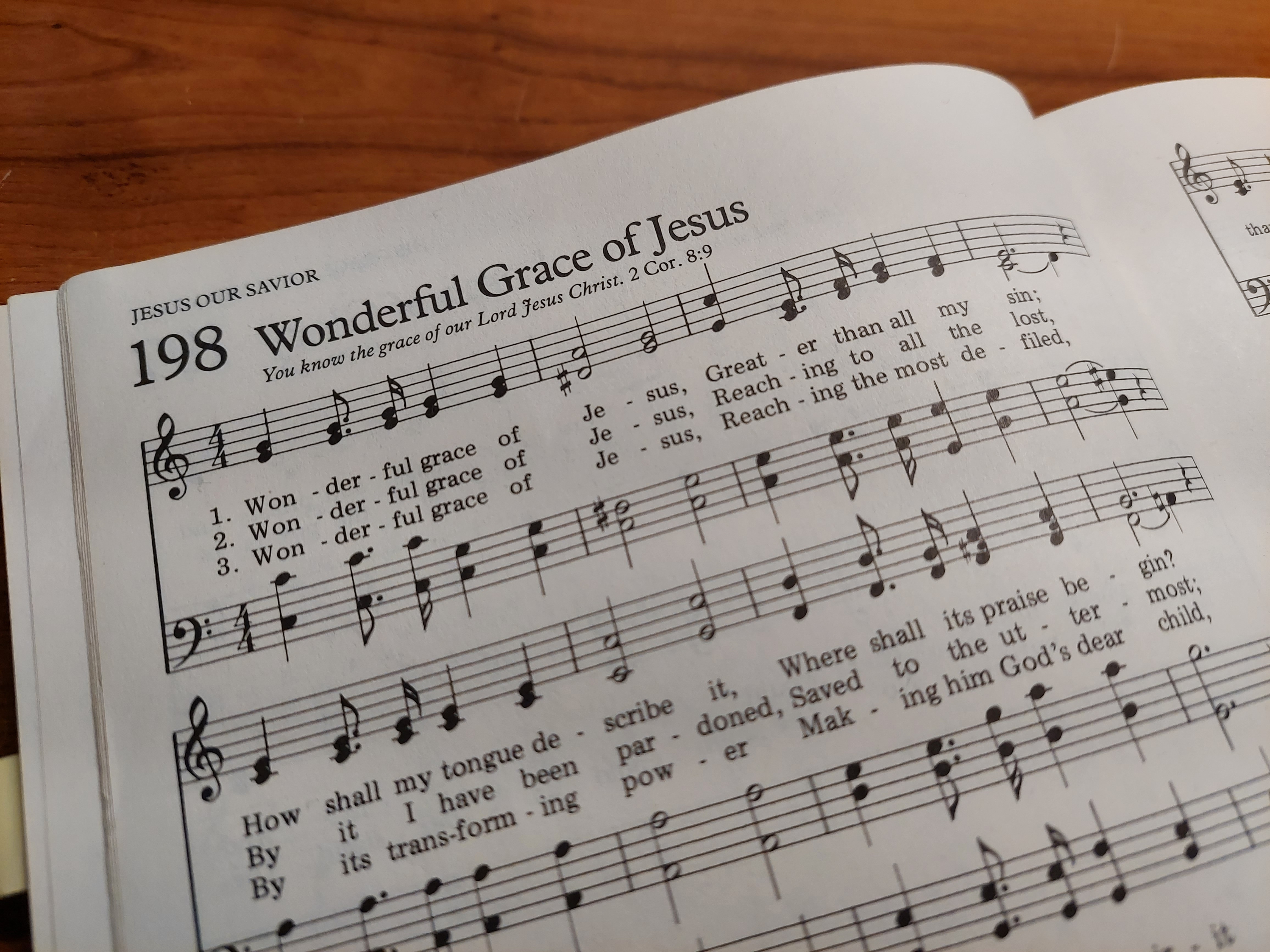
hymnal wonderful grace of jesus

I actually didn’t “grow up in church” before my teens, and I hadn’t sung any hymns other than the few that made their appearance in my (public school!) second grade Christmas program. So I had to adjust to taking my cues from a hymnal just like anyone might have to do today. It took some work and a few pointers from friends, but I was delighted to learn so that I could sing along. This was a part of joining in the worship of God among His people—I valued that and wanted in.

Logistical considerations aside, if we abandon hymnals because we’re afraid people can’t or won’t want to learn how to use them, what are we saying about the people who enter through our doors? We’re assuming their inability and disinterest, instead of giving them the opportunity to learn and be initiated into the historical songs of our faith.

The church itself has a legacy, a history, a heritage. This is something missing from many modern lives—why should we assume that believers in Christ won’t want to be a part of it?

My husband Nathaniel recently lamented to me that Christian music in general has a very short shelf life. If you make music in the secular world and get really popular, you have a shot at getting played on an oldie station after your “big time” fame begins to wane. Well, my friends, there are no Christian oldie stations. Pop culture is obsessed with what’s hot NOW, and it would seem that Christian pop culture is even more so.

This is indeed worthy of lament.

Nathaniel explained to me further that the average lifespan of a church worship song is five years. Five. Years.

Two years ago we were looking for a new church, and when we visited many places around town, we noticed a pattern. Most churches sang almost no hymns. And when they did throw a hymn in the mix, it was done up with a new chorus made popular by a hit song on the radio—or else it was simply a hit song on the radio that incorporated one verse from “Amazing Grace” just to check the nostalgia box. It’s not hard to imagine that much of today’s music exists mostly for the feels and the ratings.

In most of the churches we visited, we had to learn to sing new praise songs. Some were decent, and some were meh, and some were terrible. But all of them were from the last 5-10 years of Christian radio (which is why we didn’t know them—we don’t listen to Christian radio much these days. The musical and lyrical quality is mostly meh and self is at the center far too often.).

Now, don’t take this the wrong way. I love a good praise song, and it isn’t a problem if we have to learn some. In fact, there were a handful of wonderful praise songs that I sang in my youth group and alongside the hymns in that church I attended in my teens. But those songs are all but forgotten now. No one under 30 seems to know them.

What will happen to the good songs written in the past 30-50 years—the time period in which those songs were tested and enjoyed but didn’t exist in any hymnals? By now some of them could be added to such collections. But who is going to do it if no one uses hymnals anymore?

It’s expected that we, as a church, will sift through the songs of a given age and only keep the ones that are most valuable. Many old songs will be forgotten. There are old hymns that aren’t that good and don’t need to be kept alive. This is normal.

But in past generations, as my husband pointed out to me, we had repositories where we collected those best-of-each-age songs. We had hymnals. And these hymnals might be used in different churches, providing some continuity of worship even across denominational lines. Owning a few hymnals meant you could (literally) flip through several curated collections and determine which songs you thought most sound, most edifying, most worshipful, and most reflective of a heart devoted to Jesus.

hymnals song collection Christian hymns


Now? Now we have popular Christian radio to tell us what we should sing in the car, in our homes, and in our churches. And what makes for good popular Christian radio? Songs that have good ratings—from the average Joe who turns on or streams said station—no knowledge of the Bible or tests of character required. Just your vote.

Of course someone at the local church level makes the actual selections for what a congregation will sing, but what pool are they choosing from? Do they themselves know any of the old hymns? If so, how many?

I’m going to go out on a limb here and suggest that connecting with church history is of greater importance than connecting with what is popular and consumable under the “Christian” banner. We have a faith heritage that ought to connect our churches today—we don’t need to have that replaced with a worldly mechanism (the mere popularity contest) glazed over with Christian labels.

Maybe, like me, you recognize that the songs on the radio are weak, so you have a curated online playlist of not-the-radio songs. Maybe this includes re-vamped hymns, but with more substance than the radio. But the mechanism is much the same, and the lifespan of these songs is similar to the radio hits.

If the hymnals are gone from most evangelical churches, what mechanism will keep our people from forgetting the songs of the past?

Even among the churches that still sing hymns, which ones? How deep is the well from which you draw? We need more than the individual memories of the older folks who remember a broad range of hymns—we, as a people, are all too quick to forget. And when the older believers pass on from this life, their memories go with them—how do we tap into their wealth of hymnody for the edification of generations to come?

If everything is digital and customizable, how will that help us connect with other churches? Happenstance overlap? Or would it be helpful to have defined collections?

How could we revive the practice of gathering (’round the fire or piano) for a hymn sing? Would physical hymnals, printed papers, or digital song books work best for this?

If Christian radio didn’t exist to train your taste to whatever is new, how might that change your taste in worship music in church?

Do you have a personal or family hymnal? When was the last time you dusted it off and sang a few?

May the Lord be glorified in His church, as we “sing a new song” and as we keep alive His time-tested praises as well.

What do you think? Am I just an old curmudgeon ranting about “church these days”? Or is there something here we as Christians ought to consider and hold on to?

A Good Friday Devotional

07 Friday Apr 2023

Posted by Lauren Scott in Living Faith

≈ Leave a comment

Tags

Bible Lessons, Bible Study, Christian life, devotional, faith, Good Friday, Good Friday Devotional, Hymns, Jesus

I won’t spend many words of my own on this post. I’d like to point to a few passages of Scripture and a hymn to aid your thoughts of the Lord Jesus and His death on the cross in the place of sinners. My goal is simply to introduce these passages for your reading, meditation, prayer, and praise. Let the Scriptures speak to you of the death of our Lord.

Scriptures: Psalm 22, Isaiah 53, and Matthew 27

Hymn: Stricken, Smitten, and Afflicted

Psalm 22 Good Friday devotional death of Christ

Psalm 22

Psalm 22 is a Psalm of David, where he expresses in vivid terms his own anguish and hope in the Lord. The details of suffering match the crucifixion of Christ more than anything that we know of David’s own experience. Jesus cried out from the cross, “My God, My God, why have you forsaken Me?”–the opening line of the Psalm. David, inspired by the Holy Spirit, hinted at the sufferings of Christ, the promised Son of David, about 1,000 years before He arrived on the scene.

Here is Psalm 22 in its entirety (read the text with footnotes Here):

1 My God, my God, why have you forsaken me?
    Why are you so far from saving me, from the words of my groaning?
2 O my God, I cry by day, but you do not answer,
    and by night, but I find no rest.

3 Yet you are holy,
    enthroned on the praises of Israel.
4 In you our fathers trusted;
    they trusted, and you delivered them.
5 To you they cried and were rescued;
    in you they trusted and were not put to shame.

6 But I am a worm and not a man,
    scorned by mankind and despised by the people.
7 All who see me mock me;
    they make mouths at me; they wag their heads;
8 “He trusts in the Lord; let him deliver him;
    let him rescue him, for he delights in him!”

9 Yet you are he who took me from the womb;
    you made me trust you at my mother’s breasts.
10 On you was I cast from my birth,
    and from my mother’s womb you have been my God.
11 Be not far from me,
    for trouble is near,
    and there is none to help.

12 Many bulls encompass me;
    strong bulls of Bashan surround me;
13 they open wide their mouths at me,
    like a ravening and roaring lion.

14 I am poured out like water,
    and all my bones are out of joint;
my heart is like wax;
    it is melted within my breast;
15 my strength is dried up like a potsherd,
    and my tongue sticks to my jaws;
    you lay me in the dust of death.

16 For dogs encompass me;
    a company of evildoers encircles me;
they have pierced my hands and feet—
17 I can count all my bones—
they stare and gloat over me;
18 they divide my garments among them,
    and for my clothing they cast lots.

19 But you, O Lord, do not be far off!
    O you my help, come quickly to my aid!
20 Deliver my soul from the sword,
    my precious life from the power of the dog!
21     Save me from the mouth of the lion!
You have rescued me from the horns of the wild oxen!

22 I will tell of your name to my brothers;
    in the midst of the congregation I will praise you:
23 You who fear the Lord, praise him!
    All you offspring of Jacob, glorify him,
    and stand in awe of him, all you offspring of Israel!
24 For he has not despised or abhorred
    the affliction of the afflicted,
and he has not hidden his face from him,
    but has heard, when he cried to him.

25 From you comes my praise in the great congregation;
    my vows I will perform before those who fear him.
26 The afflicted shall eat and be satisfied;
    those who seek him shall praise the Lord!
    May your hearts live forever!

27 All the ends of the earth shall remember
    and turn to the Lord,
and all the families of the nations
    shall worship before you.
28 For kingship belongs to the Lord,
    and he rules over the nations.

29 All the prosperous of the earth eat and worship;
    before him shall bow all who go down to the dust,
    even the one who could not keep himself alive.
30 Posterity shall serve him;
    it shall be told of the Lord to the coming generation;
31 they shall come and proclaim his righteousness to a people yet unborn,
    that he has done it.

Isaiah 53

Isaiah 53 is another prophetic Old Testament passage that gives incredible detail about the Suffering Servant–the Messiah Who would come not only to rule as a King after David, but to suffer for His people, being “crushed for our iniquities” and “justify[ing] the many.” This is the passage the Ethiopian eunuch was reading when Phillip came to him, explained the gospel, and he believed (see Acts 8).

Here is Isaiah 53 in its entirety, one of the most obvious descriptions of Jesus Christ in the Old Testament, written some 700 years Before Christ. (Find the passage with footnotes Here.)

1 Who has believed what he has heard from us?
    And to whom has the arm of the Lord been revealed?
2 For he grew up before him like a young plant,
    and like a root out of dry ground;
he had no form or majesty that we should look at him,
    and no beauty that we should desire him.
3 He was despised and rejected by men,
    a man of sorrows and acquainted with grief;
and as one from whom men hide their faces
    he was despised, and we esteemed him not.

4 Surely he has borne our griefs
    and carried our sorrows;
yet we esteemed him stricken,
    smitten by God, and afflicted.
5 But he was pierced for our transgressions;
    he was crushed for our iniquities;
upon him was the chastisement that brought us peace,
    and with his wounds we are healed.
6 All we like sheep have gone astray;
    we have turned—every one—to his own way;
and the Lord has laid on him
    the iniquity of us all.

7 He was oppressed, and he was afflicted,
    yet he opened not his mouth;
like a lamb that is led to the slaughter,
    and like a sheep that before its shearers is silent,
    so he opened not his mouth.
8 By oppression and judgment he was taken away;
    and as for his generation, who considered
that he was cut off out of the land of the living,
    stricken for the transgression of my people?
9 And they made his grave with the wicked
    and with a rich man in his death,
although he had done no violence,
    and there was no deceit in his mouth.

10 Yet it was the will of the Lord to crush him;
    he has put him to grief;
when his soul makes an offering for guilt,
    he shall see his offspring; he shall prolong his days;
the will of the Lord shall prosper in his hand.
11 Out of the anguish of his soul he shall see and be satisfied;
by his knowledge shall the righteous one, my servant,
    make many to be accounted righteous,
    and he shall bear their iniquities.
12 Therefore I will divide him a portion with the many,
    and he shall divide the spoil with the strong,
because he poured out his soul to death
    and was numbered with the transgressors;
yet he bore the sin of many,
    and makes intercession for the transgressors.

Matthew 27:11-66

Here is Matthew’s account of the crucifixion. Notice especially the detailed connections to Psalm 22, and consider both the details and the theological implications of Isaiah 53 as you read. (Find Matthew 27:11-66 with footnotes Here.)

Jesus Before Pilate

11 Now Jesus stood before the governor, and the governor asked him, “Are you the King of the Jews?” Jesus said, “You have said so.” 12 But when he was accused by the chief priests and elders, he gave no answer. 13 Then Pilate said to him, “Do you not hear how many things they testify against you?” 14 But he gave him no answer, not even to a single charge, so that the governor was greatly amazed.

The Crowd Chooses Barabbas

15 Now at the feast the governor was accustomed to release for the crowd any one prisoner whom they wanted. 16 And they had then a notorious prisoner called Barabbas. 17 So when they had gathered, Pilate said to them, “Whom do you want me to release for you: Barabbas, or Jesus who is called Christ?” 18 For he knew that it was out of envy that they had delivered him up. 19 Besides, while he was sitting on the judgment seat, his wife sent word to him, “Have nothing to do with that righteous man, for I have suffered much because of him today in a dream.” 20 Now the chief priests and the elders persuaded the crowd to ask for Barabbas and destroy Jesus. 21 The governor again said to them, “Which of the two do you want me to release for you?” And they said, “Barabbas.” 22 Pilate said to them, “Then what shall I do with Jesus who is called Christ?” They all said, “Let him be crucified!” 23 And he said, “Why? What evil has he done?” But they shouted all the more, “Let him be crucified!”

Pilate Delivers Jesus to Be Crucified

24 So when Pilate saw that he was gaining nothing, but rather that a riot was beginning, he took water and washed his hands before the crowd, saying, “I am innocent of this man’s blood; see to it yourselves.” 25 And all the people answered, “His blood be on us and on our children!” 26 Then he released for them Barabbas, and having scourged Jesus, delivered him to be crucified.

Jesus Is Mocked

27 Then the soldiers of the governor took Jesus into the governor’s headquarters, and they gathered the whole battalion before him. 28 And they stripped him and put a scarlet robe on him, 29 and twisting together a crown of thorns, they put it on his head and put a reed in his right hand. And kneeling before him, they mocked him, saying, “Hail, King of the Jews!” 30 And they spit on him and took the reed and struck him on the head. 31 And when they had mocked him, they stripped him of the robe and put his own clothes on him and led him away to crucify him.

The Crucifixion

32 As they went out, they found a man of Cyrene, Simon by name. They compelled this man to carry his cross. 33 And when they came to a place called Golgotha (which means Place of a Skull), 34 they offered him wine to drink, mixed with gall, but when he tasted it, he would not drink it. 35 And when they had crucified him, they divided his garments among them by casting lots. 36 Then they sat down and kept watch over him there. 37 And over his head they put the charge against him, which read, “This is Jesus, the King of the Jews.” 38 Then two robbers were crucified with him, one on the right and one on the left. 39 And those who passed by derided him, wagging their heads 40 and saying, “You who would destroy the temple and rebuild it in three days, save yourself! If you are the Son of God, come down from the cross.” 41 So also the chief priests, with the scribes and elders, mocked him, saying, 42 “He saved others; he cannot save himself. He is the King of Israel; let him come down now from the cross, and we will believe in him. 43 He trusts in God; let God deliver him now, if he desires him. For he said, ‘I am the Son of God.’” 44 And the robbers who were crucified with him also reviled him in the same way.

The Death of Jesus

45 Now from the sixth hour there was darkness over all the land until the ninth hour. 46 And about the ninth hour Jesus cried out with a loud voice, saying, “Eli, Eli, lema sabachthani?” that is, “My God, my God, why have you forsaken me?” 47 And some of the bystanders, hearing it, said, “This man is calling Elijah.” 48 And one of them at once ran and took a sponge, filled it with sour wine, and put it on a reed and gave it to him to drink. 49 But the others said, “Wait, let us see whether Elijah will come to save him.” 50 And Jesus cried out again with a loud voice and yielded up his spirit.

51 And behold, the curtain of the temple was torn in two, from top to bottom. And the earth shook, and the rocks were split. 52 The tombs also were opened. And many bodies of the saints who had fallen asleep were raised, 53 and coming out of the tombs after his resurrection they went into the holy city and appeared to many. 54 When the centurion and those who were with him, keeping watch over Jesus, saw the earthquake and what took place, they were filled with awe and said, “Truly this was the Son of God!”

55 There were also many women there, looking on from a distance, who had followed Jesus from Galilee, ministering to him, 56 among whom were Mary Magdalene and Mary the mother of James and Joseph and the mother of the sons of Zebedee.

Jesus Is Buried

57 When it was evening, there came a rich man from Arimathea, named Joseph, who also was a disciple of Jesus. 58 He went to Pilate and asked for the body of Jesus. Then Pilate ordered it to be given to him. 59 And Joseph took the body and wrapped it in a clean linen shroud 60 and laid it in his own new tomb, which he had cut in the rock. And he rolled a great stone to the entrance of the tomb and went away. 61 Mary Magdalene and the other Mary were there, sitting opposite the tomb.

The Guard at the Tomb

62 The next day, that is, after the day of Preparation, the chief priests and the Pharisees gathered before Pilate 63 and said, “Sir, we remember how that impostor said, while he was still alive, ‘After three days I will rise.’ 64 Therefore order the tomb to be made secure until the third day, lest his disciples go and steal him away and tell the people, ‘He has risen from the dead,’ and the last fraud will be worse than the first.” 65 Pilate said to them, “You have a guard of soldiers. Go, make it as secure as you can.” 66 So they went and made the tomb secure by sealing the stone and setting a guard.

Stricken, Smitten, and Afflicted

This is one of my long-time favorite hymns. It ties a lot of themes together from the passages we’ve read above. Consider these words and sing along, meditating on the Lord and His work, with praise and thanksgiving. (These are the lyrics from the Trinity Hymnal, find more details Here.)

1 Stricken, smitten, and afflicted,
see him dying on the tree!
‘Tis the Christ by man rejected;
yes, my soul, ’tis he, ’tis he!
‘Tis the long-expected Prophet,
David’s Son, yet David’s Lord;
by his Son God now has spoken:
’tis the true and faithful Word.

2 Tell me, ye who hear him groaning,
was there ever grief like his?
Friends thro’ fear his cause disowning,
foes insulting his distress;
many hands were raised to wound him,
none would interpose to save;
but the deepest stroke that pierced him
was the stroke that Justice gave.

3 Ye who think of sin but lightly
nor suppose the evil great
here may view its nature rightly,
here its guilt may estimate.
Mark the sacrifice appointed,
see who bears the awful load;
’tis the Word, the Lord’s Anointed,
Son of Man and Son of God.

4 Here we have a firm foundation,
here the refuge of the lost;
Christ’s the Rock of our salvation,
his the name of which we boast.
Lamb of God, for sinners wounded,
sacrifice to cancel guilt!
None shall ever be confounded
who on him their hope have built.

Here are two good lyric videos so that you can sing along:

May you be blessed and encouraged as you consider the Lord Jesus today and celebrate His resurrection this Sunday!

Remember and Rejoice: Thanksgiving Meditations from the Book of Deuteronomy

20 Sunday Nov 2022

Posted by Lauren Scott in Living Faith

≈ 2 Comments

Tags

Deuteronomy, Holidays, Hymns, Loss, Rejoice, Remembering, Thanksgiving

This post was originally published four years ago on November 19, 2018. That was the first Thanksgiving after my PopPop passed away. This year, Thanksgiving 2022 will be the first Thanksgiving after losing my Grandma. I had forgotten the context of this article when reviewing it this year, so when I read it today the concluding thoughts really hit home. Maybe it will (again?) be a blessing to some of you, as well. 

I’ve had the pleasure recently of reading through Deuteronomy as I follow my Bible reading plan.

Deuteronomy? Pleasure? you may ask. Well, yes.

While it’s sometimes hard to slog through the books of the Old Testament, there are gems to be found, and I discovered that Deuteronomy had some relevant passages for this season of Thanksgiving.

In fact, the many references to “rejoicing” in the book surprised me! Sprinkled throughout much of the book are commands regarding the feasts that Israel was to celebrate–and celebrate with gusto!

remember rejoice thanksgiving celebrate

It’s not my intention to give a detailed overview of the feasts mentioned here, but rather I hope to express the elements of God-centered celebration that I have found helpful as we head into the holiday season.

In America, we have only one feast-day that harkens back to agricultural times: Thanksgiving. And while “giving thanks” isn’t really mentioned in Deuteronomy concerning the Jewish feasts, the purpose of these celebrations is clear: to remember and bless the Lord for His provision.

So whether it’s First Fruits (celebrated in late spring) or the Feast of Ingathering or Tabernacles (celebrated in the fall), the heart of each is expressed in Deuteronomy 8:10, “When you have eaten and are satisfied, you shall bless the LORD your God for the good land which He has given you.”

When you enter the land for the first time, bless the Lord. When you reap its goodness each year, bless the Lord.

We moderns find ourselves a bit far-removed from this kind of dependence upon the land. Not that we don’t eat its produce, but we rarely experience an actual harvest without going out of our way to do so.

I found myself reading about the Offering of First Fruits within a few days of harvesting our first ever (and completely volunteer) pumpkin patch. Nevermind the different time of year and different crops they would have had in Israel (olives, figs, etc), this passage resonated with me.

Here’s what Deuteronomy 26 says about First Fruits:

The Israelites were to bring their offering before the Lord and announce, after recounting the history of God’s provision for their people, “Now behold, I have brought the first of the produce of the ground which You, O LORD have given me.” And then they were instructed to “set it down before the LORD your God, and worship before the LORD you God; and you and the Levite and the alien who is among you shall rejoice in all the good which the LORD your God has given you and your household.“

Now, when I read about the Israelites giving the first of their produce to the Lord, I can’t help but think of that one, solitary, beautiful, orange pumpkin we picked. Sure, we picked 14 green ones. But that first, ripe orb was our delight! And that pumpkin, and no other, would, in another time and place, be offered to the Lord. It would be His, not ours.

20181102_182042
pumpkin thanksgiving rejoice celebrate

This vivid picture of the pride of our harvest belonging to the Lord began to expand in my mind. Not just fruits of the land. Fruit of the womb, also. The first born son would be the Lord’s (Exodus 34:19-20).

Just like that first pumpkin is the Lord’s and is intended to remind me that all of our pumpkins are His, so too my first child is the Lord’s–and by extension any further children are.

“The earth is the LORD’s and all it contains.”

I’m beginning to get it.

Deuteronomy 26:16 continues: “This day the LORD your God commands you to do these statutes and ordinances [immediate context is the feast of first fruits]. You shall therefore be careful to do them with all your heart and all your soul.”

What did the statutes and ordinances in this passage involve?

Remembering God’s goodness and covenant
Bringing the first of your produce
Worshiping before God
Rejoicing (with the Levite and alien!) in all the good which the LORD your God has given you and your household–there is a community giving thanks!
Sharing with the Levite, stranger, orphan, and widow–there is a community being cared for!
“I have not eaten it while mourning”–just in case you missed it, rejoicing is emphasized here by negatively stating its opposite.
Praying for God’s future blessing on His people “Look down and bless”

The Israelites were to do all of these things with all of their heart and all of their soul! “Soul” in the bible usually denotes your whole being, including your body. So, everything within us (heart) and all that we are (soul) ought to go into this remembering, rejoicing, worshiping, sharing, blessing…

Is this not the essence of thanksgiving?!?

The Feast of Ingathering (Deuteronomy 16:13-15) has similar instructions:

You shall celebrate the Feast of Booths seven days after you have gathered in from your threshing floor and your wine vat; and you shall rejoice in your feast, you and your son and your daughter and your male and female servants and the Levite and the stranger and the orphan and the widow who are in your towns. Seven days you shall celebrate a feast to the Lord your God in the place which the Lord chooses, because the Lord your God will bless you in all your produce and in all the work of your hands, so that you will be altogether joyful.

So much rejoicing! Again, this is a feast not only remembering past blessings (the things gathered in) but also awaiting with expectant joy the future provision of the Lord.

I can’t help but think of the Passover, which also looked back at past deliverance and forward to the Messiah. And of the Lord’s Supper, by which we remember and “proclaim the Lord’s death until He comes.” It seems the pattern of biblical celebration looks both backward and forward. It’s a pattern of remembering and rejoicing!

celebrate thanksgiving remember rejoice

All of this imagery and idealism is wonderful, but what if I’m heading into Thanksgiving with a nasty cold and way too many servings of responsibility and stress on my plate? And what if this is the first major holiday without a dearly loved family member?

This is where the rubber meets the road, isn’t it? There are things to begrudge and mourn. A lack of health, a lack of peace, and an empty chair at the table.

For an Israelite to swear, “I did not eat it while mourning” they would have had to push pause on, well, life. Because life is hard and we experience loss and disappointment often. Even in times of abundance.

I don’t have a remote with a quick-and-easy-fix button to literally pause pain so that rejoicing is effortless. But I can remember the Lord’s goodness and provision–past and present, in times of abundance and in times of need.

And I can rejoice. Because I know the One who will “guide the future as He has the past.”

As I went for a walk today (for the first time in what seems like forever) I had to deal with my grumbling attitude that had become my more-often-than-not companion in the past few days. The sunshine and fresh air helped to remind me that the world is still a beautiful place and God is still on His throne–even if I don’t get everything done, even if I’m carrying around my own personal storm cloud.

And as it turned out, being sick forced me to push pause today. I took a nap. In the quiet of a walk, in the quiet of my couch, in the midst of a busy, noisy, frenetic season, the Lord calmed my heart and reminded me of His care and provision.

Perhaps I can leave that storm cloud behind. Remember the Lord. Rejoice in His provision. And share that with those around me this Thanksgiving.

How about you?


Here are a few hymns that refreshed my soul on my walk today as the Lord brought them to mind. Looking to the Lord as a good, sovereign Provider is necessary if we’re to give Him thanks, isn’t it? I hope these songs will bless you as they have blessed me.

God Moves in a Mysterious Way (with added chorus in the video):

Be Still My Soul:

And, finally, one that actually gives thanks, rejoicing: For the Beauty of the Earth

Looking for more posts on Thanksgiving? Here you go:

The Poverty of Pragmatic Gratitude and the Riches of True Thanksgiving

Thanksgiving: A Holiday Made for Unsettling Times

  • View KeptandKeeping’s profile on Facebook
  • View lauren.keptandkeeping’s profile on Instagram
  • View keptandkeeping’s profile on Pinterest
  • View @laurenscott.keptandkeeping’s profile on YouTube
Lauren Scott

Lauren Scott

Christian. Wife. Mother. Homemaker. Home Educator. Blogger. Book Addict. Outdoorist.

View Full Profile →

Enter your email address to follow Life Meets Jesus and receive notifications of new posts by email.

Affiliate Disclosure

We are a participant in the Amazon Services LLC Associates Program, an affiliate advertising program designed to provide a means for us to earn fees by linking to Amazon.com and affiliated sites.

Hands-on Math Curriculum

RightStart™ Mathematics

Check Out Prodigies Music Curriculum!

music curriculum sale

Quality Video Curriculum

Top Posts & Pages

  • Wisdom in the Book of James
    Wisdom in the Book of James
  • Wise Women Build Up, Part One: Godly Wisdom
    Wise Women Build Up, Part One: Godly Wisdom
  • Word of the Year for 2025: STABILITY (and Bible Verses on Stability!)
    Word of the Year for 2025: STABILITY (and Bible Verses on Stability!)

Advent April Fool's Day April Fools Book Review Books Books Charlotte Mason Charlotte Mason Homeschool children Christian Classical Education Christian Classical Homeschool Christian Homeschool Christian life Christian mom Christian Parenting Christian Women Christmas Classical Education Classical Homeschool devotional education faith Guest Post Home and Family Home Education Homemaking homeschool encouragement homeschooling Jesus Living Books love marriage meditations micro book reviews motherhood Nature Nature Studies parenting poems poetry Practical Atheism Reading List Reflections Relationships trials

A WordPress.com Website.

  • Subscribe Subscribed
    • Kept and Keeping
    • Join 172 other subscribers
    • Already have a WordPress.com account? Log in now.
    • Kept and Keeping
    • Subscribe Subscribed
    • Sign up
    • Log in
    • Report this content
    • View site in Reader
    • Manage subscriptions
    • Collapse this bar
 

Loading Comments...