• Home
  • About
  • Living Faith
  • Home and Family
  • Home Education
  • Books
  • Recommended Resources
  • Media

Kept and Keeping

~ Rest in Grace, Labor in Love

Kept and Keeping

Tag Archives: Homeschool Bible

Family Bible Time Grows with the Kids!

23 Wednesday Aug 2023

Posted by Lauren Scott in Guest Posts, Home and Family, Home Education, Living Faith

≈ Leave a comment

Tags

Bible Reading, Bible Reading Plan, Bible Study, Christian Classical Education, Christian Classical Homeschool, Christian Parenting, devotional, family bible time, Family Worship, Home Education, Homeschool Bible, Homeschooling Middle School, Spiritual Disciplines

Amazon links are affiliate links. If you make a purchase through one of these links, I may receive a commission at no additional cost to you.

I’ve written in the past about how our family covers “Bible” in our homeschool, which is to say, I’ve written about how we don’t consider it a subject in school so much as a part of life. You can read that article here, especially if you have little ones or are just getting started reading the Bible together as a family.

The following article is actually a guest post from my husband, as he reflects on what we have done differently in our family Bible time this year–instead of reading a chapter aloud at the kitchen table, we’re reading independently and discussing it together over a meal.

I hope my husband’s words are an encouragement to you to see how family bible time can grow and mature as you and your children grow and mature together. If you don’t have kids, I hope these meditations on reading the Scriptures and the resources listed might encourage you in your own pursuit of God through His Word.

For reference, our boys are turning 14 and 12 this calendar year. So the following practice reflects what is possible with fairly strong readers, ages 11 and up.

Here’s Nathaniel:
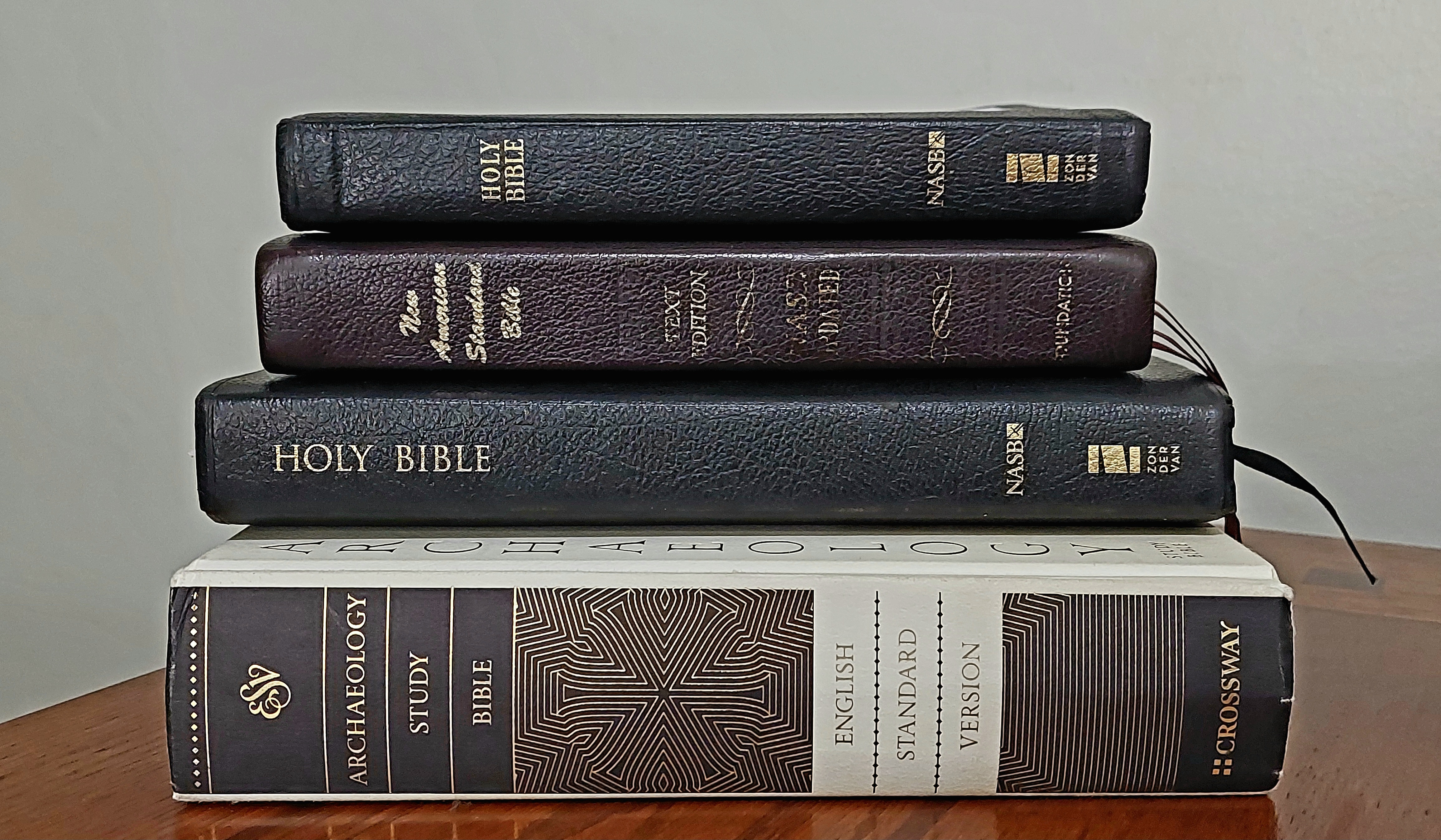
bibles stack bible reading ESV NASB

This year we changed up how we do family Bible time. We decided to read through the Bible in a year by having each person read on their own. Then we discuss over a meal every day. It has been incredibly rewarding for the whole family. Today we finished our last reading in the Old Testament, and I want to share some things that have made it rewarding so far:

1) A primary intention was to read the Bible as literature. Not as “mere literature”, but as literature nonetheless. We wanted to see the overall story arcs and major themes, to enjoy each genre, and to see how it all worked together.

2) We followed a reading plan that is based on the book order of the Hebrew Bible, which would have been the order in Jesus’ day. It has some nice advantages, particularly in that the prophets follow immediately after the books of Kings. For example, I have long enjoyed the poetry and imagery of Isaiah, but had a hard time understanding to whom he’s talking, particularly when he’s cursing neighboring nations. I thought I needed to find a good commentary to provide all the historical background. Turns out, the book of 2 Kings is a good commentary to provide the historical background! When these books are read quickly and close together, I can remember who these neighboring nations are and why they are being cursed.

3) The reading plan we’re using also has us read a Psalm every day. I have been amazed at how often the Psalms connect with the historical reading. It’s much easier now to see the role of the Psalms as the hymnbook of ancient Israel and to see the value of the imprecatory prayers in the context of national turmoil and destruction.

4) I read the ESV Archaeology Study Bible. It was phenomenally helpful to fill in the gaps of historical details and to better understand the world and worldview of the Ancient Near East. It has lots of maps (!!!) and some helpful historical explanation.

ESV Archeology Study Bible Map Genesis
Here’s an example spread from Genesis.

Today, I read in 2 Chronicles 35 of King Josiah going to an ill-advised battle with Pharaoh Neco, who’s just passing through on his way to fight someone else. The scripture doesn’t explain who that someone else is, because it’s concerned with Josiah, not with world history. But the study Bible commentary (a portion is pictured below) explained that Neco was allied with the Assyrians and on his way to battle the newly-resurrected Babylonian empire. Neco and Assyria are defeated, and 2 Chronicles 36 picks up a few years later as Babylon sweeps in and attacks Jerusalem.

ESV Archeology Study Bible

5) I appreciated that the commentary in this study bible is primarily observation-level commentary. It’s not about digging out deep theological interpretations, it’s more about understanding the historical and literary context of the Scripture. Which really helped in seeing the literary flow of the Bible.

6) We also have watched the Bible Project summary videos of each book. I know that in some theological camps there is some controversy around the Bible Project, and I certainly don’t agree with all of their systematic theology, but I think they do a great job aiding a literary reading of scripture with their compelling outlines and summaries of each book of the Bible in their Read Scripture series.

7) The pattern in our family time this year is for our youngest son to narrate the day’s reading and for our oldest to read his written one-sentence summaries of each chapter. Then I will share my observations, Lauren will chime in, and we generally have an enthusiastic discussion.

The boys have enjoyed it, too. They have established a great habit of daily bible reading as soon as they get up. Without being reminded, they are committed to it and haven’t missed a day all year. Prior to this, our youngest was about halfway through reading the entire bible on his own. But he says this group discussion approach has helped him understand it much better. It is my prayer that this year will provide a great foundation for a lifetime of rewarding Bible reading for my sons.

When we started this plan, I mentioned it offhand to a father at church who is some years my elder. He mentioned that a read-the-Bible-in-a-year plan really makes you appreciate the New Testament when you finally get to it. I don’t think I have ever enjoyed reading the Old Testament as much as this year — even Leviticus and Zechariah — but I believe he’s right: The Old Testament has clearly demonstrated humanity’s sinfulness and persistent rebellion against all that is holy and good and right. Against God Himself. Over and over again, God creates good things, and men reject His leading and ruin everything, resulting in tragic consequences. Even as the Jews return from exile in Babylon, they still can’t get it right. And those of us outside the Jewish nation are even worse off, without the scriptures! We need light to break through our darkness. We need new hearts, with God’s law written on them. We need an anointed King of a transformed people to spread His kingdom of love, peace, and righteousness all over the earth.

I’m ready for Jesus!

Back to Lauren:

Amen! I’m eager to see Jesus enter into our needy world, “in the fullness of time”, as we begin our readings in the New Testament–tomorrow!

To wrap up, here’s a quick summary of our family Bible time practice for this year:

  • Follow the Bible reading plan from the Bible Project, each of us doing our daily reading independently.
  • Discuss as a family, usually at breakfast:
    Youngest son gives an oral narration (or retelling) of our reading;
    Oldest son shares his short, written summary (usually 1-2 sentences per chapter);
    Nathaniel guides discussion and shares from his findings in the ESV Archaeology Study Bible;
    Lauren shares her insights (sometimes drawing from Words of Delight by Leland Ryken) and asks a guiding question on occasion.
  • At the start of a new book, watch the corresponding Bible Project video(s).
  • We have also added some side studies on the Code of Hammurabi and the Canaanite god Ba’al (among others) to broaden our understanding of biblical and ancient history and to be aware of the way that some critics and liberal theologians will use such sources and subjects to undermine divine inspiration and biblical historicity. It’s been a fascinating study that has made for great discussions. Keep in mind: this level of study is best undertaken when the kids already have a good grasp of history and the parents are solid in the faith and have at least some knowledge of how to interact with historical source material, able to ask good questions of a text or artifact and able to separate what’s actually there from a scholar’s speculative commentary.

Where are you in your own Bible reading journey? (Hint: It’s ok for it to look different in your home!)

Do you have a habit of reading and/or discussing the Bible with your family? What does that look like in your current stage of life?

If you’re just getting started, don’t be intimidated. Just take the next right step. And be sure to check out this post for what we’ve done in younger years.

May you and yours be built up in the Lord as you feast upon (or are just acquainting yourselves with) His word.

How We Homeschool: Bible

14 Thursday Jan 2021

Posted by Lauren Scott in Home and Family, Home Education, Living Faith

≈ 1 Comment

Tags

Bible Curriculum, Bible Lessons, Charlotte Mason Homeschool, Child Training, Christian Classical Education, Christian Classical Homeschool, Christian Homeschool, Christian Parenting, discipleship, Family Culture, Family Discipleship, Family Worship, Homeschool Bible, homeschool encouragement, homeschooling, parenting

Amazon links are affiliate links. If you make a purchase through one of these links, I may receive a commission at no additional cost to you. I make no money from links to Christian sellers, but I encourage you to support them over Amazon whenever possible.

“What Bible curriculum do you use for grade x?”

It’s a question I get from time to time, and it never ceases to make me squirm a little.

Why, you may ask? Well, because the idea of “Bible curriculum,” and especially for a particular “grade level,” is foreign to me.

Now of course I’m aware of the fact that “Bible curriculum” and “Bible classes” exist in Christian school settings, but I’ve always wrinkled up my nose a bit thinking about the Bible being made to fit the mold of an academic subject, added on to a school day like just another textbook or workbook to get through. What affect does that have on the way kids approach the Scriptures? And do they give grades for those classes? What does that teach?

Our approach to the Bible looks a lot less like school and a lot more like discipleship. Reading the Bible together has been a part of our family culture since before our children were born. We haven’t ever felt a need to make sure we added Bible to the kids’ schooling because they’ve been getting Bible with their breakfast since they were tiny.

In fact, while every part of school is informed by the Scriptures, we like to keep the Bible itself separate from “school” in a sense so that they don’t get the impression that a day off of school is a day off from devotion to the Lord.

But what does that look like? And how can you get started with this holistic family discipleship model of Bible learning if it’s foreign to you?

Well, let’s start with why.

Our Why: Created Reality and Biblical Goals

Our children are precious creations of our Heavenly Father–and they are precious gifts entrusted to us as parents. We desire to give them access to the Truth that God has revealed in His Word so that they can grow in wisdom and stature and in favor with God and man, that they would begin to know and love their Creator.

Ultimately, we desire that our children would trust in the Lord Jesus Christ for salvation from their sins and that they would love and serve Him all their days–for their good and God’s glory, both in this life and in the life to come. We don’t ultimately control this outcome. But we can be faithful to train our children in the way they should go.

Our Why Dictates Our How: Holistic Family Discipleship

Given the nature of our children, the nature of our relationship to them as their parents, and the nature of our goal (that they would have a relationship with God), it follows then that we ought to teach them in a way that is first and foremost relational. And decidedly not academic.

This means that interaction with the Scriptures comes woven into the fabric of our every day lives. There are no worksheets nor tests, no grades nor grade levels.

This doesn’t mean we don’t use printed materials to aid our children’s learning (I will link to some below), but we need to remember that the greatest resources we have to instruct our children in the ways of the Lord are His Word, His Holy Spirit, and our own lives lived alongside and before our children.

God’s Word: We must be in the bible ourselves and we must offer the Scriptures to our children.

The Holy Spirit: We must be seeking God to be at work both in us and in our children–apart from Christ we can do nothing. We may have had a direct role in bringing about our children’s physical life, but the spiritual life is of the Spirit–we cannot manufacture it in our kids. Prayer is indispensable.

Our Own Lives: We must model for our children what it means to believe the Word of God, to study it, to meditate on it, to practically submit our lives to it, and to receive both correction from it when we fail and comfort from it when we repent.

What does this actually look like?

Family Bible Time (what some call Family Worship)

Our current family Bible reading pattern, which we’ve had going for several years, is Proverbs at breakfast and Gospels at supper.

Now, this doesn’t mean each one happens every day. The reason we read the Bible over breakfast and dinner is because we often don’t read the Bible over breakfast and dinner. This is a scattering of seeds, not mechanical planting. We aim for faithfulness and perseverance rather than anything that resembles perfect consistency. But in keeping up the habit, we pretty reliably hit at least one of these each day, sometimes both. And before it was Proverbs and Gospels, we read slowly through the entire Bible at meal times–it may have taken a decade, but we kept going. The reason we’re in Proverbs and the Gospels right now is because the primary needs of our children are to receive instruction and correction according to God’s wisdom and to receive Jesus the Messiah as their Savior.

While we eat breakfast, my husband will read a few verses from the chapter of Proverbs that matches the calendar date (since there are conveniently 31 chapters in Proverbs), either selecting these verses ahead of time or asking for the kids to randomly select a number. He reads a verse and asks what it means. The kids give it their best shot and then we all discuss the meaning. He asks if they can think of any examples (a child may not use his brother as a negative example–this is a necessary rule, folks!). It has been fun over the years to hear the examples the kids come up with–sometimes from a fable, from literature, from a Bible story, from a movie. They are learning about wisdom and foolishness and learning how to identify each.

After Proverbs, we recite the Shema and the Lord’s Prayer. We switched up this recitation time over the holidays last year in order to recite and memorize Mary’s Magnificat. Now that we have the placeholder for recitation, we may use the time for other passages when they seem fitting.

Our evening Family Bible Time involves my husband reading from a passage of Scripture (currently Luke) at mealtime and then asking a few questions:

What did we learn? This is a good time for kids to either pick one thing that stuck out to them or simply narrate what they heard.

What can we worship God for? Sometimes, when we’ve been in the prophets, the answer is usually “That God was so patient and gave so many warnings.” Now that we’re in the first few chapters of Luke, the answer is usually “For sending Jesus to save us.” Sometimes the answer is different, but it’s no problem to worship God for the same things over and over again–in fact, it’s right to do so. Once answered, we pray and praise God based on what we saw in the passage–even if it’s simply for preserving the genealogy of Christ (which is pretty amazing when you think about it). Sometimes there may not be an obvious answer. When we were in the middle of Job as a family, it was admittedly hard to find any answer from the text–so we felt Job’s desolation a bit but worshipped God anyway.

What can we do with what we have learned? This is where we pay attention to the right response(s) to what we have read. Sometimes it is simply to worship as we did in the second question. Sometimes there is a command that we ought to obey. Sometimes there is something for which we ought to be thankful, something that ought to amaze us, something that ought to cause us to care for others, an example to follow or an example not to follow.

Now, these questions aren’t magical. They’re just the tools we have used for discussing the Bible as a family and for attempting to respond to it properly. Sometimes the kids are fully engaged and wow us with their insight. But sometimes the kids aren’t super excited to answer. Sometimes we get blank stares. But we don’t read the Bible and ask the questions in order to get perfect responses from our kids. We do it so that they are regularly interacting with the Scriptures and learning by modeling how to respond to them. It’s not perfect, but it is worthwhile. We are planting seeds.

Other Applications and Resources

The seeds we plant in Family Bible Time are watered by a lot of other practices and experiences.

We pray together as a family before meals and before bed. We try to remember to include intercession: to pray for neighbors, friends, family members, etc–sometimes on a weekly rotation so we don’t forget (but let’s be honest, we sometimes forget and go for long stretches with just basic bedtime prayers).

We have also made sure to include Bible time for our children to enjoy independently, even from a very early age by listening: Dove Tales (with cassettes–yes, we inherited these from my in-laws), Jesus Story Book Bible (with CDs), and a dramatized audio Bible from Faith Comes by Hearing. Now that our boys are 11 and 9, they are expected to read a chapter of the Bible first thing in the morning before coming downstairs for breakfast. This doesn’t mean it always happens, but that’s the goal and the general habit.

We’ve also enjoyed watching videos by The Bible Project–edifying for parent and child alike.

This emphasis on the Word of God being integrated into all of life means that it also influences our school day–just not in the graded-Bible-curriculum sort of way.

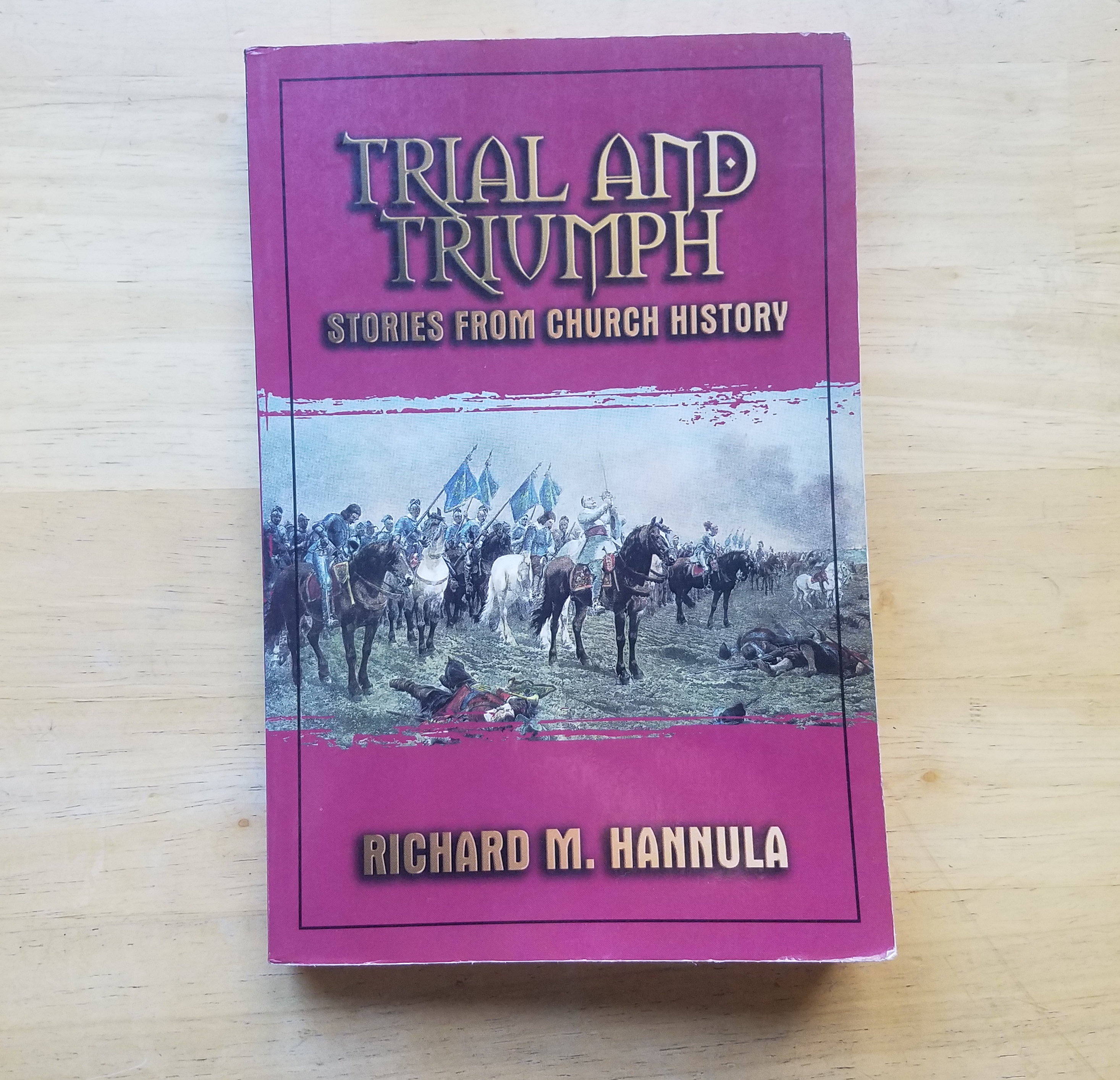
We read church history: Little Lights Biographies (for very young children, from a Christian seller), Christian Biographies for Young Readers (from a Christian seller), and Trial and Triumph (from a Christian seller).

We read aloud some theological books for children: A Faith to Grow On, Sammy and His Shepherd, The Attributes of God for Kids (from a Christian seller), and The Ology (from a Christian seller). As the kids grow older, their school reading list will include many Christian books that encourage them to walk with God and know Him more deeply.

We have listened and sung along with scriptures put to music: Hide ’em in Your Heart and Seeds Family Worship.

We have enjoyed singing many hymns in our Morning Time (currently singing along with this channel), and we have also enjoyed music by Sovereign Grace Kids (from a Christian seller). Even as adults, when we listen to music with lyrics, we generally choose music that is spiritually edifying. Our kids take this in as well.

The Scriptures inform the other books we choose–and how we read them–whether literature, tales, history, poetry, nature, etc.

The Scriptures make it into our kids’ copy work and dictation, too (that’s language arts).

Keeping It Real

We don’t do all of these things all the time. The most regular parts of our every day life are family Bible time, listening to hymns and other spiritual songs, family prayer, and good discussions on all kinds of things as we go about our days together. And these discussions aren’t just aimed at our kids. My husband and I discuss books, current events, and so many things with each other, seeking to apply God’s Word and His wisdom to everything we encounter. Our kids are audience to these adult conversations, too.

The aim is holistic, not check-list driven. And it is gloriously free from pressure to “get through it” on any kind of annual school schedule (thank God!).

The point of this post isn’t to say we’ve got it down, nor to set any kind of expectation for anyone else. The point is to demonstrate the many ways in which we can spiritually nurture and disciple our children–without boxed curriculum. And to remind all of us (myself included) that we may sow seeds, but the Lord causes the growth. Our dependence upon Him is central to our efforts at training up our children in the ways of the Lord.

All of the things we do have begun as small habits. A little here, a little there. If you are just starting to bring Scripture into your home and homeschool, don’t be discouraged or overwhelmed. Pick one thing. One habit that you and your children can enjoy. Plant a seed. And then another. Water where you can. The Lord causes the growth.

I hope this post has helped to somewhat answer the “What do you use for Bible curriculum?” question. It’s not a short answer, but I hope it may encourage some to think outside that proverbial box … of curriculum. 😉

How do you nurture your children in God’s Word? What resources have you found helpful?

Looking for Bible time ideas for older kids? Here’s an update on How Family Bible Time Has Grown with the Kids.

Other posts in this series (so far):

Why We Homeschool: Our Top Seven Reasons

How We Homeschool: Hello, Charlotte. Hello, Classical.

  • View KeptandKeeping’s profile on Facebook
  • View lauren.keptandkeeping’s profile on Instagram
  • View keptandkeeping’s profile on Pinterest
  • View @laurenscott.keptandkeeping’s profile on YouTube
Lauren Scott

Lauren Scott

Christian. Wife. Mother. Homemaker. Home Educator. Blogger. Book Addict. Outdoorist.

View Full Profile →

Enter your email address to follow Life Meets Jesus and receive notifications of new posts by email.

Affiliate Disclosure

We are a participant in the Amazon Services LLC Associates Program, an affiliate advertising program designed to provide a means for us to earn fees by linking to Amazon.com and affiliated sites.

Hands-on Math Curriculum

RightStartâ„¢ Mathematics

Check Out Prodigies Music Curriculum!

music curriculum sale

Quality Video Curriculum

Top Posts & Pages

  • Five Refreshing Scriptures for Finishing Strong when You Feel Weak and Weary
    Five Refreshing Scriptures for Finishing Strong when You Feel Weak and Weary
  • Versatile Basic Biscotti Recipe (Gluten Free / Dairy Free Option)
    Versatile Basic Biscotti Recipe (Gluten Free / Dairy Free Option)
  • Wisdom in the Book of James
    Wisdom in the Book of James

Advent April Fool's Day April Fools Book Review Books Books Charlotte Mason Charlotte Mason Homeschool children Christian Classical Education Christian Classical Homeschool Christian Homeschool Christian life Christian mom Christian Parenting Christian Women Christmas Classical Education Classical Homeschool devotional education faith Guest Post Home and Family Home Education Homemaking homeschool encouragement homeschooling Jesus Living Books love marriage meditations micro book reviews motherhood Nature Nature Studies parenting poems poetry Practical Atheism Reading List Reflections Relationships trials

A WordPress.com Website.

  • Subscribe Subscribed
    • Kept and Keeping
    • Join 171 other subscribers
    • Already have a WordPress.com account? Log in now.
    • Kept and Keeping
    • Subscribe Subscribed
    • Sign up
    • Log in
    • Report this content
    • View site in Reader
    • Manage subscriptions
    • Collapse this bar
 

Loading Comments...