I wanted to hop on here today to let you know that I recently had the privilege of being a guest on Scholé Sisters, a podcast for classical Christian homeschool moms who want to “learn and grow as they help their children learn and grow.” I’ve been listening to Scholé Sisters since show one (or rather episode SS#00) dropped NINE years ago. To say I’ve been blessed by these ladies over the years would be an understatement. So you can imagine my delight at the opportunity to chat with Brandy and Mystie on their most recent episode, SS#152: School Choice–Freedom isn’t Free.
State funding for private education–including homeschooling–is a hot topic these days. If it isn’t in your state yet, it’s likely on its way. The rhetoric and intentions may sound noble, and in the short-term it may seem like a great deal: free homeschooling! And given the amount of money some states are handing out, you may be able to quadruple (or more) your current purchasing power.
But is it all it’s cracked up to be? Is there a catch?
The simple answer is: No, it’s not. And yes, there is. You’ll find there’s far more than one catch. There’s a whole slew of strings attached and unintended (or intended?) consequences. “Free” homeschooling does not equal homeschool freedom.
The thorough answer is: listen to the podcast. 🙂 It’s a long one, but well worth it, I promise!
If you are wondering why I would dedicate space on this blog to such an issue, why I would light up my social media accounts with it, then I think you’ll appreciate hearing my story–how I got involved in researching this issue last May, and how it became personal very, very quickly.
The podcast covers my experience with a “school choice” program rolling out in my home state of Arkansas, as well as Brandy’s experience in California and now in Texas. We also discuss key principles that you can use to evaluate any “school choice” legislation or programs in your own state (or country).
The details may differ from state to state, but the basic principles remain the same.
I strongly encourage you to give this episode a listen. The future of homeschooling and private Christian education in America may very well depend upon our understanding of these principles–and our courage to act upon them…or not.
Be sure to follow me on Facebook and Instagram. More memes and videos forthcoming. 😉
[In case anyone is wondering, I still stand by everything I’ve said before about Instagram. Please don’t take my presence as an encouragement for you to hop on if you aren’t already there. My only motivation to be back on IG is to help get the word out about *this issue*. If that doesn’t tell you how important this is, I don’t know what will.]
This post contains affiliate links. If you make a purchase through one of these links, I may make a commission at no additional cost to you. Thank you for supporting this blog.
It’s been suggested that the average spending for one homeschooled child for one year can range from $250 to $2,500 (other estimates say $700-$1700, but I don’t take that lower number seriously—it’s too high).
The families who spend on the higher-end of that range are likely paying for private tutors, expensive co-ops, on-line courses, or pre-packaged programs with all the bells and whistles.
But I know families who have spent less than $100 per child (or even for the whole family!) in a given year. And often in my experience, some of the highest-achieving homeschool students I know come from families with the most frugal homeschool practices. While some level of monetary investment in your child’s home education is necessary and worth it(!!!), beyond the point at which the real necessities are covered for your family, more money in does not necessarily equal more education out.
You do not have to break the bank (or use government funds) to give your child an excellent education at home. Here’s a word from a good friend of mine who, like me, has been homeschooling for well over a decade:
“I discovered after the first year that I could do this gig fairly cheaply. The most money I have spent in a year, when I was homeschooling three kids was $500. This year, I spent less than $100 [for two kids].” And I happen to know that her kids are doing quite well.
My own family spends a bit more than that on average. (That’s why I consider this friend of mine to be a true queen of frugal homeschooling!) But our homeschool spending, even in our highest years, still stays pretty close to the low end of the average spending listed above. Averaging across all eleven years we’ve been homeschooling, we probably come out close to $200-$400 per student per year.
Old-school homeschool moms know how to do their job well on the cheap. Here’s how it’s done:
0. Start with Why
After compiling this list, I realized that one of the most foundational reasons that we are able to homeschool on the cheap is because we have a view of education that is far bigger and broader than the promises made by curriculum providers and other teachers that would charge high dollar to be a part of our homeschool. We don’t want to replicate public school at home. We know that real-life learning is just as valuable as book learning (if not more so!). We want to prioritize family life over a ton of out-of-the-home activities. Quality literature is more important than busy work. Christian discipleship in the home is of far greater importance than the standards measured by norm-referenced tests (though by aiming at the higher thing, we’ve gotten the lesser thing thrown in, too).
Develop a mission statement for your homeschool. Dig in to biblical theology and educational philosophy so you can weight the ideas and claims floating all around you against a standard of what is truly good and right for children. If you’d like to know what that looks like for our family, check out these articles on Why We Homeschool and How We Homeschool.
Curriculum resources are tools to help you educate your children. They are not the substance nor the goal of education. Arm yourself by thinking things through before you go shopping.
Ok, now for that Top Ten list!
1. Pass on Pricey Tech
Let’s just start with a statement that might be controversial (but it shouldn’t be): You don’t need much more than books, paper, and pencils to give a child an excellent education. Public schools are handing out tablets, but that won’t actually improve the quality of education for students (though it’s sure to help tech companies). Screens cannot replace books and human interaction. YOU are far more valuable to your child’s education than anything they could access on a screen.
There is literally no need for kids under age ten to be doing any school on a device or computer. The only exception to this is when you, as a parent, believe it’s an appropriate time to teach your child typing skills. And even then, it’s actually just fine for kids to share a computer. Taking turns is a life skill, after all.
If YOU have a device/computer and access to a printer for your needs as an adult and for printing off any worksheets or online resources you may use, then you have all the tech you need. Don’t cave to the pressure that your kids are missing out if they don’t have their own personal tech devices—for school or any other purpose. This is actually where frugality wins big—you will be giving your child a childhood free from screen addiction. That alone will bolster their ability to learn and grow academically and in pretty much every other way as well.
2. Borrow What You Can / Find Books for Free
From lesson books to literature to science kits and more, you may have way more opportunities to borrow what you need than you now realize. Ask around to swap these items with friends—you can even arrange to swap teaching particular skills or in-person lessons. This year, one of my sons is using another family’s Arkansas history textbook since the other family doesn’t have a student who needs it this year.
Long-time homeschoolers love their local libraries, so don’t underestimate them. And don’t forget that if your public library doesn’t have a title that you need, you can request the title via InterLibrary Loan. But also remember that we are by no means limited to the public library. My local homeschool support group has a well-stocked library full of carefully curated books, curriculum, DVDs, and more—all items that can be checked out for an entire school year, if needed.
There’s a university in my town, as well. Residents can get a library card—it’s not just for college students! I have found that the children’s / education section of this library has a different if not better collection of classic children’s books than the public library.
You can find free books online, as well. Check out ebooks and audiobooks using Libby, an app that works through your public library system.
Librivox.org is a great resource for free audiobooks on titles that are in the public domain. You can listen online, in the app, or download the mp3 files. Librivox has supplied us with good listening on many family road trips! Check out Pinocchio by Carlo Collodi.
Gutenberg.org similarly has free ebooks available online. Public domain and hard-to-find-in-print books can be found here.
3. Buy Used / Scratch-and-Dent / Big Sales
Old-school homeschoolers know that a well-curated home library is one of the greatest assets to a successful homeschool. And they know how to build that asset over time. A 25 cent book here, a $2 book there. Don’t be afraid to dig through bargain bins and garage sale boxes and dusty used bookstore shelves to find gold. Don’t know what books to look for? There are great book lists available in book form or online to help you know when you’ve found a good one: Honey for a Child’s Heart, Read for the Heart, at the back of this incredibly helpful book on Christian homeschooling: Educating the WholeHearted Child; AmblesideOnline’s free curriculum is a treasure trove of resources and book lists by year, and here’s a private classical Christian school’s literature list for elementary. Any of those can get you more than started.
Be sure to take advantage of any local homeschool used book sales in your area or region. While online shopping may feel convenient, in-person used book sales give you the opportunity to flip through the curriculum items and books before you purchase them, and you may even be able to ask other homeschool parents what they think about different programs right there on the spot. Making real-life connections with others on this homeschool journey is a blessing, so run to these in-person opportunities rather than away from them.
There are, of course, many ways to find used books and curriculum resources online: HomeschoolClassifieds.com, Facebook Marketplace, scratch-and-dent options at your favorite book sellers or curriculum companies, and shopping for used items at Amazon.com, to name a few.
4. Reuse Curriculum Books and Resources with Younger Children
Do you have more than one child in the home? The cost of homeschooling your first child does not have to be doubled by adding another student! Nearly all of your materials can be reused down through the whole family if you are strategic about the types of resources you purchase and how you use them.
Purchase quality, classic books that will stand the test of time and hold up against wear and tear. Classic children’s literature isn’t tied to movies or fads. And the best books for girls are good stories for boys, too, and vice versa. Don’t fill your shelves or drain your bank account for books that don’t have staying power.
Avoid consumable texts. Worksheets and workbooks can be a blessing where they fit best for you and your children, but you will save money by either limiting their use or using them in non-consumable ways. You can have your children write their work and/or answers on a separate piece of paper instead of writing in a workbook. Another clever option that we used for math facts practice was to put math sheets inside of page protectors and have the kids write their answers with dry-erase markers. Once mom checks the work, it gets erased. And the page is ready for tomorrow or the next day or for the next student in two years.
At times it may feel more painful to have your child copy from the book and write a heading and problem numbers and answers out on their own sheet of paper. But kids eventually get over whining about these things if you are consistent about requiring them. And having kids that don’t whine about writing basic information on a sheet of paper is an asset to their character in the long run. Again, the habits formed by frugality can be a blessing to your homeschool rather than a liability.
5. DIY Do It Yourself
Back in the day, the really old school homeschool moms HAD to do a lot more of their own lesson planning. My mother-in-law made her own worksheets, crossword puzzles, mazes, and quizzes for my husband and his siblings!
I’ve done a little bit of the same at times for our homeschool. My kids participate in the spelling bee (we have never done a purchased spelling curriculum!), and I would write silly sentences using words from their list. This made for entertaining copy work for my elementary kiddos.
Lots of copy work for early elementary can either be simply written out by hand or made online. (Here’s one example of a handwriting practice sheet generator!)
Your growth as a mother-teacher can enable you to save money in your homeschool. Learn to teach basic skills without curriculum or with the most efficient and cost-effective curriculum. (Some simple curriculum items: 100 Easy Lessons for phonics/reading, Our Mother Tongue for middle to high school grammar in just one book.) Language arts can be taught simply by reading aloud (both to the child and having them read aloud to you), copying a paragraph from the book, gently correcting any errors and explaining the basic grammar of an example sentence, memorizing a poem or passage of scripture, etc. It may be hard to believe, but workbooks and textbooks aren’t really necessary.
6. Make the Most of Local Community
I cannot stress enough how important it is to connect with other like-minded homeschool families. It doesn’t have to be a co-op, and especially not an expensive academically-focused one. Building relationships with other families on this journey provides more than just resources—it provides encouragement and shared wisdom.
My family has been a part of an old-school homeschool support group for eleven years. It currently costs $70 per year for the whole family to join, and that includes access to a homeschool library.
I also organize an old-school, moms-pitch-in Co-op. We enjoy enriching lessons and activities but most of all a close-knit fellowship. No one pays a dime to join.
There may be other clubs or organizations in your area that can enhance your homeschool for free or at a reasonable cost. Don’t forget about other community events and activities. State parks often have free or low cost guided nature tours. And of course self-guided nature walks are a free and long-time staple of homeschooling.
7. Leverage Rewards Programs
Use credit card rewards points (if you can use CC’s responsibly) for homeschool purchases. I rarely buy new books without using points. This is another great way to build that home library. You can also see if your favorite vendors or websites have their own rewards programs to take advantage of.
8. Enlist Extended Family
Ask grandparents or other interested relatives to forgo unhelpful toys and candy and instead buy birthday and Christmas gifts that enrich their grandkids’ education (open-play toys or building sets, bird feeding/watching supplies, music lessons, instruments, helpful DVDs, quality literature, intelligent board/strategy games, etc). And don’t forget that extended family members may have hobbies and skills and stories they can share—family time is formative. Building these relationships is more important that just adding on another costly activity with strangers.
From my friend: “I don’t use very many online resources at all, but I do like lizardpoint.com for geography quizzes.”
My family has enjoyed Prodigies Music lessons (It’s pricey now. I got in on the lifetime deal early when it was very inexpensive—there’s another tip: get in on a start-up). But there are also free solfa music lessons that some of my friends have enjoyed. One year we purchased an online Spanish lesson subscription (we got it for half off with a Black Friday deal). In my experience, language lessons and music are some of the best candidates for online learning, just keep in mind that there are free versions of those things—you don’t have to purchase anything if you do some digging on YouTube. Just keep “auto play” turned off and don’t leave your kiddos alone with the internet. Our kids don’t watch anything online by themselves. It’s just not a habit worth building.
10. Pray and Practice Christian Contentment
This tip really isn’t a last resort. It ought to flow through and undergird all of the tips on this list.
The Lord cares for you and your children. Do you believe this? Enough to trust Him that your loaves and fishes will be enough? It’s tempting to look at all the shiny curriculum and fancy courses available to homeschoolers these days and imagine that we are missing out.
We have so much available to us today, it really is amazing! But it doesn’t mean that we need all of these things in order to homeschool well! Don’t let curriculum marketing prey upon your mother-teacher insecurities, promising to fill your lack of experience with their expert teachers, scripted lessons, convenient this-and-that, and blah blah blah. You’ll get the experience simply by teaching your child. So the best thing to do is simply start.
Don’t let Instagram images and curriculum ads get to you. If you are willing to learn alongside (and sometimes just ahead of) your children, you will do well. If you trust in the Lord to provide for you and your children, and if you are committed to walking in His ways and guiding them to do the same, you will do well. Don’t forget why you took on this homeschool gig to begin with. The curriculum resources are simply tools to help you accomplish something way bigger. Don’t let them steal the show or make you feel inferior if you can’t have the shiniest program. You don’t need it. You really don’t.
You can do this. Bring your own skills and creativity and passion to the work of homeschooling, and you will bless your family in unique ways that no curriculum could have done for you.
If putting these tips into practice isn’t enough to make it possible to homeschool…
Get Help: If you and your family are in dire straights, talk to the leadership of your local church to prayerfully consider sponsoring your family through a tough time. And check out HSLDA Compassion—they exist to help homeschool families in need to be able to continue to homeschool in the aftermath of devastating events.
If you are in good financial shape, would you consider giving to HSLDA Compassion? Or talk to your church leadership about how you can give to help families in your fellowship who are already willing to sacrifice to give their children a Christian education…but it simply isn’t adding up right now.
God’s people are equipped to love and support one another in raising up the next generation in the ways of the Lord. This is a noble goal to prayerfully pursue.
Well, that’s it for my top ten tips for homeschooling on a tight budget!
Do you have any other tips for frugal homeschooling? How do you save money on your child’s education?
It’s always a good idea to define terms at the outset of a public policy conversation. Unfortunately, that’s a rule not often followed.
Words are powerful, friends. They can powerfully inform, they can powerfully persuade, and they can powerfully mask reality, glossing it over with feel-good buzz words to garner our support or acceptance. “School Choice” is no different.
“Choice”
“Savings”
“Freedom”
Aren’t you ready to sign up when you hear those words?
But here’s the truth:
“School Choice”
“School Choice” is really about funding.
Now, some may object that “school choice” means the ability to choose which public school or public charter school to send your child to, even when those schools are outside of the district in which you live. And to that I say, yes. That’s a good use of the term “school choice.” But that’s not the “school choice” movement that’s sweeping state legislatures as I type.
You might also say that “school choice” just means the freedom or ability of parents to choose options other than public school. And I would say that’s another accurate use of the term. But the reality is that in all 50 states parents may ALREADY choose to pursue the private education of their choice and which fits their budget and priorities.
So when politicians are promoting “school choice” programs these days, they’re offering something other than the freedom to choose. They’re offering public funding for private education.
“Education Savings Accounts”
“Education Savings Accounts” may be the fastest-growing form of “school choice” among governors and state legislators today (I’m looking at you, AZ, AR, FL, IA, IN, MS, NH, SC, TN, [TX,] UT, WV). But they aren’t savings accounts at all.
You don’t put your money in them. You don’t get money from them. They’re funded by the government with money that travels through your hands and into vendor/provider hands. ESAs are really Education Subsidy Accounts.
“Education Freedom Accounts”
The cleverly-named “Education Freedom Accounts” in my home state of Arkansas (and New Hampshire) work the same way. They’re really Education Funding Accounts. And yes, you actually trade freedom for those funds.
There’s no such thing as free lunch. You pay for that money with decreased privacy, increased regulation, and psuedo-choice on the “approved vendors” market.
I suppose I could have also taken a shot at the fact that politicians promoting “school choice” programs like to tell us that their initiatives are pro- “free market.” But in reality, they’re pro- public-private partnerships, luring both buyers and sellers into a government-monitored and government-regulated market. A once-free market will be free no more. But teasing out market impacts is a task for another day.
The Bottom Line:
You already have the CHOICE. You are already FREE. The question is who funds your child’s education? And what freedom are you willing to trade for state funding?
That’s a trade I’m not willing to make.
It’s National School Choice Week, and I’m beginning to release the findings of my 7-month deep dive on this subject. Be sure to subscribe here on the blog and follow me on Facebook and Instagram so you can stay informed and share this important information with others (starting with this blog post? 😉 ). The freedom of private and home education is at stake. Multiple state legislatures are in session debating this issue RIGHT NOW. Thank you for helping me to get the word out.
I recently had the privilege of chatting with Mystie Winckler on her Simplified Organization Podcast, sharing the story of how I really learned to be an impervious homeschool mom during my oldest son’s challenging fourth grade year. As soon as the recording was over my mind filled with further thoughts and clarity on the subject, which, in my limited experience with podcasts, seems to be par for the course. At any rate, I’d like to share the concept of imperviousness with you for your benefit so that the story I tell on Mystie’s podcast will make that much more sense and be that much more helpful.
I first heard about imperviousness many years ago from Mystie herself, who heard it from Cindy Rollins before that. Despite having been introduced to the concept early in our homeschool journey, it took me some time to wrap my head around it.
So what does it mean to be impervious? Here’s the definition from Webster’s:
Impervious: 1a: not allowing entrance or passage : impenetrable Ex: ‘a coat impervious to rain’ b: not capable of being damaged or harmed Ex: ‘a carpet impervious to rough treatment’ 2: not capable of being affected or disturbed Ex: ‘impervious to criticism’
The essential idea when applied to parenting and homeschooling is to not let your kids get to you. You are committed to doing what is right for your kids without being thrown off course by their ups and downs, whining or talking-back, disobedience or tantrums, pleading or puppy-dog eyes.
This doesn’t mean you’re cold and heartless, it just means that you are in control of yourself rather than letting your kids take the reigns or knock you off-kilter. Kids aren’t born with self-control, so you’ve got a long head-start on them in developing it; and if you are a regenerate follower of Jesus Christ, you have the Holy Spirit to produce that fruit in you.
Be controlled by the Spirit, not by your kids. (See Ephesians 5:18 and laugh with me at the loose parallelism that I just made.)
Imperviousness absolutely ought to come with love, joy, peace, patience, kindness, goodness, faithfulness, gentleness, and self-control (Galatians 5:22-23). Though in the moment, when you’re tested by all the fuss your children can muster, it can feel a lot more like holding back a wave of frustration and mommy-tantrums than like “smooth and easy days” (I’m looking at you, Charlotte). 😉
From my own experience, I will offer that imperviousness—a bit of emotional separation from your kids—is actually an important step toward having genuine fruit of the Spirit grow in your relationships with your children.
It’s tempting to think that the more we detach from our kids’ emotions, the less able we will be to sympathize with them and offer the emotional support that they may need. But in reality, if my emotions aren’t under control, if they are instead reactive or reflective of my child’s emotions, then I’m not providing the stable anchor for my child in the midst of his turbulent sea.
Once I was able to see my son’s ups and downs without joining him in them or reacting to them, I was then able to calmly call him to do his duty and also calmly comfort him when learning to overcome his particular challenges was really hard.
Imperviousness is sometimes referred to as “being the wall” for our kids. Setting a course or a standard and sticking to it no matter how our kids bump up against us. But take note that being a wall doesn’t require being angry. In fact, getting upset actually means that our wall is likely to move—either to give way to our kids or to fall on them and crush them. That’s not imperviousness in either case.
When our kids are on an emotional roller coaster, we don’t need to get on the roller coaster with them. We can help them calm down and do the work only when we ourselves remain calm and stay off of the wild ride that they’re on.
In the podcast with Mystie, I tell the story of my oldest son’s fourth grade year, which was a painful learning process for us both. My lack of imperviousness around math led to a need for intervention—my husband helped set us on a course that provided more distance between me and my son’s day-to-day math performance. As a result, we both grew by leaps and bounds that year, and we have reaped the benefits of it ever since (that 10-year-old is now 15!). I learned to be truly impervious in what was for me the place of greatest testing. Make sure you get the full story by listening to (or watching) the podcast, and then consider these take-aways from my experience:
Even when you have an idea of how to be impervious as a mother, don’t be surprised if you find yourself tested in a particular area. I could be impervious in a lot of settings, but math was my Achilles’ heel. Watch out for that one specific area that trips you up. “Therefore let him who thinks he stands take heed that he does not fall.” 1 Corinthians 10:12
Impatience is the opposite of imperviousness. Maybe imperviousness can have other opposites, too, but in my case, the real emotional upheaval was around the fact that I couldn’t speed up the learning process to meet my expectations. My expectations and attitude had to change before I could provide the stability my son needed.
Natural consequences and/or an impersonal standard are tools that can make imperviousness a little easier to practice. When your kids are reeling against the direction you’ve given or are asking for things to be different, it’s a lot easier to hold your ground when you have already clearly communicated your expectations and have even written them down somewhere. You don’t have to flex your authority when you can simply appeal to the law of the land (or maybe just your house) and tell them that if you do x you get y (whether that’s a positive or negative reinforcement). Direct disobedience needs discipline, authority isn’t something to be afraid of, but well-established expectations and consequences can help with most other scenarios. (Listen to the podcast for the specific steps we took in this department!)
One important element of imperviousness is that you can see beyond more than just today. We can expect that there will be ups and downs in our day-to-day experience, but we need to remember that we’re playing the long-game (something my husband has had to remind me of often).
When Mom lacks imperviousness, Dad may be a good source of it! Dads (not always but often) can come at a parenting situation with greater emotional distance. Sometimes their approach seems harsh/too strict to us as moms, but sometimes that’s exactly what is needed. Value what Dad brings to your parenting team.
If you find yourself in the middle of a crazy season because you’ve gotten on the roller coaster ride with your kids or have provided some of the loopty-loops yourself, it’s ok. You’re normal. Course correct as soon as you can—preferably before outside intervention is necessary! Hold the line. But don’t wallow in your past mistakes. To quote Mystie: “Repent. Rejoice. Repeat.”
There CAN be peace on the other side of your worst homeschooling mistakes. God is merciful and gracious. And He can heal what is broken. Confess and repent, rejoice in the Lord, and pursue joyful-yet-impervious fellowship with your kids as you guide them through their home school years and beyond.
I hope my story and these considerations can help you in your parenting and homeschool journey. God is faithful. Look to Him for the fruit of the Spirit each day, and trust Him for the fruit He will produce in you and your children over the long haul. Steady your heart to provide a stable, impervious mama for your kiddos. You and they will be better for it.
Here’s the podcast link, one last time:
And if you want another peek into my story, here’s an article I wrote while in the middle of that challenging season: Ideals and the Daily Grind.
Have you ever heard the term “impervious” before? Have you had a seriously challenging season with one of your children? How did you handle it?
This post contains affiliate links. If you make a purchase through one of these links, I may make a commission at no additional cost to you. Thank you for supporting my blog!
This is a guest post from my good friend, Tabitha Alloway. We both have high schoolers this year, and they’re both going to read some Homer. While I’ve read The Iliad and The Odysseyrecently so that I can be in conversation with my son about what he is reading, Tabitha has gone a step further and actually written out her thoughts, which I have found both interesting and helpful! I hope you will, too. Check out Part 1, Part 2, and Part 3 if you haven’t already. Here’s Tabitha with Part 4:
“The Greeks seek after wisdom: But we preach Christ crucified… unto the Greeks foolishness” (see 1 Corinthians 1:17-31).
The Greeks had no shortage of bizarre and outlandish tales about their gods. But Christ astonished them.
He died for mankind. Their gods could not die—and certainly wouldn’t for anything so insignificant as a mortal.
He forgave man’s sins. Their gods were quick to mete out justice and retribution, but slower to show mercy. Forgiveness was not a well-developed concept in Greek culture.
He conquered death. A general resurrection of the dead? This was an outrageous thought—something beyond the Greeks’ wildest dreams. It just couldn’t be.
It was the teaching of the resurrection that divided the Greeks who heard Paul preach at Mars Hill. Some mocked. Others were willing to hear him again. A few believed.
To most, the gospel appeared weak and foolish. Their heroes smashed their enemies—they didn’t die for them! The Greeks could not understand a God who would suffer for mortals, just as the Jews, who were looking for a mighty conqueror to save them, did not recognize their humble Messiah who came to serve, rather than be served. And perhaps more than anything, the Greeks couldn’t fathom eternal life in immortal bodies—something they could only envy the gods for possessing. Or else, like Plato, found ridiculous and even undesirable.
Early Church Father Justin Martyr appealed to the Greeks’ understanding of the gods’ immortality to explain the resurrection: “And when we say also that…Jesus Christ, our Teacher, was crucified and died, and rose again, and ascended into heaven, we propound nothing different from what you believe regarding those whom you esteem sons of Jupiter [Zeus]” (1 Apol. 21).
The gospel was the power of God to salvation for everyone who believed, and God added both Jew and Greek to his church, washing away strife, envy, wrath, and hatred through the Lamb who conquered sin, death, and the grave.
Christ is not only the Lamb of God. He is also the Lion of the Tribe of Judah. He did not suffer for suffering’s own sake; he did it for the joy set before him. He came to rescue a people for himself. He earned a name above every name. Glory. Honor.
In contrast to the Greeks, many today may be more comfortable with a God who is kind, forgiving, suffers without returning insult for insult, and mingles with the lowly, yet struggle with aspects of his justice that might not have been so difficult for the Greeks to understand.
A Servant who girds himself to wash his disciples’ feet is a comforting picture. Is he equally accepted as a King who will return to require worship—and destroy those who do not give it (Psalm 2)? A Lord who will rule with a rod of iron and smash his enemies to pieces (Revelation 2:27, 19:11-16)? A Lawgiver who will break the teeth of the wicked (Psalm 3:7/58:6-8)? An Avenger who “reserveth wrath for his enemies” (Nahum 1:2) and is “angry with the wicked every day” (Psalm 7:11)? A God who tramples the wicked in fury until their blood is splattered all over his garments, and feeds their carcasses to the animals (see Isaiah 63:1-10, Revelation 19:11-18)?
“Kiss the son [signifying worship], lest he be angry, and ye perish from the way, when his wrath is kindled but a little. Blessed are all they that put their trust in him” (Psalm 2:12).
This picture of God may be a far less comfortable one for modern sensibilities, but it puts the cross into perspective. It tells us just how offensive we are to a righteous Sovereign.
Mercy only means something in the presence of true justice.
Christ came to reconcile us to God and deliver us from his anger. But the day of mercy will not last forever. When the door of the ark closes, only those found in Christ will be able to safely ride out the flood of God’s wrath. Unlike the Greeks and their petty gods, God’s wrath is holy and justified.
The cross was not the end, but a means to an end: to redeem a people for God’s own glory and possession. Both divine justice and mercy were displayed at the cross. God has linked our good and his glory together.
The God of the Bible is not about foregoing glory. We may be less comfortable with the concept of seeking personal glory (while in the pursuit of God’s glory) than the biblical writers are.
But Paul puts the idea of seeking glory, honor, and immortality for oneself in a good light (the full context of Romans 1-5, of course, is an argument against trusting in works for salvation, and the need to find it—this glory, honor, and immortality—by faith in the finished work of Christ). He motivates believers with the promise of glory, praise, and reward awaiting them, and warns them not to look for this from man on earth. (See John 5:44, Matthew 25:21, 23, 1 Corinthians 4:5, 2 Corinthians 10:17-18, Romans 2:6-7, 29, 8:16-17, 30, 2 Thessalonians 1:11-12, Galatians 1:10, Matthew 6:1-6 Colossians 3:23-24, James 1:12, Matthew 5:11-12, Ephesians 6:8, Hebrews 11:6, Revelation 22:12, 1 Corinthians 3:8-15, etc, etc.)
The question is not whether it is a moral thing to seek glory, honor, and immortality for oneself. That is a given in Scripture. It is moral for God to seek his own glory, and it is moral for us to seek both his and our own (these are tied together for the Christian). But how and where are we looking to find it? Vainglory is empty, vapid, invaluable. It is the kind of glory most men seek, and it falls far short of the glory awaiting the believer.
“When I began to look into this matter I was shocked to find such different Christians…taking heavenly glory quite frankly in the sense of fame or good report. But not fame conferred by our fellow creatures —fame with God or (I might say) ‘appreciation’ by God. And then, when I had thought it over, I saw that this view was scriptural; nothing can eliminate from the parable the divine accolade, ‘Well done, thou good and faithful servant’.”
Striving for reward is a concept that would have been very familiar to the Greeks. In fact, Paul uses the picture of running for a prize or competing in athletic games to illustrate the Christian life (1 Corinthians 9:24-27, Hebrews 12:1-3, Philippians 3:13-14, 2 Timothy 4:7-8). Earning prizes and glory is something his Gentile audience would have easily understood.
So there are aspects of our God that the Greeks probably could have understood, to some degree, even better than we might today. And yet, he was still so different from their own gods, from anything they had conceived in their own minds.
They may have been able to appreciate God’s demand for worship and his promise of personal glory and reward for his followers. But the idea of taking up one’s cross and being willing to relinquish temporal life to save one’s eternal soul (Matthew 16:24-25) might have been less tasteful.
They might have been able to identify with Christ as a conquering King and hero. But His life as a suffering Servant to mortals would have been more difficult to understand.
They may have been able to recognize a God of justice. But a God of mercy and forgiveness who reached out in love to those who were his enemies would have been harder to comprehend.
“Among the gods there is none like unto thee, O Lord, neither are there any works like unto thy works… thou art God alone” (Psalm 86:8, 10).
The Greeks valued glory, honor, wisdom, and longingly wished for immortality, a resurrection of the body. Those among them who believed found all these things in Christ—and more. They were freed from wrath, pride, envy, and the sins that so easily beset men. Finding peace with God, they experienced it with their fellow man and strife was “able to die”—a thing Achilles fruitlessly sighed for. They became heirs of a lively hope, an inheritance incorruptible and undefiled. They enjoyed the hospitality and fellowship of the house of God.
While the gospel appeared foolish to the rest of their countrymen, to those who believed, Christ was made the wisdom and power of God… a power not even their greatest heroes could boast.
This post contains affiliate links. If you make a purchase through one of these links, I may make a commission at no additional cost to you. Thank you for supporting my blog!
This is a guest post from my good friend, Tabitha Alloway. We both have high schoolers this year, and they’re both going to read some Homer. While I’ve read The Iliad and The Odysseyrecently so that I can be in conversation with my son about what he is reading, Tabitha has gone a step further and actually written out her thoughts, which I have found both interesting and helpful! I hope you will, too. Check out Part 1 and Part 2 if you haven’t already. Here’s Tabitha with Part 3:
Unless both of your parents were gods, you could expect a rather bleak and meaningless existence after death.
The Underworld, ruled by the god Hades, was split into three parts: Tartarus (where the evil went), Asphodel meadows (essentially purgatory for all the souls of those who were not particularly good, evil, or noteworthy—this is where Achilles descends to), and the Elysium fields (for good men and great warriors/leaders). The Greeks had a sturdy sense of their own mortality. As Achilles acknowledges, “The grave…hugs the strongest man alive.”
Radcliffe Edmonds III writes,
“The Homeric epics present a mixed picture of what happens to an individual after death… [The] bleak vision of death and afterlife is fundamental to the Homeric idea of the hero’s choice – only in life is there any meaningful existence, so the hero is the one who, like Achilles, chooses to do glorious deeds. Since death is inevitable, Sarpedon points out, the hero should not try to avoid it but go out into the front of battle and win honor and glory. Such glory is the only thing that really is imperishable, the only meaningful form of immortality, since the persistence of the soul after death is so unappealing. “As powerful as this grim vision of the afterlife is in the Homeric epics, commentators since antiquity have noticed that this uniformly dreary life for the senseless, strengthless dead is not the only vision of afterlife presented in the Homeric poems.” (A Lively Afterlife and Beyond: The Soul in Plato, Homer, and the Orphica)
There are times in Homer’s works in which the dead experience feelings and emotions and have memories of their former lives. Sometimes they even interfere in the world of human affairs.
But for the most part, Homer presents an existence in the House of Hades as empty, mindless, meaningless. When Odysseus speaks to the spirit of dead Achilles in The Odyssey, Achilles moans,
“By god, I’d rather slave on earth for another man— some dirt-poor tenant farmer who scrapes to keep alive than rule down here over all the breathless dead.”
There was little hope of joy in the afterlife. No general resurrection of the dead. This was reserved for only a small handful of privileged individuals—perhaps a mortal whose parentage included at least one god or goddess and who had done great deeds (such as Hercules, who was promoted to immortality). Or a man or woman who was very great and good might possibly be reincarnated up to three times, after which the soul could travel to the Blessed Isles and enjoy a happy existence.
The desire for a happier ending in the afterlife led some Greeks to turn to Middle Eastern mystery religions. The Eleusis mysteries promised that those who lived a virtuous life and performed certain religious rituals would experience a blessed afterlife. The Orphic cult assured followers that through special rites and initiation into secret knowledge they could escape the fate of most men and find the path to a better place in the afterlife. Members were buried with esoteric inscriptions on thin gold sheets that would guide the deceased through the Underworld.
Greek culture focused on glory. Eternity would probably be bleak, but if you could win a name for yourself, you would at least be remembered and praised after your death. Feats of courage and strength were applauded; cowardice and weakness, despised. This created a highly competitive culture that, arguably, was responsible for much of the country’s rise in the world.
Leaving behind great deeds was a way of becoming immortal, in a sense: the Greeks could not be reunited with their bodies, but they could be memorialized.
Avoiding bodily decay after death was a big deal: if a warrior did not receive a proper burial, his spirit was doomed to forever wander along the riverbank Styx. It could not properly rest in the house of the dead. This is why Achilles is desperate to recover the body of his friend Patroclus and see it gets an honorable burial—and to desecrate the body of Hector, his enemy.
While the Greeks valued life—the physical body and the material world—Plato would later (about 300 years after Homer’s time) present a different conception of life and death, meaning and purpose. He saw the body as something to one day happily put off, so that one’s soul might be set free from a prison that prevents a person from reaching true knowledge, True Being—the Beatific Vision. The physical and material were inferior to the spiritual and mystical. The body was a tomb to be cast off in order that one might become “other-worldly.” Plato spurned the idea of resurrection—for anyone. The Gnostics drew from his teachings.
True immortality for the Greeks meant the body must be resurrected and eternally united with the soul. All the immortal gods engaged in physical activities—eating, drinking, sleeping, having marital relations. Unless you were of the Platonian persuasion, it was a state much to be desired, but one which few, even among their best, could ever hope to attain.
The light of the Christian resurrection would one day pierce the darkness of this fear of death—and divide the Greeks at Mars Hill…
Lauren’s Note:
In reading The Republic, it’s so interesting to me that Plato didn’t want people to read/listen to Homer (though he acknowledges that Homer was pretty much the source of philosophical education for the Greeks in his day). Plato wanted gods that were far better examples than they were in Homer’s telling. He idealized and wanted a truly just and honorable God, and the truly just man according to Plato would be just even when not recognized as such, even when treated as though he were unjust, even to the point of …wait for it… crucifixion! What Plato longed for in a God, in a just man…he didn’t find it in Homer. But he was on to something.
Plato also didn’t like poetry. He was a “give it to me straight” kind of guy.
This post contains affiliate links. If you make a purchase through one of these links, I may make a commission at no additional cost to you. Thank you for supporting my blog!
This is a guest post from my good friend, Tabitha Alloway. We both have high schoolers this year, and they’re both going to read some Homer. While I’ve read The Iliad and The Odysseyrecently so that I can be in conversation with my son about what he is reading, Tabitha has gone a step further and actually written out her thoughts, which I have found both interesting and helpful! I hope you will, too. Read Part 1 if you haven’t already. Here’s Tabitha with Part 2:
The characters of The Iliad are often arrogant, petty, and easily angered—much like their gods. The Greek deities bicker and quarrel throughout the story, employ deception, fight one another, and alternately wreck havoc on the defenders and attackers of Troy, their only guide their own whims, unconstrained by moral considerations. Capricious and fickle, they often behave like spoiled children.
Achilles is described throughout the epic as “god-like.” But perhaps their gods were more “man-like” than anything: except for their immortality and power, the deities resembled man all too much in their thoughts and vices.
The concept of forgiveness and mercy was not really an intrinsic part of Greek culture. David J. Leigh writes,
“A study of the earliest Greek literature and philosophy indicates that the Greeks developed a strong sense of justice and law as related to both gods and humans, but did not develop a concept of forgiveness and mercy. The closest they came to the latter concept was the practice of legal leniency and the notion of ‘pity’… Neither the gods nor human beings in early Greece were seen as ‘forgiving’ people their injustices or offenses… Because the Greeks lacked a divine or messianic example of unconditional forgiveness, they did not feel a religious compulsion to forgive other persons… At most, these hints of the rising importance of pity in the Greek world might suggest some readiness for the reception of the Christian teachings on the divine forgiveness of sins and the human need to forgive one another.” (Forgiveness, Pity, and Ultimacy in Ancient Greek Culture)
Over time, “emergence of something beyond strict justice” did make its way into Greek thinking. And even Homer shows the characters acting, at times, with a compassion borne of pity. Homer presents these as admirable virtues, as part of what makes us truly human. He occasionally gives us a glimpse of man at his worst. And yet, woven throughout the tragedy, acts of kindness, mercy, justice, courage, friendship, loyalty, and honor are displayed.
Even by Achilles.
After killing Hector, Achilles drags the body behind his chariot, dishonoring him in one of the worst ways a man could be dishonored in the ancient world: he intends to let his corpse rot without burial.
But King Priam, Hector’s father, sneaks into the Greek camp and approaches Achilles, begging him to have pity on a grieving old man who has lost his sons. He reminds him how Achilles’s father would grieve were he to lose him. He asks to be given the body of Hector that he might bury it honorably.
It is human feeling that suddenly causes a change of heart in Achilles. Achilles the beast becomes a man again. He weeps for his own father, knowing he (Achilles) will soon die. Pity, compassion, even gentleness overtake him.
He grants Priam his wish, even offering him food and a place to spend the night.
Another shocking turn takes place in the poem when Diomedes and Glaucus meet on the battlefield. Both men are seething with hate and ready to kill when Diomedes calls out to Glaucus, asking who he is. Glaucus proceeds to give him his family lineage. Suddenly, Diomedes plunges his spear into the ground and joyfully tells Glaucus they cannot be enemies.
“…Splendid—you are my friend, my guest from the days of our grandfathers long ago! Noble Oeneus hosted your brave Bellerophon once, he held him there in his halls, twenty whole days, and they gave each other handsome gifts of friendship.”
The two soldiers immediately make a pact of friendship, based on the fact that the ancestor of one had entertained the ancestor of the other. In one moment, hate melts into love and goodwill.
This seems strange—until one understands the significance of hospitality in the ancient Greek culture. Hospitality, or philoxenia (“loving the stranger”), was considered a sacred duty. Turning a stranger away was an ill-advised act, for it might be a god in disguise, testing the host to see if he would practice proper hospitality. (There’s a rather interesting Christian corollary in Hebrews 13:2: “Be not forgetful to entertain strangers: for thereby some have entertained angels unawares.”)
It didn’t matter who came to your door—they must be fed, entertained, and given a parting gift. This important ritual usually signified friendship for life. This is why, even generations removed from the original act of hospitality, Diomedes and Glaucus instantly reconcile.
And this is the reason Paris’s treachery was so heinous to the Greeks. When Paris visited King Menelaus’s home, he took advantage of his host’s hospitality to woo Menelaus’s wife, Helen, away. By this act, he violated a sacred code of Greek ethics—xenia (“guest-friendship” or “ritualized friendship”), returning evil for hospitality.
Philonexia/philoxenia and philoxenos (Strong’s Greek #5381 and #5382) are found a total of five times in the New Testament: in Hebrews 13:2 (as mentioned above), Romans 12:13 (when Paul admonishes the believers of Rome to be “given to hospitality”), 1 Timothy 3:2/Titus 1:8 (a requirement for an elder is that he be a “lover of hospitality” and “given” to it), and 1 Peter 4:9 (“Use hospitality one to another without grudging”).
Both the Greeks, and later the Christians, would highly value the practice of hospitality, but there are some key differences:
The Greeks practiced hospitality out of duty, fearing retribution of the gods. The Christian practices hospitality out of love, for God’s glory and Christ’s reward.
The Greeks expected the good they did to be returned to them by their guest (if opportunity arose). The Christian only looks to God for reward, not expecting man to pay him in kind.
The Greeks were not allowed to turn a stranger away. Christians are actually commanded to turn some men away, and to withhold fellowship from others. “If there come any unto you, and bring not this doctrine, receive him not into your house, neither bid him God speed: For he that biddeth him God speed is partaker of his evil deeds” (2 John 1:10-11). “I wrote unto you in an epistle not to company with fornicators… But now I have written unto you not to keep company, if any man that is called a brother be a fornicator, or covetous, or an idolater, or a railer, or a drunkard, or an extortioner; with such an one no not to eat” (1 Corinthians 5:9, 11).
Peace was made between two soldiers because of an old act of hospitality. Sharing one’s home and table in the ancient world was a symbol of friendship and goodwill. This also carried great significance for new Jewish converts, who, prior to Christianity, physically separated themselves from the Gentiles.
“Ye know how that it is an unlawful thing for a man that is a Jew to keep company, or come unto one of another nation,” said Peter to the Gentile Cornelius as he stood in his home. He continued, “But God hath shewed me that I should not call any man common or unclean” (Acts 10:28).
The gospel shattered the barrier walls between Jew and Gentile. Both were invited to the future marriage supper of the Lamb—and both could now practice hospitality with one another. Homes and hearts opened. Tables accepted guests previously shunned. When Peter cowardly went back on this and stopped eating with the Gentiles, Paul rebuked him to his face (see Galatians 2:11-13).
Dining together and practicing hospitality were important rituals in the ancient world. At least eighteen scenes of hospitality are said to be found in Homer’s works. To share a table was to share more than food. It was an acknowledgment of shared humanity. This kindness marked good men—virtuous men. Paris is thus a true villain, lacking the humane instinct to gratefully return the good he has received. His treachery brings strife and death to both Greeks and Trojans.
Lauren’s Note:
It is striking when reading Plato’s Republic, that in all of his discussion of justice and virtue, love is not really a part of the discussion. This is why Faith, Hope, and Love are called the “Christian virtues”. While the concepts existed, they were not held up as ideals by the Greeks in the way that Christians exalted them.
This post contains affiliate links. If you make a purchase through one of these links, I may make a commission at no additional cost to you. Thank you for supporting my blog!
This is a guest post from my good friend, Tabitha Alloway. We both have high schoolers this year, and they’re both going to read some Homer. While I’ve read The Iliad and The Odysseyrecently so that I can be in conversation with my son about what he is reading, Tabitha has gone a step further and actually written out her thoughts, which I have found both interesting and helpful! I hope you will, too. Here’s Tabitha with Part 1:
“Rage—”
The opening word of The Iliad captures the whole tenor of this Homeric epic: wrath, hatred, strife, envy, pride, the clash of wills—of both gods and mortals. Rage drives the heroes to great acts of courage… and rage brings ruin and death.
Beginning with a description of the anger of Achilles, Homer introduces us in the opening lines of the poem to the quintessential Greek hero: a mortal man born of the gods, fated to suffer tragedy, who will accomplish supernatural feats.
When his pride is wounded over an insult by King Agamemnon, Achilles swears he will no longer help the Greek army—already nine years into the siege of Troy—till tragedy befalls them. No generous offer of gifts, restitution of wrongs, or desire to reconcile on the part of Agamemnon can move him.
When a party of men conveys Agamemnon’s offer of peace and begs him to let his “heart-devouring anger go,” he explodes,
“… Die and be damned for all I care!… His gifts, I loathe his gifts… I wouldn’t give you a splinter for that man.”
Odysseus, one of the three men sent with the message, rebukes,
“Achilles— he’s made his own proud spirit so wild in his chest, so savage, not a thought for his comrades’ love… You—the gods have planted a cruel, relentless fury in your chest!…”
Odysseus returns to King Agamemnon with these words: “The man has no intention of quenching his rage.”
Later, Apollo himself expresses disgust over Achilles’s anger:
“That man without a shred of decency in his heart… his temper can never bend and change—like some lion going his own barbaric way, giving in to his power, his brute force and wild pride, as down he swoops on the flocks of men to seize his savage feast. Achilles has lost all pity!…”
This stubborn pride costs Achilles his dearest friend, Patroclus:
With Achilles out of the fight, the tide of war turns in favor of the Trojans. After seeing the devastation inflicted by their enemies, Patroclus implores Achilles to let him join the battle if he will not do so himself. Consenting, Achilles sends Patroclus out with his own suit of armor.
Patroclus achieves a victory on the battlefield, but is killed when he pursues the Trojans back to their city. The news devastates Achilles. In his grief, he cries out,
“If only strife could die from the lives of gods and men and anger that drives the sanest man to flare in outrage— bitter gall, sweeter than dripping streams of honey, that swarms in people’s chests and blinds like smoke—”
He resolves to beat down “the fury mounting inside” him, “down by force.” At last he is able to set aside his personal grievances in order to avenge his friend’s death. A formal display of reconciliation between Agamemnon and Achilles reveals that neither party takes full responsibility for their acts. Both blame their bad behavior on the gods. Nonetheless, Achilles is back in the fight.
But rather than overcoming his fury, he merely finds a new target for it—the Trojans, and Hector in particular.
Now his bloody rampage begins. He slaughters mercilessly, with cruelty and joy. He mocks and taunts, hates—and loves hating. “God-like Achilles” descends to the lows of a murderous animal, with so much hostility in his heart he cares not if he dies.
Achilles was born of a goddess and a mortal. Knowing her son was fated for an untimely death, his mother attempted to avert the inevitable by holding him by his heel and dipping him into the River Styx when he was an infant. He was made invulnerable everywhere the water touched him. His heel, which was not submerged, became his one point of weakness. It is Paris who later brings down the mighty warrior—with a poisoned arrow to his heel.
But Achilles’s true heel, his vulnerability, is his inability to control his spirit and check his wrath. “He that hath no rule over his own spirit is like a city that is broken down, and without walls,” wrote the wise man (Proverbs 25:28).
The conquer and sack of Troy after the death of Achilles mirrors the defeat in his own heart, the pillaging of his soul.
The great hero is a conquered man, driven by his feelings and passions rather than guided by reason and wisdom. He has no walls of self-control, no defenses against his own pride that poisons him long before Paris’s arrow flies to its mark. His spirit ravaged by rage, he falls. His “cruel, relentless fury” nearly burns to ashes his very humanity, just as the Greek fires will later blacken the streets of Troy.
And yet, for a moment in the saga, before he reaches his end, his fury relents–and Achilles finds room in his proud, bitter heart for mercy…
This post contains affiliate links. If you make a purchase at one of these links, I may make a commission at no additional charge to you. Thank you for supporting my blog!
Charlotte Mason’s writings have been such a blessing to me–a tool in God’s hands to shape my mother’s heart into what it ought to be, chiseling away at rough edges and teaching me to love what is truly good and right and beautiful.
To date, I have read four out of Charlotte Mason’s six volumes that make up her Home Education Series: Volume One: Home Education, Volume Two: Parents and Children, Volume Four: Ourselves, and Volume Six: Toward a Philosophy of Education. I wish I had blogged through each of these over the years. I think it would have been valuable to force myself to do a written narration of each chapter all along the way. But it isn’t too late to start that habit! So here is my first installment. Maybe it will be a good refresher–or an introduction!–to you, my readers. I’d love to hear your thoughts.
Volume Three, Chapter One: Docility and Authority in the Home and the School
Miss Mason opens her book on School Education with a discussion of two key principles: authority (as authorized rule) and docility (as teachable obedience).
She notes that most adults at the time of her writing were raised under rather autocratic and arbitrary rule by their parents. There is a kind of sturdiness that comes from an entire society upholding the rule of authority by parents, even to the fault of upholding arbitrary rule, but the benefits of this system have their limits. Children, for example, may bear their fears and other burdens all on their own without helpful direction if there is not a means by which they can share their struggles and questions with their parents.
Miss Mason notes that rationalistic philosophers from Locke to Spencer have etched away at this notion of arbitrary authority (and the idea of the divine right of kings) by elevating the idea of individual reason.
When Locke promoted the rationality of the individual, he did not do so in a materialist philosophic vacuum. He developed his ideas with a view to Christian religion and virtue. But, Miss Mason argues, people picked up the lone idea of individual reason trumping all and left behind the insistence upon training that reason in what is good. An extreme example of this is the excessive and myopic (and bloody) rationalism of the French Revolution.
The likes of Mr. Spencer (an educationalist cited throughout the chapter by Miss Mason) promote parental authority only as it serves to throw off all authority. Why? Because Spencer recognizes that to throw off God’s authority is to throw off all other authority. Or, conversely, to diminish parental authority is to chip away at God’s. This is the kind of “liberation” that the extreme rationalist wants.
As Miss Mason puts it, “So long as men acknowledge a God, they of necessity acknowledge authority, supreme and deputed.”
One movement’s excesses may be tamed by another’s…and also replaced by a new set of vices. So the old arbitrary authority might be slightly corrected by rationalism…and then thrown off in a fury when that rationalism proceeds on into its own excess.
But what is best for children?
There is an Almighty God with whom we have to do. And He has set parents in the place of authority over their children. Not to wield it arbitrarily but to do so responsibly under God’s authority. As Charlotte Mason sums it up at the end of the chapter:
“We know now that authority is vested in the office and not in the person; that the moment it is treated as a personal attribute it is forfeited. We know that a person in authority is a person authorised; and that he who is authorised is under authority. The person under authority holds and fulfils a trust; in so far as he asserts himself, governs upon the impulse of his own will, he ceases to be authoritative and authorised, and becomes arbitrary and autocratic.”
More Quotes from Chapter One
Here are a few other quotes I appreciated from this chapter:
“The evolution of educational thought is like the incoming of the tide. The wave comes and the wave goes and you hardly know whether you are watching ebb or flow; but let an hour elapse and then judge. … After all allowances for ebb and flow, for failure here and mistake there, truer educational thought must of necessity result in an output of more worthy character.” Vol. 3 p. 3-4
So the test of our philosophy of education will be the character it produces in our children (and perhaps also in ourselves, eh?).
~~~
“But it is much to a child to know that he may question, may talk of the thing that perplexes him, and that there is comprehension for his perplexities. Effusive sympathy is a mistake, and bores a child when it does not make him silly. But just to know that you can ask and tell is a great outlet, and means, to the parent, the power of direction, and to the child, free and natural development.” Vol. 3 p. 4-5
I especially appreciated how this quote illustrated the ideal of open communication between child and parent. The parent’s thoughts are not the only ones that count. It is not an abdication of parental authority to be capable of hearing a child’s sincere questions and helping them to sort out what confuses them. In fact, a parent that so knows their child’s heart is in a much better position to wisely direct it. And a child given such a safe place to be heard can grow and develop in a healthy, “free and natural” way.
~~~
Speaking of Spencer: “he repudiates the authority of parents because it is a link in the chain which binds the universe to God.”
My how we see this today, don’t we?
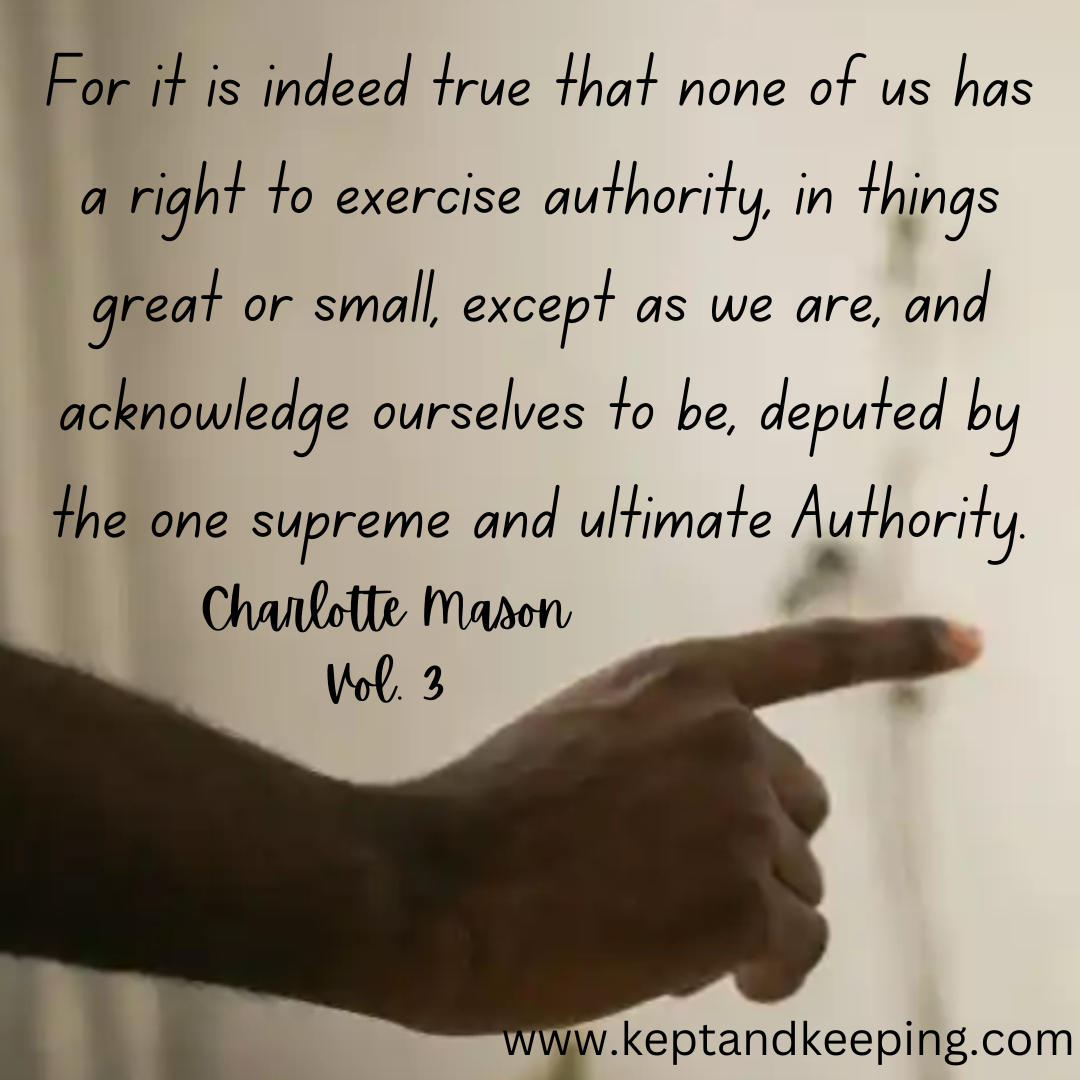
She then continues: “For it is indeed true that none of us has a right to exercise authority, in things great or small, except as we are, and acknowledge ourselves to be, deputed by the one supreme and ultimate Authority.” Vol. 3 p. 7
~~~
Echoing St. Augustine: “Nothing less than the Infinite will satisfy the spirit of a man. We again recognize that we are made for God, and have no rest until we find Him…” Vol. 3 p. 9
~~~
A warning against the wrong kind of liberty: “We all have it in us to serve or to rule as occasion demands. To dream of liberty, in the sense of every man his own sole governor, is as futile as to dream of a world in which apples do not necessarily drop from the tree, but may fly off at a tangent in any direction.” Vol. 3 p. 10
~~~
Here’s a good word on how damaging, reductionist ideologies form in a person:
“Some such principle stands out luminous in the vision of a philosopher; he sees it is truth; it takes possession of him and he believes it to be the whole truth, and urges it to the point of reductio ad absurdum. [reduction to absurdity]” Vol. 3 p. 11
Key Takeaways for the Parent-Teacher
My parental authority is given me by God (as “deputed authority”). I cannot exercise it properly if I do not first recognize that I myself am under authority—authorized by Someone above me, namely God.
Children by nature have questions. Wise authority leaves room for this—and even welcomes questions and expressions of genuine confusion about the world or even parental expectations as organic opportunities to guide the child in the way they should go.
Don’t get swept away with the latest tide, especially when one concept is elevated to the exclusion of all else. Parenting and educational fads may come and go, but the proof of their wisdom will be in the kind of character they produce over the long haul.
Have you read Volume Three lately? Or been meditating on Charlotte Mason’s principles of authority and docility (they make up the third of her 20 principles)? I’d love to have you weigh in with your thoughts in the comments!
Amazon links are affiliate links. If you make a purchase through one of these links, I may receive a commission at no additional cost to you.
I’ve written in the past about how our family covers “Bible” in our homeschool, which is to say, I’ve written about how we don’t consider it a subject in school so much as a part of life. You can read that article here, especially if you have little ones or are just getting started reading the Bible together as a family.
The following article is actually a guest post from my husband, as he reflects on what we have done differently in our family Bible time this year–instead of reading a chapter aloud at the kitchen table, we’re reading independently and discussing it together over a meal.
I hope my husband’s words are an encouragement to you to see how family bible time can grow and mature as you and your children grow and mature together. If you don’t have kids, I hope these meditations on reading the Scriptures and the resources listed might encourage you in your own pursuit of God through His Word.
For reference, our boys are turning 14 and 12 this calendar year. So the following practice reflects what is possible with fairly strong readers, ages 11 and up.
Here’s Nathaniel:
This year we changed up how we do family Bible time. We decided to read through the Bible in a year by having each person read on their own. Then we discuss over a meal every day. It has been incredibly rewarding for the whole family. Today we finished our last reading in the Old Testament, and I want to share some things that have made it rewarding so far:
1) A primary intention was to read the Bible as literature. Not as “mere literature”, but as literature nonetheless. We wanted to see the overall story arcs and major themes, to enjoy each genre, and to see how it all worked together.
2) We followed a reading plan that is based on the book order of the Hebrew Bible, which would have been the order in Jesus’ day. It has some nice advantages, particularly in that the prophets follow immediately after the books of Kings. For example, I have long enjoyed the poetry and imagery of Isaiah, but had a hard time understanding to whom he’s talking, particularly when he’s cursing neighboring nations. I thought I needed to find a good commentary to provide all the historical background. Turns out, the book of 2 Kings is a good commentary to provide the historical background! When these books are read quickly and close together, I can remember who these neighboring nations are and why they are being cursed.
3) The reading plan we’re using also has us read a Psalm every day. I have been amazed at how often the Psalms connect with the historical reading. It’s much easier now to see the role of the Psalms as the hymnbook of ancient Israel and to see the value of the imprecatory prayers in the context of national turmoil and destruction.
4) I read the ESV Archaeology Study Bible. It was phenomenally helpful to fill in the gaps of historical details and to better understand the world and worldview of the Ancient Near East. It has lots of maps (!!!) and some helpful historical explanation.
Here’s an example spread from Genesis.
Today, I read in 2 Chronicles 35 of King Josiah going to an ill-advised battle with Pharaoh Neco, who’s just passing through on his way to fight someone else. The scripture doesn’t explain who that someone else is, because it’s concerned with Josiah, not with world history. But the study Bible commentary (a portion is pictured below) explained that Neco was allied with the Assyrians and on his way to battle the newly-resurrected Babylonian empire. Neco and Assyria are defeated, and 2 Chronicles 36 picks up a few years later as Babylon sweeps in and attacks Jerusalem.
5) I appreciated that the commentary in this study bible is primarily observation-level commentary. It’s not about digging out deep theological interpretations, it’s more about understanding the historical and literary context of the Scripture. Which really helped in seeing the literary flow of the Bible.
6) We also have watched the Bible Project summary videos of each book. I know that in some theological camps there is some controversy around the Bible Project, and I certainly don’t agree with all of their systematic theology, but I think they do a great job aiding a literary reading of scripture with their compelling outlines and summaries of each book of the Bible in their Read Scripture series.
7) The pattern in our family time this year is for our youngest son to narrate the day’s reading and for our oldest to read his written one-sentence summaries of each chapter. Then I will share my observations, Lauren will chime in, and we generally have an enthusiastic discussion.
The boys have enjoyed it, too. They have established a great habit of daily bible reading as soon as they get up. Without being reminded, they are committed to it and haven’t missed a day all year. Prior to this, our youngest was about halfway through reading the entire bible on his own. But he says this group discussion approach has helped him understand it much better. It is my prayer that this year will provide a great foundation for a lifetime of rewarding Bible reading for my sons.
When we started this plan, I mentioned it offhand to a father at church who is some years my elder. He mentioned that a read-the-Bible-in-a-year plan really makes you appreciate the New Testament when you finally get to it. I don’t think I have ever enjoyed reading the Old Testament as much as this year — even Leviticus and Zechariah — but I believe he’s right: The Old Testament has clearly demonstrated humanity’s sinfulness and persistent rebellion against all that is holy and good and right. Against God Himself. Over and over again, God creates good things, and men reject His leading and ruin everything, resulting in tragic consequences. Even as the Jews return from exile in Babylon, they still can’t get it right. And those of us outside the Jewish nation are even worse off, without the scriptures! We need light to break through our darkness. We need new hearts, with God’s law written on them. We need an anointed King of a transformed people to spread His kingdom of love, peace, and righteousness all over the earth.
I’m ready for Jesus!
Back to Lauren:
Amen! I’m eager to see Jesus enter into our needy world, “in the fullness of time”, as we begin our readings in the New Testament–tomorrow!
To wrap up, here’s a quick summary of our family Bible time practice for this year:
Follow the Bible reading plan from the Bible Project, each of us doing our daily reading independently.
Discuss as a family, usually at breakfast: Youngest son gives an oral narration (or retelling) of our reading; Oldest son shares his short, written summary (usually 1-2 sentences per chapter); Nathaniel guides discussion and shares from his findings in the ESV Archaeology Study Bible; Lauren shares her insights (sometimes drawing from Words of Delight by Leland Ryken) and asks a guiding question on occasion.
We have also added some side studies on the Code of Hammurabi and the Canaanite god Ba’al (among others) to broaden our understanding of biblical and ancient history and to be aware of the way that some critics and liberal theologians will use such sources and subjects to undermine divine inspiration and biblical historicity. It’s been a fascinating study that has made for great discussions. Keep in mind: this level of study is best undertaken when the kids already have a good grasp of history and the parents are solid in the faith and have at least some knowledge of how to interact with historical source material, able to ask good questions of a text or artifact and able to separate what’s actually there from a scholar’s speculative commentary.
Where are you in your own Bible reading journey? (Hint: It’s ok for it to look different in your home!)
Do you have a habit of reading and/or discussing the Bible with your family? What does that look like in your current stage of life?
If you’re just getting started, don’t be intimidated. Just take the next right step. And be sure to check out this post for what we’ve done in younger years.
May you and yours be built up in the Lord as you feast upon (or are just acquainting yourselves with) His word.












 He was a “give it to me straight” kind of guy.





 Kept and Keeping