• Home
  • About
  • Living Faith
  • Home and Family
  • Home Education
  • Books
  • Recommended Resources
  • Media

Kept and Keeping

~ Rest in Grace, Labor in Love

Kept and Keeping

Tag Archives: Christian Parenting

How I Learned to be a *Truly* Impervious Homeschool Mom

20 Tuesday Aug 2024

Posted by Lauren Scott in Home and Family, Home Education, Media

≈ 7 Comments

Tags

Christian Homeschool, Christian Parenting, Home Education, homeschooling, Imperviousness, motherhood, Parental Authority, parenting, podcast

I recently had the privilege of chatting with Mystie Winckler on her Simplified Organization Podcast, sharing the story of how I really learned to be an impervious homeschool mom during my oldest son’s challenging fourth grade year. As soon as the recording was over my mind filled with further thoughts and clarity on the subject, which, in my limited experience with podcasts, seems to be par for the course. At any rate, I’d like to share the concept of imperviousness with you for your benefit so that the story I tell on Mystie’s podcast will make that much more sense and be that much more helpful.

how to be impervious homeschool mom wall

I first heard about imperviousness many years ago from Mystie herself, who heard it from Cindy Rollins before that. Despite having been introduced to the concept early in our homeschool journey, it took me some time to wrap my head around it.

So what does it mean to be impervious? Here’s the definition from Webster’s:

Impervious:
1a: not allowing entrance or passage : impenetrable
Ex: ‘a coat impervious to rain’
b: not capable of being damaged or harmed
Ex: ‘a carpet impervious to rough treatment’
2: not capable of being affected or disturbed
Ex: ‘impervious to criticism’

The essential idea when applied to parenting and homeschooling is to not let your kids get to you. You are committed to doing what is right for your kids without being thrown off course by their ups and downs, whining or talking-back, disobedience or tantrums, pleading or puppy-dog eyes.

This doesn’t mean you’re cold and heartless, it just means that you are in control of yourself rather than letting your kids take the reigns or knock you off-kilter. Kids aren’t born with self-control, so you’ve got a long head-start on them in developing it; and if you are a regenerate follower of Jesus Christ, you have the Holy Spirit to produce that fruit in you.

Be controlled by the Spirit, not by your kids. (See Ephesians 5:18 and laugh with me at the loose parallelism that I just made.)

Imperviousness absolutely ought to come with love, joy, peace, patience, kindness, goodness, faithfulness, gentleness, and self-control (Galatians 5:22-23). Though in the moment, when you’re tested by all the fuss your children can muster, it can feel a lot more like holding back a wave of frustration and mommy-tantrums than like “smooth and easy days” (I’m looking at you, Charlotte). 😉

From my own experience, I will offer that imperviousness—a bit of emotional separation from your kids—is actually an important step toward having genuine fruit of the Spirit grow in your relationships with your children.

It’s tempting to think that the more we detach from our kids’ emotions, the less able we will be to sympathize with them and offer the emotional support that they may need. But in reality, if my emotions aren’t under control, if they are instead reactive or reflective of my child’s emotions, then I’m not providing the stable anchor for my child in the midst of his turbulent sea.

Once I was able to see my son’s ups and downs without joining him in them or reacting to them, I was then able to calmly call him to do his duty and also calmly comfort him when learning to overcome his particular challenges was really hard.

Imperviousness is sometimes referred to as “being the wall” for our kids. Setting a course or a standard and sticking to it no matter how our kids bump up against us. But take note that being a wall doesn’t require being angry. In fact, getting upset actually means that our wall is likely to move—either to give way to our kids or to fall on them and crush them. That’s not imperviousness in either case.

When our kids are on an emotional roller coaster, we don’t need to get on the roller coaster with them. We can help them calm down and do the work only when we ourselves remain calm and stay off of the wild ride that they’re on.

In the podcast with Mystie, I tell the story of my oldest son’s fourth grade year, which was a painful learning process for us both. My lack of imperviousness around math led to a need for intervention—my husband helped set us on a course that provided more distance between me and my son’s day-to-day math performance. As a result, we both grew by leaps and bounds that year, and we have reaped the benefits of it ever since (that 10-year-old is now 15!). I learned to be truly impervious in what was for me the place of greatest testing. Make sure you get the full story by listening to (or watching) the podcast, and then consider these take-aways from my experience:

  • Even when you have an idea of how to be impervious as a mother, don’t be surprised if you find yourself tested in a particular area. I could be impervious in a lot of settings, but math was my Achilles’ heel. Watch out for that one specific area that trips you up. “Therefore let him who thinks he stands take heed that he does not fall.” 1 Corinthians 10:12
  • Impatience is the opposite of imperviousness. Maybe imperviousness can have other opposites, too, but in my case, the real emotional upheaval was around the fact that I couldn’t speed up the learning process to meet my expectations. My expectations and attitude had to change before I could provide the stability my son needed.
  • Natural consequences and/or an impersonal standard are tools that can make imperviousness a little easier to practice. When your kids are reeling against the direction you’ve given or are asking for things to be different, it’s a lot easier to hold your ground when you have already clearly communicated your expectations and have even written them down somewhere. You don’t have to flex your authority when you can simply appeal to the law of the land (or maybe just your house) and tell them that if you do x you get y (whether that’s a positive or negative reinforcement). Direct disobedience needs discipline, authority isn’t something to be afraid of, but well-established expectations and consequences can help with most other scenarios. (Listen to the podcast for the specific steps we took in this department!)
  • One important element of imperviousness is that you can see beyond more than just today. We can expect that there will be ups and downs in our day-to-day experience, but we need to remember that we’re playing the long-game (something my husband has had to remind me of often).
  • When Mom lacks imperviousness, Dad may be a good source of it! Dads (not always but often) can come at a parenting situation with greater emotional distance. Sometimes their approach seems harsh/too strict to us as moms, but sometimes that’s exactly what is needed. Value what Dad brings to your parenting team.
  • If you find yourself in the middle of a crazy season because you’ve gotten on the roller coaster ride with your kids or have provided some of the loopty-loops yourself, it’s ok. You’re normal. Course correct as soon as you can—preferably before outside intervention is necessary! Hold the line. But don’t wallow in your past mistakes. To quote Mystie: “Repent. Rejoice. Repeat.”
  • There CAN be peace on the other side of your worst homeschooling mistakes. God is merciful and gracious. And He can heal what is broken. Confess and repent, rejoice in the Lord, and pursue joyful-yet-impervious fellowship with your kids as you guide them through their home school years and beyond.

I hope my story and these considerations can help you in your parenting and homeschool journey. God is faithful. Look to Him for the fruit of the Spirit each day, and trust Him for the fruit He will produce in you and your children over the long haul. Steady your heart to provide a stable, impervious mama for your kiddos. You and they will be better for it.

Here’s the podcast link, one last time:

simply convivial podcast how to be impervious homeschool mom

And if you want another peek into my story, here’s an article I wrote while in the middle of that challenging season: Ideals and the Daily Grind.

Have you ever heard the term “impervious” before? Have you had a seriously challenging season with one of your children? How did you handle it?

Book Review: Mama Bear Apologetics

09 Tuesday Jul 2024

Posted by Lauren Scott in Books, Home and Family

≈ 2 Comments

Tags

Apologetics, Books, Christian life, Christian mom, Christian Parenting, Christian thinking, faith, Family Discipleship, Mama Bear Apologetics, motherhood, parenting

This post contains affiliate links. If you make a purchase through one of these links, I may make a commission at no additional cost to you. Thank you for supporting my blog!

This is a longer book review than I usually write on Goodreads, so I thought I’d share it here. When I take the time to give a more thorough review, it’s often because I think the book is valuable and that at least some people probably ought to read it, but it also likely means I have some considerations that I think readers ought to keep in mind in order to sift through it and apply it rightly. Mama Bear Apologetics is one such book. In this case, there are some things to “chew and spit” from the book, even as the book itself teaches moms how to “chew and spit” what they encounter in the world today.

Mama Bear Apologetics: Empowering Your Kids to Challenge Cultural Lies by Hillary Morgan Ferrer (and a handful of other Christian women)

My rating: 4 of 5 stars
I give this 4 stars, but that’s rounded up from 3.5.

While I am a mother, I am not the target audience for Mama Bear Apologetics. I’ve been around the block a few times when it comes to apologetics. The authors are writing to moms who aren’t so familiar with it. But I was excited to see this title in Hobby Lobby and wanted to preview it to see how useful it would be for younger moms I know.

Verdict: The content chapters are very good at briefly covering the various isms and issues of our day–I’m thankful that a book like this exists. I’d say it is useful to its purpose but with a few very important caveats, especially concerning the introductory chapters.

Most foundationally, while I understand wanting to stress the importance of apologetics, there were some problems in how the authors laid it out in the first two chapters. They talked about apologetics as “foundational”. They cited the sad statistics of how few professing Christian teens actually read their bibles (among other stats). But then a few pages later they said that reading the bible (along with Sunday school, etc) isn’t enough–we need apologetics. There’s a disconnect here, folks. If only 5% of professing Christian teens today read the bible, and that’s down from 8% in 1991, then the most foundational problem is that teens aren’t actually in the Word. And what’s more, those teens from 1991 (or the decade or two after that) are parents today–so we have biblically illiterate parents as well as teens. If apologetics gets people to dig into their bibles more, great. But the foundational issue is not a lack of apologetics. The foundational issue is a lack of a foundation–in the Scriptures.

To be fair, the author of chapter two does say: “We need to remain in God’s Word and in regular prayer to Him. After all, we can’t defend Scripture if we don’t know it.” But 1) this was one statement in a sea of overemphasis on apologetics, 2) it still makes bible reading subservient to apologetics (“we can’t defend…”) instead of reading it for its most foundational purpose–to know and love God, and 3) it still only refers to the parents and not the training of the children to read the Bible for themselves.

It may feel to some like I am splitting hairs here, but it is incredibly important to put things in their proper order! Jesus is worthy of devotion no matter what goes on in the world around us. And His Word is precious to us because it is how we grow in knowledge of our God and how we can serve Him. Then we can learn to defend against enemy attacks because we prize what we are defending. We only arm ourselves with apologetics because there is something worth defending and holding onto for its own sake. I trust that the authors agree with this, but I sure wish they had taken the time to allude to the real foundation and give a brief outline of core Christian teachings and basic spiritual disciplines before diving into the rest of their content. A little less cutesy talking down to moms would probably have provided the space needed.

Connected to this inordinate emphasis on apologetics is the idea that apologetics is needed–and even apologetics curriculum!–for very, very young children. Everything in me screams, “No!” Children need to be steeped in the Word of God. Their first instruction needs to be the positive teaching of Christian faith and practice in reference to the Bible and their everyday life, not instruction in reference to the wrong ideas in the world. A closing thought from one of the authors at the end said that in reading this book, “you have taken your first step toward teaching yourself and training your children to love God with their minds. Bravo!” The encouragement intended is not lost on me, but a book like this is not the first step, friends. Confess your sins and trust in Jesus for salvation. Read God’s word, memorize it and meditate on it (THIS is how you train or renew your mind). Participate in local church fellowship, baptism, and the Lord’s supper. Teach and share these things with your children and pray for the Lord to work. The ordinary means of grace are the first steps and they are the step after that and the step after that and the step after that–even as you add some apologetic training to your ordinary, faithful Christian lives.

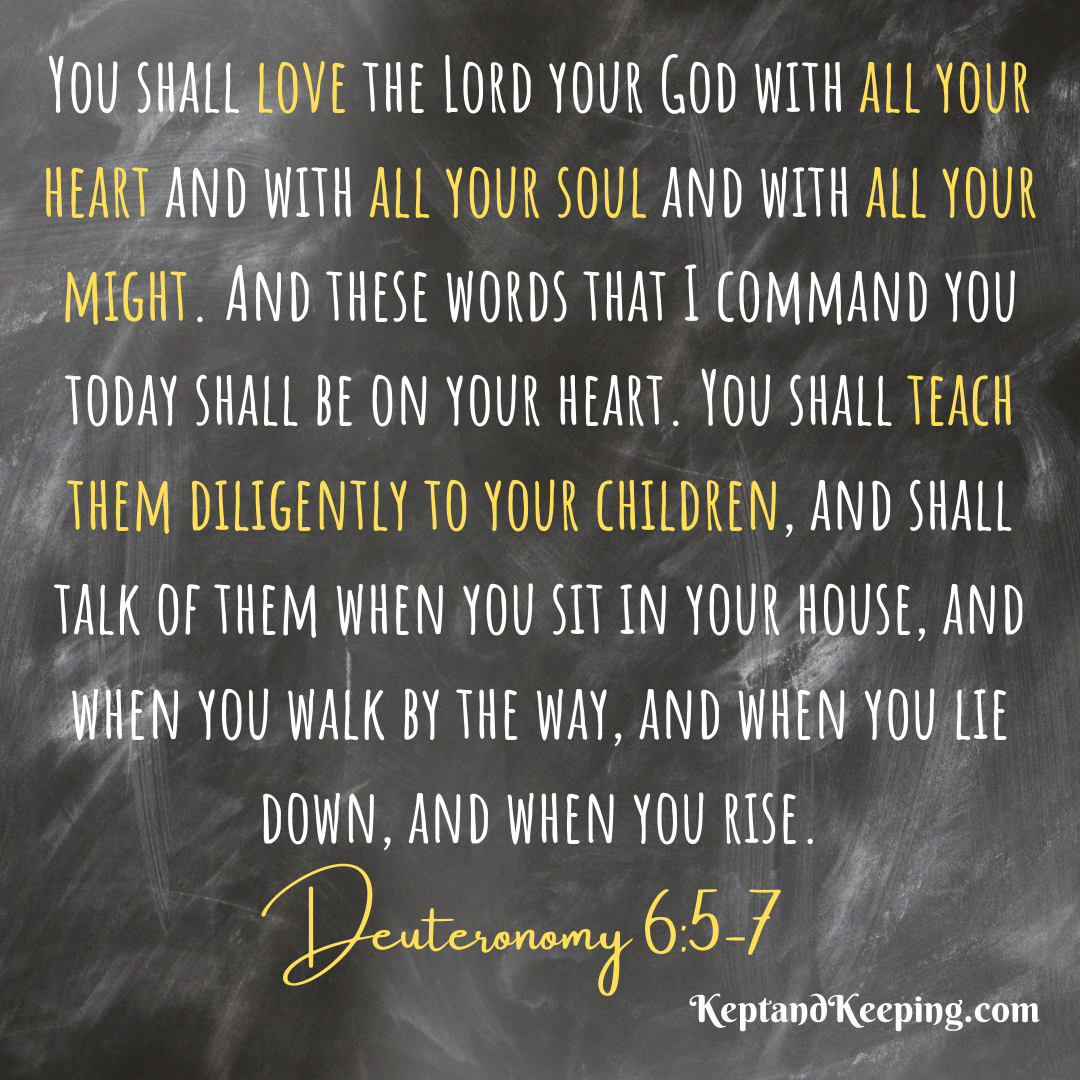
In chapter two, there’s a bullet point tip to “Carve Out Regular Family Time to Study”. This sounds great on the surface, but it’s not a direct call to read the bible together as a family, it’s a call to go through apologetic resources (which is fine if you’re already doing the basics, but it’s sidestepping the obvious if you aren’t). And if you need an example to help you get started, “we can look to…other faith systems that have successfully established certain routines within their families. Islam, Mormonism, and Orthodox Judaism prescribe specific times each day during which they stop to pray, study their religious texts, or disciple their kids.” My friends, we don’t need to look elsewhere for how to train up our children, as interesting and instructive as an outside comparison may be. Our point of reference ought to be Deuteronomy 6:4-9 and Ephesians 6:1-4 and the countless examples of faithful Christians who have been intentional about training up their children in the ways of the Lord for centuries to the present day. Not to mention countless modern books encouraging parents in their role of discipling their children. Why not recommend one of those books in passing? Why not call parents to their duty in reference to scriptural command rather than in reference to fear of the culture?

The above examples are real point-of-reference problems in the book (almost all from the introductory material in chapters one and two). As much as I love the content chapters on the issues of our day, the way in which the entire discussion is framed falls short–readers ought to take this into consideration. Seek out positive examples of Christian training and instruction in the home–from real, live godly people and solid books. Apologetics is only one small but important part of the whole, and unfortunately that isn’t communicated well in Mama Bear Apologetics.

Most of the rest of the book was very good and helpful. The chapters on Discernment and Linguistic theft were great. As were those on Self-Helpism and Naturalism.

But Chapter 7 on Skepticism (agnosticism and atheism) contains encouragement for Christians to embrace a “healthy skepticism”. This is clever, perhaps, but I don’t see the Scriptures promoting any kind of skepticism. Wisdom and discernment and turning away from lies, yes. Taking captive every thought, yes. But not “skepticism.” I think this is a poor word choice when there are Christian virtues and scriptural language that could be forwarded instead. There are great points in this chapter about being willing to wrestle openly with doubt and questions, but please take care not to promote “skepticism” to your children. I couldn’t pray along with those words in the scripted prayer at the end of the chapter.

The chapters on Postmodernism and Moral Relativism are pretty good, but after the chapter on Emotionalism I felt like I needed a break from the book.

Switching between writers mid-chapter (especially in the chapter on Emotionalism), was confusing at times and made for a less than great reading experience. I didn’t care for the overly-caricatured tone throughout the book, either. Everything is in “mama bear” terms, and it gets a little old and cheesy (even for a seasoned mother!). And some of the illustrations just didn’t work logically. I put the book down about half way through due to these frustrations, but I am glad I picked it back up several months later to finish it. I found the latter half (chapters on Pluralism, New Spirituality, Marxism, Feminism, and Progressive Christianity) to contain better writing and argumentation and to be a bit more serious in tone.

While I don’t believe we need to “advocate for a healthier feminism” just like I don’t believe my kids need to be “healthy skeptics,” the general handling of all of these isms was really very good.

Bottom line for young moms: This book can help you get a handle on the big ideas competing for hearts and minds in our world today, and if you have kids in public school where they encounter these ideas early, or if one or more of your kids are 10+, it can equip you to practically start and navigate conversations with your children.

But if you only have little ones, there isn’t anything to do with this information yet other than to learn it yourself. Your young children primarily need you to do the normal (traditional) Christian things: pray with and for your children, read the bible to them, sing hymns and praise songs and scripture set to music, memorize key bible verses, learn to give instruction with loving patience, but also teach them to obey and to repent and to believe and trust in Jesus’ death, burial, and resurrection. Love them and their father well, teaching them to be respectful by your example. Be faithful members of a biblically-solid local church. Love God and your neighbor. Live out your faith alongside your children and before them. Teach them ordinary life skills. All of the above, laid down little by little, is the best foundation you can give them. You’ve got time to learn and grow yourself in all of these things, so don’t parent scared. Be faithful in these “little” things, and when it comes time to tackle tough issues or formally teach your kids apologetics, trust the Lord that you’ll all be ready for it–and trust in the Lord that He will be there with you.

Proverbs 3:1-12

View all my reviews

Have you read Mama Bear Apologetics? What did you think? What was most helpful for you?

Narrating through School Education, Ch. 1: Docility and Authority Pt. 1

28 Saturday Oct 2023

Posted by Lauren Scott in Home and Family, Home Education

≈ 1 Comment

Tags

Charlotte Mason, Charlotte Mason Homeschool, Charlotte Mason Philosophy, Christian Parenting, Educational Philosophy, Home Education, homeschooling, motherhood, Parental Authority, parenting

This post contains affiliate links. If you make a purchase at one of these links, I may make a commission at no additional charge to you. Thank you for supporting my blog!

Charlotte Mason’s writings have been such a blessing to me–a tool in God’s hands to shape my mother’s heart into what it ought to be, chiseling away at rough edges and teaching me to love what is truly good and right and beautiful.

To date, I have read four out of Charlotte Mason’s six volumes that make up her Home Education Series: Volume One: Home Education, Volume Two: Parents and Children, Volume Four: Ourselves, and Volume Six: Toward a Philosophy of Education. I wish I had blogged through each of these over the years. I think it would have been valuable to force myself to do a written narration of each chapter all along the way. But it isn’t too late to start that habit! So here is my first installment. Maybe it will be a good refresher–or an introduction!–to you, my readers. I’d love to hear your thoughts.

Charlotte Mason Philosophy School Education volume 3

Volume Three, Chapter One: Docility and Authority in the Home and the School

Miss Mason opens her book on School Education with a discussion of two key principles: authority (as authorized rule) and docility (as teachable obedience).

She notes that most adults at the time of her writing were raised under rather autocratic and arbitrary rule by their parents. There is a kind of sturdiness that comes from an entire society upholding the rule of authority by parents, even to the fault of upholding arbitrary rule, but the benefits of this system have their limits. Children, for example, may bear their fears and other burdens all on their own without helpful direction if there is not a means by which they can share their struggles and questions with their parents.

Miss Mason notes that rationalistic philosophers from Locke to Spencer have etched away at this notion of arbitrary authority (and the idea of the divine right of kings) by elevating the idea of individual reason.

When Locke promoted the rationality of the individual, he did not do so in a materialist philosophic vacuum. He developed his ideas with a view to Christian religion and virtue. But, Miss Mason argues, people picked up the lone idea of individual reason trumping all and left behind the insistence upon training that reason in what is good. An extreme example of this is the excessive and myopic (and bloody) rationalism of the French Revolution.

The likes of Mr. Spencer (an educationalist cited throughout the chapter by Miss Mason) promote parental authority only as it serves to throw off all authority. Why? Because Spencer recognizes that to throw off God’s authority is to throw off all other authority. Or, conversely, to diminish parental authority is to chip away at God’s. This is the kind of “liberation” that the extreme rationalist wants.

As Miss Mason puts it, “So long as men acknowledge a God, they of necessity acknowledge authority, supreme and deputed.”

One movement’s excesses may be tamed by another’s…and also replaced by a new set of vices. So the old arbitrary authority might be slightly corrected by rationalism…and then thrown off in a fury when that rationalism proceeds on into its own excess.

But what is best for children?

There is an Almighty God with whom we have to do. And He has set parents in the place of authority over their children. Not to wield it arbitrarily but to do so responsibly under God’s authority. As Charlotte Mason sums it up at the end of the chapter:

“We know now that authority is vested in the office and not in the person; that the moment it is treated as a personal attribute it is forfeited. We know that a person in authority is a person authorised; and that he who is authorised is under authority. The person under authority holds and fulfils a trust; in so far as he asserts himself, governs upon the impulse of his own will, he ceases to be authoritative and authorised, and becomes arbitrary and autocratic.”

More Quotes from Chapter One

Here are a few other quotes I appreciated from this chapter:

“The evolution of educational thought is like the incoming of the tide. The wave comes and the wave goes and you hardly know whether you are watching ebb or flow; but let an hour elapse and then judge. … After all allowances for ebb and flow, for failure here and mistake there, truer educational thought must of necessity result in an output of more worthy character.” Vol. 3 p. 3-4

So the test of our philosophy of education will be the character it produces in our children (and perhaps also in ourselves, eh?).

~~~

“But it is much to a child to know that he may question, may talk of the thing that perplexes him, and that there is comprehension for his perplexities. Effusive sympathy is a mistake, and bores a child when it does not make him silly. But just to know that you can ask and tell is a great outlet, and means, to the parent, the power of direction, and to the child, free and natural development.” Vol. 3 p. 4-5

I especially appreciated how this quote illustrated the ideal of open communication between child and parent. The parent’s thoughts are not the only ones that count. It is not an abdication of parental authority to be capable of hearing a child’s sincere questions and helping them to sort out what confuses them. In fact, a parent that so knows their child’s heart is in a much better position to wisely direct it. And a child given such a safe place to be heard can grow and develop in a healthy, “free and natural” way.

~~~

Speaking of Spencer: “he repudiates the authority of parents because it is a link in the chain which binds the universe to God.”

My how we see this today, don’t we?

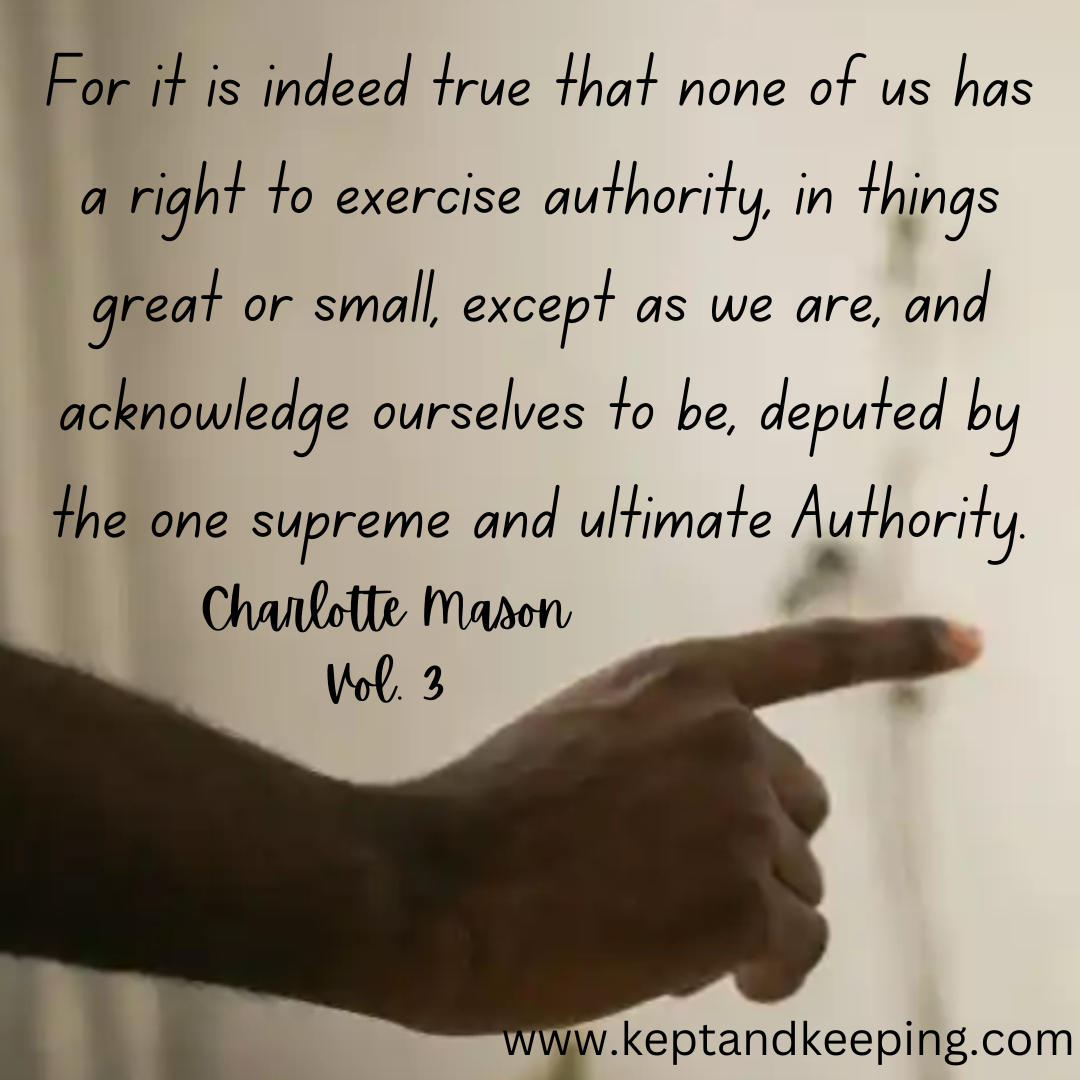
She then continues: “For it is indeed true that none of us has a right to exercise authority, in things great or small, except as we are, and acknowledge ourselves to be, deputed by the one supreme and ultimate Authority.” Vol. 3 p. 7

Charlotte Mason philosophy authority parenting quote

~~~

Echoing St. Augustine: “Nothing less than the Infinite will satisfy the spirit of a man. We again recognize that we are made for God, and have no rest until we find Him…” Vol. 3 p. 9

~~~

A warning against the wrong kind of liberty: “We all have it in us to serve or to rule as occasion demands. To dream of liberty, in the sense of every man his own sole governor, is as futile as to dream of a world in which apples do not necessarily drop from the tree, but may fly off at a tangent in any direction.” Vol. 3 p. 10

~~~

Here’s a good word on how damaging, reductionist ideologies form in a person:

“Some such principle stands out luminous in the vision of a philosopher; he sees it is truth; it takes possession of him and he believes it to be the whole truth, and urges it to the point of reductio ad absurdum. [reduction to absurdity]” Vol. 3 p. 11

Key Takeaways for the Parent-Teacher

My parental authority is given me by God (as “deputed authority”). I cannot exercise it properly if I do not first recognize that I myself am under authority—authorized by Someone above me, namely God.

Children by nature have questions. Wise authority leaves room for this—and even welcomes questions and expressions of genuine confusion about the world or even parental expectations as organic opportunities to guide the child in the way they should go.

Don’t get swept away with the latest tide, especially when one concept is elevated to the exclusion of all else. Parenting and educational fads may come and go, but the proof of their wisdom will be in the kind of character they produce over the long haul.

Have you read Volume Three lately? Or been meditating on Charlotte Mason’s principles of authority and docility (they make up the third of her 20 principles)? I’d love to have you weigh in with your thoughts in the comments!

Family Bible Time Grows with the Kids!

23 Wednesday Aug 2023

Posted by Lauren Scott in Guest Posts, Home and Family, Home Education, Living Faith

≈ Leave a comment

Tags

Bible Reading, Bible Reading Plan, Bible Study, Christian Classical Education, Christian Classical Homeschool, Christian Parenting, devotional, family bible time, Family Worship, Home Education, Homeschool Bible, Homeschooling Middle School, Spiritual Disciplines

Amazon links are affiliate links. If you make a purchase through one of these links, I may receive a commission at no additional cost to you.

I’ve written in the past about how our family covers “Bible” in our homeschool, which is to say, I’ve written about how we don’t consider it a subject in school so much as a part of life. You can read that article here, especially if you have little ones or are just getting started reading the Bible together as a family.

The following article is actually a guest post from my husband, as he reflects on what we have done differently in our family Bible time this year–instead of reading a chapter aloud at the kitchen table, we’re reading independently and discussing it together over a meal.

I hope my husband’s words are an encouragement to you to see how family bible time can grow and mature as you and your children grow and mature together. If you don’t have kids, I hope these meditations on reading the Scriptures and the resources listed might encourage you in your own pursuit of God through His Word.

For reference, our boys are turning 14 and 12 this calendar year. So the following practice reflects what is possible with fairly strong readers, ages 11 and up.

Here’s Nathaniel:

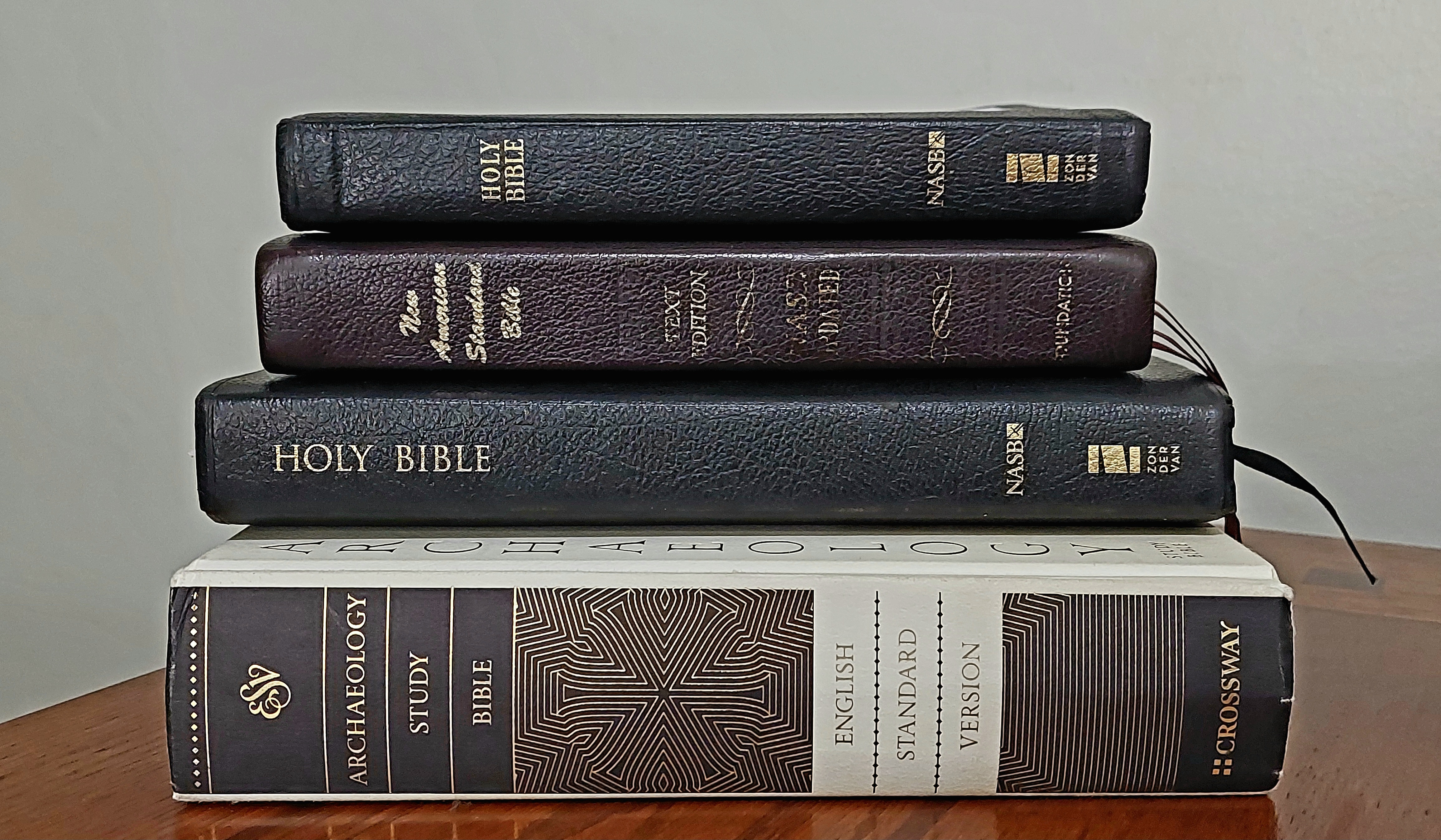
bibles stack bible reading ESV NASB

This year we changed up how we do family Bible time. We decided to read through the Bible in a year by having each person read on their own. Then we discuss over a meal every day. It has been incredibly rewarding for the whole family. Today we finished our last reading in the Old Testament, and I want to share some things that have made it rewarding so far:

1) A primary intention was to read the Bible as literature. Not as “mere literature”, but as literature nonetheless. We wanted to see the overall story arcs and major themes, to enjoy each genre, and to see how it all worked together.

2) We followed a reading plan that is based on the book order of the Hebrew Bible, which would have been the order in Jesus’ day. It has some nice advantages, particularly in that the prophets follow immediately after the books of Kings. For example, I have long enjoyed the poetry and imagery of Isaiah, but had a hard time understanding to whom he’s talking, particularly when he’s cursing neighboring nations. I thought I needed to find a good commentary to provide all the historical background. Turns out, the book of 2 Kings is a good commentary to provide the historical background! When these books are read quickly and close together, I can remember who these neighboring nations are and why they are being cursed.

3) The reading plan we’re using also has us read a Psalm every day. I have been amazed at how often the Psalms connect with the historical reading. It’s much easier now to see the role of the Psalms as the hymnbook of ancient Israel and to see the value of the imprecatory prayers in the context of national turmoil and destruction.

4) I read the ESV Archaeology Study Bible. It was phenomenally helpful to fill in the gaps of historical details and to better understand the world and worldview of the Ancient Near East. It has lots of maps (!!!) and some helpful historical explanation.

ESV Archeology Study Bible Map Genesis
Here’s an example spread from Genesis.

Today, I read in 2 Chronicles 35 of King Josiah going to an ill-advised battle with Pharaoh Neco, who’s just passing through on his way to fight someone else. The scripture doesn’t explain who that someone else is, because it’s concerned with Josiah, not with world history. But the study Bible commentary (a portion is pictured below) explained that Neco was allied with the Assyrians and on his way to battle the newly-resurrected Babylonian empire. Neco and Assyria are defeated, and 2 Chronicles 36 picks up a few years later as Babylon sweeps in and attacks Jerusalem.

ESV Archeology Study Bible

5) I appreciated that the commentary in this study bible is primarily observation-level commentary. It’s not about digging out deep theological interpretations, it’s more about understanding the historical and literary context of the Scripture. Which really helped in seeing the literary flow of the Bible.

6) We also have watched the Bible Project summary videos of each book. I know that in some theological camps there is some controversy around the Bible Project, and I certainly don’t agree with all of their systematic theology, but I think they do a great job aiding a literary reading of scripture with their compelling outlines and summaries of each book of the Bible in their Read Scripture series.

7) The pattern in our family time this year is for our youngest son to narrate the day’s reading and for our oldest to read his written one-sentence summaries of each chapter. Then I will share my observations, Lauren will chime in, and we generally have an enthusiastic discussion.

The boys have enjoyed it, too. They have established a great habit of daily bible reading as soon as they get up. Without being reminded, they are committed to it and haven’t missed a day all year. Prior to this, our youngest was about halfway through reading the entire bible on his own. But he says this group discussion approach has helped him understand it much better. It is my prayer that this year will provide a great foundation for a lifetime of rewarding Bible reading for my sons.

When we started this plan, I mentioned it offhand to a father at church who is some years my elder. He mentioned that a read-the-Bible-in-a-year plan really makes you appreciate the New Testament when you finally get to it. I don’t think I have ever enjoyed reading the Old Testament as much as this year — even Leviticus and Zechariah — but I believe he’s right: The Old Testament has clearly demonstrated humanity’s sinfulness and persistent rebellion against all that is holy and good and right. Against God Himself. Over and over again, God creates good things, and men reject His leading and ruin everything, resulting in tragic consequences. Even as the Jews return from exile in Babylon, they still can’t get it right. And those of us outside the Jewish nation are even worse off, without the scriptures! We need light to break through our darkness. We need new hearts, with God’s law written on them. We need an anointed King of a transformed people to spread His kingdom of love, peace, and righteousness all over the earth.

I’m ready for Jesus!

Back to Lauren:

Amen! I’m eager to see Jesus enter into our needy world, “in the fullness of time”, as we begin our readings in the New Testament–tomorrow!

To wrap up, here’s a quick summary of our family Bible time practice for this year:

  • Follow the Bible reading plan from the Bible Project, each of us doing our daily reading independently.
  • Discuss as a family, usually at breakfast:
    Youngest son gives an oral narration (or retelling) of our reading;
    Oldest son shares his short, written summary (usually 1-2 sentences per chapter);
    Nathaniel guides discussion and shares from his findings in the ESV Archaeology Study Bible;
    Lauren shares her insights (sometimes drawing from Words of Delight by Leland Ryken) and asks a guiding question on occasion.
  • At the start of a new book, watch the corresponding Bible Project video(s).
  • We have also added some side studies on the Code of Hammurabi and the Canaanite god Ba’al (among others) to broaden our understanding of biblical and ancient history and to be aware of the way that some critics and liberal theologians will use such sources and subjects to undermine divine inspiration and biblical historicity. It’s been a fascinating study that has made for great discussions. Keep in mind: this level of study is best undertaken when the kids already have a good grasp of history and the parents are solid in the faith and have at least some knowledge of how to interact with historical source material, able to ask good questions of a text or artifact and able to separate what’s actually there from a scholar’s speculative commentary.

Where are you in your own Bible reading journey? (Hint: It’s ok for it to look different in your home!)

Do you have a habit of reading and/or discussing the Bible with your family? What does that look like in your current stage of life?

If you’re just getting started, don’t be intimidated. Just take the next right step. And be sure to check out this post for what we’ve done in younger years.

May you and yours be built up in the Lord as you feast upon (or are just acquainting yourselves with) His word.

Gardening: A Prescription for Perfectionists

18 Thursday Mar 2021

Posted by Lauren Scott in Living Faith

≈ 1 Comment

Tags

Christian growth, Christian life, Christian Parenting, Garden, Garden Therapy, Gardening, Perfectionism, Recovering Perfectionist

It’s garden-planting time where I live. And that means I’m spending more time outside in the cool air and warm sunshine with my hands in the dirt. Time outside often gives me space to think, and time in the garden gives me a lot to think about–including the attitudes that I bring with me.

I can be a bit of a perfectionist. Wanting to get things just right. Spending way too much time researching a subject until I know it thoroughly enough to not mess it up (as if that were somehow possible). Perfectionism is a kind of obsession over performance and results. While it focuses on improvement and promises fulfillment, it actually tends to get in the way of both.

gardening cure perfectionist perfectionism

When I walk out into the garden and away from my other chores and plans and projects, I’m confronted by something very outside of myself. It’s easy to assume that my home and my work and my plans are all somehow a kind of extension–or at least a reflection–of who I am. But when I walk outside, I encounter something obviously other. There’s a wild beauty to things that grow. And in the presence of this wild beauty, I’m less tempted to delusions of control over it. Instead I’m drawn into wonder.

By the time I’m out planting our first seeds, the snow has just melted and revealed that under a thick blanket of frozen white, our daffodils have not only been surviving but actually growing–green and tall. And I didn’t do a thing to make this happen. I’m in awe of their happy refusal to stay dormant in our recent and unseasonable cold snap. Arguably not the perfect conditions. Yet they respond to the call to perk up–a call that doesn’t come from me or my plans.

daffodils in snow spring garden

Stepping outside of the four walls of my home usually gets me out of the four walls of my perfectionistic, all-or-nothing head. You could say that going outside prepares the soil of my heart to receive seeds of truth. To that soil, the garden adds images, active reminders of those seeds, of that truth.

As I plant and marvel at seeds in the dirt, my Father sows and tends seeds in my heart.

Here are a few of them:

  • Not every seed will sprout. When you have an all-or-nothing mentality, it can be discouraging to know that if I plant just one seed it may not work out. Planting more seeds than the number of plants I intend to grow feels potentially wasteful. I don’t ultimately control germination. I can help it along, but I mostly have to sit and wait and see. And be generous enough with my seeds to see something come to life. If I’m seeking perfect outcomes and efficiency, I might be upset that I won’t get a return on every little bit of my investment. But that’s just reality. God calls me to generously plant seeds anyway.
  • But somehow seeds DO sprout. We’ve been at this gardening thing for at least six years and yet it never fails to amaze me when tiny bits of green pop out of the ground where we planted seeds a few days or weeks before. God is good. He made this beautiful process and I get to take part in it. How much more delightful when God is at work in human hearts and invites me to participate and marvel at His work?
  • Frost may come and kill. Sun may scorch and burn. Those precious little seedlings that do sprout are up against the elements. I do what I can to protect and provide for them, but I cannot shield them from everything. In fact, a measured exposure to the elements is actually part of the process for these little plant babies to grow strong and learn to stand up on their own. Oh, how this speaks to me as a mama!
  • It pays to be firmly rooted. That exposure to the elements can benefit the plant only if it has a good root system–both for taking in water and nutrients from the soil and for keeping the plant sturdy enough not to topple over. When we transplant tomato seedlings, we burry about three quarters of the plant! It feels like a setback. Like we’ve now put ourselves behind in terms of growing a nice, big plant. But that apparent setback results in greater health and fruitfulness.
  • Bugs may devour. Vigilance is required. Whether it’s squash bugs or tomato hornworms or aphids, we’re always on guard. This is not a once-and-done thing, as though picking all of the bugs off in one day would keep us from having problems the rest of the season. A perfect sprint doesn’t work here, but rather faithful watchfulness. And even still, we will lose some fruit and some leaves to pests. That’s how we know they are there.
  • Pruning is hard. Cutting off potentialities doesn’t feel good. But we don’t have infinite space in the garden (nor does each plant have infinite resources). Despite aiming for high-intensity growing methods, there are still, by nature, limits within which we must work. Refusing to stay within the limitations of nature results in stunted growth and disease. That perfectionistic tendency to push for more-and-better often ignores the reality of limitation. If we don’t cull the excess seedlings, if we don’t prune the lower and non-productive branches, we aren’t helping our plants. I, like my plants, am finite. I, like my plants, have limitations. Culling and pruning are necessary and good.
  • Results will vary. With all these variables of seed conditions and weather and pests, it should be obvious that I can’t perfectly predict the outcome. I can’t guarantee the results. Sure, I plan carefully and consider quantities needed in advance. But the results simply aren’t that much in my control. We may get a lot, we may get a little. Our harvest may be beautiful or riddled with holes. Related to this fact…
  • Imperfect fruit still eats. In the store, when I’m putting down money for fruits and veggies, I inspect every piece, making sure I get the most perfect and untainted produce possible for my dollar. But when I’m harvesting out of the garden, a tomato that is only half-eaten by a worm is still good for half a tomato. A couple of these “bad tomatoes” can dress a salad or tacos. A bunch of them can make a batch of salsa or a tomato pie. It requires more work to make the most of the imperfect gifts from the garden, but they are gifts nonetheless. It’s an opportunity to grow in both thankfulness and resourcefulness–two things that I might miss if I continued to always insist on “perfect” produce.
  • God causes the growth. This is the real “capital T” truth. And it’s the truth that runs through the rest of these bullet points. I’m not in control, God is. I’m not on the throne, He is. I may plant the seeds and provide what I can, but God causes the growth. The reason gardening is so powerfully instructive, so beautifully corrective of my perfectionistic tendencies, is because it visually, tangibly illustrates the truth that God is the Creator and Sustainer of all things, and that He simply invites me to participate with Him in His beautiful work.

We read in the scriptures truth about God, truth about the world, and truth about ourselves. We know we are to respond to it properly. But sometimes the truth takes time to sink in. And sometimes it takes living the metaphor.

  • shovel dirt garden sprouts

When God created Adam and Eve, He placed them in a garden. He told them to “cultivate it and keep it.” The Hebrew words in this phrase from Genesis 2 mean something along the lines of “work or serve it and guard or attend to it.” Working in a garden was part of the original earthly paradise. And I think it’s interesting to note that God’s calling here is not to make things grow–that was His job. His children were simply to work and guard, to serve and attend. Basically, to show up and care for it.

It’s the same for me, whether in the garden or in life. My responsibilities, beyond staying firmly rooted in Christ and His Word, come down to these:

  • Faithfully sow
  • Faithfully water
  • Faithfully tend
  • Expectantly watch
daffodils spring garden growth

Every time I wander out into the garden, it’s an invitation to enter into the metaphor, to contemplate the truth beautifully woven into the fabric of Creation.

Here are a few of the scriptures that bring my garden time to life:

And He was saying, “The kingdom of God is like a man who casts seed upon the soil; and he goes to bed at night and gets up daily, and the seed sprouts and grows—how, he himself does not know. The soil produces crops by itself; first the stalk, then the head, then the mature grain in the head. Now when the crop permits, he immediately puts in the sickle, because the harvest has come.” Mark 4:26-29

“I am the true vine, and My Father is the vinedresser. Every branch in Me that does not bear fruit, He takes away; and every branch that bears fruit, He prunes it so that it may bear more fruit. You are already clean because of the word which I have spoken to you. Remain in Me, and I in you. Just as the branch cannot bear fruit of itself but must remain in the vine, so neither can you unless you remain in Me. I am the vine, you are the branches; the one who remains in Me, and I in him bears much fruit, for apart from Me you can do nothing. John 15:1-5

I planted, Apollos watered, but God was causing the growth. So then neither the one who plants nor the one who waters is anything, but God who causes the growth. 1 Corinthians 3:6-7

I’ll sign off with a quote my husband found in a gardening article some time back. He shared it with me, and I’ve made a point of hanging on to it.

The principle value of the garden . . . is to teach . . . patience and philosophy, and the higher virtue – hope deferred, and expectations blighted, leading directly to resignation, and sometimes to alienation. The garden thus becomes a moral agent, a test of character, as it was in the beginning.

–Charles Dudley Warner, My Summer in the Garden (found at this website: http://www.leereich.com/2012/06/every-time-i-go-near-my-apple-and-plum.html)

Post script: The day I started writing this article, I realized that our refrigerator went out. Nothing was cold. All the ice had completely melted. My day was not my own. We had to change gears, adjust, adapt. Within 30 minutes of wiping up the floor, I managed to drop a quart jar half full of coffee as I was attempting to put it in a cooler. Coffee splashed all over the floor, the fridge, and the cooler, requiring me to wipe up everywhere-again-and-then-some. I found myself saying, “Well! This is the day!” And then I laughed. And started singing, “This is the day that the Lord has made…We will rejoice and be glad in it,” inviting my kids to smile and laugh along with me. Yes, my friends, God is good. He graciously allows us many imperfections–and uses them to capture our hearts…if we but recognize the invitation.

Gardening is just one way God reminds us we’re not in control, that seeking to be perfect in ourselves is a fool’s errand. How else do you feel His gentle nudge?

How We Homeschool: Bible

14 Thursday Jan 2021

Posted by Lauren Scott in Home and Family, Home Education, Living Faith

≈ 1 Comment

Tags

Bible Curriculum, Bible Lessons, Charlotte Mason Homeschool, Child Training, Christian Classical Education, Christian Classical Homeschool, Christian Homeschool, Christian Parenting, discipleship, Family Culture, Family Discipleship, Family Worship, Homeschool Bible, homeschool encouragement, homeschooling, parenting

Amazon links are affiliate links. If you make a purchase through one of these links, I may receive a commission at no additional cost to you. I make no money from links to Christian sellers, but I encourage you to support them over Amazon whenever possible.

“What Bible curriculum do you use for grade x?”

It’s a question I get from time to time, and it never ceases to make me squirm a little.

Why, you may ask? Well, because the idea of “Bible curriculum,” and especially for a particular “grade level,” is foreign to me.

Now of course I’m aware of the fact that “Bible curriculum” and “Bible classes” exist in Christian school settings, but I’ve always wrinkled up my nose a bit thinking about the Bible being made to fit the mold of an academic subject, added on to a school day like just another textbook or workbook to get through. What affect does that have on the way kids approach the Scriptures? And do they give grades for those classes? What does that teach?

Our approach to the Bible looks a lot less like school and a lot more like discipleship. Reading the Bible together has been a part of our family culture since before our children were born. We haven’t ever felt a need to make sure we added Bible to the kids’ schooling because they’ve been getting Bible with their breakfast since they were tiny.

In fact, while every part of school is informed by the Scriptures, we like to keep the Bible itself separate from “school” in a sense so that they don’t get the impression that a day off of school is a day off from devotion to the Lord.

But what does that look like? And how can you get started with this holistic family discipleship model of Bible learning if it’s foreign to you?

Well, let’s start with why.

Our Why: Created Reality and Biblical Goals

Our children are precious creations of our Heavenly Father–and they are precious gifts entrusted to us as parents. We desire to give them access to the Truth that God has revealed in His Word so that they can grow in wisdom and stature and in favor with God and man, that they would begin to know and love their Creator.

Ultimately, we desire that our children would trust in the Lord Jesus Christ for salvation from their sins and that they would love and serve Him all their days–for their good and God’s glory, both in this life and in the life to come. We don’t ultimately control this outcome. But we can be faithful to train our children in the way they should go.

Our Why Dictates Our How: Holistic Family Discipleship

Given the nature of our children, the nature of our relationship to them as their parents, and the nature of our goal (that they would have a relationship with God), it follows then that we ought to teach them in a way that is first and foremost relational. And decidedly not academic.

This means that interaction with the Scriptures comes woven into the fabric of our every day lives. There are no worksheets nor tests, no grades nor grade levels.

This doesn’t mean we don’t use printed materials to aid our children’s learning (I will link to some below), but we need to remember that the greatest resources we have to instruct our children in the ways of the Lord are His Word, His Holy Spirit, and our own lives lived alongside and before our children.

God’s Word: We must be in the bible ourselves and we must offer the Scriptures to our children.

The Holy Spirit: We must be seeking God to be at work both in us and in our children–apart from Christ we can do nothing. We may have had a direct role in bringing about our children’s physical life, but the spiritual life is of the Spirit–we cannot manufacture it in our kids. Prayer is indispensable.

Our Own Lives: We must model for our children what it means to believe the Word of God, to study it, to meditate on it, to practically submit our lives to it, and to receive both correction from it when we fail and comfort from it when we repent.

What does this actually look like?

Family Bible Time (what some call Family Worship)

Our current family Bible reading pattern, which we’ve had going for several years, is Proverbs at breakfast and Gospels at supper.

Now, this doesn’t mean each one happens every day. The reason we read the Bible over breakfast and dinner is because we often don’t read the Bible over breakfast and dinner. This is a scattering of seeds, not mechanical planting. We aim for faithfulness and perseverance rather than anything that resembles perfect consistency. But in keeping up the habit, we pretty reliably hit at least one of these each day, sometimes both. And before it was Proverbs and Gospels, we read slowly through the entire Bible at meal times–it may have taken a decade, but we kept going. The reason we’re in Proverbs and the Gospels right now is because the primary needs of our children are to receive instruction and correction according to God’s wisdom and to receive Jesus the Messiah as their Savior.

While we eat breakfast, my husband will read a few verses from the chapter of Proverbs that matches the calendar date (since there are conveniently 31 chapters in Proverbs), either selecting these verses ahead of time or asking for the kids to randomly select a number. He reads a verse and asks what it means. The kids give it their best shot and then we all discuss the meaning. He asks if they can think of any examples (a child may not use his brother as a negative example–this is a necessary rule, folks!). It has been fun over the years to hear the examples the kids come up with–sometimes from a fable, from literature, from a Bible story, from a movie. They are learning about wisdom and foolishness and learning how to identify each.

After Proverbs, we recite the Shema and the Lord’s Prayer. We switched up this recitation time over the holidays last year in order to recite and memorize Mary’s Magnificat. Now that we have the placeholder for recitation, we may use the time for other passages when they seem fitting.

Our evening Family Bible Time involves my husband reading from a passage of Scripture (currently Luke) at mealtime and then asking a few questions:

What did we learn? This is a good time for kids to either pick one thing that stuck out to them or simply narrate what they heard.

What can we worship God for? Sometimes, when we’ve been in the prophets, the answer is usually “That God was so patient and gave so many warnings.” Now that we’re in the first few chapters of Luke, the answer is usually “For sending Jesus to save us.” Sometimes the answer is different, but it’s no problem to worship God for the same things over and over again–in fact, it’s right to do so. Once answered, we pray and praise God based on what we saw in the passage–even if it’s simply for preserving the genealogy of Christ (which is pretty amazing when you think about it). Sometimes there may not be an obvious answer. When we were in the middle of Job as a family, it was admittedly hard to find any answer from the text–so we felt Job’s desolation a bit but worshipped God anyway.

What can we do with what we have learned? This is where we pay attention to the right response(s) to what we have read. Sometimes it is simply to worship as we did in the second question. Sometimes there is a command that we ought to obey. Sometimes there is something for which we ought to be thankful, something that ought to amaze us, something that ought to cause us to care for others, an example to follow or an example not to follow.

Now, these questions aren’t magical. They’re just the tools we have used for discussing the Bible as a family and for attempting to respond to it properly. Sometimes the kids are fully engaged and wow us with their insight. But sometimes the kids aren’t super excited to answer. Sometimes we get blank stares. But we don’t read the Bible and ask the questions in order to get perfect responses from our kids. We do it so that they are regularly interacting with the Scriptures and learning by modeling how to respond to them. It’s not perfect, but it is worthwhile. We are planting seeds.

Other Applications and Resources

The seeds we plant in Family Bible Time are watered by a lot of other practices and experiences.

We pray together as a family before meals and before bed. We try to remember to include intercession: to pray for neighbors, friends, family members, etc–sometimes on a weekly rotation so we don’t forget (but let’s be honest, we sometimes forget and go for long stretches with just basic bedtime prayers).

We have also made sure to include Bible time for our children to enjoy independently, even from a very early age by listening: Dove Tales (with cassettes–yes, we inherited these from my in-laws), Jesus Story Book Bible (with CDs), and a dramatized audio Bible from Faith Comes by Hearing. Now that our boys are 11 and 9, they are expected to read a chapter of the Bible first thing in the morning before coming downstairs for breakfast. This doesn’t mean it always happens, but that’s the goal and the general habit.

We’ve also enjoyed watching videos by The Bible Project–edifying for parent and child alike.

This emphasis on the Word of God being integrated into all of life means that it also influences our school day–just not in the graded-Bible-curriculum sort of way.

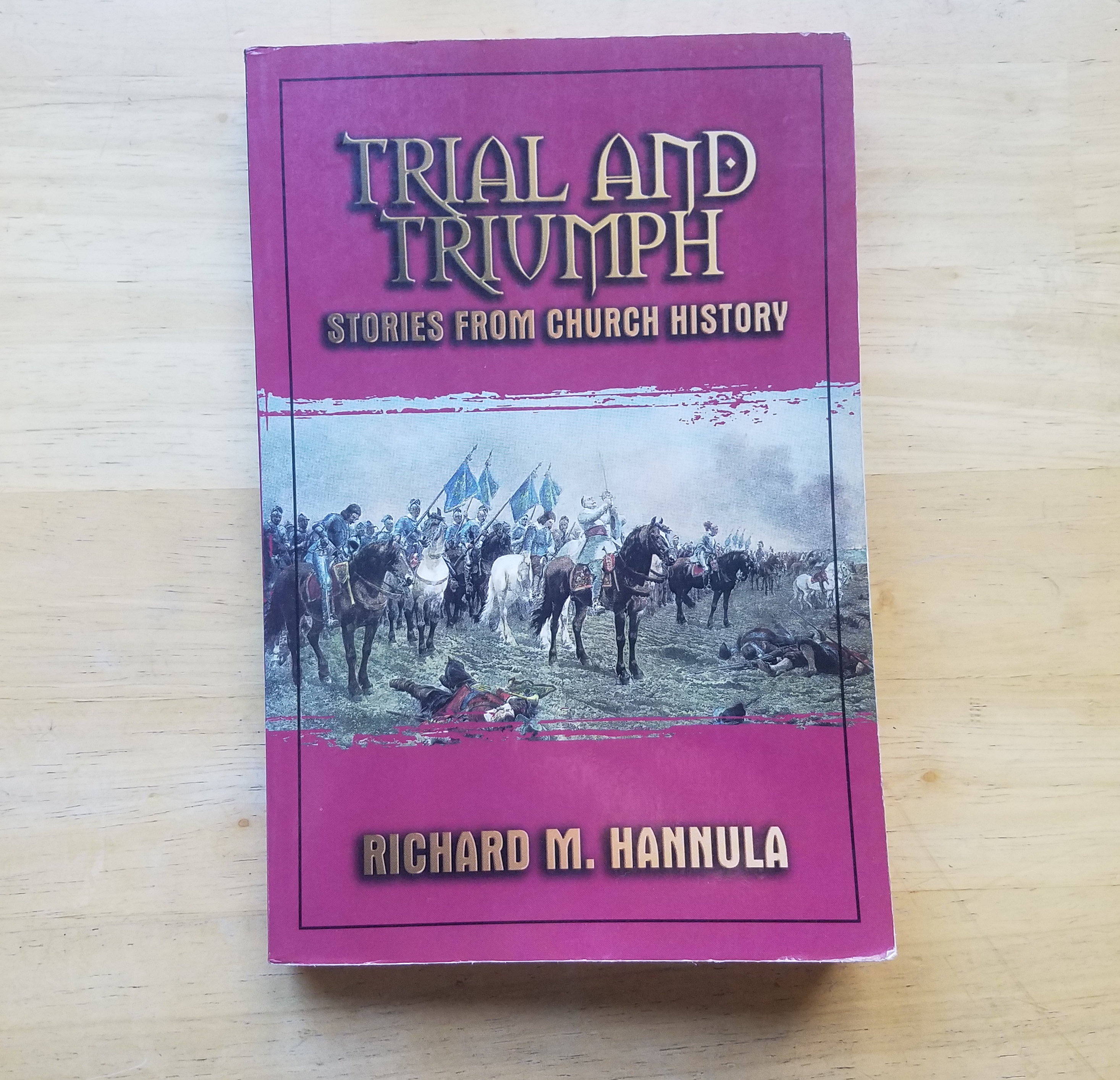
We read church history: Little Lights Biographies (for very young children, from a Christian seller), Christian Biographies for Young Readers (from a Christian seller), and Trial and Triumph (from a Christian seller).

We read aloud some theological books for children: A Faith to Grow On, Sammy and His Shepherd, The Attributes of God for Kids (from a Christian seller), and The Ology (from a Christian seller). As the kids grow older, their school reading list will include many Christian books that encourage them to walk with God and know Him more deeply.

We have listened and sung along with scriptures put to music: Hide ’em in Your Heart and Seeds Family Worship.

We have enjoyed singing many hymns in our Morning Time (currently singing along with this channel), and we have also enjoyed music by Sovereign Grace Kids (from a Christian seller). Even as adults, when we listen to music with lyrics, we generally choose music that is spiritually edifying. Our kids take this in as well.

The Scriptures inform the other books we choose–and how we read them–whether literature, tales, history, poetry, nature, etc.

The Scriptures make it into our kids’ copy work and dictation, too (that’s language arts).

Keeping It Real

We don’t do all of these things all the time. The most regular parts of our every day life are family Bible time, listening to hymns and other spiritual songs, family prayer, and good discussions on all kinds of things as we go about our days together. And these discussions aren’t just aimed at our kids. My husband and I discuss books, current events, and so many things with each other, seeking to apply God’s Word and His wisdom to everything we encounter. Our kids are audience to these adult conversations, too.

The aim is holistic, not check-list driven. And it is gloriously free from pressure to “get through it” on any kind of annual school schedule (thank God!).

The point of this post isn’t to say we’ve got it down, nor to set any kind of expectation for anyone else. The point is to demonstrate the many ways in which we can spiritually nurture and disciple our children–without boxed curriculum. And to remind all of us (myself included) that we may sow seeds, but the Lord causes the growth. Our dependence upon Him is central to our efforts at training up our children in the ways of the Lord.

All of the things we do have begun as small habits. A little here, a little there. If you are just starting to bring Scripture into your home and homeschool, don’t be discouraged or overwhelmed. Pick one thing. One habit that you and your children can enjoy. Plant a seed. And then another. Water where you can. The Lord causes the growth.

I hope this post has helped to somewhat answer the “What do you use for Bible curriculum?” question. It’s not a short answer, but I hope it may encourage some to think outside that proverbial box … of curriculum. 😉

How do you nurture your children in God’s Word? What resources have you found helpful?

Looking for Bible time ideas for older kids? Here’s an update on How Family Bible Time Has Grown with the Kids.

Other posts in this series (so far):

Why We Homeschool: Our Top Seven Reasons

How We Homeschool: Hello, Charlotte. Hello, Classical.

  • View KeptandKeeping’s profile on Facebook
  • View lauren.keptandkeeping’s profile on Instagram
  • View keptandkeeping’s profile on Pinterest
  • View @laurenscott.keptandkeeping’s profile on YouTube
Lauren Scott

Lauren Scott

Christian. Wife. Mother. Homemaker. Home Educator. Blogger. Book Addict. Outdoorist.

View Full Profile →

Enter your email address to follow Life Meets Jesus and receive notifications of new posts by email.

Affiliate Disclosure

We are a participant in the Amazon Services LLC Associates Program, an affiliate advertising program designed to provide a means for us to earn fees by linking to Amazon.com and affiliated sites.

Hands-on Math Curriculum

RightStart™ Mathematics

Check Out Prodigies Music Curriculum!

music curriculum sale

Quality Video Curriculum

Top Posts & Pages

  • Five Refreshing Scriptures for Finishing Strong when You Feel Weak and Weary
    Five Refreshing Scriptures for Finishing Strong when You Feel Weak and Weary
  • Wisdom in the Book of James
    Wisdom in the Book of James
  • 30 Day Dress Challenge Recap
    30 Day Dress Challenge Recap

Advent April Fool's Day April Fools Book Review Books Books Charlotte Mason Charlotte Mason Homeschool children Christian Classical Education Christian Classical Homeschool Christian Homeschool Christian life Christian mom Christian Parenting Christian Women Christmas Classical Education Classical Homeschool devotional education faith Guest Post Home and Family Home Education Homemaking homeschool encouragement homeschooling Jesus Living Books love marriage meditations micro book reviews motherhood Nature Nature Studies parenting poems poetry Practical Atheism Reading List Reflections Relationships trials

A WordPress.com Website.

  • Subscribe Subscribed
    • Kept and Keeping
    • Join 171 other subscribers
    • Already have a WordPress.com account? Log in now.
    • Kept and Keeping
    • Subscribe Subscribed
    • Sign up
    • Log in
    • Report this content
    • View site in Reader
    • Manage subscriptions
    • Collapse this bar
 

Loading Comments...