Mother-in-law stories. Many of us have them, for better or for worse. I’ve got one that might just shock you.
My microwave oven gets cleaned pretty regularly these days, but it has not always been this way. In fact, it used to get pretty horrendously filthy due to my neglect. That is, until my mother-in-law butted-in several years ago and insisted that I keep it clean.
How did she insist upon this, you may ask? Well, I’ll tell you.
She had the nerve to notice that the microwave was dirty, and then, often without saying a word, she would clean it for me.
That’s it, folks. The nerve!
She would do this nearly every time she came over to my house. She never nagged me, she just did it. I began to feel bad that she was doing what ought to have been my job. “You don’t have to do that!” I would insist. But she would just smile, shrug, and brush it off—and still clean the microwave.
Mothers-in-law can be stubborn, can’t they?
The only way I could win this one was to actually keep the microwave clean so that she wouldn’t have to clean it.
Initially, her love and my shame mixed together in my heart and mind to start the habit, and over time, I began to appreciate having a clean microwave for myself.
And, as mothers-in-law are wont to notice things, mine took notice, too.
“It’s clean! Well! Good job!”
This kind of thing wasn’t a new habit for her. She’d already been commenting on the state of the bathroom when she’d visit: “Your bathroom is always so clean!”
Persistent with that manipulation, isn’t she?
Never mind that she was usually there when we were hosting our house church, so I had cleaned the bathroom the day before–or even just that morning. She wouldn’t hear those excuses, either. She still insisted that I was doing well.
She’s stubborn, I tell you. Through and through.
—————
I sure hope your mother-in-law is sweet and stubborn in all the same ways as mine. But if she isn’t, instead of playing the comparison game, how about take some notes? I know I am. I have a pretty good idea what kind of mother-in-law I want to be some day. Maybe I can practice being that kind of mentor and friend now…
There’s a place for tough love, to be sure. Sometimes a timely rebuke or even a shaking of the shoulders is necessary. But there are other times in a young woman’s life that the most effective means of Titus-two mentorship come from simply showing up, cleaning something, and praising what she’s doing well.
And if she tries to evade the compliment or prevent you from helping, just smile, shrug, and keep at it. Be stubborn in the best kind of way.
That’s how my mother-in-law convinced me to keep my microwave clean. And I’m thankful that she did.
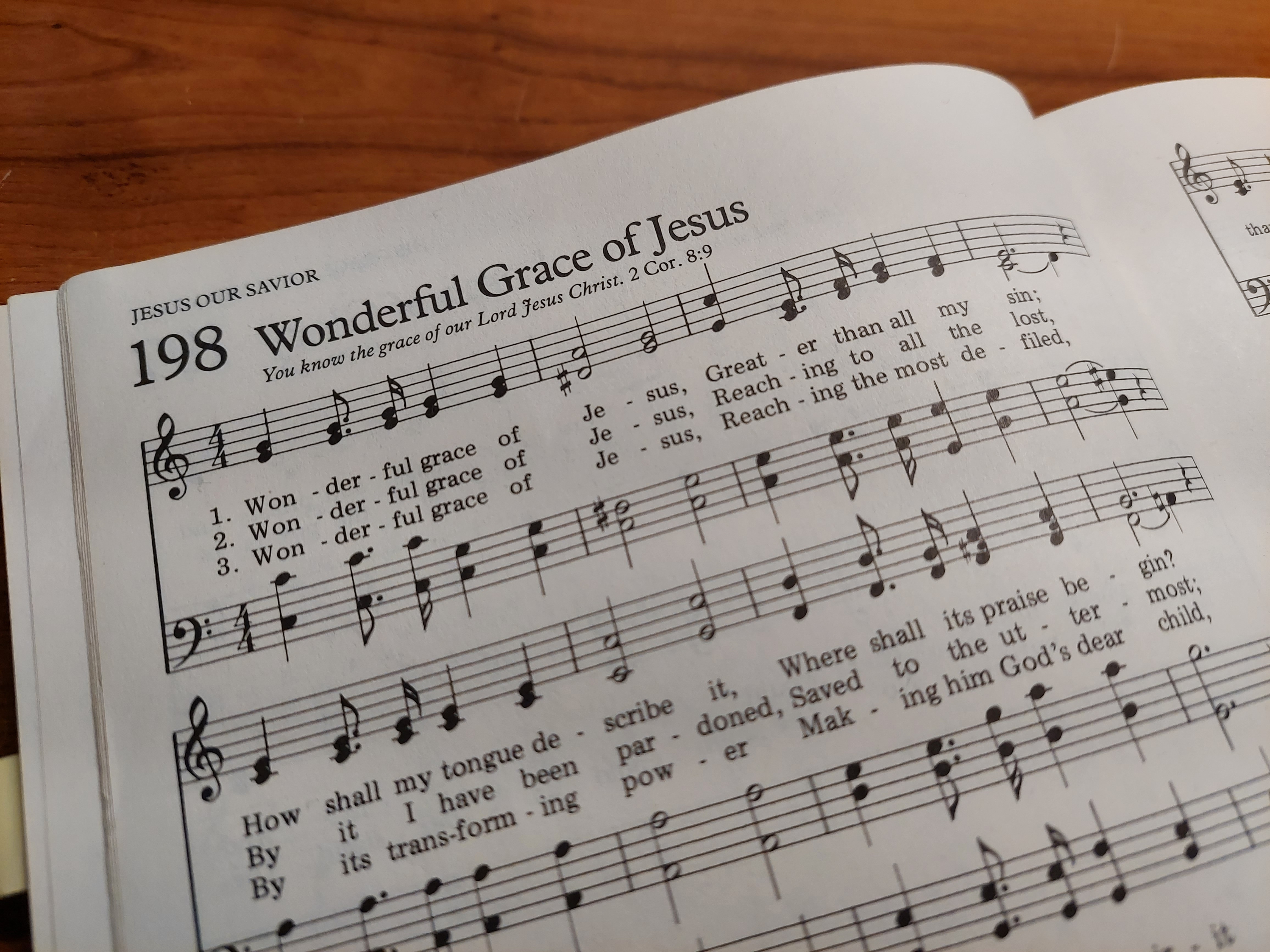
I recently visited a lovely church with friends a few hours from home. Almost every song we sang in worship was a hymn, and I was thankful. But as we sang “Wonderful Grace of Jesus,” I began to realize that something was missing.
The men and women sang different parts for this song, as is traditional. While the words were clearly visible on a screen, they didn’t exactly reflect the parts, and I was left guessing—both at the words (the women’s part wasn’t even entirely presented on the screen) and at the tune (when was the last time you saw solfege or a music staff included on-screen?).
We made it through, and I’m sure the Lord was honored by the praises of His people, but something was missing from the experience.
My own church sings quite a lot of hymns. And I’m quite thankful for it. They, too, have forgone the expense of maintaining hymnals, and especially the added-weight of lugging them every Sunday from the church office to the rented public building where we meet for church. It makes sense that digital and projected words are easier in such a situation. And we don’t ever sing any songs with men and women singing a call-and-response or anything like that. That’s a loss in itself, but it works out logistically.
The church I grew up in (at least from age 14 on) had hymnals. My sight reading ability has never been that amazing, even when I was in choir in middle and high school. But the hymnal at least gave a sense of where the tune was going, the shape of the music, if you knew where to look. And it had those echo parts typed out neatly—and in time—either above or below the main lyrics.
I actually didn’t “grow up in church” before my teens, and I hadn’t sung any hymns other than the few that made their appearance in my (public school!) second grade Christmas program. So I had to adjust to taking my cues from a hymnal just like anyone might have to do today. It took some work and a few pointers from friends, but I was delighted to learn so that I could sing along. This was a part of joining in the worship of God among His people—I valued that and wanted in.
Logistical considerations aside, if we abandon hymnals because we’re afraid people can’t or won’t want to learn how to use them, what are we saying about the people who enter through our doors? We’re assuming their inability and disinterest, instead of giving them the opportunity to learn and be initiated into the historical songs of our faith.
The church itself has a legacy, a history, a heritage. This is something missing from many modern lives—why should we assume that believers in Christ won’t want to be a part of it?
My husband Nathaniel recently lamented to me that Christian music in general has a very short shelf life. If you make music in the secular world and get really popular, you have a shot at getting played on an oldie station after your “big time” fame begins to wane. Well, my friends, there are no Christian oldie stations. Pop culture is obsessed with what’s hot NOW, and it would seem that Christian pop culture is even more so.
This is indeed worthy of lament.
Nathaniel explained to me further that the average lifespan of a church worship song is five years. Five. Years.
Two years ago we were looking for a new church, and when we visited many places around town, we noticed a pattern. Most churches sang almost no hymns. And when they did throw a hymn in the mix, it was done up with a new chorus made popular by a hit song on the radio—or else it was simply a hit song on the radio that incorporated one verse from “Amazing Grace” just to check the nostalgia box. It’s not hard to imagine that much of today’s music exists mostly for the feels and the ratings.
In most of the churches we visited, we had to learn to sing new praise songs. Some were decent, and some were meh, and some were terrible. But all of them were from the last 5-10 years of Christian radio (which is why we didn’t know them—we don’t listen to Christian radio much these days. The musical and lyrical quality is mostly meh and self is at the center far too often.).
Now, don’t take this the wrong way. I love a good praise song, and it isn’t a problem if we have to learn some. In fact, there were a handful of wonderful praise songs that I sang in my youth group and alongside the hymns in that church I attended in my teens. But those songs are all but forgotten now. No one under 30 seems to know them.
What will happen to the good songs written in the past 30-50 years—the time period in which those songs were tested and enjoyed but didn’t exist in any hymnals? By now some of them could be added to such collections. But who is going to do it if no one uses hymnals anymore?
It’s expected that we, as a church, will sift through the songs of a given age and only keep the ones that are most valuable. Many old songs will be forgotten. There are old hymns that aren’t that good and don’t need to be kept alive. This is normal.
But in past generations, as my husband pointed out to me, we had repositories where we collected those best-of-each-age songs. We had hymnals. And these hymnals might be used in different churches, providing some continuity of worship even across denominational lines. Owning a few hymnals meant you could (literally) flip through several curated collections and determine which songs you thought most sound, most edifying, most worshipful, and most reflective of a heart devoted to Jesus.
Now? Now we have popular Christian radio to tell us what we should sing in the car, in our homes, and in our churches. And what makes for good popular Christian radio? Songs that have good ratings—from the average Joe who turns on or streams said station—no knowledge of the Bible or tests of character required. Just your vote.
Of course someone at the local church level makes the actual selections for what a congregation will sing, but what pool are they choosing from? Do they themselves know any of the old hymns? If so, how many?
I’m going to go out on a limb here and suggest that connecting with church history is of greater importance than connecting with what is popular and consumable under the “Christian” banner. We have a faith heritage that ought to connect our churches today—we don’t need to have that replaced with a worldly mechanism (the mere popularity contest) glazed over with Christian labels.
Maybe, like me, you recognize that the songs on the radio are weak, so you have a curated online playlist of not-the-radio songs. Maybe this includes re-vamped hymns, but with more substance than the radio. But the mechanism is much the same, and the lifespan of these songs is similar to the radio hits.
If the hymnals are gone from most evangelical churches, what mechanism will keep our people from forgetting the songs of the past?
Even among the churches that still sing hymns, which ones? How deep is the well from which you draw? We need more than the individual memories of the older folks who remember a broad range of hymns—we, as a people, are all too quick to forget. And when the older believers pass on from this life, their memories go with them—how do we tap into their wealth of hymnody for the edification of generations to come?
If everything is digital and customizable, how will that help us connect with other churches? Happenstance overlap? Or would it be helpful to have defined collections?
How could we revive the practice of gathering (’round the fire or piano) for a hymn sing? Would physical hymnals, printed papers, or digital song books work best for this?
If Christian radio didn’t exist to train your taste to whatever is new, how might that change your taste in worship music in church?
Do you have a personal or family hymnal? When was the last time you dusted it off and sang a few?
May the Lord be glorified in His church, as we “sing a new song” and as we keep alive His time-tested praises as well.
What do you think? Am I just an old curmudgeon ranting about “church these days”? Or is there something here we as Christians ought to consider and hold on to?
I won’t spend many words of my own on this post. I’d like to point to a few passages of Scripture and a hymn to aid your thoughts of the Lord Jesus and His death on the cross in the place of sinners. My goal is simply to introduce these passages for your reading, meditation, prayer, and praise. Let the Scriptures speak to you of the death of our Lord.
Scriptures: Psalm 22, Isaiah 53, and Matthew 27
Hymn: Stricken, Smitten, and Afflicted
Psalm 22
Psalm 22 is a Psalm of David, where he expresses in vivid terms his own anguish and hope in the Lord. The details of suffering match the crucifixion of Christ more than anything that we know of David’s own experience. Jesus cried out from the cross, “My God, My God, why have you forsaken Me?”–the opening line of the Psalm. David, inspired by the Holy Spirit, hinted at the sufferings of Christ, the promised Son of David, about 1,000 years before He arrived on the scene.
Here is Psalm 22 in its entirety (read the text with footnotes Here):
1 My God, my God, why have you forsaken me? Why are you so far from saving me, from the words of my groaning? 2 O my God, I cry by day, but you do not answer, and by night, but I find no rest.
3 Yet you are holy, enthroned on the praises of Israel. 4 In you our fathers trusted; they trusted, and you delivered them. 5 To you they cried and were rescued; in you they trusted and were not put to shame.
6 But I am a worm and not a man, scorned by mankind and despised by the people. 7 All who see me mock me; they make mouths at me; they wag their heads; 8 “He trusts in the Lord; let him deliver him; let him rescue him, for he delights in him!”
9 Yet you are he who took me from the womb; you made me trust you at my mother’s breasts. 10 On you was I cast from my birth, and from my mother’s womb you have been my God. 11 Be not far from me, for trouble is near, and there is none to help.
12 Many bulls encompass me; strong bulls of Bashan surround me; 13 they open wide their mouths at me, like a ravening and roaring lion.
14 I am poured out like water, and all my bones are out of joint; my heart is like wax; it is melted within my breast; 15 my strength is dried up like a potsherd, and my tongue sticks to my jaws; you lay me in the dust of death.
16 For dogs encompass me; a company of evildoers encircles me; they have pierced my hands and feet— 17 I can count all my bones— they stare and gloat over me; 18 they divide my garments among them, and for my clothing they cast lots.
19 But you, O Lord, do not be far off! O you my help, come quickly to my aid! 20 Deliver my soul from the sword, my precious life from the power of the dog! 21 Save me from the mouth of the lion! You have rescued me from the horns of the wild oxen!
22 I will tell of your name to my brothers; in the midst of the congregation I will praise you: 23 You who fear the Lord, praise him! All you offspring of Jacob, glorify him, and stand in awe of him, all you offspring of Israel! 24 For he has not despised or abhorred the affliction of the afflicted, and he has not hidden his face from him, but has heard, when he cried to him.
25 From you comes my praise in the great congregation; my vows I will perform before those who fear him. 26 The afflicted shall eat and be satisfied; those who seek him shall praise the Lord! May your hearts live forever!
27 All the ends of the earth shall remember and turn to the Lord, and all the families of the nations shall worship before you. 28 For kingship belongs to the Lord, and he rules over the nations.
29 All the prosperous of the earth eat and worship; before him shall bow all who go down to the dust, even the one who could not keep himself alive. 30 Posterity shall serve him; it shall be told of the Lord to the coming generation; 31 they shall come and proclaim his righteousness to a people yet unborn, that he has done it.
Isaiah 53
Isaiah 53 is another prophetic Old Testament passage that gives incredible detail about the Suffering Servant–the Messiah Who would come not only to rule as a King after David, but to suffer for His people, being “crushed for our iniquities” and “justify[ing] the many.” This is the passage the Ethiopian eunuch was reading when Phillip came to him, explained the gospel, and he believed (see Acts 8).
Here is Isaiah 53 in its entirety, one of the most obvious descriptions of Jesus Christ in the Old Testament, written some 700 years Before Christ. (Find the passage with footnotes Here.)
1 Who has believed what he has heard from us? And to whom has the arm of the Lord been revealed? 2 For he grew up before him like a young plant, and like a root out of dry ground; he had no form or majesty that we should look at him, and no beauty that we should desire him. 3 He was despised and rejected by men, a man of sorrows and acquainted with grief; and as one from whom men hide their faces he was despised, and we esteemed him not.
4 Surely he has borne our griefs and carried our sorrows; yet we esteemed him stricken, smitten by God, and afflicted. 5 But he was pierced for our transgressions; he was crushed for our iniquities; upon him was the chastisement that brought us peace, and with his wounds we are healed. 6 All we like sheep have gone astray; we have turned—every one—to his own way; and the Lord has laid on him the iniquity of us all.
7 He was oppressed, and he was afflicted, yet he opened not his mouth; like a lamb that is led to the slaughter, and like a sheep that before its shearers is silent, so he opened not his mouth. 8 By oppression and judgment he was taken away; and as for his generation, who considered that he was cut off out of the land of the living, stricken for the transgression of my people? 9 And they made his grave with the wicked and with a rich man in his death, although he had done no violence, and there was no deceit in his mouth.
10 Yet it was the will of the Lord to crush him; he has put him to grief; when his soul makes an offering for guilt, he shall see his offspring; he shall prolong his days; the will of the Lord shall prosper in his hand. 11 Out of the anguish of his soul he shall see and be satisfied; by his knowledge shall the righteous one, my servant, make many to be accounted righteous, and he shall bear their iniquities. 12 Therefore I will divide him a portion with the many, and he shall divide the spoil with the strong, because he poured out his soul to death and was numbered with the transgressors; yet he bore the sin of many, and makes intercession for the transgressors.
Matthew 27:11-66
Here is Matthew’s account of the crucifixion. Notice especially the detailed connections to Psalm 22, and consider both the details and the theological implications of Isaiah 53 as you read. (Find Matthew 27:11-66 with footnotes Here.)
Jesus Before Pilate
11 Now Jesus stood before the governor, and the governor asked him, “Are you the King of the Jews?” Jesus said, “You have said so.” 12 But when he was accused by the chief priests and elders, he gave no answer. 13 Then Pilate said to him, “Do you not hear how many things they testify against you?” 14 But he gave him no answer, not even to a single charge, so that the governor was greatly amazed.
The Crowd Chooses Barabbas
15 Now at the feast the governor was accustomed to release for the crowd any one prisoner whom they wanted. 16 And they had then a notorious prisoner called Barabbas. 17 So when they had gathered, Pilate said to them, “Whom do you want me to release for you: Barabbas, or Jesus who is called Christ?” 18 For he knew that it was out of envy that they had delivered him up. 19 Besides, while he was sitting on the judgment seat, his wife sent word to him, “Have nothing to do with that righteous man, for I have suffered much because of him today in a dream.” 20 Now the chief priests and the elders persuaded the crowd to ask for Barabbas and destroy Jesus. 21 The governor again said to them, “Which of the two do you want me to release for you?” And they said, “Barabbas.” 22 Pilate said to them, “Then what shall I do with Jesus who is called Christ?” They all said, “Let him be crucified!” 23 And he said, “Why? What evil has he done?” But they shouted all the more, “Let him be crucified!”
Pilate Delivers Jesus to Be Crucified
24 So when Pilate saw that he was gaining nothing, but rather that a riot was beginning, he took water and washed his hands before the crowd, saying, “I am innocent of this man’s blood; see to it yourselves.” 25 And all the people answered, “His blood be on us and on our children!” 26 Then he released for them Barabbas, and having scourged Jesus, delivered him to be crucified.
Jesus Is Mocked
27 Then the soldiers of the governor took Jesus into the governor’s headquarters, and they gathered the whole battalion before him. 28 And they stripped him and put a scarlet robe on him, 29 and twisting together a crown of thorns, they put it on his head and put a reed in his right hand. And kneeling before him, they mocked him, saying, “Hail, King of the Jews!” 30 And they spit on him and took the reed and struck him on the head. 31 And when they had mocked him, they stripped him of the robe and put his own clothes on him and led him away to crucify him.
The Crucifixion
32 As they went out, they found a man of Cyrene, Simon by name. They compelled this man to carry his cross. 33 And when they came to a place called Golgotha (which means Place of a Skull), 34 they offered him wine to drink, mixed with gall, but when he tasted it, he would not drink it. 35 And when they had crucified him, they divided his garments among them by casting lots. 36 Then they sat down and kept watch over him there. 37 And over his head they put the charge against him, which read, “This is Jesus, the King of the Jews.” 38 Then two robbers were crucified with him, one on the right and one on the left. 39 And those who passed by derided him, wagging their heads 40 and saying, “You who would destroy the temple and rebuild it in three days, save yourself! If you are the Son of God, come down from the cross.” 41 So also the chief priests, with the scribes and elders, mocked him, saying, 42 “He saved others; he cannot save himself. He is the King of Israel; let him come down now from the cross, and we will believe in him. 43 He trusts in God; let God deliver him now, if he desires him. For he said, ‘I am the Son of God.’” 44 And the robbers who were crucified with him also reviled him in the same way.
The Death of Jesus
45 Now from the sixth hour there was darkness over all the land until the ninth hour. 46 And about the ninth hour Jesus cried out with a loud voice, saying, “Eli, Eli, lema sabachthani?” that is, “My God, my God, why have you forsaken me?” 47 And some of the bystanders, hearing it, said, “This man is calling Elijah.” 48 And one of them at once ran and took a sponge, filled it with sour wine, and put it on a reed and gave it to him to drink. 49 But the others said, “Wait, let us see whether Elijah will come to save him.” 50 And Jesus cried out again with a loud voice and yielded up his spirit.
51 And behold, the curtain of the temple was torn in two, from top to bottom. And the earth shook, and the rocks were split. 52 The tombs also were opened. And many bodies of the saints who had fallen asleep were raised, 53 and coming out of the tombs after his resurrection they went into the holy city and appeared to many. 54 When the centurion and those who were with him, keeping watch over Jesus, saw the earthquake and what took place, they were filled with awe and said, “Truly this was the Son of God!”
55 There were also many women there, looking on from a distance, who had followed Jesus from Galilee, ministering to him, 56 among whom were Mary Magdalene and Mary the mother of James and Joseph and the mother of the sons of Zebedee.
Jesus Is Buried
57 When it was evening, there came a rich man from Arimathea, named Joseph, who also was a disciple of Jesus. 58 He went to Pilate and asked for the body of Jesus. Then Pilate ordered it to be given to him. 59 And Joseph took the body and wrapped it in a clean linen shroud 60 and laid it in his own new tomb, which he had cut in the rock. And he rolled a great stone to the entrance of the tomb and went away. 61 Mary Magdalene and the other Mary were there, sitting opposite the tomb.
The Guard at the Tomb
62 The next day, that is, after the day of Preparation, the chief priests and the Pharisees gathered before Pilate 63 and said, “Sir, we remember how that impostor said, while he was still alive, ‘After three days I will rise.’ 64 Therefore order the tomb to be made secure until the third day, lest his disciples go and steal him away and tell the people, ‘He has risen from the dead,’ and the last fraud will be worse than the first.” 65 Pilate said to them, “You have a guard of soldiers. Go, make it as secure as you can.” 66 So they went and made the tomb secure by sealing the stone and setting a guard.
Stricken, Smitten, and Afflicted
This is one of my long-time favorite hymns. It ties a lot of themes together from the passages we’ve read above. Consider these words and sing along, meditating on the Lord and His work, with praise and thanksgiving. (These are the lyrics from the Trinity Hymnal, find more details Here.)
1 Stricken, smitten, and afflicted, see him dying on the tree! ‘Tis the Christ by man rejected; yes, my soul, ’tis he, ’tis he! ‘Tis the long-expected Prophet, David’s Son, yet David’s Lord; by his Son God now has spoken: ’tis the true and faithful Word.
2 Tell me, ye who hear him groaning, was there ever grief like his? Friends thro’ fear his cause disowning, foes insulting his distress; many hands were raised to wound him, none would interpose to save; but the deepest stroke that pierced him was the stroke that Justice gave.
3 Ye who think of sin but lightly nor suppose the evil great here may view its nature rightly, here its guilt may estimate. Mark the sacrifice appointed, see who bears the awful load; ’tis the Word, the Lord’s Anointed, Son of Man and Son of God.
4 Here we have a firm foundation, here the refuge of the lost; Christ’s the Rock of our salvation, his the name of which we boast. Lamb of God, for sinners wounded, sacrifice to cancel guilt! None shall ever be confounded who on him their hope have built.
Here are two good lyric videos so that you can sing along:
May you be blessed and encouraged as you consider the Lord Jesus today and celebrate His resurrection this Sunday!
This post contains affiliate links. If you make a purchase through one of these links, I may make a commission at no additional cost to you. Thank you for supporting my blog.
Here’s another installment of my micro book reviews for 2022. In my last post, I shared the books I read for our homeschool. This time around, I’ve collected my 2022 reads on Christian Thought as well as Life Management (and a bonus category Just For Fun).
Christian Books on Theology, Practice, Philosophy, or Education
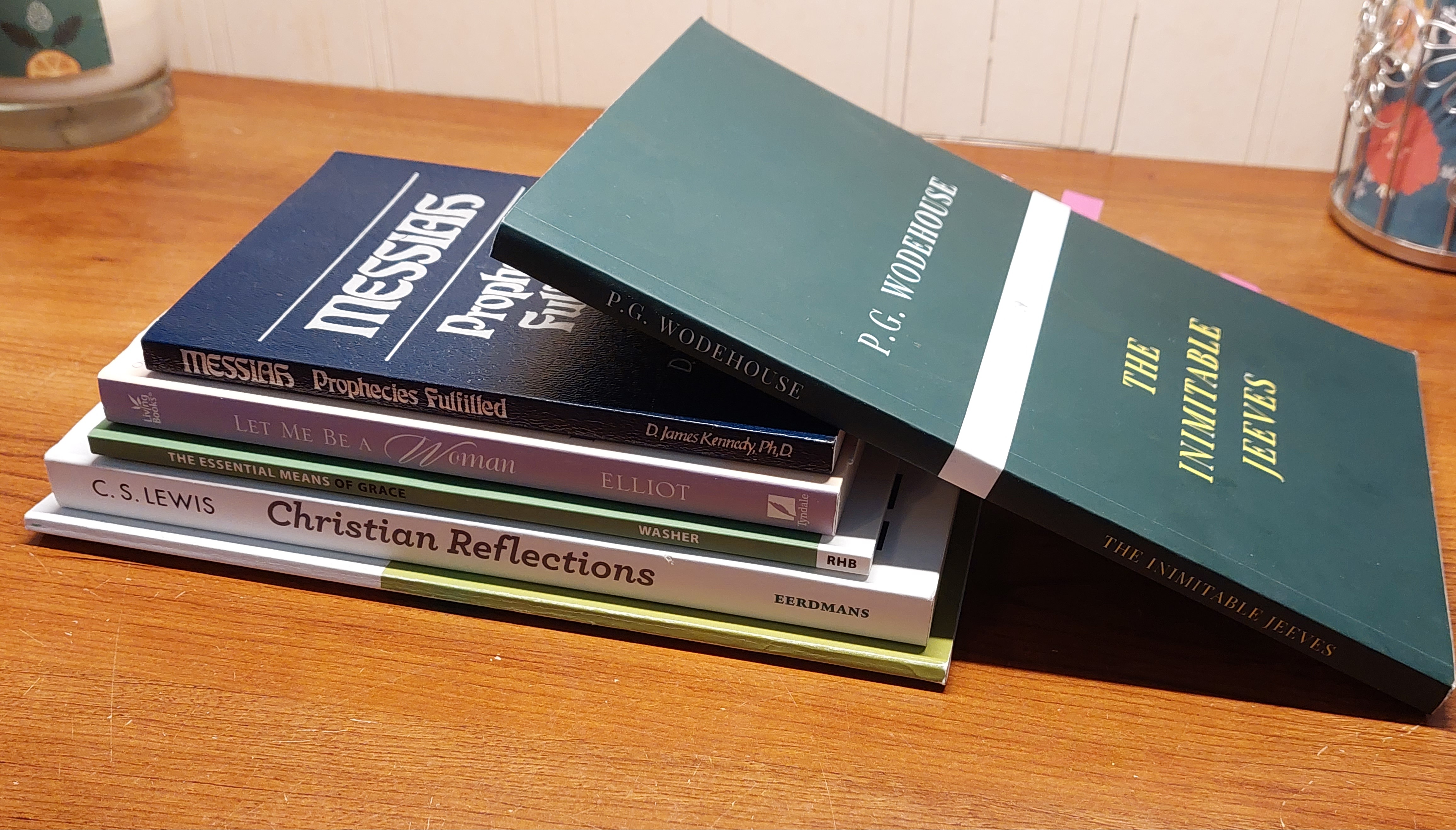
On Christian Teaching by Augustine This was probably the oldest work I read last year, aside from Plutarch and the Bible. Writing in the fourth century, Augustine lays out some important guidelines and considerations for teaching–with applications for education in general and for the study and teaching of the Scriptures. Augustine’s ordering of loves (ordo amoris) is incredibly edifying, explaining how all earthly loves can and ought to be turned into the stream of love that we have for God most of all. He also addresses some classical education practices and suggests how Christians ought to approach them. I found reading Augustine to be more approachable and edifying than I had anticipated. I can see why his writing has stood the test of time.
Let Me be a Woman by Elisabeth Elliot This was a re-read of a beloved book. Elisabeth Elliot is one of my all-time favorite authors. Given the crazy confusion of our time, it was good to be immersed in a book that celebrates being a woman—and being a godly woman at that. Let Me be a Woman is a collection of short chapters written to Elliot’s daughter, making her prose both warm and candid. Here’s a particularly poignant quote about worldly attitudes toward women:
Women’s work, particularly the task assigned by Creation exclusively to women, that of bearing and nurturing children, is regarded not only as of lesser value but even degrading and “animal-like.” This is a hideous distortion of the truth, and an attempt to judge women by the criteria of men, to force them into an alien mold, to rob them of the very gifts that make them what they were meant to be. To subject femininity to the criteria of masculinity is as foolish as it would be to judge meat by the standards of potatoes. Meat would fail every test. For women to assume an esatz [or artificial] masculinity means that they will always lose.
Let Me Be a Woman, P. 151
Turns out women also lose when men assume an “esatz” femininity. But I digress…
Christian Reflections (essays) by C. S. Lewis I have to say, Lewis is right up there with Elisabeth Elliot as one of my favorite authors. I bought this book initially for Lewis’ essay on “Historicism,” which I very much enjoyed. I’ve read many of his books: The Chronicles of Narnia(series), The Screwtape Letters, Mere Christianity, A Grief Observed, The Great Divorce, The Four Loves, The Abolition of Man, and That Hideous Strength. But this is my first read through a collection of his essays. Lewis has an incredible ability to evaluate the past and see where things are headed in days to come. I don’t always agree with his take on everything (his essay on “Church Music” being a good example), but he sure does make me think. Here are some of my favorite essays from this collection: “The Poison of Subjectivism,” “Historicism,” “The Psalms,” “The Language of Religion,” and “Modern Theology and Biblical Criticism.” So many of the problems we see today are the fall-out of ideas that Lewis confronted in his day. I think this makes his writing essential reading. Start with Narnia (at least The Lion, the Witch, and the Wardrobe) and Mere Christianity, especially if you need to strengthen your reading muscles. But do work your way “further up and further in.” You will be rewarded for doing so.
First Principles: Becoming a Disciple by Geoff Reed My husband and I hosted an outreach Bible study last year using this first book in the First Principles series. We covered the gospel, baptism, and the call to renew our minds in God’s truth, which stands in stark contrast to the ideas and values of the world. It was a great study, digging into one Bible passage for each lesson, as well as offering discussion questions and commentary. One thing that sets this book apart from other Bible studies is the heavy emphasis on both discussion and follow-through. The questions make you think and examine the Scriptures without feeling like an exercise out of an academic textbook. There is ample room for taking your own notes and recording your own questions to bring to discussion. And the sixth and final lesson in the book asks you to look back over the first five lessons to restate what you’ve learned, ground it in the Scriptures, pick a verse or passage to memorize, and set some goal or intention for your life going forward. A lot of studies have little assignments with each lesson and then just plow ahead. This one makes you sit with what you’ve covered a bit more–and challenges you to really apply it before moving on. Because simply gaining academic knowledge of God’s word isn’t what we’re after–we want to respond to it properly, applying it to our lives with the help of the Holy Spirit and in fellowship with other believers who can hold us accountable.
The Essential Means of Grace by Paul Washer I have appreciated the teaching of Paul Washer since my college days, but this is the first book I’ve read by him. It was a short but meaty and refreshing read, covering our relationship to God through the Scriptures, prayer, repentance and confession, and the local church. Highly recommended. Only 71 pages.
Messiah: Prophecies Fulfilled by D. James Kennedy My husband read this to us in December as our Advent devotional. It was a good overview of Old Testament prophecies about Jesus Christ, the Son of God. My boys are in 7th and 5th grade, and it was a good fit for our family, though there was a reference to infant baptism, which we do not practice, so we simply and briefly discussed that with our kids. (Links are to a newer version of the book than we own.)
Life Skills/Management
Do More Better by Tim Challies I started 2022 off listening to this audiobook. Challies has some good principles for productivity that were helpful to me, and for a season I tried his process for managing tasks in ToDoist. I fell off of that specific application, but together with the books listed below, I think this has been a help to my focus and life management this past year.
Essentialism by Gregg McKeown This was recommended by a friend last spring and I snagged it on Audible. I wish I had a hard copy, because I think there are some diagrams that would be helpful, especially to review. At any rate, I loved this book. It urges you to really ask the important questions—what matters most? What is most essential? And then it challenges you to live by that. It’s not a Christian book, but it is Christian-friendly.
Effortless by Gregg McKeown This is the follow-up book to Essentialism. I’m not sure “effortless” is really what you get out of it, but the author does help you think through applying the principles of essentialism more thoroughly to your life. It was a good listen (again, audiobook). I will probably revisit both of these books sometime soon—maybe even this year. I think they’ve helped me a lot.
Cozy Minimalist Home by Myquillyn Smith I found this delightful book at an “extras” bookstore on our long drive home from a trip to Florida. Why have I never read a book on decorating before? I’ve been a homemaker for fifteen years, for crying out loud! Anyway, I’m glad I read this and glad to have some principles and guidelines for making décor decisions for my home. Cozy + minimalist is really a great combination, putting people above stuff, but also not putting bare minimalism over people. The author is apparently a Christian, so the decorating advice is well-ordered and not at all about putting on a show or keeping up with the Joneses.
Don’t Overthink It by Anne Bogel This was a fairly helpful book. As I listened to the audiobook, I kept finding myself wishing that the author would have dealt with the spiritual side of worry/overthinking. Instead all she did was give positive tips and tricks. All of which are helpful, but it’s just not the complete picture, and I had hoped for better from an author who is a professing Christian. Tips and tricks don’t fix my trust-in-God issues. All that to say, this was a profitable listen, but not nearly so much as it could have been. This is a your-best-life-now kind of book, and needs to be balanced by biblical truth.
Ploductivity by Doug Wilson Speaking of biblical truth, there’s a lot of it in this little book (again, for me, audiobook). I was surprised to find a lot of discussion on technology—even a theology of technology. This book was far less about tips and tricks and processes and far more about our assumptions and beliefs about technology, work, etc. A very good read, especially after having finished Don’t Overthink It and finding it wanting in the theological department. That said, I don’t share Doug Wilson’s Presbyterian eschatology, which does come out in the book; but that is a small part of the whole, and it was interesting and edifying to listen to nonetheless.
Just for Fun
The Inimitable Jeeves by P. G. Wodehouse This was my second-ever Wodehouse read. I liked The Code of the Woosters better, but this book was fun, too. I read it at the beginning of 2022 and can hardly remember what happened in the story…Bertie gets himself in trouble and Jeeves has to help him out of it, but some of that trouble is caused this time by his even-more-pathetic friend, Bingo. This one is more serial while all of Code of the Woosters unfolds from Bertie’s accidental pinching of a cow creamer. It’s hard to beat a cow creamer for ridiculous and memorable comedy. So if you want to enjoy some good laughs and British humor, you know which one I’d recommend.
That’s a wrap for today! What are your favorite Christian theology or Christian living books? What books have helped you to manage life well? I don’t seem to make much space for fun, comedic reading, but I find it refreshing when I do–what about you?
For more Books Read in 2022: For Homeschooling On Marxism and Black Christian Perspective (coming soon!)
This post contains an affiliate link. If you make a purchase through this link, I may receive a commission at no additional cost to you.
Last night I watched Allie Beth Stuckey interview Jinger Duggar Vuolo about her new book, Becoming Free Indeed, in which she details how she was raised under the legalistic teachings of Bill Gothard and how she has come to be free from them by a more thorough and biblical understanding of the gospel and the nature of God Himself.
I’m sharing the interview here (at the end of article) because I think that this conversation is important for a few reasons:
One. Deconstruction and ex-vangelicalism is a fad these days. It’s “cool” to talk about all the bad things you experienced or were taught and then to throw under the bus anyone or any belief system that still holds to anything remotely resembling those things.
Were you pressured to conform to extra-biblical man-made standards of modesty? You can now be suspect of anyone that promotes modesty at all.
Were you taught a perverted version of male headship that left you with no strength of will and perhaps subjected you to mistreatment? You can now be sure that the bible has absolutely nothing different to say to men and women ever. Consider it your mission to rescue women from any and all discussions of biblical manhood and womanhood–those categories, whether defined biblically or not, just aren’t ok anymore.
Were you hurt by judgmental people in the church? You can now vent your bitterness, expose the hypocrisy, and throw church away altogether because of it. They’re all a bunch of hypocrites anyway.
Was Jesus and His word used to manipulate you for someone else’s advantage? You can now be free by abandoning the biblical Jesus altogether, either by becoming agnostic or following your favorite liberal/progressive Christian influencer who will tell you that Jesus agrees with everything that is currently politically correct.
Oh, and don’t forget that any appeal to the Scriptures now qualifies as “spiritual manipulation.” The bible is only allowed to make you feel good about yourself, not to convict you of sin–anything but that.
If you listen to the voices promoting this kind of deconstruction, you’ll be following a pendulum swing from legalism and spiritual abuse on the one end to license and its spiritual abuses on the other. Be warned: Self-righteousness can puff you up whether you’re proud ofwhat you condemn or proud of what you accept.
Legalism and spiritual manipulation are real problems (just listen to Jinger). But they’re wrong and wind up hurting people precisely because they violate what God has said in His word; they’re not a reason to explain away “politically incorrect” passages or abandon the Bible altogether.
Misusing a tool doesn’t make the tool bad. It just means you need to learn to use it properly.
Two. I’ve seen first hand the fall-out from the teachings of Bill Gothard and other groups or leaders who elevate personality, tribalism, and fads of supposed holiness over wise, humble faithfulness to God’s word and teaching that refuses to take the Scriptures out of context.
Jinger explains toward the end of the interview the difference between deconstruction (like I illustrated above) and the kind of careful work it takes to disentangle your faith from false teaching. She used a helpful illustration of having “putty” in your hair.
Do you just chop it all off or do you carefully take it out bit by bit so that you can preserve what is good–in this case, your hair?
There is something worth holding onto, worth preserving. Disentangling seeks to keep the good, to keep the faith, while detaching it from the bad, that is, the false teaching or misguided ideas. Deconstructing, on the other hand, pulls it all down together, without necessarily having a view to building anything back up again.
I have a lot of homeschooled friends now in their 30s and 40s. I’ve watched as some of them have had to process these things. Some do it well, like Jinger has apparently done. But some have thrown the baby out with the bathwater and are now given over to worldliness (having completely or nearly completely deconstructed). It’s my prayer that this interview might help those who are still sorting things out. And that it might call out to those who have sorted things out poorly: come back to Christ.
Three. Jinger doesn’t exhibit any of the negative attitudes you’ll see from some of the other whistle-blowers out there. Praise be to God, she speaks graciously of her parents even while exposing the teaching that they had unfortunately latched onto and promoted to their children. With the help of her husband and solid teaching, Jinger has been able to evaluate what she was taught by reading the Scriptures in context. From what I can tell, she’s not pendulum swinging nor holding onto or promoting bitterness. This makes her an example of how to sort things out in the fruit of the Spirit–something painfully missing from a lot of critiques today.
Four. It’s good to be reminded that cult-like following of one man’s teaching isn’t healthy. I don’t care if it’s Bill Gothard (problematic), Joel Osteen (problematic), or even John MacArthur (a faithful teacher). No one-man show is going to have the corner on all biblical truth. The body of Christ is full of believers with different gifts and different experiences in order that we might edify one another. This is true at the local level and it is also true when it comes to public teachers and writers, both contemporary and from church history.
We benefit from wide reading within Christian orthodoxy.
Sometimes in our efforts to be “safe” we fall prey to the sins that we weren’t watching out for. Falling in lock-step with one teacher and his tribe will likely keep you from seeing a host of blind spots.
Finally, this brings me to a couple important points I’d like to make (and then I’ll share that interview, I promise!).
If no one-man show has the corner on all biblical truth (no matter how well credentialed), I think it’s safe to say that no parents are going to get it all just right in raising their kids. Not the Duggars, not your parents, not mine.
We can choose to give the benefit of the doubt to those who loved us enough to take our raising seriously, being thankful for the good and being wary of the bad or misleading. If we have good parents, this is what they desire for their children anyway–to learn not just from what they taught us but also from their mistakes. To do better than they did but without thinking too highly of ourselves and spurning them in the process.
While Jinger and many others are picking up the pieces after having had some actual bad teaching in their growing up years, some people are abandoning ship because of their own misunderstandings and misapplications–perhaps because the teaching they received was a mix of good and bad or because it was good but it wasn’t complete.
The mind of a child or young adult may not put the pieces together just right. This does, of course, raise the bar for us as parents to do the best we can to help them, but it also should humble the child who thinks all of their problems came only from their parents or teachers.
Shocker: we can’t blame everyone else for all of our problems.
We bring to the teaching we receive our own personality quirks, experiences, and fallible attempts to make sense of the world, not to mention our own amount of faith or lack thereof. Not only are our teachers fallible in their teaching, we are fallible in our understanding. This should bring us to a place where we rely so much more on the grace of God in Christ for all of our shortcomings and sins, and on the Holy Spirit to guide us in Truth as we interact with God’s word and His people–with humility and grace.
Growing up and keeping the faith takes processing the past (because we all have one) with careful consideration, prayer, study of the Scriptures, and fellowship with godly believers who are willing to discuss all of these things with humble care for one another and humble reverence for Christ. No matter how you were raised, commit yourself to these things, connect yourself with these kinds of people in a local church.
And may you hold fast to Christ and to what is good.
I’m in the midst of a rather busy season. We still have three weeks left in our homeschool year, but summer, with its mowing, gardening, and adventuring, is already in full swing.
As the work picks up outside, mess and clutter build up inside, too. New projects create new piles, and sometimes it’s hard to walk through the house without tripping over something.
I might like to have my plans accomplished and tied up with a bow, but that doesn’t happen very often. I might like to have my whole house cleaned and organized at one time–even just the first floor all at one time!–but that feels like a distant dream and not a soon-to-be-had reality.
So when I sat at my desk to pray this morning after sleepily popping a couple pans of baked oatmeal into the oven, I gave thanks for all I could. And then I pulled out the Valley of Vision and read a prayer, one that happened to speak to me ever so sweetly even as it prompted me to speak to God. I would reproduce it here for you, but I want to respect copyrights, so I’ll link to it instead. The prayer is titled Resting on God. I hope you’ll find it an encouragement like I did.
As I roll up my sleeves and get busy with the day’s work, I’m going to try to keep these truths at the forefront of my mind. Join me?
The mind of man plans his way, But the Lord directs his steps.
Proverbs 16:9
The counsel of the LORD stands forever, The plans of His heart from generation to generation.
Psalm 33:11
My soul, wait in silence for God only, For my hope is from Him. He only is my rock and my salvation, My stronghold; I shall not be shaken. On God my salvation and my glory rest; The rock of my strength, my refuge is in God. Trust in Him at all times, O people; Pour out your heart before Him; God is a refuge for us.
Psalm 62:5-8
Come to Me, all who are weary and heavy-laden, and I will give you rest. Take My yoke upon you and learn from Me, for I am gentle and humble in heart, and you will find rest for your souls.”
Amazon links are affiliate links. If you make a purchase through one of these links, I may make a small commission at no additional charge to you.
This spring has been full of life: with garden work, schooling, spring cleaning, taxes, and adventures. I just wanted to hop on here today to share some of the wonderful things that I’ve been enjoying (mostly in my earbuds) lately. I’m on a bit of biblical womanhood kick, and whatever the world may bemoan about that subject, I’m incredibly refreshed by reminders of what God has both called me to and given me grace for in this life as a woman made in His image.
The Simplified Organization Podcast by Mystie Winckler (also available as YouTube videos). Mystie interviews Christian moms to get their best tips for parenting and home management to the glory of God. There’s a great variety of topics and tips. The practical and the spiritual don’t have to be kept in separate categories. 🙂 That’s what I love so much about this podcast (and other resources from Mystie)–not just life hacks, but real help toward godly faithfulness in both our homes and our hearts.
Fruitful Homemaker Podcast This is hosted by Emily Drew, a young mom (and fellow Arkansan!) who interviews older women in the faith. I love that she’s seeking to bring the Titus 2 wisdom of truly older women forward for today’s younger women to hear! Some notable guests include Martha Peace, Nancy Wilson, and Abigail Dodds.
Women Encouraged Podcast, Good Theology: As Mothers – with Nana Dolce This particular episode came recommended by a sweet new mom at my church. It’s a great encouragement to think carefully about what we believe and how that affects the relationships in our home–especially our lives lived out before our kids.
Dwell Podcast: Pouring from a Full Pitcher and The Difference between Peace and Self-Care These two episodes were a breath of fresh air from moms who (two out of three of them) have raised all their children and can now share a great deal of perspective on the long, hard seasons of motherhood and homeschooling.
Let Me Be a Woman by Elisabeth Elliot. This is an old classic–one I read in my early twenties and then lent to a friend…never to be seen again. I finally repurchased the book last year, and reading it the last month or so has been such a breath of fresh air in the midst the smoggy mess made by our culture’s current state of confusion.
Speaking of the current state of things, since finishing Let Me Be a Woman, I’ve begun listening to That Hideous Strength by C. S. Lewis. This third book of Lewis’ Space Trilogy confronts totalitarian scientism and many of the themes addressed in The Abolition of Man. It may seem like a strange addition to a list of “encouragement for moms,” but I’ve found it to be great food for thought. Elisabeth Elliot tells about being a woman. Lewis shows it. His character Jane wrestles through it, and Lewis, as the author, lets her be a woman. I’m not done with the book, but I’m finding it quite instructive and freeing, as I tend to have some of the same modern-woman hang-ups as Jane.
What encouragement have you found lately, mama? Not just to get through the long days of noise and messes, but what has been encouraging you to thrive in you role as a wife and mother? What resources help you lift up your eyes (Psalm 121)?
As I’ve considered how to write this series of posts on sin, guilt, and shame, I’ve come up against a bit of a problem, especially around the topic of sin. You see, I can’t write about sin as though it is something out there, separate from me.
It would be pretty easy (and would feel pretty good, wouldn’t it?) to point to the problems in others or in the world-at-large if I didn’t also suffer from the same malady. But the reality is that I do suffer from it. And as soon as I begin to wax eloquent on the topic through my writing, the Lord provides an opportunity to practice what I’m preaching.
You believe others ought to fight the sin that is within them. Have you noticed this particular area in your life that you’ve been ignoring? This particular instance of selfishness? Your latest indulgence? The pride that creeps in even as you write against sinful pride?
Sometimes such words are the gentle nudge of my loving heavenly Father, brimming with parental affection: Dear daughter, flee from these things. And look to My provision for you in Jesus.
Other times they are an attack of the accuser, laced with poison and deceit: You can’t write about sin. You’re filth yourself. A hypocrite. A self-righteous prig. A joke. Stop thinking you have any right to tell others what to do.
The Lord’s conviction compels me both to deal with my sin as the Spirit brings it to light and to not shrink back from speaking Truth, especially in the midst of a culture that glories in sin and shuns true righteousness. God’s desire is my repentance and joy in Christ, empowering me then to live in further obedience.
The accuser seeks to stop the work of God in me by keeping me weighed down with sin, continuing in despair rather than finding repentance, and using any opportunity to keep me from doing whatever it is that the Lord is calling me to do.
And so the task is laid before me: to be killing sin in me even as I write about it here to you.
The writing about it is, in fact, part of how the Lord is working on me. Perhaps that’s part of the reason that the going gets tough and the writing gets sparse. It’s uncomfortable. Submitting to the Lord’s discipline, the Spirit’s scrutinizing work on my heart, is hard. And I’m often tired. A little lazy. A bit too easily–or is it eagerly?–distracted.
Hebrews 4:13 reminds me: “…there is no creature hidden from His sight, but all things are open and laid bare to the eyes of Him with whom we have to do.” I may cringe at the invitation to to see what’s in my heart. But that doesn’t keep the Lord from seeing it. It’s all open before Him.
And as a Christian, as one who has trusted in Christ’s death and resurrection on my behalf, I have a great comfort and assurance in the verses that follow:
Therefore, since we have a great high priest who has passed through the heavens, Jesus the Son of God, let us hold fast our confession. For we do not have a high priest who cannot sympathize with our weaknesses, but One who has been tempted in all things as we are, yet without sin. Therefore let us draw near with confidence to the throne of grace, so that we may receive mercy and find grace to help in time of need.
Hebrews 4:14-16
It would “be nice” if I could talk about sin from a position of real accomplishment, like I’m some kind of expert on the subject. Then I might feel qualified to write about it. But did you read the words from Hebrews? Jesus is the only One in that position, the only One truly qualified by virtue of the fact that He, being fully God and fully man, has been tempted in all things, yet without sin.
What you get here, my friends, is a fellow sinner attempting to relay the Truth handed down by the One whose words on the subject actually matter, actually carry weight, actually give life. As this series continues, keep that at the forefront of your minds.
Soon we’ll dive in to what sin is. But for now, as you may have guessed, I’m working up the courage both write about it and to submit myself to the Lord’s work on my heart through that process.
Thanks for joining me in this process. May the Lord be at work in us all for His glory. And may we not shrink from that work but instead draw near to the throne of grace with confidence, finding mercy and help in our need. As we move on to discuss sin more deeply, we’ll sure need it!
Don’t forget to share your thoughts in the comments below–I’d truly love to hear from you!
This post contains Amazon affiliate links. If you make a purchase through one of these links, I may make a small commission at no additional cost to you.
I’ve posted a few articles in the past few months, but I haven’t posted a personal update of any kind in a long while. Life has been full, so it seems like a good time!
Injuries
Back in August my husband broke his neck and my oldest son broke his arm (both by falling off of a backyard zipline). That began a new (unusually slow in some ways, unusually busy in others) season for us that lasted right up until Christmas, when Nathaniel was finally released from his neck brace. Woo-hoo!
Family picture with the neck brace. And now without! Yes, same day for these pictures. This was the first time he played with taking the brace off for a picture.
We thought we were jumping into “normal” again when January rolled around. No injuries! No extra doctor’s appointments! The medical bills are almost behind us!
Loss
We had a steady first two weeks, and then my Grandma was put on hospice. We traveled to see her before she passed. We made it to town in time, but not to the hospital. Still, I was thankful to be there with my family, my parents and my brother. It was good to say “good bye” to Grandma together.
Last pic with my precious Grandma. At Christmas, when we visited PopPop’s grave at the National Cemetery.
Illness
The morning of the last day we planned to be there with family, Nathaniel woke up with a fever. A quick test confirmed he had that contagion that gets posts flagged on Facebook. We got out of dodge as quickly as we could, and thankfully my parents and brother stayed well. The boys and I, however, followed Nathaniel’s lead a few days later. Fevers and coughing and headaches, oh my.
We didn’t have as easy of a time as some, but we didn’t have a serious case, either–nor did we pass it to family. And for all of this, we are thankful for the Lord’s mercies.
Vacation
We had a ski trip planned two weeks from the day we first came down with the C bug. Fatigue and cough still present, we played with canceling, but to no avail.
We went ahead with our trip, and had a great time–but with doctor’s orders restraining Nathaniel from literally risking his neck on the slopes (avoiding trees and jumps in particular), and with some of that lingering fatigue holding us (mostly me) back at altitude, we took it easier than we normally would.
School
We had two solid weeks of school after Christmas break before we took school with us to visit family around Grandma’s passing. Sickness knocked us out for a week. And we got back to it for a week before taking a week of vacation. We’re back at it now. It feels like a very interrupted start to the spring semester, but our daily routine is strong, even if the Monday after a vacation is still the Monday after a vacation. 😉
And the Monday after that is a Monday, as well.
The boys are working independently on their core school work (math, writing, reading living books for various subjects), and the things that I’m teaching/doing with them are things that I’m excited to be learning alongside them (Latin, logic, and history read alouds).
Marxism
This may seem like a strange addition to the list, but the Scholé Sisters are doing a Spring Seminar called Excellent Marxmanship inside Sistership (the online network for Christian classical homeschool moms to discuss all-the-things–free to join, but this course is available at the paid Sophie level). Marxism, which is antithetical to Christianity, has influenced our modern world in many ways, and there’s no better way to see it for what it is than to get it from the source. I listened to The Communist Manifesto (available at librivox.org) back in 2020. That was a great first pass, and this Excellent Marxmanship seminar is giving me a chance to read it again and dig deeper–along with other ladies who are interested in Truth more than knee-jerk reactions. Along with Marx’s Manifesto, they’re reading two other books related to the subject. The background knowledge provided and discussion via comment threads and video chats makes this a high value course! It’s worth the cost of paid membership in Sistership, to be sure. Just make sure you can set aside some time for it.
Even if you can’t join this seminar, it’s valuable to read The Communist Manifesto for yourself. It’s sometimes hard to understand, sometimes (ok, often) infuriating, but well worth being aware of, especially if you are guiding your children through the ideological jungle of our world today.
A good book to pair with Marx would be C. S. Lewis’ The Abolition of Man. I’ve been thinking for a while that these two books, both short and a bit challenging, one diabolical and the other full of truth and insight, are so worth wrestling through in order to understand our world today. Let me know in the comments if you’ve read either of them or plan to!
Food
Prepping food for my family has always been part of my day job, but there have been some seasons, like last fall, where I get into survival mode and I rely way too often on canned refried beans and tortillas to get a quick meal of bean burritos on the table. We still love our bean burritos, but I’m getting creative in the kitchen again. 🙂 It’s funny how when you put just a little extra thought into something, even something as every day as dinner, you can turn the mundane into something creative. And it makes the whole process more enjoyable.
Spring
Every year I appreciate the coming of spring. We encounter trials and dry seasons in life, but God graciously gives us signs of life even during the coldest time of year. The trees started budding as soon as the days started getting longer again (back in January!). We’ve seen a few daffodil blooms in the past two weeks. Sure, I live in the south, so your experience may vary, but the imagery of spring, whenever it does come, is a beautiful reminder of a God who can raise the dead. Of a Father who provides for His children. Of a Savior who died to give us life and who rose again for our justification and our hope. I love finding hints of the gospel of grace in the world that God has made. As we look forward to spring, may you find those traces of His grace around you, as well.
This article continues the discussion on how we deal with sin, guilt, and shame. Find the first part of this series here.
In our world today (and perhaps in humanity in general) we tend to confuse results with character. We tend to admire the folks who are “making it” and shake our heads at those who don’t. This mode of judgment turns inward on ourselves, too.
Am I failing at what I set out to do? Am I feeling not-awesome? “I’m bad.”
Am I achieving success? Are things going great? “I’m amazing.”
We carry guilt and shame (or else self-justification and pride) over these self-assessments, often ignoring an objective moral standard in favor of our own or society’s ideas about “success” and what we should be, do, or achieve.
This became shockingly evident to me when I read the results of a Barna poll from 2012. When Christian women were asked to choose what they struggle with the most, they rather staggeringly cited the modern “sins” of disorganization (50%) and inefficiency (42%), with traditional biblical sins like anger, selfishness, envy, and lust ranking much, much lower.
For the majority of respondents, it would seem their self-evaluations are guided more by extra-biblical categories than by scripture.
This focus on failures that undermine our personal success rather than sins as defined by God means our emotional heap of guilt and shame is often clouded, confused, false, or misplaced. And it means our confidence is on rocky ground, as well.
It’s no wonder women-focused memes often try to pick us up out of our pit of despair by telling us we’re beautiful and amazing and enough. That we can do it. Just follow this five step plan.
But these memes operate in the same muddied realm as our misguided guilt and shame.
To really be free from the disorienting weight we carry, we need clarity not congratulations, true relief not trite reassurance.
Heaping praise on ourselves usually just creates further shame and dissonance when we inevitably fail again.
Clarity comes when we look to a higher court of opinion than the flighty world around us or our fickle heart within us.
We feel weighed down with guilt, shame, and anxiety. Then someone tries to talk to us about our sin, our moral failings. What?! “I’m beating myself up enough already, thankyouverymuch.” In the moment, it feels better to talk about our struggles in non-moral/non-sinful terms. We assume that to go in that direction is an attack on our person, a hindrance to our well-being and self-esteem.
But what we don’t realize is that the world and our own hearts are harsh and inconsistent taskmasters. And our heavenly Father, who calls us to a higher standard, also grants us mercy and compassion. And in Jesus, we see that our God, who “will not break a bruised reed,” calls the weary to come to Him for rest and to find that His “yoke is easy and [His] burden is light.” (See Isaiah 42:3, Matthew 12:20, and Matthew 11:28-30.)
You see, our God is specific enough about actual sin, actual spiritual and moral failing, that we can know right from wrong–what pleases Him and what doesn’t. His commands have much more to do with love and faithfulness than with getting results or being productive. God’s call to righteousness is very different from the world’s call to awesomeness. The world focuses on outcomes, but God is most concerned with the substance of our daily living.
By submitting to what God’s word says is right, we can see real sin and guilt more accurately and deal with it promptly, freeing our conscience from a lot of weight and confusion–and freeing us to pursue faithfulness while trusting the outcomes to God.
If we allow our general feelings of success and failure to rule, either fearing others’ or our own scrutinizing judgment rather than fearing God, we will find an ever-present cycle of self-exaltation and self-condemnation. A crazy cycle that doesn’t bring the peace that God intends when He calls us to humble ourselves, confessing and turning from sin, and resting with confidence in the righteous Savior Jesus.










 Kept and Keeping