Of Atheism and Fools, Part Four

Tags

, , , , , , , , ,

This is the conclusion of Nathaniel’s series on Practical Atheism from Psalm 14.  In case you missed them, here are Part One, Part Two, and Part Three

DSC_0002

“Christian Loses his Burden” Etching by William Strang found in Bunyan’s Pilgrim’s Progress

So can a christian even seek after God at all?  Are we pursuing the unattainable?  Well, yes and yes.  Part of seeking God is accepting what He says, even if it makes you feel bad about yourself.  Only when we admit the rottenness of our condition can we see our need for His salvation and begin to seek Him, to value what He values, and to hate what He hates.

A Call to Repentance

The late great DC Talk opened their hauntingly poignant song “What If I Stumble” on the double-platinum selling album Jesus Freak with this quote from the admittedly controversial Brennan Manning:

The single greatest cause of atheism in the world today is Christians who acknowledge Jesus with their lips, then walk out the door and deny Him by their lifestyles. That is what an unbelieving world simply finds unbelievable.

It is worth pausing a moment to consider whether or not we live like those who believe.

Be careful with your cream pies.  We shouldn’t mock the philosophical atheist.  Of course, neither should we defend him.  Instead, we should beg him to join us in deep contrition and earnest repentance for our failure to acknowledge God in how we live our every moment.

We may be shocked by the revelation of the waywardness of our own hearts, but is God surprised by our frequent disregard of Him?  No, He’s used to it.

Before Paul used this Psalm in Romans 3 to illustrate mankind’s universal need for salvation in Christ, before David wrote Psalm 14, before the nation of Israel had driven their enemies out of the Promised Land, God told the Israelites through Moses that they were not being given the land because of their righteousness, but because of His covenant with their forefathers, and because of the exceeding wickedness of the natives of the land.  Check out Deuteronomy 9 for more details.  Here’s verse 6:

‘Know, then, it is not because of your righteousness that the LORD your God is giving you this good land to possess, for you are a stubborn people.’

And while Moses communicated to the people all of God’s marvelous works, all of the promises of blessing, and all of the warnings of consequences should they become unfaithful to their covenant with God, the LORD tells Moses at the end of Deuteronomy that soon after he dies, they will forget their God.

He wasn’t surprised then.  He isn’t surprised now.  But He continues to graciously call us to repentance.

The Antidote to Practical Atheism:  Gospel-Grounded Godliness

As Christians, we are no more deserving of God’s grace than the oft-forgetful Israelites–or the most flagrant atheists around us.  At best, we are more aware of the depths of our own depravity and our desperate need for God in every moment of every day.  If we truly understand this, we will be ever more grateful for the means of salvation that He has provided through faith in Jesus Christ!

That salvation is really the key to all of this.  All I am suggesting is that we live our lives as Christians in the light of the same good news that brought us to God in the first place: that Jesus died for wretched sinners like me.

I am a wretched sinner, I have disregarded God—His will, His glory, and my need for Him—pursuing instead my own agenda.  I must repent of this disregard of God, this practical atheism.  I must trust in the Lord Jesus Christ: for forgiveness of my sins, and for direction and power to live my life according to His word and purpose.

And I must do this not only in the initial moment of my conversion, but in every moment thereafter, so that the Holy Spirit can make me more like Him until He takes me home to be with Him.

I can’t fix the philosophical atheists.  I can’t fix you.  But I can attend to me.  I am very cognizant of the tendencies in my own heart and life to both philosophical atheism and practical atheism.  I must repent.  I must continue to remind myself of the gospel of grace in Christ Jesus.  I must seek more and deeper awareness of the presence, work, and will of God in my life.

After condemning ungodliness, Jerry Bridges explains the goal of pursuing godliness in every aspect of our lives:

Our goal in the pursuit of godliness should be to grow more in our conscious awareness that every moment of our lives is lived in the presence of God; that we are responsible to Him and dependent on Him.  This goal would include a growing desire to please Him and glorify Him in the most ordinary activities of life.

And again:

Above all, pray that God will make you more conscious of the fact that you live every moment of every day under His all-seeing eye.  While you may not be mindful of Him, He is certainly aware of you and sees every deed you do, hears every word you say, and knows every thought you think (see Psalm 139:1-4).  Beyond that, He even searches out your motives.  Let us then seek to be as mindful of Him as He is of us.

May we be mindful of His presence, knowledge, power, wisdom, goodness, holiness, grace, truth, justice, mercy, faithfulness, and tender love for those who are His.  And may we repent when we lose sight of Him.

Dear Father!  How far short of Your glory I fall!  Please sober me under this Psalm that teaches that no one, especially not I, does good, or seeks You as You deserve. Please confront me with my sin, and help me to trust in You, in Your forgiveness of my sin, and in Your work to cleanse me from it.  Make me more like Jesus, in whose name I pray.  Amen
Of Atheism and Fools, Part Three

Tags

, , , , , , , , ,

Here is the third installment of my husband Nathaniel’s series on Practical Atheism from Psalm 14.  If you missed them, check out Part One and Part Two

DSC_0005.JPGHow Bad is it Really?
So the scriptures are clear.  There is no one who does good, not even one.  We are all corrupted, which according to Adam Clarke, cited in Spurgeon’s Treasury of David, is a picturesque and vivid metaphor taken from milk that has fermented and turned sour, rancid and worthless.”  Does this match our experience?  Am I really as nasty as rancid milk?  That is a pretty hard statement to swallow…

And here’s the other quandary… on the one hand this Psalm is telling me that we are ALL corrupt, practical atheists who do abominable deeds instead of what is good, but it’s pretty hard for me to get that concerned about it if everyone else is doing it too.  But on the other hand, I can look around at everyone else, and I actually feel pretty good about myself.  I’m not nearly as corrupt as some of them are… especially those nasty atheist fools!

The problem here is my standard of measure.  I am comparing myself to other people.  The result is that I either think, “Hey, I’m not that bad!” or “Hey, we’re not that bad!”  But when the Lord Himself looks down from heaven in Psalm 14:2, He’s not grading us on a sliding scale.  He is comparing us to His standard of perfection, and not only moral perfection, but perfect devotedness to Himself.  And His conclusion?  “There is no one who seeks after God.”  That is the root of everything else wrong in the world.

If we really sought after God, if we valued what He values and hated what He hates, if we weren’t so inclined to neglect Him to pursue our own agendas, then moral perfection would be possible.  But there is not one of us that can dodge that label of “practical atheist” and therefore not one of us that can attain that moral perfection.  And it is repulsive, like rancid milk, to our Holy God.  We must face up to the fact that the root of all our sin, even as Christians, is practical atheism.

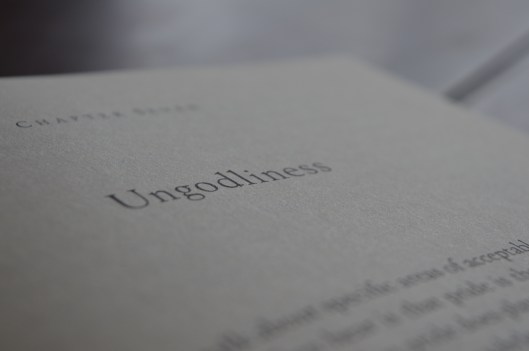
Jerry Bridges, in his excellent book Respectable Sins, confronts the many abominable deeds which Christians are inclined to tolerate in themselves, because “they aren’t the heinous sins of unbelievers”.  The book tears down the Us Versus Them mentality, and reminds us again and again that we have all sinned and fall short of the glory of God.  One of the first sins that Bridges addresses is Ungodliness.  He contends that Ungodliness, rather than Pride, is the root of all sin.  He explains:

Contrary to what we normally think, ungodliness and wickedness are not the same … Ungodliness may be defined as living one’s everyday life with little or no thought of God, or of God’s will, or of God’s glory, or of one’s dependence on God.

 Oh that cuts deep!  How rarely are my thoughts on God, His will, His glory, or my need for Him!  How rarely do I consider my actions in the light of His character, His word, His purpose in the world.  I am such a fool!  Back to the NET Bible’s note:

This practical atheism — living as if there is no God who will hold them accountable for their actions — makes them fools, for one of the earmarks of folly is to fail to anticipate the long range consequences of one’s behavior.

If we deny the applicability of Psalm 14 to our own lives, or refuse to admit our own practical atheism, we can turn aside into some dangerous places!  I have been studying the Psalms in tandem with the life of David.  In one of David’s crowning moments of godliness described in 1 Samuel 24 he spares the life of King Saul, the man who is unjustly pursuing him to death.  Saul abandons his hunt for David, and David has some room to breathe.  But in the very next chapter, David interacts with an evil man named Nabal whose name is the very same word for “fool” that is used in Psalm 14. When David allows himself to scorn Nabal from the moral high-ground of having just spared King Saul’s life, he foolishly decides to slay Nabal and all his servants!  Thankfully a wise woman interposes herself into the pending deadly confrontation and in 1 Samuel 25:23-31 Abigail reminds David of God’s promises to him, of God’s will for him, and of the danger that shedding blood without cause brings both to his relationship with God and to his coming kingdom.  She delicately confronts David with his own foolishness, his own failure to anticipate the consequences of his behavior, and his own practical atheism.  David, the man after God’s own heart, was about to commit mass murder because of a verbal insult.

Brothers and sisters, fellow Christians: if you really believe that God will hold you accountable for your actions, that there are long range consequences for your behavior, how differently should you live?  I have already quoted in passing Romans 3:23 twice in this article.  We must face up to this reality daily, before we can daily move past it to our calling in Christ.  All have sinned, and beyond that, all fall short of God’s glory!  He deserves our full attention, our full submission, our deepest love, and our highest worship.

And we all fall so short.

And then, instead of seeking His mercy and grace (which ought to be the most natural response for those who have already tasted it), we look for someone who is even worse than us, and we mock the philosophical atheists so that we can avoid feeling so bad over our own practical atheism.  This blame shifting hearkens back to Adam’s response to God’s first confrontation of his sin, reflecting the very opposite of the trust and repentance that should characterize our walk with Christ just as much as it did the initial moment of our salvation.

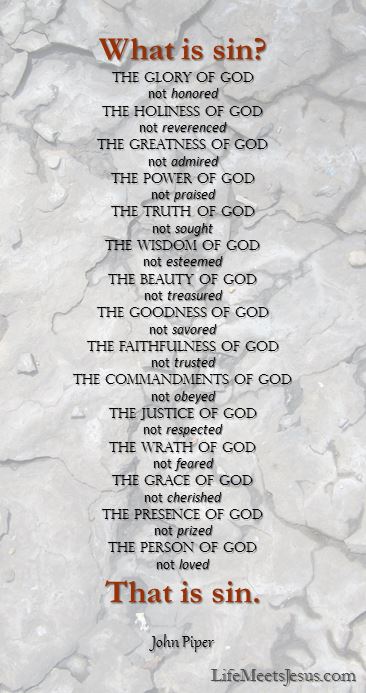
What is Sin

Check out Part Four for the conclusion of this series. 

Of Atheism and Fools, Part Two

Tags

, , , , , ,

In part one Nathaniel challenged us to see ourselves in the fool of Psalm 14 rather than merely pinning the title on the nearest atheist. 

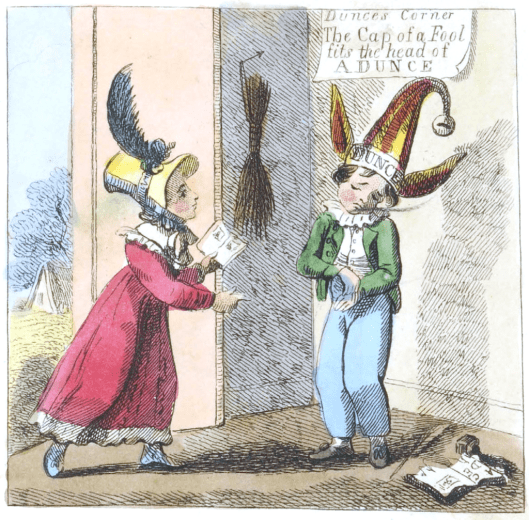
The_Cap_of_a_Fool_fits_the_Head_of_a_Dunce.png

You can’t get out of this!

“But really!  This psalm can’t be about me!  I’m a Christian—I do believe in God!  I do seek after Him!  I do good things!”

I hear you, I hear you, and I am in no position to argue with you.  I get defensive when I read this Psalm too!  But as much as I wish it did, I don’t think the scriptures allow us to exempt ourselves from the condemnation of this passage.  Bear with me as I make the case that we all play the fool–not from my own opinion–but from the passage itself and the apostle Paul’s use of it in the epistle to the Romans.

The Internal Case

Psalm 14 is full of strong statements.  Not only is the charge laid out that the practical atheist is a fool, but along with that come moral judgments–and every one of these has a universal application.  Twice David says, “There is no one who does good,” and the second time, as if anticipating our objections, he continues emphatically, “not even one.”

Spurgeon explains:

But are there no special cases, are all men sinful? ‘Yes,’ says the Psalmist, in a manner not to be mistaken, ‘they are.’ He has put it positively, he repeats it negatively, ‘There is none that doeth good, no, not one.’ The Hebrew phrase is an utter denial concerning any mere man that he of himself doeth good. What can be more sweeping? This is the verdict of the all-seeing Jehovah, who cannot exaggerate or mistake. As if no hope of finding a solitary specimen of a good man among the unrenewed human family might be harboured for an instant. The Holy Spirit is not content with saying all and altogether, but adds the crushing threefold negative, ‘none, no, not one.’

And this judgment is not the opinion of David.  As we see in verse two, “The LORD [YHWH] has looked down from heaven upon the sons of men”–it is the result of an investigation conducted by Yahweh, God Himself!

“But what about the fact that the second half of the passage seems to be talking about the victims of the corrupt individuals called out in the first half?  Surely there is an ‘us versus them’ scenario in mind there!”

We certainly can’t avoid wrestling with the latter half of Psalm 14, especially the statement that the LORD is the refuge of the afflicted righteous in verses five and six.  How do we make sense of this?

In my efforts to exempt the “righteous” (and myself with them) from the sweeping condemnation in verse one,  I took a closer look at the investigation performed by God Himself in verses two and three.  Remembering that sometimes a biblical phrase is used that implies a certain group distinct from another group (e.g. “nations” in the scriptures always means Gentiles distinct from Jews), I thought to check in on the phrase “sons of men”. Could it be used to designate a certain subset of the human population, while excluding the rest of us who actually do seek after God?

It turns out the phrase “sons of men” is literally “sons of Adam” or “people/descendants of Adam.  Think about that for a minute…  It would be hard to come up with a more inclusive term for all of humanity.

No, you really can’t get out of this.

The External Case

If you are still inclined to exempt yourself from the condemnation of practical atheism in this psalm, consider the fact that there’s a remix: Psalm 53.  This Psalm is only slightly different from Psalm 14.  The Hebrew scribes were far too meticulous to have accidentally duplicated the psalm, so the only feasible explanation is that David rewrote the psalm with a few variations because it was such an important message as to deserve restatement.

And, as if that were not enough, the Apostle Paul makes the application abundantly clear in Romans chapter 3.  After spending the previous two chapters demonstrating that Gentles are guilty before God because they have violated the laws that He has written in their hearts, and Jews are guilty before God because they have violated the law of Moses, he uses Psalm 14 to tie these arguments together and prove that “all have sinned and fall short of the glory of God”.  Take a look at Romans 3:9-12:

What then? Are we better than they? Not at all; for we have already charged that both Jews and Greeks are all under sin;  as it is written, ‘There is none righteous, not even one; there is none who understands, there is none who seeks for God;  all have turned aside, together they have become useless; there is none who does good, there is not even one.’
So tell me, do you find yourself anywhere outside of the categories of Jew + Gentile?  Are you “better than they”?

No, you really can’t get out of this.

It would seem the fool’s hat fits all of us.  But since we’re all equal in this regard, does it really matter?  Just how big of a deal is this?  Check out Part Three for the answer.

Of Atheism and Fools, Part One

Tags

, , , , , , , ,

This post contains affiliate links. If you purchase something through one of these links, I may receive a commission at no extra charge to you.

I’m happy to introduce this guest post as the first in a series by none other than my husband, Nathaniel Scott.  He’s been studying and teaching through the Psalms and the life of David in our church for the past five years.  In this introductory post, he invites us to take another look at the oft-quoted early verses of Psalm 14. 


wp-1491013694888.jpg

Whose Day is It?

There is a running joke on the Christian interwebs that April 1st is “International Atheist’s Day”–a pointed jab based on the opening line of Psalm 14: “The fool has said in his heart, ‘There is no God.’”  While I don’t question the validity of this application, I would suggest that we Christians often fail to recognize when the joke is on us.

Atheism has two dominions.  That of philosophical atheism is the mind.  It is here that the famous atheists dwell, building arguments and spewing hatred against a Being whose very existence they deny, but who has managed nonetheless to get them rather perturbed.  The occupants of this realm make up a relatively small percentage of the human population.

The second dominion of atheism is the heart and the actions.  This we call practical atheism.  This dominion is occupied not only by the famous atheists, but by the men, women, and children throughout history who disregard God and His will and pursue their own ways.  This describes all of humanity.

So today, amidst the cream pies that are being thrown at Richard Dawkins, Voltaire, and Christopher Hitchens, we as Christians need to consider Psalm 14 as a call to check our own God delusions.

Here’s the full text to get us started:

The fool has said in his heart, ‘There is no God.’
They are corrupt, they have committed abominable deeds;
There is no one who does good.
The LORD has looked down from heaven upon the sons of men
To see if there are any who understand,
Who seek after God.
They have all turned aside, together they have become corrupt;
There is no one who does good, not even one.
Do all the workers of wickedness not know,
Who eat up my people as they eat bread,
And do not call upon the Lord?
There they are in great dread,
For God is with the righteous generation.
You would put to shame the counsel of the afflicted,
But the LORD is his refuge.
Oh, that the salvation of Israel would come out of Zion!
When the LORD restores His captive people,
Jacob will rejoice, Israel will be glad.

The NET Bible, in one of its characteristically succinct and profound Translators’ Notes, says of the Psalm’s opening line:

‘There is no God.’ The statement is probably not a philosophical assertion that God does not exist, but rather a confident affirmation that God is unconcerned about how men live morally and ethically.

This practical atheism — living as if there is no God who will hold them accountable for their actions — makes them fools, for one of the earmarks of folly is to fail to anticipate the long range consequences of one’s behavior.

How many of us, as Christians, live as if there is no God who will hold us accountable for our actions?  How many of us fail to anticipate the long range consequences of our behavior?  We ourselves are under a delusion.  As we contend for the existence of God in the public square of cyberspace, let’s check our hearts and our lives to make sure we are living in the light of that existence.

Us Versus Them?

Using this Psalm as an insult against philosophical atheism is not new.  The meme goes back for generations.  In Charles Spurgeon’s Treasury of David you can find a collection of many writers over many eras barbecuing the atheist with a myriad of insulting terms.  These writers differentiate strongly between themselves and the atheist, much like the Christian internet warriors of today.

But there are a few writers in Spurgeon’s compendium who see the fool as representing the practical atheism of which we are all guilty.  These writers are much more gentle, and while clearly condemning the error of the fool’s ways, they do so with more humility.  They cautiously look to themselves lest they too be caught in foolishness.

As we dig deeper into Psalm 14, let’s follow their example.

Let’s not draw too sharp of a distinction between “us” and “them”.  To do so would be an attempt to write ourselves out of the line “They have all turned aside, together they have become corrupt; There is no one who does good, not even one.”

And if you go on to Part Two, you’ll see why doing so would be quite problematic.

Running for Another

Tags

, , , , , , , ,

I’m one of those crazy types that actually enjoys running.  Once upon a time I even looked like a runner.

Over the years, running has filled several important roles for me: it’s been a way of escape, a way to burn off energy, to get or stay in shape, to cope, to get alone and talk to God, to enjoy sunshine and wildlife, to improve my running time, to compete, to show off, to win.

Admittedly, some of those are more virtuous motivations than others.

But this past Saturday I had an opportunity to run for a very different reason.

My local women’s running clinic was invited to participate in the sixth annual Arkansas Run for the Fallen, an apolitical 146-mile weekend-long event honoring service men and women who died in the line of duty since September 11, 2001.  Our part was to join the team of running soldiers for one mile through the middle of town.

In the weeks leading up to the event, I thought about it quite a bit.  I read the stories of the two Navy SEALs who would be remembered at the Hero Markers at the beginning and end of our course.  I thought about my own grandparents and aunt and uncle who served in the Army Air Force and in the Navy.

And I felt quite small and pampered by comparison.  Not exactly worthy to be running with people who have taken on so much personal risk for something bigger than themselves–or for people who have quite literally laid down their lives for others.

When Saturday came and our red-shirted local ladies assembled, the anticipation we all felt was a strange mix of excitement and sobriety.  Soon the running servicemen arrived, paused to remember one fallen comrade, planted a flag in his name, and then we were off.

20170325_090745

The usual “racer’s mindset” tried to assume its place in my thoughts, but there wasn’t any room for it.  No room for looking ahead to see who you’re going to try to pass next–that wasn’t the goal.  No room for pulling away from the crowd–the purpose this time was to get lost in the crowd, in the small sea of red.  No room for going at your own pace–we had to keep pace with those who were leading us on.  No room for thinking about how to position yourself for the best finish so you could point to your rank or time in the end–this run was intended to point to someone else.

It’s easy to get comfortable in our lives here in the West and forget that the blessings we enjoy have been paid for by others.  So too as Christians, we can lose sight of the fact that our greatest, eternal blessings have been paid for by the Lord Jesus Himself.  Sometimes our normal routines need to be shaken up a bit to give us new perspective.

That’s exactly what happened for me on Saturday.  This whole experience has refreshed my view of the race set before us as Christians.

We “run with endurance” remembering those who have gone on before us and with our eyes fixed on Jesus (Hebrews 12:1-4). 

We encourage one another (1 Thessalonians 5:11) and cheer each other on rather than treating the gospel of God’s grace as a program for self-advancement and our fellow runners as competitors

We “keep in step with [His] Spirit” (Galatians 5:22-26)–He sets the pace for us to follow, not the other way around.

Our run on Saturday morning lasted less than ten minutes, but the impact of running to honor someone else has been felt all week.  And while my legs have been resting, the words of John the baptist have continued to run through my head:  “He must increase, but I must decrease.” (John 3:30)

Let Him be seen as I run this race called life.  Not me.

In a world that preaches so often that we are the most useful or influential when we place ourselves on a pedestal to be seen by others, we need to be reminded that it’s ok, right even, to live outside of the spotlight, to blend in with the crowd of those who live–who run–not for themselves, but for the glory and honor of Another.

Soli Deo gloria.


Signs of Spring

Tags

, , , , , ,

dsc_0062

For the beauty of the earth,
For the glory of the skies,
For the love which from our birth
Over and around us lies:

Lord of all, to Thee we raise
This our hymn of grateful praise.

dsc_0038

dsc_0039

dsc_0043

dsc_0051

dsc_0054

For the wonder of each hour
Of the day and of the night,
Hill and vale and tree and flower,
Sun and moon and stars of light:

dsc_0055

dsc_0069

dsc_0074

dsc_0072

dsc_0078

Lord of all, to Thee we raise
This our hymn of grateful praise.

dsc_0084

dsc_0092

dsc_0093

dsc_0101

For the joy of human love,
Brother, sister, parent, child,
Friends on earth and friends above;
For all gentle thoughts and mild:

dsc_0097

dsc_0116

dsc_0133

dsc_0188

Lord of all, to Thee we raise
This our hymn of grateful praise.

dsc_0183

dsc_0186

dsc_0138.jpg

dsc_0164

For Thy Church that evermore
Lifteth holy hands above,
Offering up on every shore
Her pure sacrifice of love:

dsc_0120

dsc_0126

dsc_0132

dsc_0168

Lord of all, to Thee we raise
This our hymn of grateful praise.

dsc_0146

dsc_0135

dsc_0150

dsc_0156

For Thyself, best gift divine,
To our race so freely given;
For that great, great love of Thine,
Peace on earth and joy in heaven:

Lord of all, to Thee we raise
This our hymn of grateful praise.

For the Beauty of the Earth by Folliott S. Pierpoint, adapted text

Learning from My Children: To Dance Like David

Tags

, , , , , , , , , , , ,

https://i0.wp.com/www.jesuswalk.com/david/images/tissot-david-dancing-before-the-ark-640x444.jpg

“David Dancing before the Ark” by James Tissot.  The ephod might have been a simple robe like this, or it might have been a loincloth.

Last night as I was making dinner I put on a Fernando Ortega CD.

My seven-year-old began moving to the music, something reminiscent of interpretive dance and ballet, though he has had no instruction and has seriously no chance at all of picking up such graceful moves from his parents.

At the end of “All Creatures of our God and King” my son announced that he wanted to dance to that song for next year’s talent show.

My initial reaction was less than enthusiastic.  I’m a rather reserved person.  I’d be somewhat embarrassed for him if he did something like that, something so…so…contrary to our culture’s gender stereotypes.  I wouldn’t want him to be labeled or made fun of.

And then it hit me:  I was responding in my mind like Michal did to David.

Are you familiar with the story?

And David was dancing before the Lord with all his might, and David was wearing a linen ephod.  So David and all the house of Israel were bringing up the ark of the Lord with shouting and the sound of the trumpet.

Then it happened as the ark of the Lord came into the city of David that Michal the daughter of Saul looked out of the window and saw King David leaping and dancing before the Lord; and she despised him in her heart.

My precious boy was dancing before the Lord, in jeans and no shirt, joyfully moving his feet and lifting his hands to heaven, rejoicing in a song of praise that he has long loved.  Not unlike David danced before the Lord to celebrate the return of the Ark of the Covenant to Jerusalem.

And I was thinking about what other people would think of it if they saw it.  Not unlike Michal, who despised David for his exuberant worship and criticized him with biting sarcasm.

My son wasn’t the one missing something–I was.

“I will celebrate before the Lord,” David responded.  “I will be more lightly esteemed than this!”

Oh for the freedom to express our love for the Lord, giving Him the worship that He is due without allowing the fear of man to hinder us.

Am I willing to be undignified in the views of the world?  Am I willing to come to God as a joyful child?  Without reserve?  Without concern?

Am I willing to give my children the freedom to do so?

My boy may not remember this idea by the time the talent show comes around next year, but I at least am taking his example to heart.

Has the Lord ever taught you a lesson through the simple, unreserved faith of your children?  Please share in the comments below!

A Morning Prayer

Tags

, , , ,

064

O Father,

How great is Your goodness and Your lovingkindness!

Help me today to receive from Your hand

all that You have for me:

the forgiveness and love secured for me by Jesus Your Son,

the grace and strength needed for every moment’s calling,

the disappointments and interruptions that test my faith,

the glimpses of beauty and pictures of truth You provide in their midst,

the confident expectation and hope of all that You have promised,

the peace that passes understanding,

the fruit of Your Holy Spirit as You work to produce it in me.

O Father,

May I humble myself to receive all that You have for me this day

with open heart and hands

with full assurance of faith

cherishing Your love,

and knowing You are good.

Amen.

COPYRIGHT 2017 LAUREN SCOTT

Books Read in 2016–The Wrap-up

Tags

, , , , ,

This post contains affiliate links. If you make a purchase through one of these links, I may receive a commission at no additional cost to you. 

wp-1485921038498.jpg

In past years I have shared the books I’ve read based on an academic calendar, because when I started recording what I was reading I was using a planner that followed that format.  I’ve since decided it makes more sense to post my micro book reviews as a round up of all the books I’ve read in a calendar year.

Which brings me to this post.  The transition had to happen sometime, and it’s happening now.  So, without further adieu, I give you the books I’ve read in the latter half of 2016.  If you’d like to see the eight other books I read in 2016, they are at the bottom of my 2015-2016 post.

Pride and Prejudice by Jane Austin  I made the mistake, dare I say, of picking up this novel around 4 o’clock one afternoon when I heard that it would soon be discussed on the Circe Institute’s Close Reads podcast; and, since my husband was traveling and would not be home that evening, had the opportunity (and by compulsion took it) to read the entire thing in one night.  Once upon a time five or more years ago I had tried to read Pride and Prejudice, but found it to be nothing more than the screenplay of the A&E film version of the story, so I didn’t make it more than a few chapters before I felt there was no need of reading it.  Having not seen the movie adaptation in several years, when I picked it up this time the banter and character development of the film which was even more prevalent in the book drew me in at once.  As Miss Elizabeth Bennet learned, so have I:  some things, upon second evaluation, are found to have much more merit than we may judge them to have at the first.  Plainly stated:  I very much enjoyed this book and regretted having not read it in its entirety much sooner.  (The article that provoked my reading was “Don’t Follow Your Heart”.  I highly recommend it and the podcast discussion of the novel.  It was great fun!)

Courtesy in Christ: An Ettiquette Handbook for Christian Teens by Diane Pickup  I found this on our shelf one day and my curiosity got the best of me.  I have little boys, so training them in courtesy is on my bucket list for them.  I enjoyed how the author tied acts of courtesy and consideration to scriptural attitudes and commands to put the needs of others before our own.

The Wind in the Willows by Kenneth Grahame Listening to the Close Reads podcast also led me to this interesting read.  It’s a children’s story, but not just a children’s story.  Some of the vocabulary is very challenging for a children’s book (or for the adult reader, if I’m honest).  But I enjoyed the challenge of figuring out new words as I followed the wanderings of Mole and Ratty and the mischievous escapades of their foolish friend Toad.  The discussion on Close Reads explored similarities between The Wind in the Willows and The Hobbit, The Illiad, and even Shakespeare.  Grahame’s skill in writing and thematic depth make this a thoughtful book for adults, and maybe especially young adults ready to leave home for the first time but who find themselves longing for it once they’re gone.  I do have a major caveat, however:  chapter seven “The Piper at the Gates of Dawn” involves Mole and Rat finding a lost little friend with the pagan deity Pan—and they worship him.  While I think some generalized lessons can be drawn from this chapter with its wonder and awe, and while I think that it’s placement by Grahame in the center of the book is perhaps significant, the rest of the story line can be enjoyed without it.  My husband and I agree that there is so much wealth of children’s literature out there that we don’t feel any urgent need for our children to read The Wind in the Willows.  If we do read it out loud as a family while our children are young, we will skip chapter seven.  Most likely, however, we may save this as a fun return to childish anthropomorphism when our boys are in their late teens, where the themes may be particularly meaningful and when our boys could take on chapter seven as an exercise in practicing discernment.

Pinocchio by Carlo Collodi  On a much lighter note, we listened to the audio version of this classic on a road trip this year.  Our boys, 4 and 6 at the time, gobbled it up!  What does it mean to be a real boy?  What are the consequences of having your own way and ignoring those who give you wise counsel?  These questions are addressed in a very outrageously funny, though sometimes violent story.  I highly recommend this story, though parents should consider the age-appropriateness of some of the darker elements (Pinocchio kills the cricket, a cat’s paw is bitten off, Pinocchio is hung by his neck from a tree, etc).  For our kids, these were effectively shocking—they grabbed the attention—without causing any bad dreams or inspiring violent play.

Little House on the Prairie by Laura Ingalls Wilder  We read Little House in the Big Woods in the first half of 2016, so naturally we moved on to the next in the series.  We enjoyed following Laura’s family as they traveled to Kansas and set up their home and everything they needed from scratch.  We all gained some perspective from imagining a life in which all of your family’s belongings fit on a simple covered wagon.  And since we live in the country, there have been ample connections for us to make—they set up a garden, and we started our first garden last year; they had to dig a trench in order to protect their home from a prairie fire, and we have discussed fire safety measures like that as well. All in all, this is a series that no child should miss.

What was your favorite read from 2016?  What’s on your list for this year? 

The Word Became Flesh, Part Three

Tags

, , , , , ,

This is the final post in a series on the Incarnation with meditations from John chapter one.  Read the rest of the series here:  Intro, Part One, Part Two

It’s interesting to think that if there is a personal God who is jealous for our worship, and if Jesus is anything less than God, we Christians are in a world of hurt for worshiping Him as God.  And yet, if His claims are true–if Jesus really is Emmanuel, God with us, then we are equally as bad off if we reject Him in favor of worshiping only the Father, as the Jews of Jesus’ day were inclined to do.

He came to His own and His own did not receive Him.

To worship a mere man is preposterous.  Indeed it is treasonous. And to bow down before a tiny baby as the magi did is laughable.

Unless somehow God becomes a man.  Unless somehow that baby was more than just a baby.

But if we stop to think about the incarnation, and if we’re honest with ourselves, it’s about the most unthinkable thing, isn’t it?  The only way we can reckon it even being possible is to say that “with God all things are possible” and that “He does whatever He pleases”.

So often people seem to meditate on the fact that God would become a baby.  We’re reminded of the smallness of His stature, the utter dependence upon His mother, the poverty of His earthly family.

But the marvel of the incarnation is not so much in the tininess of the Infant nor in the lowliness of His socioeconomic status, as consequential as these may seem to us, but rather that He would become human at all.

Would we lose our wonder if He had indeed walked upon the scene as a fully-grown, handsome, rich, powerful ruler?  Those earthly things might impress us, but they don’t impress God.  The gap between the rich and poor, the greatest and the weakest of our world as it is applied to the birth of Christ is a rather silly consideration in light of the infinite gap between the majesty, sufficiency, and immensity of our Creator and mankind’s collective vulgarity, dependence, and feeble littleness.

His humility and condescension would have been on display even if He had come as the most impressive of men, simply for having clothed Himself with flesh and blood.

But we are a bit dense and our values quite backwards, so in keeping with the lowliness of becoming like us, He showed us that the Mighty One of heaven needed nothing of earthly riches, power, or glory.  He was content to empty Himself of the heavenly riches, power, and glory so that He might be like those He came to save.

We see in Jesus, the Word of God, all the perfections of character that are in God Himself; we see what it means to be Emmanuel, God with us.  And we see what it means to be a truly great human being–in the only human life with which God is well pleased.  His is a greatness so far beyond our reach that in the light of the incarnation and the life of Jesus Christ on earth, we see our desperate need for God to enter into our dark mess in order to pull us out of it.

The people who walk in darkness will see a great light.  Isaiah 9:2

In Him was life, and the life was the Light of men.  The Light shines in the darkness, and the darkness did not comprehend it.

He came to His own, and His own did not receive Him. 

But as many as received Him, to them He gave the right to become children of God, even to those who believe in His name. 

And so He came.  The glory, the humility of the incarnation is not so much that Jesus was born small and poor, but that He was born into our world at all.

And so we are invited to come.  And see.  And receive.  And worship this One to whom not only the wise men but also the angels of heaven bow down.

And the Word became flesh and dwelt among us, and we saw His glory, glory as of the only begotten of the Father, full of grace and truth. 

Merry Christmas.