• Home
  • About
  • Living Faith
  • Home and Family
  • Home Education
  • Books
  • Recommended Resources
  • Media

Kept and Keeping

~ Rest in Grace, Labor in Love

Kept and Keeping

Category Archives: Living Faith

Reformation Reflections 2017

31 Tuesday Oct 2017

Posted by Lauren Scott in Home Education, Living Faith

≈ Leave a comment

Tags

Church History, education, History, Home Education, Martin Luther, Reflections, Reformation 2017

October 31st is usually just another day for our family.  At times, when we lived in a city neighborhood, we’ve passed out candy and gospel tracts to costume-clad visitors at our door, and other times we have happily forgotten the sugar-coma-inducing festivities of the day all together.

We’ve also not necessarily done much in the past with the notable historical event that took place on this day.  We’ve recognized it as Reformation Day, and perhaps shared a “Nailed it” meme for laughs, but we’ve never, you know, dressed our two boys up as Luther and Calvin.

But today, October 31, 2017, marks the 500th anniversary of the day Martin Luther famously drove the nail that cracked Europe—and mainstream church history—forever.

This seems to call for more than just the usual nod.  Cosplay may not be necessary, but a deeper consideration of its importance certainly is.

As a history major in college, I took particular interest in two very world-changing narratives:  the World War II era and church history.  Having studied the Reformation in some depth over ten years ago (ahem, yes, it’s been a while!) and consequently having forgotten many of the details, now has seemed as appropriate a time as ever to refresh myself on the subject, especially as I have considered how to teach my children about it and determine what celebrating the Reformation looks like in our family.

As I’ve dusted off a few of my college texts, done some reading online, and discussed the subject with my husband, I’ve refined my thoughts and priorities when it comes to understanding the Reformation and passing on that understanding and perspective to my children.

IMG_20171031_071947758

Guiding Principles of our Discussion of the Reformation

Most of us know that the first three rules of buying a house are “Location, Location, Location”.  Similarly, the first three rules in rightly understanding history, the Scriptures, or anything we learn by written language are “Context, Context, Context”–both textual or historical.  The Protestant Reformation was in no way a stand-alone event.  One of my college texts is called Europe and Its Reformations, plural, because it seeks to demonstrate the continuum of social, political, and religious “reformations” surrounding the events of Luther’s life.  Despite the obvious fact that Luther’s actions and teachings set off a figurative bomb that changed the landscape of Europe forever, neither church nor political history were homogeneous, unchanged, or unchallenged before 1517.   And as we are probably more aware, neither did they remain so after the fact.  There have been throughout history pockets of believers, often persecuted, holding to the true gospel before the posted paper at Wittenberg, just as there were other movements from within the Catholic Church seeking to reform it, as well.  I believe it’s important that my children understand from the beginning that Luther’s Ninety-Five Theses and the Reformation they sparked didn’t take off in a vacuum.  Rather, in God’s providence and by His grace, Luther was at the right place at the right time to shed light on prevalent errors and bring the gospel of salvation by grace alone through faith alone into mainstream discussion.

Connected to this idea of context, it’s important to remember that Catholicism isn’t the same today as it was in Luther’s day.  Seeing the reformation sparked by Luther’s Theses as one of many efforts to reform the Catholic Church and/or Christianity and discussing this fact with my children will (I hope) help them to grasp that ideas, institutions, and people change over time.  I want them to be able to have meaningful conversations with their Catholic friends because they have some understanding of what Catholicism is today.  In the United States of America.  To this end, we watched a video covering the main differences between Catholicism and Protestantism.  It was mostly over my kids’ heads, since they are only 8- and 6-years-old, but we paused the video when necessary to discuss and understand along the way.  I hope I can instill in them a desire to ask questions to get to know what others believe and not merely spout off what they think they understand from one video they watched and a handful of discussions they had with their parents.  I have a hunch this will be a long process…
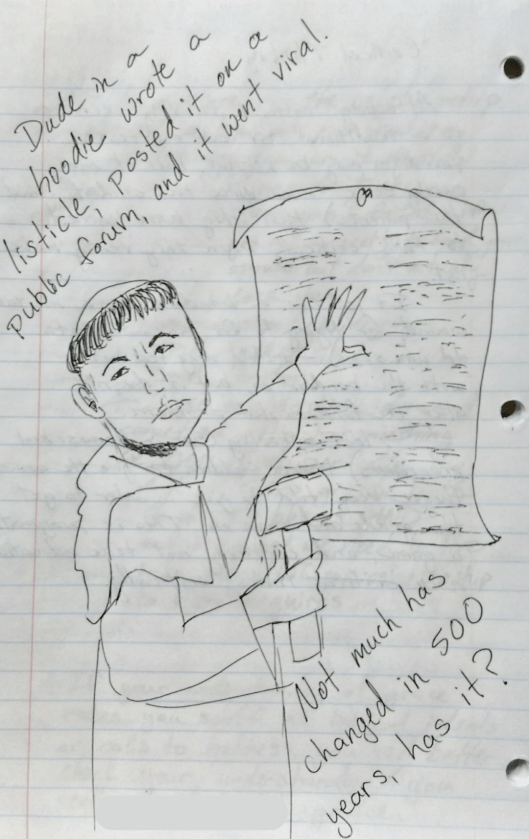
Luther cartoon Reformation Day 95 theses homeschool

As my crummy excuse for a cartoon above seeks to humorously remind us: while technologies and power structures change, mankind is very much the same throughout the centuries.

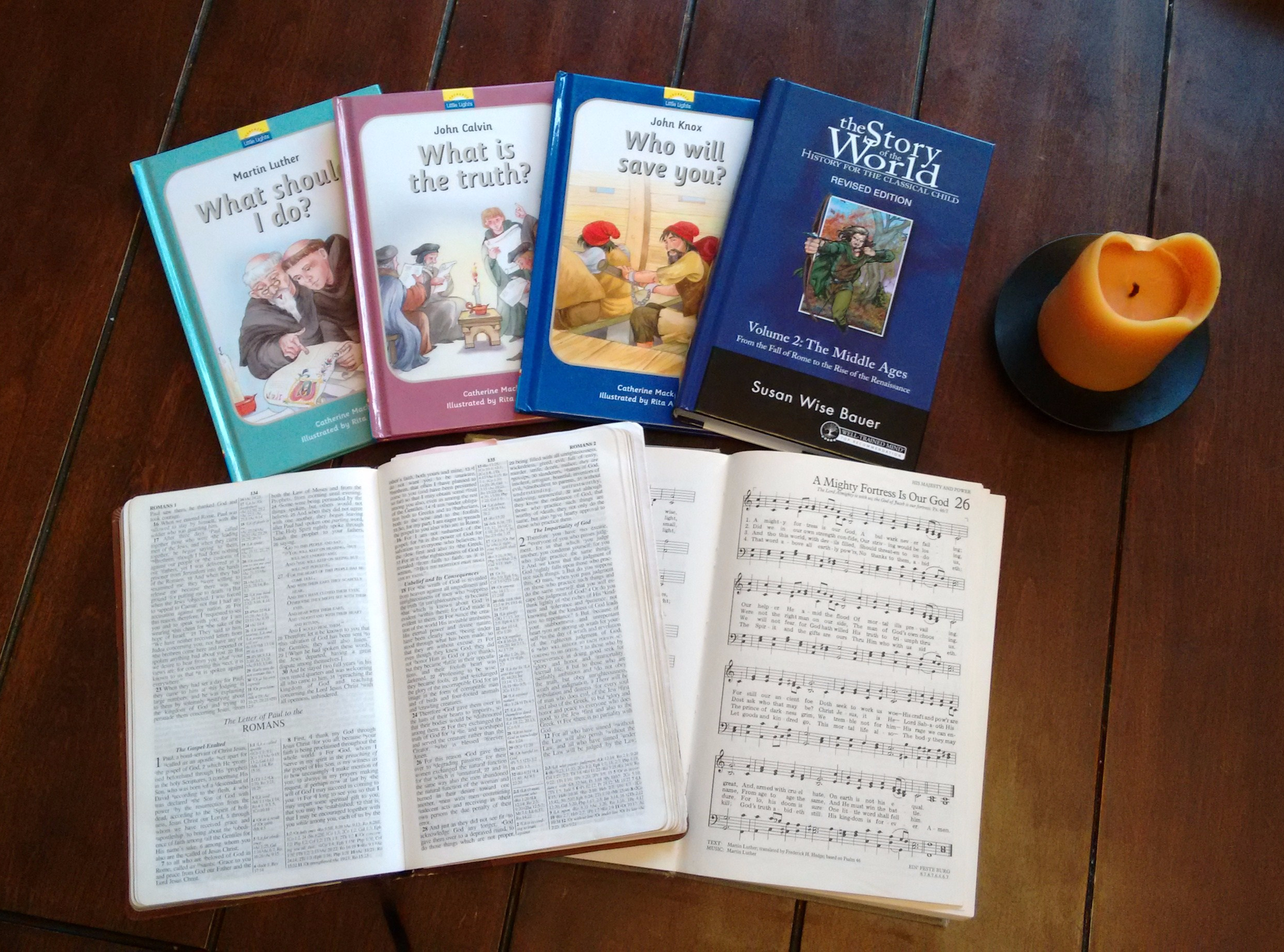
Getting a bit more practical now, primary sources are a great way to look more directly into the past.  And they’re not just for college history classes!  Here are a few we’re using with our elementary-aged kids:  the book of Romans (which the Lord used to bring Luther to the understanding of salvation by faith); quotes from Luther himself, particularly a few lines from his Ninety-Five Theses and his defense at the Diet of Worms; and Luther’s hymns “A Mighty Fortress is Our God” and “Lord, Keep Us Steadfast in Your Word”.  As our kids get older, it’s my aim that we’ll look more into Protestant, Catholic, and political documents and counsels, among many other sources and including many other key players and precursors to the Reformation.

As we engage with several kinds of source materials, I want us to remember that bias is ever-present and history is never simple.  While we can see glimpses of the hand of God weaving together the events of time into the meta-narrative tapestry of His choosing, we can only ever see a few of the threads at a time.  So we should be humble with our own narratives, recognizing that God’s truth doesn’t depend upon me spinning the events in a way that I think is favorable.  A single group’s human narrative can be helpful, but only if it recognizes it is incomplete.  (Yes, this definitely has application to the current state of upheaval in our society today.)

Confession:  Luther isn’t really on our list of personal favorite Christian heroes.  He did some really great things and God clearly used him mightily for His purposes.  But my husband’s favorite heroes of Christian history are the faithful, quiet plodders—you know, the type of people who aren’t flamboyant or famous enough to have a day set aside to celebrate them—and who maybe don’t ever make it into the history books.  This is a pretty good personal antidote to our world’s (and often the church’s) emphasis on “changing the world” and “doing big things”.  So often it’s difficult to see the line between godly motivation and mere self-promotion and glory-seeking.  Those of us who recognize this do well to slow down and consider the lowly servants of Jesus throughout the ages, or those who played a support role to the “main actors” on the stage of church history.  I’m thankful that my husband is leading our family in valuing the faithfulness that sometimes only God can see.  It’s spiritually healthy, and it’s right.

While our family certainly doesn’t care to over-emphasize Luther’s heroism, his stand for truth and for conscience is an example to be admired.  We may never find ourselves in such a life-or-death test for our faith or our trust in the Word of God as when Luther stood before the Diet of Worms in 1521 and gave his most famous declaration.  But we nevertheless need courage on a daily basis to do what is right, to share the gospel of grace, to serve and love the lowly, to choose faithfulness in the small things no matter the outcome, to say no to delusions of grandeur or inclinations toward comfort and safety that would bring us to self-preserving, self-exalting compromise and complacency.  Luther’s legacy is not only in the truth he taught, but in the courage he had to “stand, and … do no other.”
Reformation Books Hymns Romans

We’ve selected a few children’s biographies to read this morning along with singing hymns and possibly watching a movie on the subject this evening as a family.  But more even than the particular books we read or the media we consume are the discussions we have as a family.  Discussions of what the gospel, or good news, of salvation in Jesus is—and has been from the beginning.  Discussions of how the Catholic Church was in error in the past and which of those errors have been abandoned and which have been maintained to this day.  Discussions of error on the other side of the line and how we each must seek to faithfully follow the Word of God, being willing to stand even amidst pressure from “our own” institutions.  Discussions of how we should treat those with whom we disagree (hint:  we like the example of Jesus and His disciples better than that of either the Catholic or Protestant state-churches!  Eek!).  Discussions of how we can see God’s hand at work throughout history—preserving His word and His people, using imperfect men and women to accomplish His purposes, and His provision for the gospel to spread to the ends of the earth—to every tribe and tongue and nation.  These discussions contain far more than mere information—they include love for the Lord, for His word, for others, and for our children themselves as we help them understand their own place in the line of history and the world of people and ideas.

While much more could be said (and probably has been said elsewhere in this vast space called the internet), I hope these limited thoughts of mine have been coherent enough to be a thought-provoking blessing to you today as you contemplate the Reformation and remember it with your family, friends, or church.

And as for costumes, I think my kids might currently be more interested in dressing up as Calvin and Hobbes than Luther and Calvin.  And I think I’m ok with that.

In closing, I’ll leave you with the Five Solas of the Reformation, because I didn’t manage to fit them in anywhere else and it seemed wrong to leave them out:

Sola scriptura – Absolute authority for Christian faith and practice comes from God’s word alone.

Sola fide – Salvation is through faith alone.

Sola gratia – Salvation is by grace alone.

Solus Christus – Salvation is in Christ alone.

Soli Deo gloria – All of this is for the glory of God alone.

Amen.

How are you remembering or celebrating?  What’s your favorite take-away from your contemplation of the Reformation?  Do you have an angle on it that I didn’t cover in this article?  I’d love to hear it!

What Do We Do with Doubt? [VIDEO]

12 Thursday Oct 2017

Posted by Lauren Scott in Living Faith

≈ Leave a comment

Tags

Christian life, Christian Women, depression, doubt, faith, video, YouTube

Look out, world.  I have a YouTube channel.  It’s still quite laughable in my mind, but alas, it now exists and I am now telling you about it.

All not-taking-myself-too-seriously aside, my first video seeks to answer the question, “What do we do with doubt?  Where do we go with it?”  I didn’t figure my channel needed much introduction besides simply jumping right in with something that matters to me, and I suspect, to many of you.

I hope you will find the discussion encouraging to you in your walk with the Lord, whether your current situation finds you steadily leaning on the everlasting arms or shakily hanging on for dear life.

You can find my first video here.  If it’s a blessing to you and you’d like to see more videos of this kind, along with some practical home, life, and school management videos, please consider subscribing to my channel.  Lord willing, this first video will not be my last.

God bless!  Soli Deo gloria.

First Day Confessional

15 Tuesday Aug 2017

Posted by Lauren Scott in Home Education, Living Faith

≈ 3 Comments

Tags

back to school, Bullet Journal, first day of school, God's patience, Homeschool Confessional, homeschool encouragement, homeschooling, INTJ Homeschool Mom, motherhood, Planning

img_0003.jpg

Many of the public schools in our area started back yesterday, and so did we.

If you’ve been following me on Instagram, you might be a little confused since I posted about our “First Day” back in July.

That would be the first of my confessions.

I thought that in the middle of all of our remodeling craziness it would be a good idea to re-institute some order by starting back to school.  We made it a whopping four days before a trip and life in general took over again.

So yesterday was technically something like day five (or six if we’re counting the immersive day of water color painting last week–hey, I’m counting it!).

I’m just thankful that my husband encouraged me not to worry about it.  Now that the living room is, well, livable again, we can start to throw some school into the mix.

His support has been invaluable since we would, in theory, like to have our kids keep going with at least math and reading through the summer months.  I planned to just take June off, and keep a bit of review going even on break, but it stretched into an extra month-and-a-half and our review became non-existent.

And it’s ok.  Really, Lauren, it’s ok.

But those scheduled intentions are just surface-level.  I’ve got some deeper issues to confess, as well.

This is our fourth year of officially homeschooling and yet I have felt less prepared than ever.  I gave up on a traditional homeschool planner this year, opting to build my own system for planning and record keeping (a combination of Plan Your Year, a bullet journal, and clipboards for the kids).  I hope to share some reviews, articles, and videos about it sometime soon once the dust clears and the wires are all rigged up in our remodeled office/studio.  But the process has been like stepping out on an invisible floor, hoping there is something to stand on when you land.

Unlike Indiana Jones, however, on our first day of school yesterday, instead of finding a firm footing, I literally slipped on the slick, wet front steps, finding that gravity still works and that landing your rear on the corner of the step an entire foot lower than your feet began makes for a very purple derriere and quite a stiff and sore neck.

This didn’t exactly quell my fear of more figurative slips.  Again I’m reminded of the only truly firm footing I have in the first place–and that gives me strength to press on.

I know that the end result will be a good one–having a completely customized system that meets our needs better than any pre-fab planner ever could.  But with a new arrangement on paper comes a new arrangement of habits–both mental and physical–and building those habits takes time.  I need to have patience with the process, trust that it will be worth it, and simply recognize the little adjustments that have to be made along the way as a part of what makes it better.

All of that said, our first day went wonderfully well!  My well-laid plans did pay off!

At least, before lunch.

Our first day of school started well but ended woefully.

In my planning I took into consideration the longer-than-ever-time-off from which we would be recovering, and I tweaked our curriculum accordingly–especially math.  My big boy would do only half of the worksheet.  My youngest would copy numbers, do some basic math facts, and then we’d play a math game.  The almost-six-year old finished his work in no time, blazing through math, reading, and copy work so he could go to town with his beloved watercolors the rest of the morning.

I was thrilled.  This was easy.

The just-turned-eight-year-old, however, struggled to focus.  His work certainly should have taken longer than his little brother’s, but it drug on and on and on needlessly.  I told him time didn’t matter, that he didn’t need to set a timer, just work diligently.  But he set the timer anyway and then stressed himself out with it.  Long story short, he was anything but diligent, even when I gave him breaks to go outside or read and then come back to it with a fresh mind.  His score in the end was near perfect, but it was well into the afternoon before he finished and then there was language arts to do.

I was patient for the morning.  But eventually my patience ran out.

I had planned fun activities for our afternoon.  A game, read-alouds over Afternoon Tea.  Things my children LOVE.

But a dawdler was messing up my plans to do him good.

I escaped into my own projects and spent some time online to boot.

“I’ve tried to help you.  You won’t be helped.  I’m done.”

Signing off.  Checking out.  On day one.

Bravo, Lauren.

Over dinner my husband asked us each how our day had gone and how we felt about it.  There was good, there was bad, and there was ugly.  But it was good to get it out in front of us as a family.

He sweetly encouraged me not to base the success of my day on other people’s performance–especially little people.  Control what I can control–my own responses.

That’s hard, isn’t it?  But it’s exactly what I needed.

After further consideration and prayer last night, I realized that I had judged my children worthy of my time and patience during the morning hours–I had even decided this long in advance.  It’s my job, after all, as their mom and teacher.  But with one child dragging his half-sheet of math work beyond any reasonable time frame, and with the other testing my patience at lunch time, I came to judge my children as unworthy of my time and patience for the rest of the day.

Forget my God-given role as their mother and teacher, I measured them against my plans and expectations, found them wanting even after patient instruction and care, and since I wasn’t seeing the results I wanted, I decided they didn’t deserve my effort–I decided I needed a break.

There is wisdom, at times, in walking away from a situation so that both parties can get fresh air, deal with what’s in their hearts, and come back in much better spirits.  But I can’t say that was what was going on this time.  I was resentful.  And it took ME “beyond a reasonable time frame” to get my heart right.

Math work or heart work, my son and I were both taking too long to learn our lessons.

I suppose I could steal a quote from my reflections on planning above since it seems to fit this character-growing, relationship-building process, as well:

“…building those habits takes time.  I need to have patience with the process, trust that it will be worth it, and simply recognize the little adjustments that have to be made along the way as a part of what makes it better.”

The goal of education isn’t ultimately results or getting things done anyway.

As I wrestled with my own bad response–with my sin–the Lord kindly reminded me of His love and patience toward me as His child.  I cowered at the thought of His great love and my great lack.

Father, You chose to love me while I was yet a sinner when You sent Jesus to die for me.  And You choose to love me still even when it takes me years to learn a lesson, even when my attitude and actions are quite like a distracted and unruly child.  

Because You have chosen to love me, because You have made me Your child, Your patience and Your love never wane…like mine so often do for my own children.  

Forgive me, Father.  I repent.

Thank You for being a GOOD Father.  My need for Your love and patient correction is ongoing.  And the work You’ve called me to do for my children is ongoing.  Oh, please produce in me the same patient, diligent love with which You parent me.  

I saw yesterday morning that I could choose to be patient with my children.  But O how I need Your Spirit, Lord, to choose to be patient even beyond my good intentions!  When my planned patience wears out, show me Your patient love, and please help me to then pass it on to them.  

Amen.  

For those of you who also started school recently, I hope your first day fared better than mine (and you should read that as “I hope that your patience lasted more than four hours”).

But it’s just the first day.  And it’s now behind us.  Sins repented of, mercies new this morning …and every morning hereafter.  We’re in this for the long haul, aren’t we?  Let’s do it with patient love, remembering the One who continues to lavish us with it.

Happy New School Year.

All Other Ground is Sinking Sand

04 Friday Aug 2017

Posted by Lauren Scott in Living Faith

≈ Leave a comment

Tags

Assurance, God's love, hope, Peace, Reflections, Solid Rock, trials

Upheaval.  That seems to be a good word for what I’ve experienced lately.

The landscape of my life seems to always be changing.  It’s hard to find a firm footing.

Some good friends of ours moved away a few months ago, and we’re about to bid farewell to another couple of friends within the next several weeks.

Another one of my closest friends may be moving out of state in the near future as well.

We’ve grieved a loss in our extended family this year, and felt the weight of failing health in other precious family members and friends.

We’ve known the despairing sting of futility–in making our own plans and seeing them fall through, no matter how hard we tried to work out the logistics–in gardening, in homeschooling, in trying to get enough sleep, in family visits, and in many other projects and pursuits.

In the same moments that we are (by the grace of God) learning to plan and manage our lives more effectively and efficiently, more responsibilities and cares pile themselves like memorial stones set to remind us that we are not ultimately in control.

And the current state of our home is an analogy for all of the above–our one-room remodel project is stretching into its second month–and, try as I may to ignore the mess and mayhem, a simple walk from the kitchen to the front door brings it screaming to my attention.  Because if I don’t survey the landscape and watch my step I might trip over a paint can, run into a stack of boxes, or knock over the bed and box spring leaning against the couch.

This maze of a house we are living in right now is not for the faint of heart.

And neither is life itself.


If I try to stand on the good gifts God has given me in this life–blessed relationships, material possessions, good health, intellect and abilities, position and influence, the experience of all things temporally enjoyable, comforting, and familiar–I will predictably falter when they begin to wane.

My self and my circumstances are ultimately unpredictable and unreliable.  They make for a feeble and faulty foundation, indeed.

But I have a Rock, a firm foundation in Christ.  Those who hope in Him will not be disappointed.

While mowing this morning I listened to a few chapters from Knowing God by J. I. Packer, finishing with the chapter on adoption into the family of God.  It moved me to the core.  When I struggle spiritually, when I am tempted to despair, it is most often rooted in a forgetfulness of God’s promises and love for me in Christ Jesus, usually clouded over with self-condemnation and a focus on the temporal things that have me confused, cast-down, and unsatisfied.

I know my sin and my need for a Savior.  I know Jesus died to pay the penalty for my sin so that by faith I can be forgiven and escape eternal condemnation, but as Packer so richly reminded me today, Jesus not only purchased my pardon but brought me into the Family.  And the love which the Father has had for His Son throughout all eternity is mine now as a child of God.

Justification–having a declared righteousness and peace with God through Christ–is glorious because it brings me to Him.  And, as Romans 8 so emphatically reminds me, nothing can separate me from His love.

And beyond the amazing solace that brings me now, how quickly I also forget the hope of glory that is to come–to be in the presence of God, free from sin and death and suffering, but not merely as one who is tolerated in God’s presence, but as one who is loved, welcomed, embraced, and delighted in as a beloved child.

I can’t really begin to express all that this means and its effect on me as I continue to walk the maze in my living room and in the world-at-large.  I still slip and fall when, like Peter did on the sea, I look at the storm around me and the unsettling terrain below me.

“Why did you doubt?”

There was nothing in the waves holding Peter up.  It was the Lord Jesus Himself.  All he needed to do to literally keep his head above water was to look to Jesus and believe.

And I suppose at the end of the day the same goes for me, too.

Would you sing this hymn with me?  Let’s declare the truth that our hearts so often forget.

My hope is built on nothing less
Than Jesus’ blood and righteousness;
I dare not trust the sweetest frame,
But wholly lean on Jesus’ name.

On Christ, the solid Rock, I stand;
All other ground is sinking sand,
All other ground is sinking sand.

When darkness veils His lovely face,
I rest on His unchanging grace;
In every high and stormy gale,
My anchor holds within the veil.

On Christ, the solid Rock, I stand;
All other ground is sinking sand,
All other ground is sinking sand.

His oath, His covenant, His blood
Support me in the whelming flood;
When all around my soul gives way,
He then is all my hope and stay.

On Christ, the solid Rock, I stand;
All other ground is sinking sand,
All other ground is sinking sand.

When He shall come with trumpet sound,
Oh, may I then in Him be found;
Dressed in His righteousness alone,
Faultless to stand before the throne.

On Christ, the solid Rock, I stand;
All other ground is sinking sand,
All other ground is sinking sand.

Five Things: Hospitality Edition

09 Friday Jun 2017

Posted by Lauren Scott in Home and Family, Living Faith

≈ Leave a comment

Tags

Christian life, Home and Family, hospitality, Loving the Little Years, The Friday Five, The Hospitality Commands

This post contains affiliate links. If you make a purchase through one of these links, I may receive a commission at no additional cost to you. 

013Do you have a vision for hospitality?  Do you use your home as a place to welcome and refresh others?  Here’s some reading material on the subject that I’ve been chewing on lately.  I hope it will be an encouragement to you in this endeavor.

  1. Mystie Winkler has written several articles on homemaking and hospitality lately that I have found quite helpful.  Forget Pinterest or that magazine cover, Mystie’s tips get straight to the heart, encouraging us to be ready to show hospitality toward everyone who enters our home–by practicing on our own family members.  Here’s the most recent article I’ve enjoyed.
  2. Did you know that hospitality is a characteristic required of those in church leadership?  Tim Challies reminds us that the hospitality that elders are to exemplify is to be a characteristic all believers should pursue.
  3. I don’t usually read Christianity Today, but this article came to me recently by recommendation from another blogger.  Have you considered God’s role of “home-making”?  There’s good food for thought here, but I would suggest the conclusion we draw from this shouldn’t stop at awe and consolation for our souls (as wonderful as that is in and of itself!).  We’ve been made in the image of God and we can reflect His care for humanity in our care for our homes–in fact, it’s both explicitly encouraged and commanded.  All the same, if you are in a season in which you are overwhelmed by the mess, wondering if you’ll ever get things under control, take heart.  As the article says, your God has prepared and is preparing a home for you.  And He’s always on top of His game.
  4. My father-in-law recently finished reading Alexander Strauch’s The Hospitality Commands to our church over our fellowship meal on Sunday afternoons.  We took it about a chapter at a time and discussed how we might grow individually and as a church in showing hospitality.  This is a great read if you want to go deeper than a few blog articles will take you. 
  5. As I’ve considered God’s call for His children to practice hospitality, I’ve been reminded of a metaphor from one of my favorite mommy books:  Loving the Little Years by Rachel Jankovic.  The chapter entitled “Heavy Branches” likens our gifts and the things we produce to fruit on a tree.

    In the side yard, right outside my window, were two old apple trees.  And year after year they made apples.  …these trees had been throwing apples on the ground every August for probably ninety years or so.  It is something I love about fruit-bearing trees and bushes–that God told them to make something, and they do it enthusiastically.  They don’t care about what happens to the fruit.  They do not measure their efforts or fuss when no one appreciates it.

    …What happens to all our fruit is not our problem.  That doesn’t mean that we are not to care about the fruit.  While it is on our branches, it is our life work.  It is an offering to God, and we ought to care intensely about the quality of our fruit.  But the branches are our responsibility; the ground is not.

    May we joyfully produce fruit in our homes to bless our families and any who walk through our door–without being discouraged when an apple gets bruised or the beauty we sought to create gets overlooked.  May we not grow weary in doing good–our God is at work in it to accomplish His purposes.

What’s your favorite book on hospitality?  Have you read any good articles on the subject lately?

How have you been blessed by the hospitality of others?

What things get in the way of you opening up your home, and how can you, by God’s grace, overcome those obstacles?

If you’re in a tough season of life, what are some small ways you can show love and welcome to others?

Five Refreshing Scriptures for Finishing Strong when You Feel Weak and Weary

10 Wednesday May 2017

Posted by Lauren Scott in Home Education, Living Faith

≈ Leave a comment

Tags

Finishing Strong, finishing the school year strong, homeschool encouragement, lemonade, refreshing scriptures, Scripture, The Friday Five, when you're weary

This was intended to be a “Friday Five” post, but it just makes so much more sense on a Wednesday, doesn’t it? 

It’s crunch time around here.  We’re planting the last shoots and seeds in our garden, planning our homeschool group’s last big event for the year, watering the trees we planted in the fall, trying to keep up with the now-regular two-hours of mowing necessary to keep ticks at bay,  and–somehow–we’re going to have the house clean at the end of the month for a much-anticipated visit from my parents–a tall order since houses just don’t stay clean during gardening season.  Especially if you have two little dirt magnets helpers and no mud room.

Oh yeah, and then there’s my day job:  we’re still finishing up school for the year.  It’s only about two more weeks, but I must admit I wouldn’t mind fast forwarding to the pool side where I sip lemonade in the shade while the boys have their swimming lessons. At least that’s what I imagine June will look like.

IMG_20170510_081507

But I digress.

Are you in the thick of it right now?  As a student?  A teacher?  At work?  At home?  Do you wonder at times how you’ll have the strength to finish the final task (or twenty) for the season?

Maybe you’ll find these scriptures as encouraging as I have.  There is Truth we can rest in even as we roll up our sleeves to get the job done.

Isaiah 40:28-31

Do you not know? Have you not heard?
The Everlasting God, the LORD, the Creator of the ends of the earth
Does not become weary or tired.
His understanding is inscrutable.
He gives strength to the weary,
And to him who lacks might He increases power.
Though youths grow weary and tired,
And vigorous young men stumble badly,
Yet those who wait for the LORD
Will gain new strength;
They will mount up with wings like eagles,
They will run and not get tired,
They will walk and not become weary.


Jesus in Matthew 11:28

Come to Me, all who are weary and heavy-laden, and I will give you rest.


1 Corinthians 15:55-58

‘O DEATH, WHERE IS YOUR VICTORY? O DEATH, WHERE IS YOUR STING?’ The sting of death is sin, and the power of sin is the law; but thanks be to God, who gives us the victory through our Lord Jesus Christ. Therefore, my beloved brethren, be steadfast, immovable, always abounding in the work of the Lord, knowing that your toil is not in vain in the Lord.


Galatians 6:9

Let us not lose heart in doing good, for in due time we will reap if we do not grow weary.


Colossians 1:9-14

For this reason also, since the day we heard of it, we have not ceased to pray for you and to ask that you may be filled with the knowledge of His will in all spiritual wisdom and understanding, so that you will walk in a manner worthy of the Lord, to please Him in all respects, bearing fruit in every good work and increasing in the knowledge of God; strengthened with all power, according to His glorious might, for the attaining of all steadfastness and patience; joyously giving thanks to the Father, who has qualified us to share in the inheritance of the saints in Light. For He rescued us from the domain of darkness, and transferred us to the kingdom of His beloved Son, in whom we have redemption, the forgiveness of sins.

Let God’s word be your sweet lemonade in the midst of a busy season.  Sip slowly.  Be refreshed.  And finish strong.

When you struggle to find the motivation and energy to see a project or season through to the end, what scriptures do you turn to?  What truths do you savor? 

Of Atheism and Fools, Part Four

10 Monday Apr 2017

Posted by Lauren Scott in Guest Posts, Living Faith

≈ Leave a comment

Tags

April Fool's Day, April Fools, Gospel-Grounded Godliness, of atheism and fools, Practical Atheism, Psalm 14, repentance, Romans 3, The fool has said in his heart, ungodliness

This is the conclusion of Nathaniel’s series on Practical Atheism from Psalm 14.  In case you missed them, here are Part One, Part Two, and Part Three. 

DSC_0002

“Christian Loses his Burden” Etching by William Strang found in Bunyan’s Pilgrim’s Progress

So can a christian even seek after God at all?  Are we pursuing the unattainable?  Well, yes and yes.  Part of seeking God is accepting what He says, even if it makes you feel bad about yourself.  Only when we admit the rottenness of our condition can we see our need for His salvation and begin to seek Him, to value what He values, and to hate what He hates.

A Call to Repentance

The late great DC Talk opened their hauntingly poignant song “What If I Stumble” on the double-platinum selling album Jesus Freak with this quote from the admittedly controversial Brennan Manning:

The single greatest cause of atheism in the world today is Christians who acknowledge Jesus with their lips, then walk out the door and deny Him by their lifestyles. That is what an unbelieving world simply finds unbelievable.

It is worth pausing a moment to consider whether or not we live like those who believe.

Be careful with your cream pies.  We shouldn’t mock the philosophical atheist.  Of course, neither should we defend him.  Instead, we should beg him to join us in deep contrition and earnest repentance for our failure to acknowledge God in how we live our every moment.

We may be shocked by the revelation of the waywardness of our own hearts, but is God surprised by our frequent disregard of Him?  No, He’s used to it.

Before Paul used this Psalm in Romans 3 to illustrate mankind’s universal need for salvation in Christ, before David wrote Psalm 14, before the nation of Israel had driven their enemies out of the Promised Land, God told the Israelites through Moses that they were not being given the land because of their righteousness, but because of His covenant with their forefathers, and because of the exceeding wickedness of the natives of the land.  Check out Deuteronomy 9 for more details.  Here’s verse 6:

‘Know, then, it is not because of your righteousness that the LORD your God is giving you this good land to possess, for you are a stubborn people.’

And while Moses communicated to the people all of God’s marvelous works, all of the promises of blessing, and all of the warnings of consequences should they become unfaithful to their covenant with God, the LORD tells Moses at the end of Deuteronomy that soon after he dies, they will forget their God.

He wasn’t surprised then.  He isn’t surprised now.  But He continues to graciously call us to repentance.

The Antidote to Practical Atheism:  Gospel-Grounded Godliness

As Christians, we are no more deserving of God’s grace than the oft-forgetful Israelites–or the most flagrant atheists around us.  At best, we are more aware of the depths of our own depravity and our desperate need for God in every moment of every day.  If we truly understand this, we will be ever more grateful for the means of salvation that He has provided through faith in Jesus Christ!

That salvation is really the key to all of this.  All I am suggesting is that we live our lives as Christians in the light of the same good news that brought us to God in the first place: that Jesus died for wretched sinners like me.

I am a wretched sinner, I have disregarded God—His will, His glory, and my need for Him—pursuing instead my own agenda.  I must repent of this disregard of God, this practical atheism.  I must trust in the Lord Jesus Christ: for forgiveness of my sins, and for direction and power to live my life according to His word and purpose.

And I must do this not only in the initial moment of my conversion, but in every moment thereafter, so that the Holy Spirit can make me more like Him until He takes me home to be with Him.

I can’t fix the philosophical atheists.  I can’t fix you.  But I can attend to me.  I am very cognizant of the tendencies in my own heart and life to both philosophical atheism and practical atheism.  I must repent.  I must continue to remind myself of the gospel of grace in Christ Jesus.  I must seek more and deeper awareness of the presence, work, and will of God in my life.

After condemning ungodliness, Jerry Bridges explains the goal of pursuing godliness in every aspect of our lives:

Our goal in the pursuit of godliness should be to grow more in our conscious awareness that every moment of our lives is lived in the presence of God; that we are responsible to Him and dependent on Him.  This goal would include a growing desire to please Him and glorify Him in the most ordinary activities of life.

And again:

Above all, pray that God will make you more conscious of the fact that you live every moment of every day under His all-seeing eye.  While you may not be mindful of Him, He is certainly aware of you and sees every deed you do, hears every word you say, and knows every thought you think (see Psalm 139:1-4).  Beyond that, He even searches out your motives.  Let us then seek to be as mindful of Him as He is of us.

May we be mindful of His presence, knowledge, power, wisdom, goodness, holiness, grace, truth, justice, mercy, faithfulness, and tender love for those who are His.  And may we repent when we lose sight of Him.

Dear Father!  How far short of Your glory I fall!  Please sober me under this Psalm that teaches that no one, especially not I, does good, or seeks You as You deserve. Please confront me with my sin, and help me to trust in You, in Your forgiveness of my sin, and in Your work to cleanse me from it.  Make me more like Jesus, in whose name I pray.  Amen

Of Atheism and Fools, Part Three

06 Thursday Apr 2017

Posted by Lauren Scott in Guest Posts, Living Faith

≈ Leave a comment

Tags

April first, April Fool's Day, April Fools, Guest Post, of atheism and fools, Practical Atheism, Psalm 14, The fool has said in his heart, ungodliness, what is sin

Here is the third installment of my husband Nathaniel’s series on Practical Atheism from Psalm 14.  If you missed them, check out Part One and Part Two. 

DSC_0005.JPGHow Bad is it Really?

So the scriptures are clear.  There is no one who does good, not even one.  We are all corrupted, which according to Adam Clarke, cited in Spurgeon’s Treasury of David, is a picturesque and vivid “metaphor taken from milk that has fermented and turned sour, rancid and worthless.”  Does this match our experience?  Am I really as nasty as rancid milk?  That is a pretty hard statement to swallow…

And here’s the other quandary… on the one hand this Psalm is telling me that we are ALL corrupt, practical atheists who do abominable deeds instead of what is good, but it’s pretty hard for me to get that concerned about it if everyone else is doing it too.  But on the other hand, I can look around at everyone else, and I actually feel pretty good about myself.  I’m not nearly as corrupt as some of them are… especially those nasty atheist fools!

The problem here is my standard of measure.  I am comparing myself to other people.  The result is that I either think, “Hey, I’m not that bad!” or “Hey, we’re not that bad!”  But when the Lord Himself looks down from heaven in Psalm 14:2, He’s not grading us on a sliding scale.  He is comparing us to His standard of perfection, and not only moral perfection, but perfect devotedness to Himself.  And His conclusion?  “There is no one who seeks after God.”  That is the root of everything else wrong in the world.

If we really sought after God, if we valued what He values and hated what He hates, if we weren’t so inclined to neglect Him to pursue our own agendas, then moral perfection would be possible.  But there is not one of us that can dodge that label of “practical atheist” and therefore not one of us that can attain that moral perfection.  And it is repulsive, like rancid milk, to our Holy God.  We must face up to the fact that the root of all our sin, even as Christians, is practical atheism.

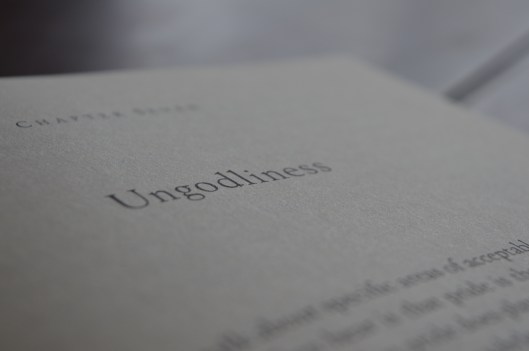
Jerry Bridges, in his excellent book Respectable Sins, confronts the many abominable deeds which Christians are inclined to tolerate in themselves, because “they aren’t the heinous sins of unbelievers”.  The book tears down the Us Versus Them mentality, and reminds us again and again that we have all sinned and fall short of the glory of God.  One of the first sins that Bridges addresses is Ungodliness.  He contends that Ungodliness, rather than Pride, is the root of all sin.  He explains:

Contrary to what we normally think, ungodliness and wickedness are not the same … Ungodliness may be defined as living one’s everyday life with little or no thought of God, or of God’s will, or of God’s glory, or of one’s dependence on God.

 Oh that cuts deep!  How rarely are my thoughts on God, His will, His glory, or my need for Him!  How rarely do I consider my actions in the light of His character, His word, His purpose in the world.  I am such a fool!  Back to the NET Bible’s note:

This practical atheism — living as if there is no God who will hold them accountable for their actions — makes them fools, for one of the earmarks of folly is to fail to anticipate the long range consequences of one’s behavior.

If we deny the applicability of Psalm 14 to our own lives, or refuse to admit our own practical atheism, we can turn aside into some dangerous places!  I have been studying the Psalms in tandem with the life of David.  In one of David’s crowning moments of godliness described in 1 Samuel 24 he spares the life of King Saul, the man who is unjustly pursuing him to death.  Saul abandons his hunt for David, and David has some room to breathe.  But in the very next chapter, David interacts with an evil man named Nabal whose name is the very same word for “fool” that is used in Psalm 14. When David allows himself to scorn Nabal from the moral high-ground of having just spared King Saul’s life, he foolishly decides to slay Nabal and all his servants!  Thankfully a wise woman interposes herself into the pending deadly confrontation and in 1 Samuel 25:23-31 Abigail reminds David of God’s promises to him, of God’s will for him, and of the danger that shedding blood without cause brings both to his relationship with God and to his coming kingdom.  She delicately confronts David with his own foolishness, his own failure to anticipate the consequences of his behavior, and his own practical atheism.  David, the man after God’s own heart, was about to commit mass murder because of a verbal insult.

Brothers and sisters, fellow Christians: if you really believe that God will hold you accountable for your actions, that there are long range consequences for your behavior, how differently should you live?  I have already quoted in passing Romans 3:23 twice in this article.  We must face up to this reality daily, before we can daily move past it to our calling in Christ.  All have sinned, and beyond that, all fall short of God’s glory!  He deserves our full attention, our full submission, our deepest love, and our highest worship.

And we all fall so short.

And then, instead of seeking His mercy and grace (which ought to be the most natural response for those who have already tasted it), we look for someone who is even worse than us, and we mock the philosophical atheists so that we can avoid feeling so bad over our own practical atheism.  This blame shifting hearkens back to Adam’s response to God’s first confrontation of his sin, reflecting the very opposite of the trust and repentance that should characterize our walk with Christ just as much as it did the initial moment of our salvation.

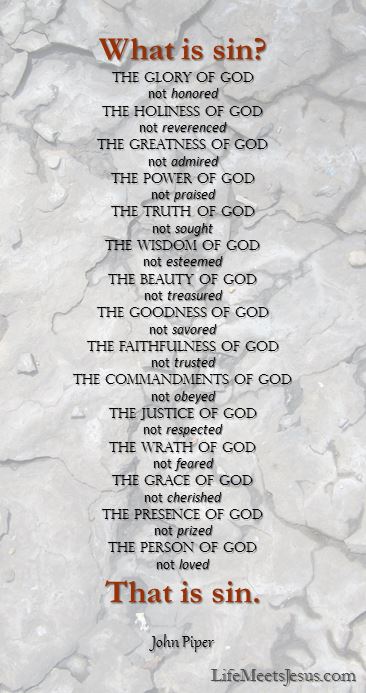
What is Sin

Check out Part Four for the conclusion of this series. 

Of Atheism and Fools, Part Two

03 Monday Apr 2017

Posted by Lauren Scott in Guest Posts, Living Faith

≈ Leave a comment

Tags

April first, April Fool's Day, April Fools, Guest Post, Practical Atheism, Psalm 14, Romans 3

In part one Nathaniel challenged us to see ourselves in the fool of Psalm 14 rather than merely pinning the title on the nearest atheist. 

The_Cap_of_a_Fool_fits_the_Head_of_a_Dunce.png

You can’t get out of this!

“But really!  This psalm can’t be about me!  I’m a Christian—I do believe in God!  I do seek after Him!  I do good things!”

I hear you, I hear you, and I am in no position to argue with you.  I get defensive when I read this Psalm too!  But as much as I wish it did, I don’t think the scriptures allow us to exempt ourselves from the condemnation of this passage.  Bear with me as I make the case that we all play the fool–not from my own opinion–but from the passage itself and the apostle Paul’s use of it in the epistle to the Romans.

The Internal Case

Psalm 14 is full of strong statements.  Not only is the charge laid out that the practical atheist is a fool, but along with that come moral judgments–and every one of these has a universal application.  Twice David says, “There is no one who does good,” and the second time, as if anticipating our objections, he continues emphatically, “not even one.”

Spurgeon explains:

But are there no special cases, are all men sinful? ‘Yes,’ says the Psalmist, in a manner not to be mistaken, ‘they are.’ He has put it positively, he repeats it negatively, ‘There is none that doeth good, no, not one.’ The Hebrew phrase is an utter denial concerning any mere man that he of himself doeth good. What can be more sweeping? This is the verdict of the all-seeing Jehovah, who cannot exaggerate or mistake. As if no hope of finding a solitary specimen of a good man among the unrenewed human family might be harboured for an instant. The Holy Spirit is not content with saying all and altogether, but adds the crushing threefold negative, ‘none, no, not one.’

And this judgment is not the opinion of David.  As we see in verse two, “The LORD [YHWH] has looked down from heaven upon the sons of men”–it is the result of an investigation conducted by Yahweh, God Himself!

“But what about the fact that the second half of the passage seems to be talking about the victims of the corrupt individuals called out in the first half?  Surely there is an ‘us versus them’ scenario in mind there!”

We certainly can’t avoid wrestling with the latter half of Psalm 14, especially the statement that the LORD is the refuge of the afflicted righteous in verses five and six.  How do we make sense of this?

In my efforts to exempt the “righteous” (and myself with them) from the sweeping condemnation in verse one,  I took a closer look at the investigation performed by God Himself in verses two and three.  Remembering that sometimes a biblical phrase is used that implies a certain group distinct from another group (e.g. “nations” in the scriptures always means Gentiles distinct from Jews), I thought to check in on the phrase “sons of men”. Could it be used to designate a certain subset of the human population, while excluding the rest of us who actually do seek after God?

It turns out the phrase “sons of men” is literally “sons of Adam” or “people/descendants of Adam.  Think about that for a minute…  It would be hard to come up with a more inclusive term for all of humanity.

No, you really can’t get out of this.

The External Case

If you are still inclined to exempt yourself from the condemnation of practical atheism in this psalm, consider the fact that there’s a remix: Psalm 53.  This Psalm is only slightly different from Psalm 14.  The Hebrew scribes were far too meticulous to have accidentally duplicated the psalm, so the only feasible explanation is that David rewrote the psalm with a few variations because it was such an important message as to deserve restatement.

And, as if that were not enough, the Apostle Paul makes the application abundantly clear in Romans chapter 3.  After spending the previous two chapters demonstrating that Gentles are guilty before God because they have violated the laws that He has written in their hearts, and Jews are guilty before God because they have violated the law of Moses, he uses Psalm 14 to tie these arguments together and prove that “all have sinned and fall short of the glory of God”.  Take a look at Romans 3:9-12:

What then? Are we better than they? Not at all; for we have already charged that both Jews and Greeks are all under sin;  as it is written, ‘There is none righteous, not even one; there is none who understands, there is none who seeks for God;  all have turned aside, together they have become useless; there is none who does good, there is not even one.’

So tell me, do you find yourself anywhere outside of the categories of Jew + Gentile?  Are you “better than they”?

No, you really can’t get out of this.

It would seem the fool’s hat fits all of us.  But since we’re all equal in this regard, does it really matter?  Just how big of a deal is this?  Check out Part Three for the answer.

Of Atheism and Fools, Part One

01 Saturday Apr 2017

Posted by Lauren Scott in Guest Posts, Living Faith

≈ Leave a comment

Tags

April first, April Fool's Day, April Fools, Guest Post, International Atheist's Day, Joke's on us, Practical Atheism, Psalm 14, The fool has said in his heart

This post contains affiliate links. If you purchase something through one of these links, I may receive a commission at no extra charge to you.

I’m happy to introduce this guest post as the first in a series by none other than my husband, Nathaniel Scott.  He’s been studying and teaching through the Psalms and the life of David in our church for the past five years.  In this introductory post, he invites us to take another look at the oft-quoted early verses of Psalm 14. 


wp-1491013694888.jpg

Whose Day is It?

There is a running joke on the Christian interwebs that April 1st is “International Atheist’s Day”–a pointed jab based on the opening line of Psalm 14: “The fool has said in his heart, ‘There is no God.’”  While I don’t question the validity of this application, I would suggest that we Christians often fail to recognize when the joke is on us.

Atheism has two dominions.  That of philosophical atheism is the mind.  It is here that the famous atheists dwell, building arguments and spewing hatred against a Being whose very existence they deny, but who has managed nonetheless to get them rather perturbed.  The occupants of this realm make up a relatively small percentage of the human population.

The second dominion of atheism is the heart and the actions.  This we call practical atheism.  This dominion is occupied not only by the famous atheists, but by the men, women, and children throughout history who disregard God and His will and pursue their own ways.  This describes all of humanity.

So today, amidst the cream pies that are being thrown at Richard Dawkins, Voltaire, and Christopher Hitchens, we as Christians need to consider Psalm 14 as a call to check our own God delusions.

Here’s the full text to get us started:

The fool has said in his heart, ‘There is no God.’
They are corrupt, they have committed abominable deeds;
There is no one who does good.
The LORD has looked down from heaven upon the sons of men
To see if there are any who understand,
Who seek after God.
They have all turned aside, together they have become corrupt;
There is no one who does good, not even one.
Do all the workers of wickedness not know,
Who eat up my people as they eat bread,
And do not call upon the Lord?
There they are in great dread,
For God is with the righteous generation.
You would put to shame the counsel of the afflicted,
But the LORD is his refuge.
Oh, that the salvation of Israel would come out of Zion!
When the LORD restores His captive people,
Jacob will rejoice, Israel will be glad.

The NET Bible, in one of its characteristically succinct and profound Translators’ Notes, says of the Psalm’s opening line:

‘There is no God.’ The statement is probably not a philosophical assertion that God does not exist, but rather a confident affirmation that God is unconcerned about how men live morally and ethically.

This practical atheism — living as if there is no God who will hold them accountable for their actions — makes them fools, for one of the earmarks of folly is to fail to anticipate the long range consequences of one’s behavior.

How many of us, as Christians, live as if there is no God who will hold us accountable for our actions?  How many of us fail to anticipate the long range consequences of our behavior?  We ourselves are under a delusion.  As we contend for the existence of God in the public square of cyberspace, let’s check our hearts and our lives to make sure we are living in the light of that existence.

Us Versus Them?

Using this Psalm as an insult against philosophical atheism is not new.  The meme goes back for generations.  In Charles Spurgeon’s Treasury of David you can find a collection of many writers over many eras barbecuing the atheist with a myriad of insulting terms.  These writers differentiate strongly between themselves and the atheist, much like the Christian internet warriors of today.

But there are a few writers in Spurgeon’s compendium who see the fool as representing the practical atheism of which we are all guilty.  These writers are much more gentle, and while clearly condemning the error of the fool’s ways, they do so with more humility.  They cautiously look to themselves lest they too be caught in foolishness.

As we dig deeper into Psalm 14, let’s follow their example.

Let’s not draw too sharp of a distinction between “us” and “them”.  To do so would be an attempt to write ourselves out of the line “They have all turned aside, together they have become corrupt; There is no one who does good, not even one.”

And if you go on to Part Two, you’ll see why doing so would be quite problematic.

← Older posts
Newer posts →
  • View KeptandKeeping’s profile on Facebook
  • View lauren.keptandkeeping’s profile on Instagram
  • View keptandkeeping’s profile on Pinterest
  • View @laurenscott.keptandkeeping’s profile on YouTube
Lauren Scott

Lauren Scott

Christian. Wife. Mother. Homemaker. Home Educator. Blogger. Book Addict. Outdoorist.

View Full Profile →

Enter your email address to follow Life Meets Jesus and receive notifications of new posts by email.

Affiliate Disclosure

We are a participant in the Amazon Services LLC Associates Program, an affiliate advertising program designed to provide a means for us to earn fees by linking to Amazon.com and affiliated sites.

Hands-on Math Curriculum

RightStart™ Mathematics

Check Out Prodigies Music Curriculum!

music curriculum sale

Quality Video Curriculum

Top Posts & Pages

  • Five Refreshing Scriptures for Finishing Strong when You Feel Weak and Weary
    Five Refreshing Scriptures for Finishing Strong when You Feel Weak and Weary
  • [Real] Life After Instagram
    [Real] Life After Instagram
  • Versatile Basic Biscotti Recipe (Gluten Free / Dairy Free Option)
    Versatile Basic Biscotti Recipe (Gluten Free / Dairy Free Option)

Advent April Fool's Day April Fools Book Review Books Books Charlotte Mason Charlotte Mason Homeschool children Christian Classical Education Christian Classical Homeschool Christian Homeschool Christian life Christian mom Christian Parenting Christian Women Christmas Classical Education Classical Homeschool devotional education faith Guest Post Home and Family Home Education Homemaking homeschool encouragement homeschooling Jesus Living Books love marriage meditations micro book reviews motherhood Nature Nature Studies parenting poems poetry Practical Atheism Reading List Reflections Relationships trials

A WordPress.com Website.

  • Subscribe Subscribed
    • Kept and Keeping
    • Join 171 other subscribers
    • Already have a WordPress.com account? Log in now.
    • Kept and Keeping
    • Subscribe Subscribed
    • Sign up
    • Log in
    • Report this content
    • View site in Reader
    • Manage subscriptions
    • Collapse this bar
 

Loading Comments...