
Tags
Books, Christian Classical Education, Christian Classical Homeschool, Classical Education, Classical Homeschool, Home Education, Homer, homeschooling, reading the classics, The Iliad
This post contains affiliate links. If you make a purchase through one of these links, I may make a commission at no additional cost to you. Thank you for supporting my blog!
This is a guest post from my good friend, Tabitha Alloway. We both have high schoolers this year, and they’re both going to read some Homer. While I’ve read The Iliad and The Odyssey recently so that I can be in conversation with my son about what he is reading, Tabitha has gone a step further and actually written out her thoughts, which I have found both interesting and helpful! I hope you will, too. Read Part 1 if you haven’t already. Here’s Tabitha with Part 2:
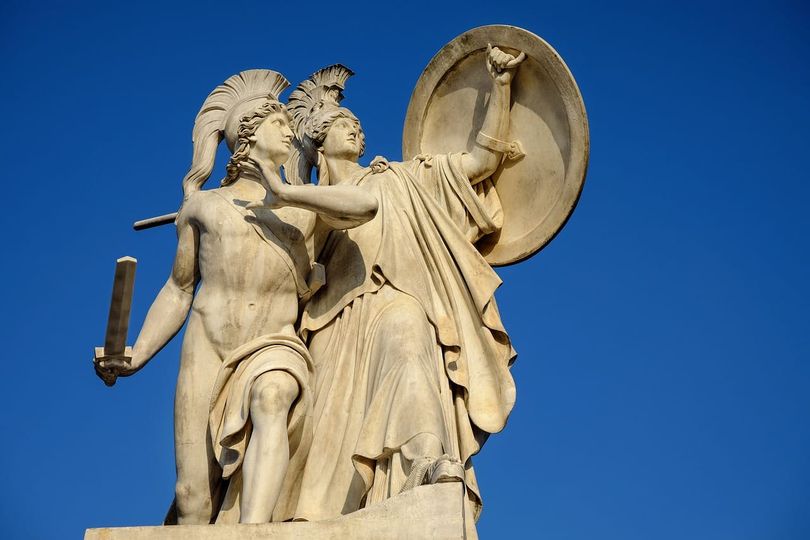
The characters of The Iliad are often arrogant, petty, and easily angered—much like their gods. The Greek
deities bicker and quarrel throughout the story, employ deception, fight one another, and alternately wreck havoc on the defenders and attackers of Troy, their only guide their own whims, unconstrained by moral considerations. Capricious and fickle, they often behave like spoiled children.
Achilles is described throughout the epic as “god-like.” But perhaps their gods were more “man-like” than anything: except for their immortality and power, the deities resembled man all too much in their thoughts and vices.
The concept of forgiveness and mercy was not really an intrinsic part of Greek culture. David J. Leigh writes,
“A study of the earliest Greek literature and philosophy indicates that the Greeks developed a strong
sense of justice and law as related to both gods and humans, but did not develop a concept of forgiveness and mercy. The closest they came to the latter concept was the practice of legal leniency and the notion of ‘pity’… Neither the gods nor human beings in early Greece were seen as ‘forgiving’ people their injustices or offenses… Because the Greeks lacked a divine or messianic example of unconditional forgiveness, they did not feel a religious compulsion to forgive other persons… At most, these hints of the rising importance of pity in the Greek world might suggest some readiness for the reception of the Christian teachings on the divine forgiveness of sins and the human need to forgive one another.” (Forgiveness, Pity, and Ultimacy in Ancient
Greek Culture)
Over time, “emergence of something beyond strict justice” did make its way into Greek thinking. And even Homer shows the characters acting, at times, with a compassion borne of pity. Homer presents these as admirable virtues, as part of what makes us truly human. He occasionally gives us a glimpse of man at his worst. And yet, woven throughout the tragedy, acts of kindness, mercy, justice, courage, friendship, loyalty, and honor are displayed.
Even by Achilles.
After killing Hector, Achilles drags the body behind his chariot, dishonoring him in one of the worst ways a man could be dishonored in the ancient world: he intends to let his corpse rot without burial.
But King Priam, Hector’s father, sneaks into the Greek camp and approaches Achilles, begging him to have pity on a grieving old man who has lost his sons. He reminds him how Achilles’s father would grieve were he to lose him. He asks to be given the body of Hector that he might bury it honorably.
It is human feeling that suddenly causes a change of heart in Achilles. Achilles the beast becomes a man again. He weeps for his own father, knowing he (Achilles) will soon die. Pity, compassion, even
gentleness overtake him.
He grants Priam his wish, even offering him food and a place to spend the night.
Another shocking turn takes place in the poem when Diomedes and Glaucus meet on the battlefield. Both men are seething with hate and ready to kill when Diomedes calls out to Glaucus, asking who he is. Glaucus proceeds to give him his family lineage. Suddenly, Diomedes plunges his spear into the ground and joyfully tells Glaucus they cannot be enemies.
“…Splendid—you are my friend,
my guest from the days of our grandfathers long ago!
Noble Oeneus hosted your brave Bellerophon once,
he held him there in his halls, twenty whole days,
and they gave each other handsome gifts of friendship.”
The two soldiers immediately make a pact of friendship, based on the fact that the ancestor of one had entertained the ancestor of the other. In one moment, hate melts into love and goodwill.
This seems strange—until one understands the significance of hospitality in the ancient Greek culture. Hospitality, or philoxenia (“loving the stranger”), was considered a sacred duty. Turning a stranger away
was an ill-advised act, for it might be a god in disguise, testing the host to see if he would practice proper hospitality. (There’s a rather interesting Christian corollary in Hebrews 13:2: “Be not forgetful to entertain strangers: for thereby some have entertained angels unawares.”)
It didn’t matter who came to your door—they must be fed, entertained, and given a parting gift. This
important ritual usually signified friendship for life. This is why, even generations removed from the
original act of hospitality, Diomedes and Glaucus instantly reconcile.
And this is the reason Paris’s treachery was so heinous to the Greeks. When Paris visited King
Menelaus’s home, he took advantage of his host’s hospitality to woo Menelaus’s wife, Helen, away.
By this act, he violated a sacred code of Greek ethics—xenia (“guest-friendship” or “ritualized friendship”), returning evil for hospitality.
Philonexia/philoxenia and philoxenos (Strong’s Greek #5381 and #5382) are found a total of five times
in the New Testament: in Hebrews 13:2 (as mentioned above), Romans 12:13 (when Paul admonishes the believers of Rome to be “given to hospitality”), 1 Timothy 3:2/Titus 1:8 (a requirement for an elder
is that he be a “lover of hospitality” and “given” to it), and 1 Peter 4:9 (“Use hospitality one to another
without grudging”).
Both the Greeks, and later the Christians, would highly value the practice of hospitality, but there are some key differences:
The Greeks practiced hospitality out of duty, fearing retribution of the gods.
The Christian practices hospitality out of love, for God’s glory and Christ’s reward.
The Greeks expected the good they did to be returned to them by their guest (if opportunity arose).
The Christian only looks to God for reward, not expecting man to pay him in kind.
The Greeks were not allowed to turn a stranger away.
Christians are actually commanded to turn some men away, and to withhold fellowship from others.
“If there come any unto you, and bring not this doctrine, receive him not into your house, neither bid
him God speed: For he that biddeth him God speed is partaker of his evil deeds” (2 John 1:10-11).
“I wrote unto you in an epistle not to company with fornicators… But now I have written unto you not
to keep company, if any man that is called a brother be a fornicator, or covetous, or an idolater, or a railer, or a drunkard, or an extortioner; with such an one no not to eat” (1 Corinthians 5:9, 11).
Peace was made between two soldiers because of an old act of hospitality. Sharing one’s home and table in the ancient world was a symbol of friendship and goodwill. This also carried great significance for new Jewish converts, who, prior to Christianity, physically separated themselves from the Gentiles.
“Ye know how that it is an unlawful thing for a man that is a Jew to keep company, or come unto one of
another nation,” said Peter to the Gentile Cornelius as he stood in his home. He continued, “But God hath shewed me that I should not call any man common or unclean” (Acts 10:28).
The gospel shattered the barrier walls between Jew and Gentile. Both were invited to the future marriage supper of the Lamb—and both could now practice hospitality with one another. Homes and hearts opened. Tables accepted guests previously shunned. When Peter cowardly went back on this and stopped eating with the Gentiles, Paul rebuked him to his face (see Galatians 2:11-13).
Dining together and practicing hospitality were important rituals in the ancient world. At least eighteen scenes of hospitality are said to be found in Homer’s works. To share a table was to share more than food. It was an acknowledgment of shared humanity. This kindness marked good men—virtuous men.
Paris is thus a true villain, lacking the humane instinct to gratefully return the good he has received. His
treachery brings strife and death to both Greeks and Trojans.
Lauren’s Note:
It is striking when reading Plato’s Republic, that in all of his discussion of justice and virtue, love is not really a part of the discussion. This is why Faith, Hope, and Love are called the “Christian virtues”. While the concepts existed, they were not held up as ideals by the Greeks in the way that Christians exalted them.
For a great podcast listen on the topic of Christian hospitality, check out: Cultivating Biblical Hospitality in Your Home and Life over at Thankful Homemaker. You can also get a hold of Rosaria Butterfield’s excellent book, The Gospel Comes with a Housekey.
Coming soon:
Reflections on The Iliad, Part 1: “Rage”
Reflections on The Iliad, Part 3: Some Thoughts on Greek Thought
Reflections on The Iliad, Part 4: Glory, Honor, Immortality, and the Folly of the Gospel
Other posts with Tabitha:
No Story is the Same, No Pain Ever Wasted
Introducing the Living Books Consortium
 Kept and Keeping
Pingback: Reflections on The Iliad, Part 3: Some Thoughts on Greek Thought | Kept and Keeping
Pingback: Reflections on The Iliad, Part 1: “Rage” | Kept and Keeping