
Tags
Charlotte Mason, Charlotte Mason Homeschool, Charlotte Mason Philosophy, Christian Parenting, Educational Philosophy, Home Education, homeschooling, motherhood, Parental Authority, parenting
This post contains affiliate links. If you make a purchase at one of these links, I may make a commission at no additional charge to you. Thank you for supporting my blog!
Charlotte Mason’s writings have been such a blessing to me–a tool in God’s hands to shape my mother’s heart into what it ought to be, chiseling away at rough edges and teaching me to love what is truly good and right and beautiful.
To date, I have read four out of Charlotte Mason’s six volumes that make up her Home Education Series: Volume One: Home Education, Volume Two: Parents and Children, Volume Four: Ourselves, and Volume Six: Toward a Philosophy of Education. I wish I had blogged through each of these over the years. I think it would have been valuable to force myself to do a written narration of each chapter all along the way. But it isn’t too late to start that habit! So here is my first installment. Maybe it will be a good refresher–or an introduction!–to you, my readers. I’d love to hear your thoughts.

Volume Three, Chapter One: Docility and Authority in the Home and the School
Miss Mason opens her book on School Education with a discussion of two key principles: authority (as authorized rule) and docility (as teachable obedience).
She notes that most adults at the time of her writing were raised under rather autocratic and arbitrary rule by their parents. There is a kind of sturdiness that comes from an entire society upholding the rule of authority by parents, even to the fault of upholding arbitrary rule, but the benefits of this system have their limits. Children, for example, may bear their fears and other burdens all on their own without helpful direction if there is not a means by which they can share their struggles and questions with their parents.
Miss Mason notes that rationalistic philosophers from Locke to Spencer have etched away at this notion of arbitrary authority (and the idea of the divine right of kings) by elevating the idea of individual reason.
When Locke promoted the rationality of the individual, he did not do so in a materialist philosophic vacuum. He developed his ideas with a view to Christian religion and virtue. But, Miss Mason argues, people picked up the lone idea of individual reason trumping all and left behind the insistence upon training that reason in what is good. An extreme example of this is the excessive and myopic (and bloody) rationalism of the French Revolution.
The likes of Mr. Spencer (an educationalist cited throughout the chapter by Miss Mason) promote parental authority only as it serves to throw off all authority. Why? Because Spencer recognizes that to throw off God’s authority is to throw off all other authority. Or, conversely, to diminish parental authority is to chip away at God’s. This is the kind of “liberation” that the extreme rationalist wants.
As Miss Mason puts it, “So long as men acknowledge a God, they of necessity acknowledge authority, supreme and deputed.”
One movement’s excesses may be tamed by another’s…and also replaced by a new set of vices. So the old arbitrary authority might be slightly corrected by rationalism…and then thrown off in a fury when that rationalism proceeds on into its own excess.
But what is best for children?
There is an Almighty God with whom we have to do. And He has set parents in the place of authority over their children. Not to wield it arbitrarily but to do so responsibly under God’s authority. As Charlotte Mason sums it up at the end of the chapter:
“We know now that authority is vested in the office and not in the person; that the moment it is treated as a personal attribute it is forfeited. We know that a person in authority is a person authorised; and that he who is authorised is under authority. The person under authority holds and fulfils a trust; in so far as he asserts himself, governs upon the impulse of his own will, he ceases to be authoritative and authorised, and becomes arbitrary and autocratic.”
More Quotes from Chapter One
Here are a few other quotes I appreciated from this chapter:
“The evolution of educational thought is like the incoming of the tide. The wave comes and the wave goes and you hardly know whether you are watching ebb or flow; but let an hour elapse and then judge. … After all allowances for ebb and flow, for failure here and mistake there, truer educational thought must of necessity result in an output of more worthy character.” Vol. 3 p. 3-4
So the test of our philosophy of education will be the character it produces in our children (and perhaps also in ourselves, eh?).
~~~
“But it is much to a child to know that he may question, may talk of the thing that perplexes him, and that there is comprehension for his perplexities. Effusive sympathy is a mistake, and bores a child when it does not make him silly. But just to know that you can ask and tell is a great outlet, and means, to the parent, the power of direction, and to the child, free and natural development.” Vol. 3 p. 4-5
I especially appreciated how this quote illustrated the ideal of open communication between child and parent. The parent’s thoughts are not the only ones that count. It is not an abdication of parental authority to be capable of hearing a child’s sincere questions and helping them to sort out what confuses them. In fact, a parent that so knows their child’s heart is in a much better position to wisely direct it. And a child given such a safe place to be heard can grow and develop in a healthy, “free and natural” way.
~~~
Speaking of Spencer: “he repudiates the authority of parents because it is a link in the chain which binds the universe to God.”
My how we see this today, don’t we?
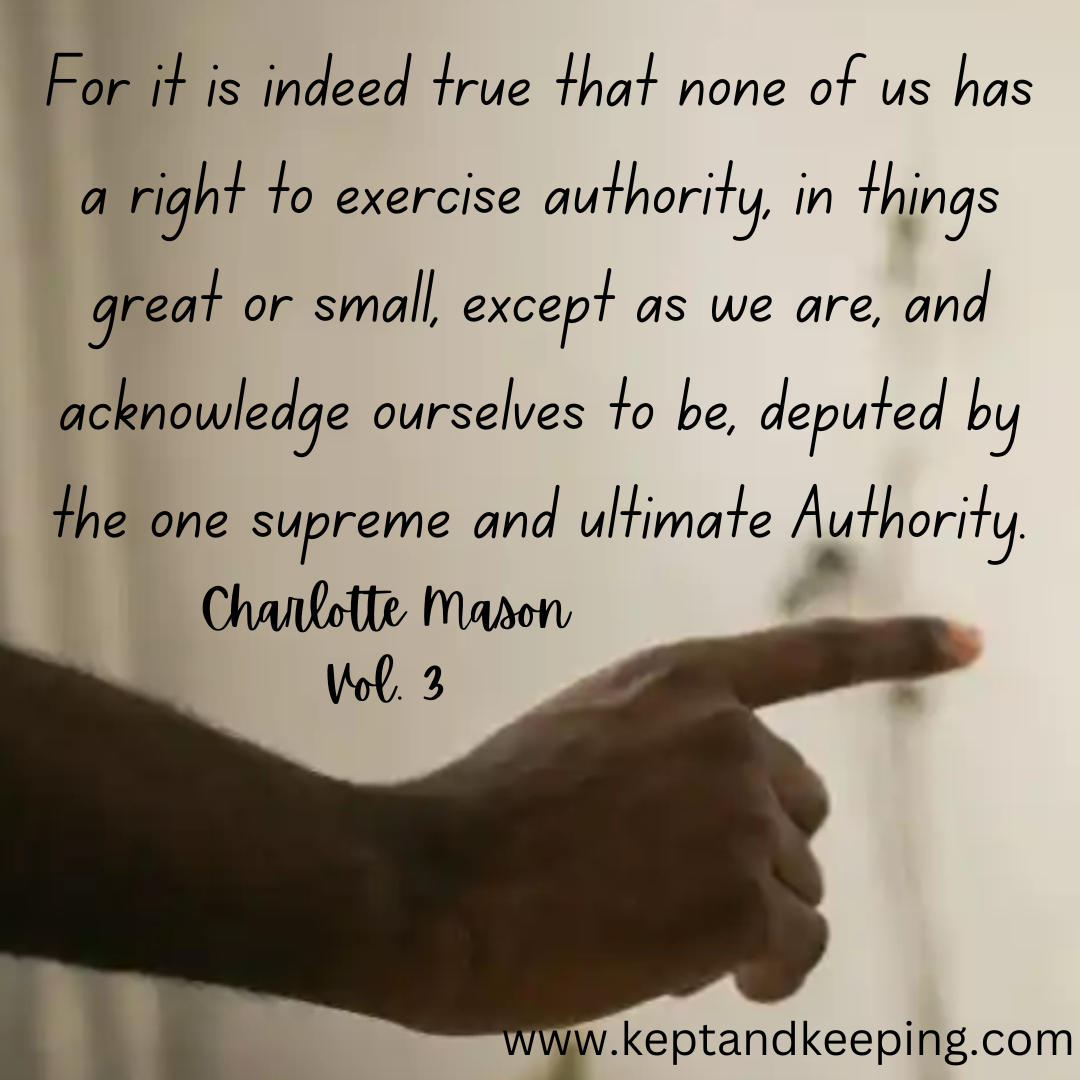
She then continues: “For it is indeed true that none of us has a right to exercise authority, in things great or small, except as we are, and acknowledge ourselves to be, deputed by the one supreme and ultimate Authority.” Vol. 3 p. 7
~~~
Echoing St. Augustine: “Nothing less than the Infinite will satisfy the spirit of a man. We again recognize that we are made for God, and have no rest until we find Him…” Vol. 3 p. 9
~~~
A warning against the wrong kind of liberty: “We all have it in us to serve or to rule as occasion demands. To dream of liberty, in the sense of every man his own sole governor, is as futile as to dream of a world in which apples do not necessarily drop from the tree, but may fly off at a tangent in any direction.” Vol. 3 p. 10
~~~
Here’s a good word on how damaging, reductionist ideologies form in a person:
“Some such principle stands out luminous in the vision of a philosopher; he sees it is truth; it takes possession of him and he believes it to be the whole truth, and urges it to the point of reductio ad absurdum. [reduction to absurdity]” Vol. 3 p. 11
Key Takeaways for the Parent-Teacher
My parental authority is given me by God (as “deputed authority”). I cannot exercise it properly if I do not first recognize that I myself am under authority—authorized by Someone above me, namely God.
Children by nature have questions. Wise authority leaves room for this—and even welcomes questions and expressions of genuine confusion about the world or even parental expectations as organic opportunities to guide the child in the way they should go.
Don’t get swept away with the latest tide, especially when one concept is elevated to the exclusion of all else. Parenting and educational fads may come and go, but the proof of their wisdom will be in the kind of character they produce over the long haul.
Have you read Volume Three lately? Or been meditating on Charlotte Mason’s principles of authority and docility (they make up the third of her 20 principles)? I’d love to have you weigh in with your thoughts in the comments!
 Kept and Keeping
This narration was a pleasure to read! I read School Education for the first time earlier this year. I’ve been inspired to think more about the principles of authority and docility thanks to the recent thread on Convivial Circle about the book Raising Godly Tomatoes. Although my child is still very young, the discussion on that thread made me ponder the idea of tomato-staking once again. I really like the idea of bonding with your child and having open lines of communication, as you pointed out – as a child, being able to ask and tell, and as a parent, pouring into your child and coming to know them deeply. Intimacy is the best setting for authority.
LikeLike