
I recently visited a lovely church with friends a few hours from home. Almost every song we sang in worship was a hymn, and I was thankful. But as we sang “Wonderful Grace of Jesus,” I began to realize that something was missing.
The men and women sang different parts for this song, as is traditional. While the words were clearly visible on a screen, they didn’t exactly reflect the parts, and I was left guessing—both at the words (the women’s part wasn’t even entirely presented on the screen) and at the tune (when was the last time you saw solfege or a music staff included on-screen?).
We made it through, and I’m sure the Lord was honored by the praises of His people, but something was missing from the experience.
My own church sings quite a lot of hymns. And I’m quite thankful for it. They, too, have forgone the expense of maintaining hymnals, and especially the added-weight of lugging them every Sunday from the church office to the rented public building where we meet for church. It makes sense that digital and projected words are easier in such a situation. And we don’t ever sing any songs with men and women singing a call-and-response or anything like that. That’s a loss in itself, but it works out logistically.
The church I grew up in (at least from age 14 on) had hymnals. My sight reading ability has never been that amazing, even when I was in choir in middle and high school. But the hymnal at least gave a sense of where the tune was going, the shape of the music, if you knew where to look. And it had those echo parts typed out neatly—and in time—either above or below the main lyrics.
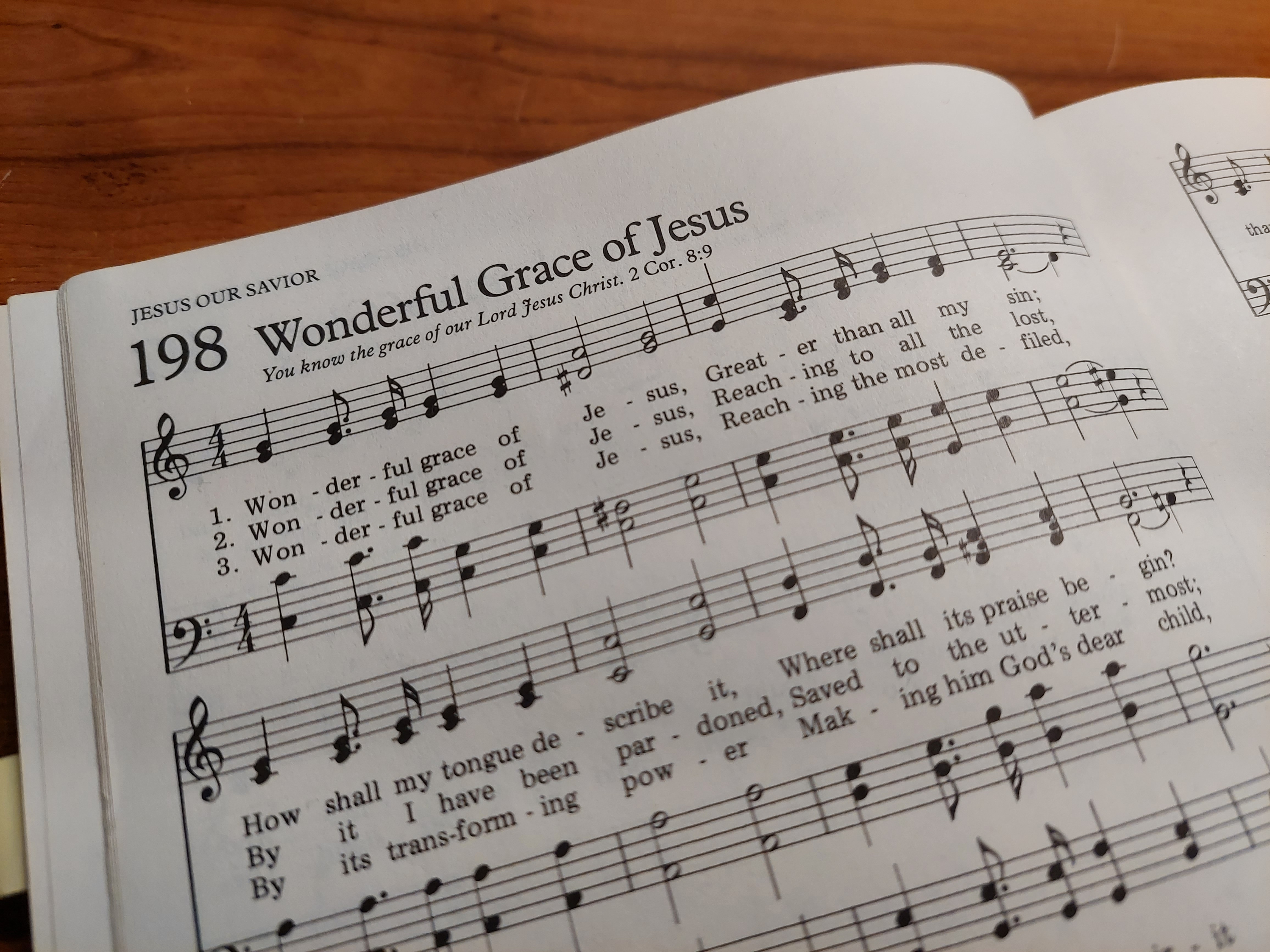
I actually didn’t “grow up in church” before my teens, and I hadn’t sung any hymns other than the few that made their appearance in my (public school!) second grade Christmas program. So I had to adjust to taking my cues from a hymnal just like anyone might have to do today. It took some work and a few pointers from friends, but I was delighted to learn so that I could sing along. This was a part of joining in the worship of God among His people—I valued that and wanted in.
Logistical considerations aside, if we abandon hymnals because we’re afraid people can’t or won’t want to learn how to use them, what are we saying about the people who enter through our doors? We’re assuming their inability and disinterest, instead of giving them the opportunity to learn and be initiated into the historical songs of our faith.
The church itself has a legacy, a history, a heritage. This is something missing from many modern lives—why should we assume that believers in Christ won’t want to be a part of it?
My husband Nathaniel recently lamented to me that Christian music in general has a very short shelf life. If you make music in the secular world and get really popular, you have a shot at getting played on an oldie station after your “big time” fame begins to wane. Well, my friends, there are no Christian oldie stations. Pop culture is obsessed with what’s hot NOW, and it would seem that Christian pop culture is even more so.
This is indeed worthy of lament.
Nathaniel explained to me further that the average lifespan of a church worship song is five years. Five. Years.
Two years ago we were looking for a new church, and when we visited many places around town, we noticed a pattern. Most churches sang almost no hymns. And when they did throw a hymn in the mix, it was done up with a new chorus made popular by a hit song on the radio—or else it was simply a hit song on the radio that incorporated one verse from “Amazing Grace” just to check the nostalgia box. It’s not hard to imagine that much of today’s music exists mostly for the feels and the ratings.
In most of the churches we visited, we had to learn to sing new praise songs. Some were decent, and some were meh, and some were terrible. But all of them were from the last 5-10 years of Christian radio (which is why we didn’t know them—we don’t listen to Christian radio much these days. The musical and lyrical quality is mostly meh and self is at the center far too often.).
Now, don’t take this the wrong way. I love a good praise song, and it isn’t a problem if we have to learn some. In fact, there were a handful of wonderful praise songs that I sang in my youth group and alongside the hymns in that church I attended in my teens. But those songs are all but forgotten now. No one under 30 seems to know them.
What will happen to the good songs written in the past 30-50 years—the time period in which those songs were tested and enjoyed but didn’t exist in any hymnals? By now some of them could be added to such collections. But who is going to do it if no one uses hymnals anymore?
It’s expected that we, as a church, will sift through the songs of a given age and only keep the ones that are most valuable. Many old songs will be forgotten. There are old hymns that aren’t that good and don’t need to be kept alive. This is normal.
But in past generations, as my husband pointed out to me, we had repositories where we collected those best-of-each-age songs. We had hymnals. And these hymnals might be used in different churches, providing some continuity of worship even across denominational lines. Owning a few hymnals meant you could (literally) flip through several curated collections and determine which songs you thought most sound, most edifying, most worshipful, and most reflective of a heart devoted to Jesus.

Now? Now we have popular Christian radio to tell us what we should sing in the car, in our homes, and in our churches. And what makes for good popular Christian radio? Songs that have good ratings—from the average Joe who turns on or streams said station—no knowledge of the Bible or tests of character required. Just your vote.
Of course someone at the local church level makes the actual selections for what a congregation will sing, but what pool are they choosing from? Do they themselves know any of the old hymns? If so, how many?
I’m going to go out on a limb here and suggest that connecting with church history is of greater importance than connecting with what is popular and consumable under the “Christian” banner. We have a faith heritage that ought to connect our churches today—we don’t need to have that replaced with a worldly mechanism (the mere popularity contest) glazed over with Christian labels.
Maybe, like me, you recognize that the songs on the radio are weak, so you have a curated online playlist of not-the-radio songs. Maybe this includes re-vamped hymns, but with more substance than the radio. But the mechanism is much the same, and the lifespan of these songs is similar to the radio hits.
If the hymnals are gone from most evangelical churches, what mechanism will keep our people from forgetting the songs of the past?
Even among the churches that still sing hymns, which ones? How deep is the well from which you draw? We need more than the individual memories of the older folks who remember a broad range of hymns—we, as a people, are all too quick to forget. And when the older believers pass on from this life, their memories go with them—how do we tap into their wealth of hymnody for the edification of generations to come?
If everything is digital and customizable, how will that help us connect with other churches? Happenstance overlap? Or would it be helpful to have defined collections?
How could we revive the practice of gathering (’round the fire or piano) for a hymn sing? Would physical hymnals, printed papers, or digital song books work best for this?
If Christian radio didn’t exist to train your taste to whatever is new, how might that change your taste in worship music in church?
Do you have a personal or family hymnal? When was the last time you dusted it off and sang a few?
May the Lord be glorified in His church, as we “sing a new song” and as we keep alive His time-tested praises as well.
What do you think? Am I just an old curmudgeon ranting about “church these days”? Or is there something here we as Christians ought to consider and hold on to?
 Kept and Keeping
Dear Lauren: My church body uses hymnals. It has all the benefits you describe and more — such as being able to continue singing praises with the same words and ideas as Christians from 100 AD forward. Plus there is the incredible richness of the words that is incomparable to most contemporary “worship songs,” which are extremely theologically weak by comparison.
If you want to check one out in your area, I recommend this finder: https://www.lutheranliturgy.org.
LikeLiked by 1 person
Thanks, Joy! I’m friends with the pastor’s wife at one such church in my area. 🙂 We are blessed to be a part of our current local church and are very much at home there, but I appreciate the suggestion!
LikeLike
I’ve also really enjoyed learning some Lutheran hymns from the group Koine over the years. Ever heard of them?
LikeLike
No, but I checked them out; thanks for the recommendation! They have some good music for bopping around in the car or house, but I would not consider it appropriate for church. Church music is about leading the congregation in singing praises, not being rockstars in front of the congregation while they sit silently.
I also think the breathy sort of lover-style music with a pelvis-thumping drum kit is inappropriate for church. We’re worshipping the king of the universe. Yes, he’s our bridegroom, but we’re also not *actually* having sex with him and church musicians shouldn’t be conjuring sexual emotions and connecting them to God. Sexual feeling-first music theologically confuses parishioners.
Just contrast Koine’s version of this hymn with this version to hear what I mean. https://www.youtube.com/watch?v=JKN8vO6EqWw This version even includes several solos and is very ornamented but the difference in appropriateness for church worship I think is very clear.
As an aside, I am a former evangelical youth worship leader, so I’m coming from having matured a lot in my faith and musical tastes, and I get that most American Christians have really been failed by their churches in both theological and musical education. Taste takes cultivation, and there’s precious little cultivation going on anywhere in our culture.
LikeLiked by 1 person
Oh, just remembered this other church finder — there will be some overlap, but both are good and each includes a few not in the other. https://issuesetc.org/findachurch/
LikeLike
I definitely don’t think you’re a curmudgeon! I am reminded of the verse in 2 Thessalonians about holding fast to the traditions we were taught. Constant change makes that a difficult thing to do!
LikeLiked by 1 person